
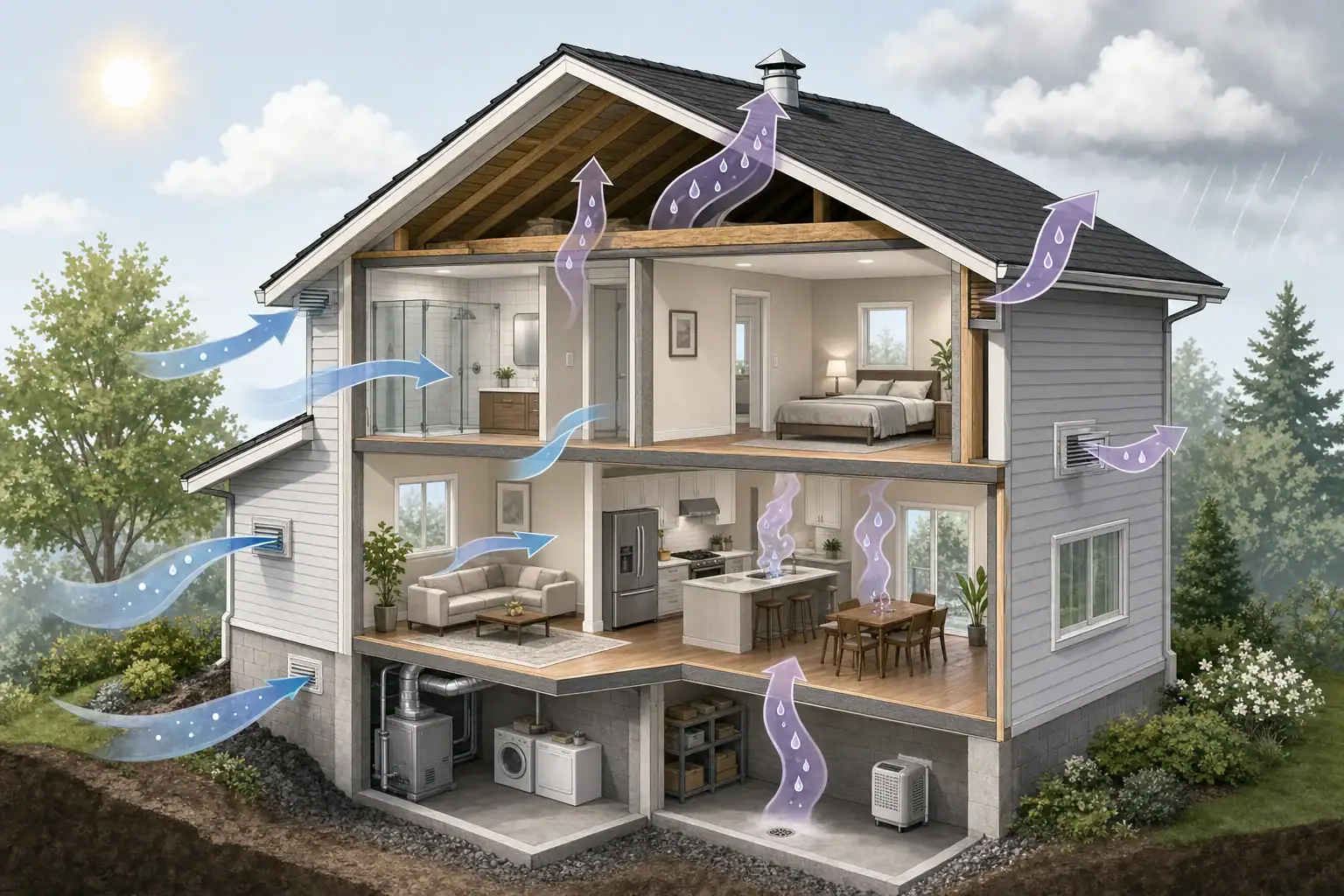
Use dew point to predict moisture movement
Ventilation can dry a home when the outdoor dew point is lower than the indoor dew point. That means the incoming air contains less water vapor than the air it replaces. If the outdoor dew point is higher, ventilation adds moisture; if the two are similar, it provides little drying. Outdoor relative humidity alone cannot answer the question because it changes with temperature.
A cold winter day can have high outdoor relative humidity but a low dew point. Once that air enters and is heated, its relative humidity falls, allowing it to absorb indoor moisture. Conversely, warm outdoor air with moderate relative humidity may have a high dew point and add substantial moisture when brought indoors.
A simple comparison
| Outdoor dew point | Likely moisture effect | General decision |
|---|---|---|
| Clearly below indoor dew point | Incoming air is drier by water-vapor content | Ventilation may help dry the home |
| Close to indoor dew point | Little net moisture change | Ventilate only for another reason |
| Above indoor dew point | Incoming air adds water vapor | Avoid using ventilation as a drying method |
This comparison predicts the direction of moisture movement, not how quickly the home will dry. Airflow, ventilation time, indoor moisture sources, weather changes and moisture stored in furnishings and building materials all affect the result.
How to make the comparison
- Measure indoor temperature and relative humidity. Use a monitor that displays dew point, or enter the readings in a psychrometric or dew-point calculator.
- Check the current outdoor dew point. Use dew point rather than the relative humidity shown in a weather report. Conditions at a distant weather station may differ from those immediately around the home.
- Look for a clear difference. A small difference may be lost within sensor uncertainty or short-term weather fluctuations.
- Track indoor dew point after ventilating. A sustained decline indicates that the indoor air is losing water vapor. A change in relative humidity alone may simply reflect a temperature change.
Place an indoor monitor away from supply registers, direct sunlight, exterior doors, cooking areas and showers. A reading from one room may not represent a basement, closed bedroom or other separated space.
Why relative humidity can be misleading
Relative humidity describes how close air is to saturation at its current temperature. Warm air and cool air can therefore have the same relative humidity while containing different amounts of water vapor.
- Cold, damp-looking weather: Outdoor relative humidity may be high, but the low dew point can make ventilation effective for drying after the air is heated.
- Warm summer weather: Outdoor relative humidity may appear moderate while the dew point remains above the indoor dew point, so open windows can increase indoor moisture.
- A temperature change indoors: Heating can lower relative humidity without removing water vapor. Cooling can raise relative humidity without adding water vapor.
For this decision, dew point is the more useful indicator of water-vapor content. Relative humidity remains relevant when considering conditions near cool surfaces and materials.
Conditions that can limit drying
Indoor moisture sources
Cooking, bathing, drying wet materials and other ongoing moisture sources can release water faster than ventilation removes it. Local exhaust should discharge outdoors and be operated as designed.
Basements and cool surfaces
A basement requires extra care because incoming air cools near basement walls, floors and pipes. Even when its dew point is below the basement air’s dew point, condensation remains possible on any surface colder than the incoming air’s dew point. Ventilation should not be treated as a solution for liquid-water leaks or groundwater entry.
Airflow and moisture stored in materials
Dry outside air must reach the affected area and moist air must leave. Building materials and furnishings may also release stored moisture as the air dries, causing the indoor reading to fall slowly or rebound after ventilation stops.
Mechanical ventilation and HVAC operation
Heating, cooling and ventilation equipment can change both temperature and moisture conditions. Energy-recovery ventilators transfer some moisture between air streams, so the outdoor-to-indoor dew-point comparison does not describe their full effect. Operate installed equipment according to its controls and documentation. The U.S. Department of Energy overview of whole-house ventilation explains common system types and their operating differences.
Opening windows may also add a heating or cooling load. A favorable dew point means ventilation can remove water vapor; it does not necessarily mean ventilation is the most energy-efficient approach.
When ventilation is not the right drying method
- The outdoor dew point is equal to or above the indoor dew point.
- Outdoor conditions are changing rapidly and are expected to become more humid.
- Rain can enter through openings.
- Outdoor air quality or local advisories make bringing in outside air inappropriate.
- The moisture originates from a plumbing leak, roof leak, drainage problem or other liquid-water source that has not been corrected.
Whole-home drying also depends on the amount of airflow. Avoid improvised high-powered exhaust arrangements, particularly in homes with fuel-burning appliances. As the EPA explains in its best practices for indoor air quality when remodeling, exhaust equipment such as exhaust fans, range hoods and clothes dryers can depressurize a home and cause combustion appliances to backdraft. Have pressure changes and combustion-air requirements evaluated by a qualified professional.
Related guides: How to Ventilate in Winter Without Freezing: Practical Strategies • Dehumidifier vs Ventilation for Damp Basements: Which Fix Comes First? • Humidity Sensor Accuracy: Why Cheap Hygrometers Disagree
Frequently asked questions
How much lower should the outdoor dew point be before I use ventilation to dry indoors?
There is no single cutoff that applies to every home, because monitor accuracy, airflow and changing weather affect the result. A clearly lower outdoor dew point offers more drying potential than a small difference; confirm the decision by checking whether the indoor dew point declines after ventilating.
Can I use a weather-app dew point for my home?
A weather-app reading is a useful starting point, but it may come from a station some distance away or from a different elevation. Compare it with an indoor reading and consider local conditions near the home, especially during rapidly changing weather.
Why did indoor relative humidity rise after I opened the windows even though the outdoor dew point was lower?
Relative humidity can rise when indoor air or nearby surfaces cool, even if the air is losing water vapor. Follow indoor dew point over time to evaluate drying, and consider whether cooler surfaces could create a condensation concern.
Bottom line
Compare outdoor and indoor dew points, not outdoor relative humidity. Ventilation has drying potential when the outdoor dew point is clearly lower, but confirm the result by watching whether the indoor dew point declines. Surface temperatures, indoor moisture sources, airflow and HVAC operation determine whether that potential produces meaningful whole-home drying.
- Clear sizing logic (room size → CADR/ACH)
- HEPA vs carbon explained for real use-cases
- Humidity + ventilation basics to reduce mold risk