
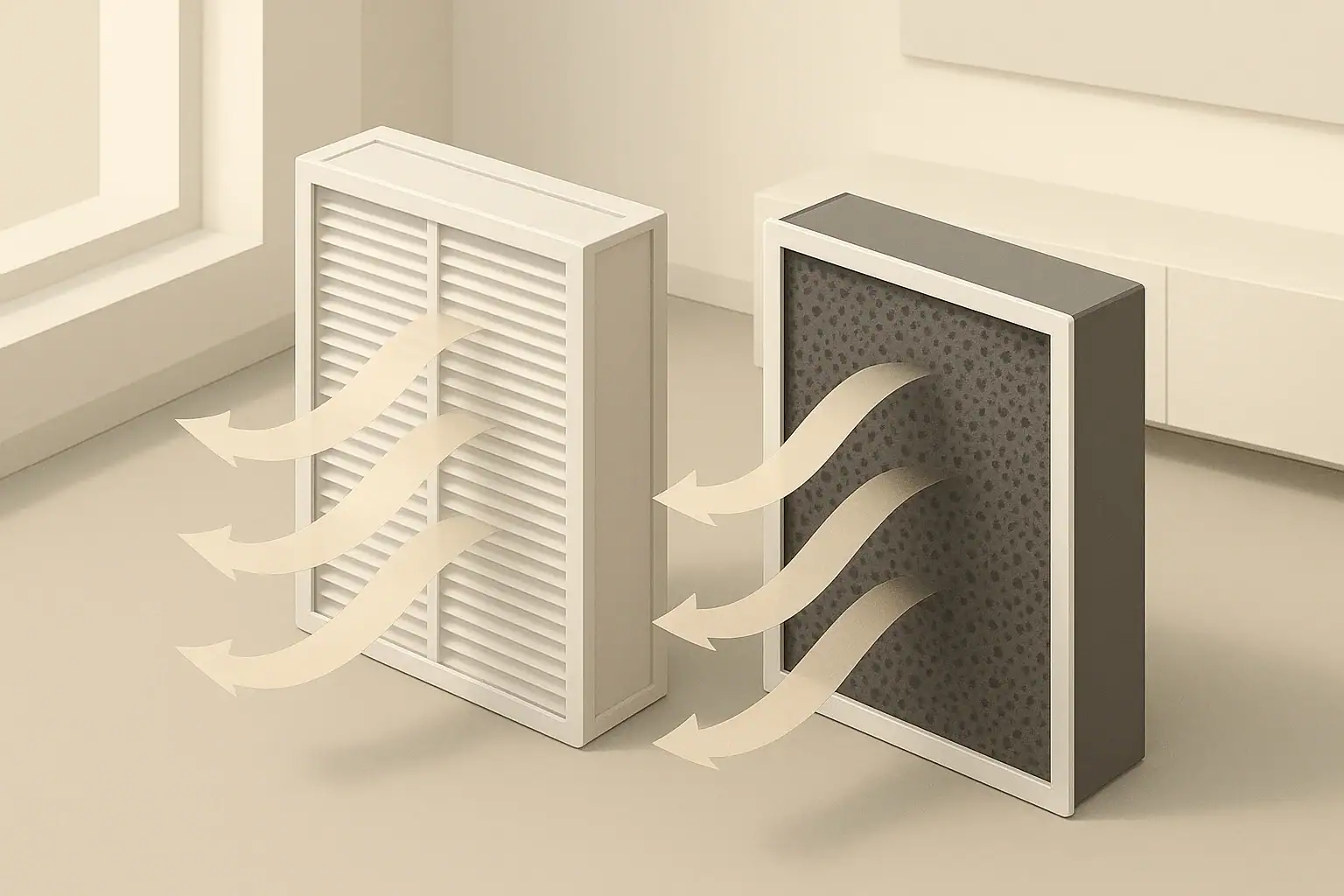
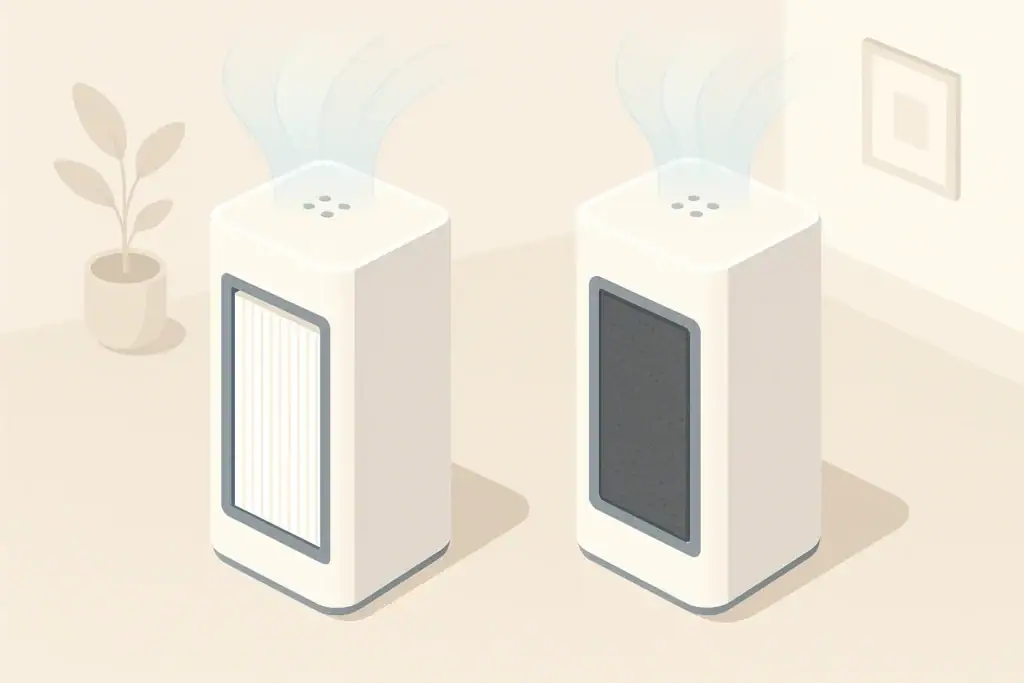
Carbon Filter vs HEPA: The Core Difference
Carbon filters and HEPA filters solve two very different air quality problems. Understanding what each one removes (and what it does not) is essential if you want your air purifier, HVAC system, or standalone filter to actually address the issues in your home.
In simple terms:
- HEPA = particles (dust, pollen, smoke particles, pet dander, many allergens)
- Activated carbon = gases (odors, some chemicals, some traffic exhaust components)
Neither filter type is “better” on its own. They are tools for different jobs, and in many homes, you need both.
How HEPA Filters Work and What They Remove
What HEPA Means in Practice
HEPA (High Efficiency Particulate Air) filters are dense mats of fibers arranged to trap tiny airborne particles. Air is forced through the fibers, and particles are captured by a mix of interception, impaction, and diffusion.
Certified HEPA filters are designed to capture a very high percentage of particles around 0.3 microns in size, and typically perform even better on both smaller and larger particles. This makes them the primary tool for removing solid and liquid particles from indoor air.
Pollutants HEPA Filters Are Good At Removing
HEPA filters are effective for most particle-based pollutants, including:
- Dust and dust mite debris – including fine settled dust that becomes airborne again when disturbed
- Pollen – from grasses, trees, and weeds, helpful for seasonal allergies
- Pet dander – tiny skin flakes from cats, dogs, and other indoor animals
- Smoke particles – fine particulate matter from cigarettes, wildfires, candles, and cooking
- Mold spores – airborne spores released from mold growth, once they are in the air
- Bacteria and some larger biological particles – especially those attached to dust or droplets
- PM2.5 and other fine particles – a major component of outdoor air pollution that can enter indoors
If your main concerns are allergies, asthma triggered by airborne particles, or visible dust buildup, HEPA filtration is usually the primary technology to look at.
What HEPA Filters Do Not Remove Well
Despite their strong performance on particles, HEPA filters have clear limitations:
- Gases and vapors – HEPA fibers are not designed to capture individual gas molecules or most volatile chemicals
- Odors – cooking smells, smoke odor, pet smells, and musty or chemical smells mostly pass through HEPA
- Most VOCs (volatile organic compounds) – such as solvents, some cleaning product fumes, off-gassing from new furniture or flooring, and some traffic-related gases
- Carbon monoxide, radon, and other small gases – these require source control and ventilation, not particle filtration
HEPA filters also do not fix the source of particles. For example, a HEPA filter can reduce airborne mold spores, but it does not remove mold growing behind a wall or in a damp basement. Likewise, it can capture smoke particles but will not fix a smoking habit indoors or a structural ventilation problem.
How Activated Carbon Filters Work and What They Remove
What Activated Carbon Is
Activated carbon (or activated charcoal) is a highly porous form of carbon processed to create an enormous internal surface area. Gas molecules in the air passing through the filter can stick to the surface of the carbon in a process called adsorption.
In air cleaning, carbon is often used as granules, pellets, or a carbon-impregnated foam or fabric. The total mass of carbon and how long air stays in contact with it are key factors in how well it works.
Pollutants Carbon Filters Are Good At Removing
Carbon filters are used for gases and odors rather than solid particles. They can help with:
- Common household odors – cooking smells, mild pet odors, garbage smells, and general “stale” indoor air
- Tobacco and wildfire smoke odors – the smell-causing gases, which HEPA alone does not remove
- Some VOCs (volatile organic compounds) – such as certain solvents, some components of traffic fumes that infiltrate indoors, and some fumes from cleaning products and paints
- Some chemical fumes – depending on the specific gas and the type and amount of carbon used
Carbon filtration can noticeably improve the way indoor air smells, even when particle levels are already low.
What Carbon Filters Do Not Remove Well
Activated carbon is not a universal chemical sponge. Its performance depends heavily on the type of gas, its concentration, humidity, contact time, and how much carbon is actually present.
In general, carbon filters will not do well with:
- Particles – dust, pollen, dander, and spores will mostly pass through unless there is another particle filter layer
- Very low or very high humidity conditions – humidity can compete with gases for adsorption sites, reducing effectiveness
- Certain small or weakly adsorbing gases – for example, carbon monoxide and some highly volatile compounds are not reliably removed
- Long-term heavy VOC loads with small carbon filters – a thin or lightweight carbon pad can saturate quickly and stop being effective
Activated carbon also does not provide a visible indicator when it is saturated. Odors may slowly return as the carbon becomes full, even though the filter looks the same.
Carbon Filter vs HEPA: Side–by–Side Comparison
What Each One Removes
| Pollutant Type | HEPA Filter | Activated Carbon Filter |
|---|---|---|
| Dust and dust mites | Yes, very effective | No, not the main function |
| Pollen | Yes, very effective | No, not designed for this |
| Pet dander | Yes, effective | No, except for associated odors |
| Mold spores (airborne) | Yes, effective | No, except for musty odor gases |
| Smoke particles | Yes, effective for fine particles | No for particles, yes for some smoke gases and odors |
| Cooking odors | Usually no | Often helpful |
| Pet odors | Usually no | Can reduce many odor compounds |
| VOCs from cleaners, paints, new materials | No, gases pass through | Sometimes, depending on VOC type and carbon amount |
| Traffic-related gases | No | Some components may be reduced |
| Carbon monoxide, radon | No | Not reliably |
Filter Efficiency vs. Real–World Performance
Laboratory efficiency ratings are usually measured under ideal conditions with controlled airflow and specific test particles or gases. In a home, performance depends on:
- Airflow – how much air actually passes through the filter per hour
- Filter sealing – whether leaks let unfiltered air bypass the filter
- Room layout – obstacles, closed doors, and placement of the purifier
- Pollutant sources – whether sources continue to emit particles or gases
A very efficient filter with poor airflow, poor sealing, or strong ongoing pollution sources may not deliver the results you expect.
Common Indoor Scenarios: When You Need HEPA, Carbon, or Both
Allergies to Dust, Pollen, and Pet Dander
If your main symptoms are sneezing, itchy eyes, or congestion triggered by dust or pollen, a HEPA filter is the key technology. It reduces airborne allergen particles that can stay suspended for hours.
Activated carbon may be useful in the same device if you also notice strong pet odors or other smells, but it does not directly target the allergenic particles themselves.
Asthma Sensitive to Particles and Irritants
For asthma triggered by fine particles, a HEPA filter helps lower exposure to dust, smoke particles, and some biological particles. Many people with asthma also find that strong odors and chemical fumes are irritating even if they are not strictly allergens.
In that case, a combination of HEPA + activated carbon can:
- Reduce the particle burden (HEPA)
- Reduce some odors and irritant gases (carbon)
This combination does not replace medication or medical advice but can be part of an overall air quality strategy.
Wildfire Smoke or Cigarette Smoke Indoors
Smoke is a mix of solid particles, liquid droplets, and gases. Relying on only one filter type leaves gaps:
- HEPA captures smoke particles that contribute to PM2.5 and visible haze
- Carbon adsorbs some of the smoke gases responsible for the lingering smell and eye or throat irritation
For smoke, a device or system that uses both a HEPA filter and a substantial amount of activated carbon generally performs better than either alone.
Cooking Odors and Kitchen Fumes
Cooking creates both particles and gases. Grease droplets, fine particles from high-heat cooking, and smoke are particle-based and can be reduced by HEPA filtration. However, the recognizable cooking smell is largely from gases.
To address kitchen air:
- Use ventilation first – range hoods vented outdoors and opening windows when possible
- HEPA filtration – helps lower fine particles from frying, broiling, and toasting
- Activated carbon – helps with lingering food and oil odors
Neither HEPA nor carbon replaces adequate kitchen exhaust, but they can complement it, especially in apartments where venting directly outdoors is limited.
New Furniture, Flooring, and Paint Smells
New materials can off‑gas VOCs, which are gases rather than particles. HEPA filters do not capture these. Activated carbon can reduce some of these compounds, particularly if there is enough carbon and air passes through it slowly enough.
However, VOC control always starts with:
- Source control – choosing low‑emission materials when possible
- Ventilation – increasing outdoor air exchange to dilute VOCs
Carbon filters can then provide an additional reduction, but they are not a full substitute for bringing in fresh air.
Mold and Musty Smells
Mold problems have two main components:
- Moisture and growth on surfaces – the root cause that must be fixed via moisture control, repairs, and cleaning
- Airborne spores and musty odors – what you experience in the air
A HEPA filter can help reduce airborne spores. A carbon filter can help reduce musty odors associated with microbial VOCs. But neither will eliminate mold growth in walls, carpets, or other materials. Moisture control and remediation come first.
What Neither Carbon Nor HEPA Can Solve Alone
Ventilation Problems
Both HEPA and carbon filters work only on air that passes through them. They do not:
- Increase the amount of outdoor fresh air entering your home
- Remove carbon dioxide (CO₂) at meaningful rates
- Address high humidity or very low humidity directly
If windows stay closed and mechanical ventilation is limited, CO₂ levels can rise even if the air smells clean and looks clear. Ventilation or air exchange systems are needed to manage this.
Moisture, Humidity, and Structural Issues
Filters do not:
- Dehumidify or humidify the air in a significant way
- Dry out wet walls, carpets, or basements
- Seal building leaks or improve insulation
Dehumidifiers, humidifiers, and building repairs are separate tools. Filters can only deal with particles and some gases suspended in the air.
Chemical and Gas Hazards
Serious gas hazards (such as carbon monoxide leaks or high levels of certain industrial chemicals) are not problems to solve with consumer HEPA or standard carbon filters. They require:
- Source control and removal
- Emergency ventilation
- Dedicated gas detection and safety equipment
Relying on a typical home filter to address safety‑critical gas problems is not appropriate.
Combining Carbon and HEPA: Layered Filtration
Typical Filter Layer Order
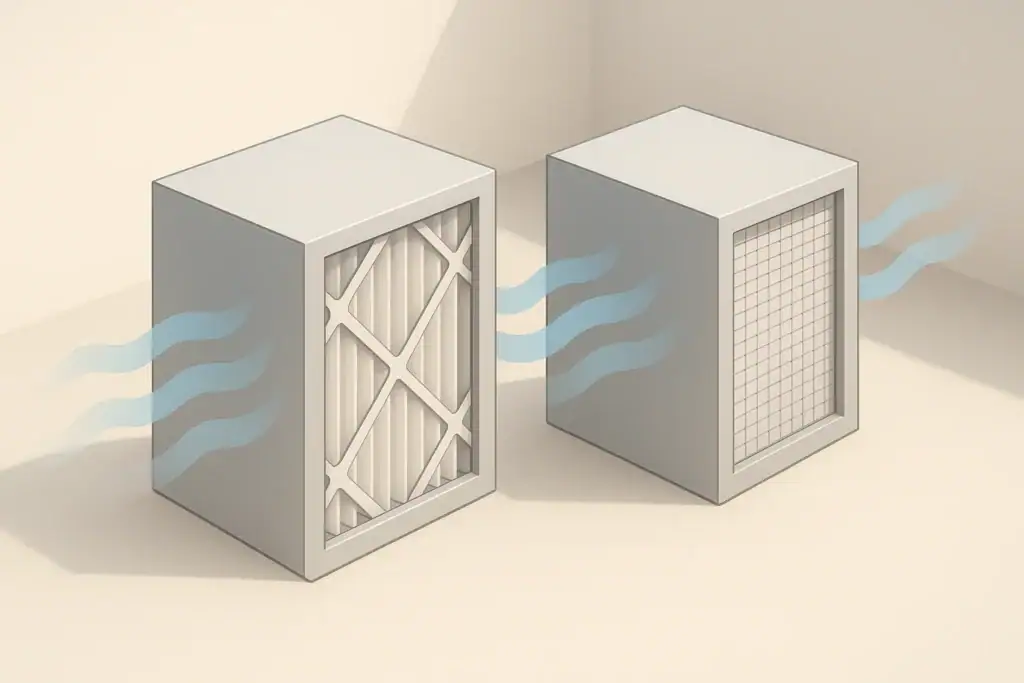
In many multi‑stage filtration systems, air passes through filters in this general order:
- Pre‑filter – captures larger dust, hair, and lint to protect the next stages
- Activated carbon layer – adsorbs some gases and odors
- HEPA or high‑efficiency particle filter – captures fine particles
This arrangement can vary, but the idea is to protect more delicate filters from rapid clogging and to treat both particles and gases in one air path.
Why Both Often Make Sense
Because indoor air usually contains a mix of particles and gases, combining HEPA and activated carbon can provide broader coverage:
- HEPA lowers exposure to fine particulate pollution and many allergens
- Carbon makes indoor air smell cleaner and can reduce some VOC irritation
This does not mean more filters are always necessary. If your only concern is visible dust, a HEPA filter alone may be sufficient. If odors are the main complaint in an otherwise low‑dust environment, carbon may be the main priority.
Maintenance Considerations
Both filter types require regular replacement or servicing to remain effective:
- HEPA filters slowly load with particles and increase resistance to airflow, reducing performance over time
- Carbon filters become saturated with gases and lose their ability to adsorb new pollutants; odors may gradually return
Filter lifespans vary widely based on pollutant levels, run time, and filter size. Checking manufacturer guidelines and monitoring actual performance (for example, by noticing increased odor or visible dust) can help you choose appropriate replacement intervals.
How to Decide What You Need in Your Space
Step 1: Identify Your Main Air Quality Concerns
Start by listing what bothers you most indoors:
- Symptoms – sneezing, congestion, itchy eyes, coughing, headaches, irritation
- Observations – visible dust, hazy air, strong odors, musty smells, chemical smells
- Sources – pets, smoking, cooking style, nearby traffic, recent renovations, damp areas
This helps you match problems to the right filtration technologies and to ventilation or moisture control where needed.
Step 2: Map Concerns to Filter Types
- If the issues are mostly particles (dust, pollen, pet dander, smoke haze, spores) → focus on HEPA
- If the issues are mostly odors and chemical smells (cooking, pets, must, traffic, new materials) → include activated carbon
- If both are present → consider a combined system or layered approach
Step 3: Remember Filtration Is Only One Piece
Carbon and HEPA filters are powerful tools, but they work best alongside:
- Ventilation – bringing in outdoor air and exhausting stale air
- Source control – reducing or isolating pollution sources indoors
- Humidity management – keeping indoor humidity in a moderate range to discourage mold and dust mites
- Regular cleaning – to remove settled dust and allergens before they re‑enter the air
By understanding what carbon filters and HEPA filters each do well—and where they fall short—you can choose or configure an air cleaning setup that actually targets the pollutants present in your home.
Frequently asked questions
Do I need a HEPA or carbon filter if I have seasonal allergies?
If your primary issue is pollen, dust, or pet dander, a HEPA filter is the most effective single technology because it captures airborne particles that trigger allergies. Add an activated carbon layer only if odors or chemical irritants are also a problem in your space.
Can activated carbon filters remove VOCs from new furniture or paint?
Activated carbon can reduce some VOCs from new furniture, flooring, or paint, but effectiveness depends on the specific compounds, the amount of carbon, and contact time. Ventilation and source control are the primary strategies, with carbon filtration as a useful supplementary measure.
Will HEPA filters protect me from wildfire smoke?
HEPA filters are effective at removing the fine particulate matter (PM2.5) in wildfire smoke, which reduces haze and particle-related health risks. Because smoke also contains gases and odorous compounds, pairing HEPA with a substantial carbon layer gives broader protection against irritation and lingering smell.
How often should HEPA and carbon filters be replaced?
Replacement intervals vary by pollutant load, runtime, and filter size; follow the manufacturer’s guidance for specific products. In general, HEPA filters clog progressively with particles while carbon filters can saturate and lose odor-capturing ability, so monitor performance (increased dust, airflow drop, or returning odors) to time replacements.
Can either filter remove carbon monoxide or radon?
No. Standard HEPA and typical activated carbon filters do not reliably remove carbon monoxide, radon, or other small toxic gases at safety-relevant concentrations. These hazards require source control, proper ventilation, and dedicated detection or mitigation equipment.
Recommended next:
- Clear sizing logic (room size → CADR/ACH)
- HEPA vs carbon explained for real use-cases
- Humidity + ventilation basics to reduce mold risk
About this site
Home Air Quality Lab publishes practical, independent guides about indoor air quality—clear sizing, safer use, and real-world expectations.
Affiliate disclosure
Some links on this site may be affiliate links. If you buy through these links, we may earn a small commission at no extra cost to you. This helps support our content. Learn more.