
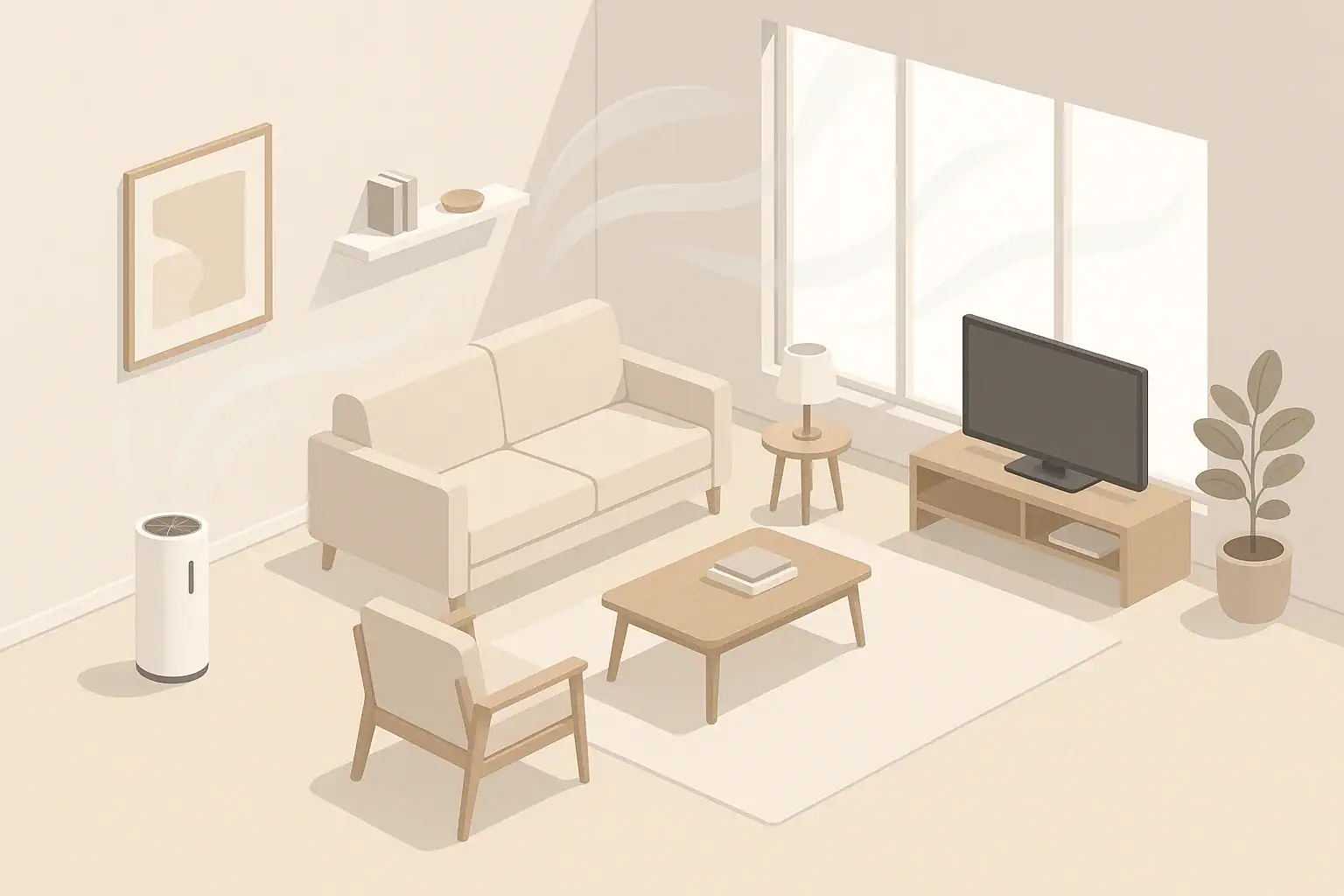
Why Large Rooms Need Special Attention
Large rooms, open-plan spaces, and high ceilings can make it difficult for an air purifier to keep up. A unit that works well in a small bedroom can feel almost useless in a big living room, basement, or combined kitchen-dining space. The main reason is simple: there is a lot more air to clean, and it keeps mixing and moving.
Most underpowered situations happen because people rely on marketing phrases like “for large rooms” instead of checking capacity numbers. Understanding a few basic concepts will help you avoid buying a purifier that runs constantly while barely improving air quality.
Key ideas to keep in mind for large rooms include:
- Room volume: floor area and ceiling height both matter.
- Clean Air Delivery Rate (CADR): how quickly the purifier delivers filtered air.
- Air changes per hour (ACH): how many times per hour the air is cycled through the purifier.
- Airflow and mixing: how freely air can move around furniture and doorways.
CADR and ACH: The Core of Sizing for Large Rooms
CADR and ACH are the two main tools for sizing an air purifier to a large space. You do not need complicated math, just a basic process and realistic expectations.
What CADR Tells You
Clean Air Delivery Rate (CADR) is a measure of how much filtered air a purifier can provide per minute. It is usually expressed in cubic feet per minute (CFM) in the US. Some manufacturers provide separate CADR values for smoke, dust, and pollen; others may provide one general value or only an air flow number. When possible, use a particle CADR value for planning.
CADR is useful because it combines both filter efficiency and airflow. A strong fan with a poor filter or a great filter with very low airflow will both result in a modest CADR. For large rooms, the CADR usually needs to be significantly higher than for a bedroom-sized space.
What ACH Tells You
Air changes per hour (ACH) tells you how many times in one hour a purifier could theoretically process the total air volume of the room. It does not mean the air becomes perfectly clean after that many changes, but it is a practical way to compare setups.
In simple terms:
- Lower ACH (for example, about 2) is more typical of light use in larger rooms.
- Moderate ACH (for example, around 4–5) is often targeted when more active particle control is desired.
- Higher ACH (for example, 6 or more) can be helpful in more demanding situations but may be noisy or require multiple units.
The ACH that makes sense for you depends on tolerance for noise, typical pollutant sources (such as cooking or outdoor smoke intrusion), and whether anyone is especially sensitive to airborne particles. Many people choose a moderate ACH target and adjust fan speeds as needed.
Example values for illustration.
| Task | Why it matters | Practical notes |
|---|---|---|
| Measure room length and width | Determines floor area to be cleaned | Round to the nearest whole foot for simplicity |
| Account for ceiling height | Larger volume needs higher CADR | Use actual height if noticeably above 8 ft |
| Choose an ACH target | Sets how aggressive filtration will be | Common examples range from about 3–6 ACH |
| Estimate needed CADR | Translates volume and ACH into purifier capacity | Higher CADR usually means faster cleaning but more noise |
| Consider two units instead of one | Improves mixing and coverage in odd-shaped rooms | Two medium units can outperform one large unit in open plans |
| Plan outlet access and placement | Prevents blocking airflow against walls or furniture | Leave breathing room around air intakes and outlets |
| Check filter replacement costs | Large-room use often means more runtime | Budget for regular filter changes to maintain performance |
How to Estimate the Right Size for Your Space
Choosing an appropriately powerful purifier for a large room starts with estimating room volume and deciding on an approximate ACH target. From there, you can match those needs to CADR values or comparable airflow information.
Step 1: Estimate Room Volume
First, measure the approximate length and width of the main area you want to treat. Multiply these to get the square footage. Then multiply by the ceiling height to estimate volume in cubic feet.
For example, if your combined living and dining area is about 20 feet by 18 feet with a 9-foot ceiling:
- Floor area: 20 × 18 = 360 square feet (rounded).
- Volume: 360 × 9 = 3,240 cubic feet.
If ceilings vary, you can use an average height. For open stairwells or lofts, include the air that freely mixes with your main room.
Step 2: Decide on an ACH Target Range
Next, choose an ACH range that fits your goals and tolerance for fan noise. Example ranges:
- About 2–3 ACH: lighter everyday use in large, open rooms when pollution sources are modest.
- About 4–5 ACH: more active particle control when cooking frequently, living in a denser urban area, or dealing with seasonal smoke.
- About 6+ ACH: more intensive control, which may require either very strong units or multiple purifiers and will often be louder.
Many households aim for roughly 3–5 ACH in large rooms and then adjust by increasing fan speed during higher-pollution activities, such as cooking or when outdoor air is especially hazy.
Step 3: Connect ACH to CADR
Once you know room volume and target ACH, you can estimate the needed CADR. A simple way is to remember that higher ACH in a larger volume requires a higher CADR. Some manufacturers and independent resources provide calculators or charts using example formulas to relate these values.
Because large rooms often need more capacity than expected, it is common to discover that a single small or medium unit marketed as suitable for “large rooms” may not reach your preferred ACH at a comfortable noise level. This is a key way underpowered setups happen.
Step 4: Consider Multiple Purifiers
Instead of relying on one very strong purifier at a high fan speed, many people find that two moderate units placed thoughtfully can:
- Provide similar or better effective ACH for the overall space.
- Operate at lower, quieter speeds.
- Improve mixing in L-shaped or long rooms.
This approach can be especially useful in open-plan homes where air needs to move around corners, into alcoves, or across long distances.
Filter Types That Matter in Large Rooms
In large rooms, the type and quality of filters inside your purifier become more noticeable because the unit processes a greater total volume of air. Filters influence both what gets removed from the air and how often you will need replacements.
Particle Filters: HEPA and Similar Options
Most people looking to control dust, smoke particles, and other fine particles focus on HEPA or HEPA-type filters. True HEPA filters are designed to capture a high percentage of fine particles. Some models reference classes such as H13 or H14, which are often associated with tighter filtration standards, though actual performance depends on the entire purifier design and proper sealing.
In large-room use, clarity around particle filtration is important because:
- More air is moving through the filter, which can load it faster.
- Any leakage around the filter (bypass) can matter more in high-volume operation.
- Higher-efficiency filters may reduce airflow if the fan is not strong enough, affecting overall CADR.
Gas and Odor Filters: Activated Carbon
For odors and many gases (often grouped as volatile organic compounds, or VOCs), purifiers may include activated carbon or similar sorbent media. In large rooms, odor and gas control can be challenging because:
- Odors from cooking, cleaning products, or occupants can disperse over a wide area.
- Small, lightly filled carbon filters may saturate quickly in high-use situations.
- Continuous sources, such as ongoing cooking, can overwhelm small gas filters.
If you want meaningful odor reduction in a large space, look for designs that offer substantial carbon capacity and budget for more frequent replacements when the purifier runs many hours per day.
Why Seal Quality and Bypass Matter
Even excellent filters can be undermined if air can slip around them instead of through them. This is called leakage or bypass. In large rooms, a strong fan may pull significant air, so good seals between the filter and the housing help maintain overall performance.
Signs that seal quality may be important include:
- Visible gaps between filters and housing.
- Filters that seem loose or shift easily when installed.
- Dust streaks inside the purifier along paths that bypass the filter.
Poor sealing can make a purifier behave as if it has a much lower effective CADR than advertised, which again leads to underpowered performance in large spaces.
Placement and Airflow in Big or Open-Plan Rooms
Even a properly sized purifier can feel underpowered if air cannot circulate. Large rooms and open plans often have dead zones, corners, or obstacles that block airflow.
Basic Placement Principles
For large rooms, consider these guidelines:
- Avoid tight corners: Placing a purifier directly in a corner can limit air intake and output.
- Allow space around the unit: A few feet of clearance from walls and large furniture helps.
- Use the natural flow of the room: Place purifiers where people spend time and where air naturally circulates, such as near central walkways or between seating areas.
- Do not blow directly into obstacles: Directing the clean air stream into a nearby wall or couch reduces effective mixing.
Using Multiple Units for Better Coverage
In large or oddly shaped spaces, two strategically placed purifiers can create a more even distribution of clean air. For example:
- One near the main sitting area.
- Another toward the opposite end of the room or near a hallway that connects to other spaces.
This can reduce the risk that one area of the room remains relatively unfiltered while the purifier focuses on the nearby zone only.
Interaction With HVAC and Ventilation
Central heating and cooling systems also move air. In some homes, it can help to place purifiers so their output is not directly fighting against a strong HVAC vent. Instead, aim for a setup where the purifier complements the existing air circulation pattern.
Natural ventilation (such as periodically opening windows) can reduce the overall particle load, but it also introduces outdoor particles. In many cases, people use a combination of mechanical ventilation, filtration, and periodic window opening to balance comfort and air freshness.
Noise, Energy Use, and Continuous Operation
Running enough filtration for a large room usually means the purifier will be on many hours per day. Noise and energy use become important practical considerations.
Noise Trade-Offs in Large Spaces
Most purifiers are quiet on their lowest fan settings but move relatively little air there. Higher speeds move more air and increase effective ACH but also add noise.
In large rooms, common strategies include:
- Using medium settings as a daily baseline and increasing to higher speeds during specific activities such as cooking or when smoke intrudes from outside.
- Placing purifiers a little farther from seating to reduce perceived loudness without blocking airflow.
- Using two units at lower speeds rather than one unit at a maximum speed.
Energy Considerations
Purifiers for large rooms typically use more power, especially at high fan speeds. To keep energy use manageable:
- Use automatic or sensor-based modes if available and reliable.
- Run higher speeds only when needed, such as after cooking or during outdoor smoke episodes.
- Keep filters clean; clogged filters can reduce airflow and may waste energy.
Air cleaning is usually a gradual process, so continuous low-to-moderate operation often works better than short bursts of high power followed by long periods with the purifier off.
Maintenance Planning for Large-Room Use
Purifiers working in big spaces process more total air and often run for longer hours. This increases the importance of a simple, realistic maintenance plan.
Filter Replacement Frequency
Manufacturers usually provide example replacement intervals based on a certain number of hours per day and average conditions. In larger rooms or in homes with higher particle loads, actual intervals can be shorter.
Factors that influence filter life include:
- Number of hours used per day.
- Fan speed settings (more airflow usually loads filters faster).
- Indoor sources of particles, such as frequent cooking or heavy dust.
- Outdoor air quality if windows are often open.
Simple Visual and Smell Checks
While not a substitute for manufacturer guidance, routine visual inspections and paying attention to odors can be helpful:
- Particle filters: look for heavy dust buildup or darkening.
- Carbon filters: note any loss of odor reduction or a persistent musty or stale smell when running.
If performance seems to decline, replacing filters on the earlier side is often wise, especially in large rooms where underperforming filters have a bigger impact.
Cleaning Pre-Filters and Grilles
Many purifiers include a washable pre-filter that catches larger dust and hair before air reaches the main filter. Keeping this pre-filter clean:
- Maintains airflow and helps preserve CADR.
- Can extend the life of the main filter.
- Reduces visible dust buildup on the unit.
Always follow the manufacturer’s instructions when cleaning pre-filters or the interior surfaces of the purifier.
Example values for illustration.
| Approx. room floor area | Ceiling height note | CADR planning idea | Notes |
|---|---|---|---|
| 250 sq ft living room | Standard height (about 8–9 ft) | Single medium CADR unit may reach about 3–4 ACH | Often acceptable for general everyday use |
| 350 sq ft open living-dining | Slightly higher ceiling (about 9–10 ft) | One stronger unit or two moderate units to reach similar ACH | Multiple units can improve comfort-level noise |
| 450 sq ft large family room | Standard height (about 8–9 ft) | Higher total CADR needed for about 4 ACH | Commonly easier with two devices positioned apart |
| 500 sq ft open-plan with loft | High or vaulted ceiling | Substantially higher CADR required to offset increased volume | Consider combining filtration with ventilation strategies |
| Basement recreation area | Varied ceiling heights | Plan for capacity across the full connected volume | Dehumidification may also be important for comfort |
| L-shaped great room | Mixed heights and partial walls | Two units, one in each leg of the “L” | Helps reduce stagnant pockets of air |
Safety and Feature Considerations
When choosing an air purifier for a large room, safety and extra features deserve attention, but they can also be a source of confusion.
Ozone and Add-On Technologies
Many households prefer purifiers that do not intentionally generate ozone. Some devices use ionizers, electrostatic technologies, or UV-C lamps. These can have benefits and limitations, but they may also introduce concerns if not implemented carefully.
If minimizing byproducts is a priority for you, focus on units that emphasize mechanical filtration (such as HEPA-type and carbon filters) and advertise low or no ozone generation in line with relevant guidelines. Avoid operating any device in ways that conflict with safety instructions from the manufacturer.
Smart Features and Monitors
Some purifiers for large rooms include air quality sensors and automatic modes that change fan speed based on detected particle levels or other metrics. These can help balance noise and cleaning power, but keep in mind:
- Sensor placement (often on the purifier itself) may not perfectly reflect conditions across a large room.
- Different sensors may vary in sensitivity to smoke, dust, or cooking aerosols.
- Automatic modes might keep the unit at low speeds unless pollution is clearly detected.
Standalone air quality monitors can be useful for spot-checking different parts of a large room. Common metrics on consumer monitors include particulate matter (such as PM2.5), carbon dioxide (CO2), and total volatile organic compounds (TVOC). These readings can help you understand how well your purifier and ventilation strategies are working, without being used as medical tools.
Fire Safety and Placement
As with any electrical appliance, follow basic safety practices:
- Do not block air intakes and outlets with fabrics or furniture.
- Avoid running power cords under rugs or in ways that can be damaged.
- Keep units on stable, level surfaces away from obvious sources of moisture or heat.
Proper use and maintenance not only improve performance but also keep long-term operation in large rooms safer and more predictable.
Frequently asked questions
How do I calculate the CADR needed for a specific large room?
Measure the room volume (floor area × ceiling height), choose a target ACH, then estimate required CADR in CFM as (room volume × ACH) ÷ 60. Round up to allow for imperfect mixing and any bypass leakage, and consider using two units if the resulting CADR would need very high, noisy fan speeds.
Is one very powerful purifier better than two medium units for an open-plan space?
Two medium units often give more even coverage, better mixing, and lower perceived noise than a single unit running at maximum speed. Multiple units also add redundancy and allow placing devices near activity zones to tackle local pollutant sources more effectively.
How often should I replace filters when running an air purifier in a large room?
Follow the manufacturer’s recommended intervals, but expect shorter service life with continuous, high-volume use. Inspect washable pre-filters monthly and check HEPA or carbon filters visually or by odor; replace earlier if filters look heavily loaded or odor reduction declines.
Where should I place purifiers in an L-shaped or open living-dining area for best performance?
Avoid corners and blocked intakes; give each unit several feet of clearance from walls and furniture. Distribute units so they sit between pollutant sources (kitchen, entryways) and main seating areas, and place one unit in each “leg” of an L-shaped room to reduce stagnant pockets.
Can air purifiers effectively remove smoke and cooking odors in large rooms?
HEPA or particle filtration is effective at removing smoke particles, while activated carbon or other sorbents are needed for many odors and VOCs. In large rooms, meaningful odor reduction requires sufficient carbon capacity and may need more frequent replacements; combining filtration with ventilation usually yields the best results.
Recommended next:
- Best Air Purifiers for Allergies: What to Look For (CADR, HEPA, Carbon)
- How to Choose the Right Air Purifier for Your Room Size
- Air Purifier Placement: Where to Put It for Best Results
- Do Air Purifiers Help With Smoke and Odors?
- Air Purifier Noise: What dB Levels Are Quiet Enough for Sleep?
- Best Air Purifiers for Pets: Dander, Odors, and Filter Costs
- More in Air Purifiers →
- Clear sizing logic (room size → CADR/ACH)
- HEPA vs carbon explained for real use-cases
- Humidity + ventilation basics to reduce mold risk





About this site
Home Air Quality Lab publishes practical, independent guides about indoor air quality—clear sizing, safer use, and real-world expectations.
Affiliate disclosure
Some links on this site may be affiliate links. If you buy through these links, we may earn a small commission at no extra cost to you. This helps support our content. Learn more.