What an air quality alert means
An air quality alert is a public notice that outdoor pollution is forecast or observed at a level that may call for precautions. State, local, or Tribal air agencies commonly issue the underlying information, which may then appear through the National Weather Service, local media, or weather apps.
The word alert alone is not enough to choose an indoor response. Names and issuance thresholds are not uniform nationwide. For example, the Illinois EPA explains that there is no national requirement or threshold for Action Day messages. Open the issuing agency’s full notice rather than relying on a notification headline.
An alert may concern a forecast, current outdoor conditions, or both. AirNow explains that forecasts are generally issued for the next day, while the NowCast reflects recent outdoor observations. Neither is a measurement of air inside a particular home.
What is an air quality alert? Decode it in four steps
- Identify the pollutant. Look for PM2.5, PM10, ground-level ozone, or another specifically named pollutant. A color alone does not show which filtration method, if any, can help.
- Check the AQI category. Note the AQI number, color, and category. If several pollutants are listed, find out which one is driving the alert.
- Confirm the area and period. Check the counties or forecast zones covered, plus the start and expiration times. Conditions can differ within a broad reporting area.
- Read the affected-groups statement. The notice may identify people who should take precautions first. Follow an existing personal medical action plan as well as general public guidance.
AQI categories at a glance
The U.S. AQI has six categories. AirNow states that AQI above 100 becomes unhealthy first for sensitive groups and then for more people as levels rise.
| AQI | Color | Official category | What to verify |
|---|---|---|---|
| 0–50 | Green | Good | Routine conditions; keep checking if a later alert is forecast. |
| 51–100 | Yellow | Moderate | Read pollutant-specific guidance if someone is unusually sensitive. |
| 101–150 | Orange | Unhealthy for Sensitive Groups | Identify the groups named in the notice and adjust their plans first. |
| 151–200 | Red | Unhealthy | Guidance may apply more broadly; check the pollutant and timing. |
| 201–300 | Purple | Very Unhealthy | Follow the issuing agency’s detailed precautions. |
| 301 and higher | Maroon | Hazardous | Use current official instructions rather than a general checklist. |
An Orange alert does not necessarily mean smoke, and a Red alert does not identify a pollution source. AQI is a pollutant-specific summary of outdoor conditions.
Particle and ozone alerts need different indoor responses
Particle filters can help capture PM2.5 and PM10, but a MERV or HEPA designation does not establish ozone or gas-removal performance. Use the pollutant named in the alert to choose actions. The CDC’s outdoor-pollutant guidance advises reducing outdoor exertion and spending more time indoors when ozone or particle pollution is high, with added caution for affected groups.
| Alert pollutant | Windows and HVAC | Filtration | Activity and condition checks |
|---|---|---|---|
| PM2.5 or PM10 | When outdoor air is worse, close windows if the home can stay at a safe, comfortable temperature. If the system has a normal, clearly identified recirculation or outdoor-air control, use it only as the manufacturer directs. | Use a properly fitted, system-compatible particle filter or a portable particle cleaner sized for the occupied room. Reduce indoor particle sources such as smoking, candles, or heavy frying when practical. | Consider moving or shortening strenuous outdoor activity. Check the notice for guidance affecting people with heart or lung disease, diabetes, children, and older adults. |
| Ground-level ozone | Spend more time indoors and use the local hourly forecast to time necessary outdoor activity. Temporarily reducing outdoor-air entry may limit infiltration if indoor temperature and other conditions remain acceptable. | Do not assume a MERV or HEPA particle filter removes ozone. Do not use devices intended to generate ozone in occupied rooms. | Pay particular attention to guidance for people with lung disease, children, older adults, and people active outdoors. |
| Another named pollutant | Follow the issuing agency’s pollutant-specific instructions. | Do not assume a cleaner will help without verified performance information for that pollutant and the stated operating conditions. | Check the named groups, geographic area, symptoms guidance, and expiration time. |
Make a temporary windows and HVAC plan
Closing windows during the worse part of a particle or ozone episode can reduce outdoor-air entry, but it does not guarantee acceptable indoor air. Pollution can enter through leaks, and indoor activities can add pollution.
- Windows: Check the alert period and current outdoor conditions before closing them. Reassess indoor temperature and conditions instead of treating a closed home as an automatic solution.
- HVAC controls: Use only normal controls provided by the equipment. Do not modify ducts, disable required ventilation, or block combustion-appliance vents.
- HVAC filter: Confirm the filter dimensions, airflow direction, and equipment limits before changing filters. ASHRAE notes that higher-MERV filters can increase airflow resistance, so manufacturer limits matter.
- Recovery: Restore normal ventilation when outdoor conditions improve, provided it is appropriate for the home and equipment.
Heat is an important exception. During combined heat and smoke, keeping occupants safely cool may take priority over keeping every window closed. EPA advises using a cooling or cleaner-air location when a person cannot remain both cool and in cleaner air; see its heat and smoke guidance.
Understand portable filtration limits
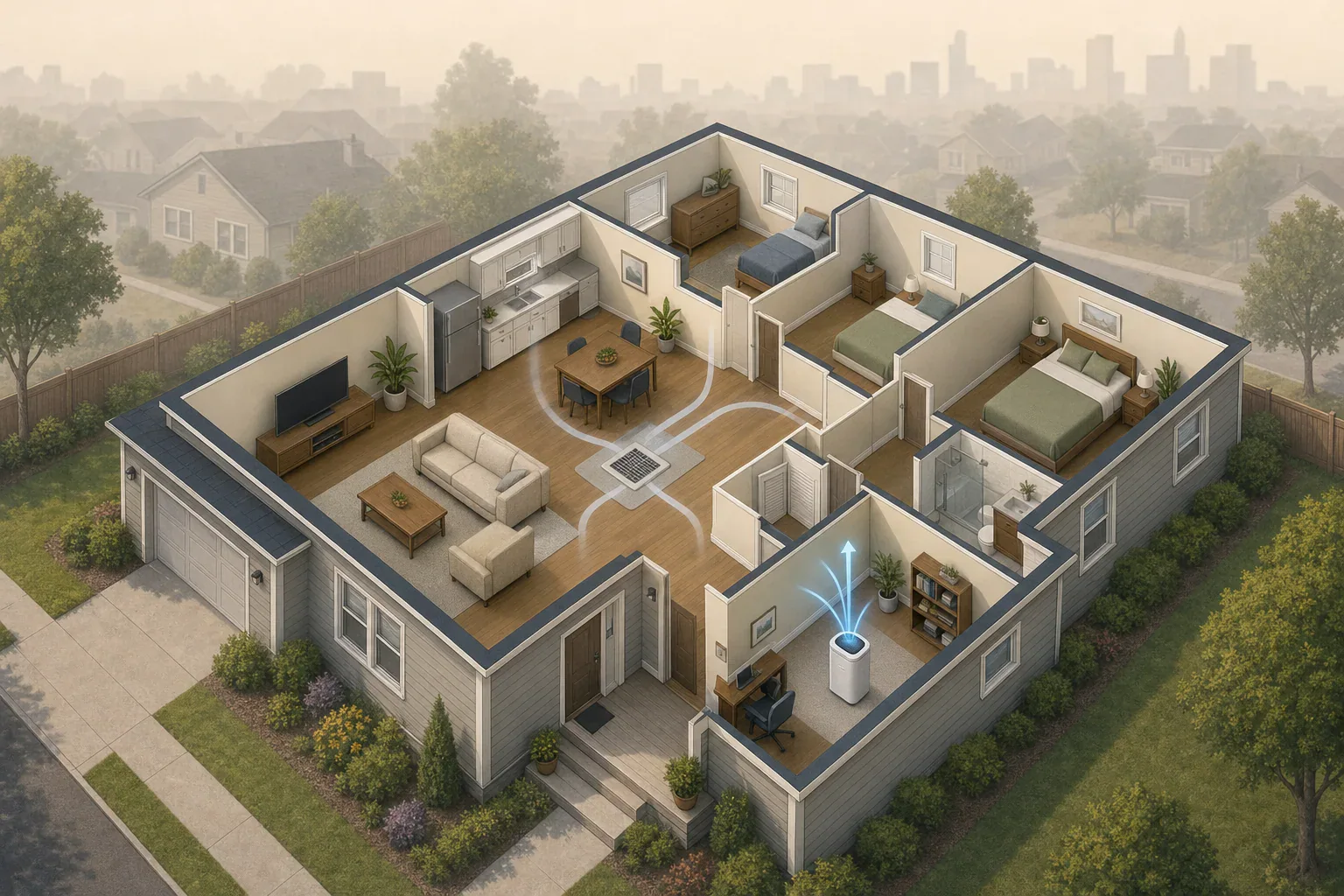
A portable particle cleaner generally serves one room, not an entire home. For smoke particles, EPA recommends choosing a portable cleaner with a smoke CADR of at least two-thirds of the room area in square feet. This is smoke-particle sizing guidance, not evidence of ozone or gas removal. See EPA’s indoor air-filtration guidance.
For smoke, EPA also recommends a MERV 13-or-higher HVAC filter if it is compatible with the system. Keep the distinction clear: MERV and CADR guidance addresses particles. It does not show that a filter removes ozone or other gases.
Place a portable unit where its intake and outlet are not blocked, run it in the occupied room, and inspect filters according to the manufacturer’s instructions. A loaded or poorly fitted filter can reduce airflow or allow air to bypass the media. EPA also cautions that some electronic air cleaners may generate ozone.
Two hypothetical alert examples
Example 1: Orange ozone alert from 1–8 p.m. Assume the notice identifies ozone as the driving pollutant and names children, people with lung disease, older adults, and people active outdoors as affected groups. A household could move strenuous outdoor tasks to a time with a better hourly forecast, spend more of the alert period indoors, and limit outdoor-air entry if indoor conditions remain suitable. A particle-only purifier should not be credited with removing ozone.
Example 2: Red PM2.5 alert through tomorrow morning. Assume the notice identifies fine particles across the household’s county. The household could close windows during the worse period, use normal HVAC controls that reduce outdoor-air entry if available, run a correctly sized portable particle cleaner in an occupied room, and reduce particle-producing indoor activities. Recheck the AQI and alert expiration before restoring normal ventilation.
These are decision examples, not predicted indoor pollution reductions. Results depend on the building, equipment, outdoor concentration, indoor sources, and how the equipment is operated.
Five-point household alert checklist
- Windows: Compare outdoor conditions with indoor temperature and obvious indoor pollutant sources.
- HVAC controls: Use recirculation or outdoor-air controls only through normal equipment settings and instructions.
- Filtration: Match the technology to the pollutant. Confirm room size, filter fit, and HVAC compatibility.
- Activity: Move, shorten, or reduce strenuous outdoor tasks according to the notice and individual needs.
- Conditions: Recheck the current AQI, forecast, alert expiration, indoor temperature, power status, symptoms, and any personal medical plan.
Generic AQI guidance cannot replace individual medical advice. Follow an established asthma or other medical action plan. Seek urgent medical care for severe or worsening symptoms, and follow official emergency, evacuation, or shelter instructions over any household checklist.
Related guides: Wildfire Smoke Indoors: Step-by-Step Plan to Lower PM2.5 Fast • How to Choose the Right Air Purifier for Your Room Size • Air Purifier vs Ozone Generator: Safety, Effectiveness, and Myths
Frequently asked questions
Does an air quality alert always begin at Orange AQI?
No. Orange is the U.S. AQI category from 101 to 150, but alert names and issuance thresholds are set by individual jurisdictions. Read the issuing agency’s notice to confirm the pollutant, area, timing, and recommended precautions.
Is an air quality alert a forecast or a current reading?
It can be either, or both. Air agencies commonly issue next-day forecasts, while AirNow’s NowCast reflects recent outdoor observations. Neither reading tells you the air quality inside a specific home.
Will a HEPA or MERV filter remove ozone during an ozone alert?
Do not assume so. HEPA and MERV ratings address particle filtration, while ozone is a gas. Follow the alert’s activity guidance and rely on gas-removal claims only when they are specifically verified for the device and operating conditions.
Summary
To respond to an air quality alert, identify the pollutant, AQI category, affected area, time period, and named groups in the full notice. Particle alerts may support temporary reductions in outdoor-air entry and particle filtration, while standard particle filters should not be assumed to remove ozone. Recheck conditions throughout the event and return to normal ventilation when conditions permit.
Recommended next:
- Indoor Air Quality Monitors: What to Measure (PM2.5, CO2, VOCs, Humidity)
- CO2 Monitors for Homes: What Good Numbers Look Like and Why They Matter
- VOC Sensors Explained: Why Readings Vary and How to Use Them Safely
- Where to Place an Air Quality Monitor: Height, Distance, and Rooms
- PM2.5 Sensor Accuracy: Why Readings Differ Between Devices
- CO2 Monitor Buying Guide: What to Look For (NDIR vs “eCO2”)
- Clear sizing logic (room size → CADR/ACH)
- HEPA vs carbon explained for real use-cases
- Humidity + ventilation basics to reduce mold risk