
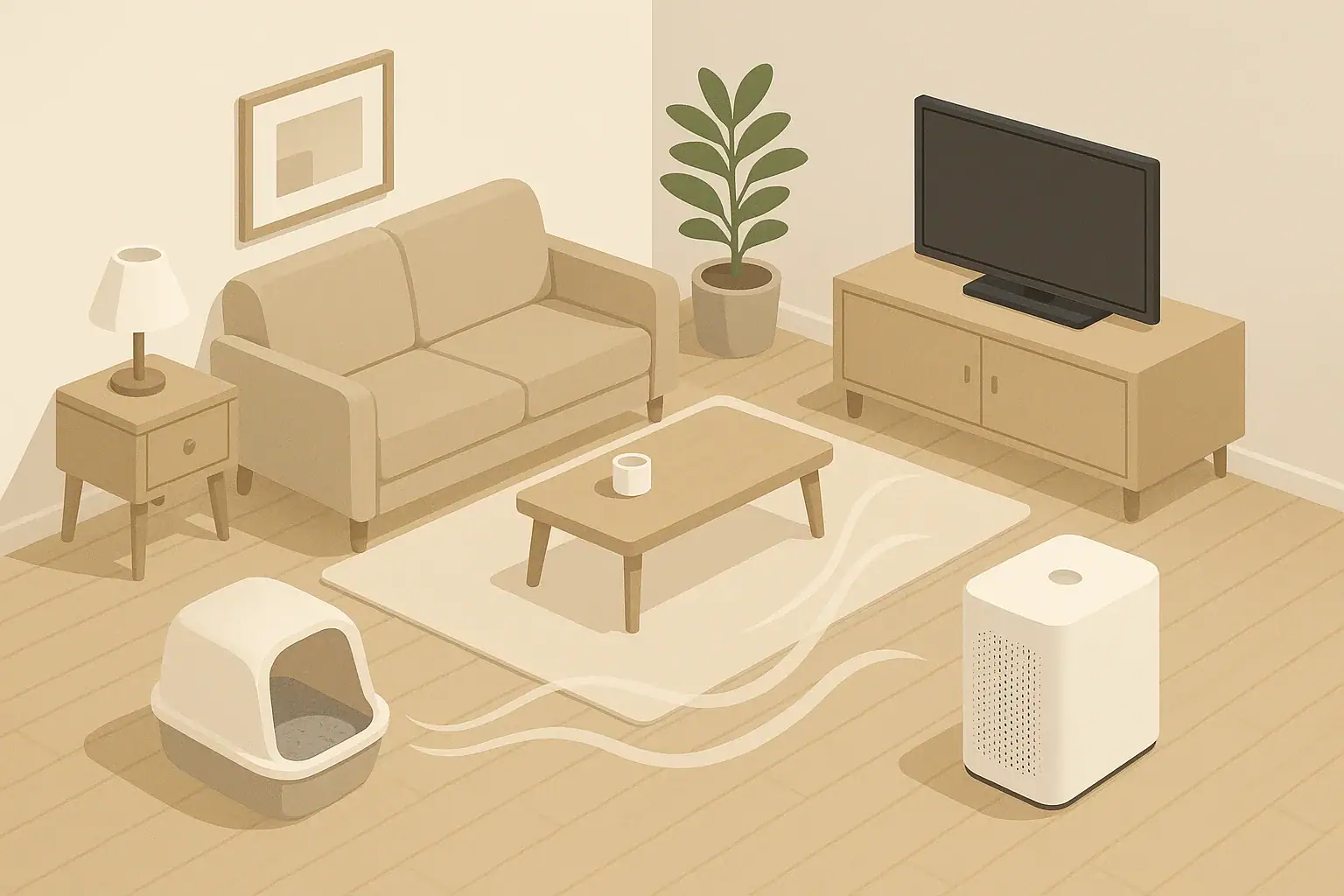
Cat litter odor can be stubborn, even in a clean home. Scooping on schedule and using a covered box may not be enough, especially in smaller apartments or in winter when windows stay closed. Cat urine and feces release gases and particles that spread quickly through indoor air.
From an air quality perspective, cat litter smells are largely caused by:
- Ammonia and other gases from urine as it breaks down
- Volatile organic compounds (VOCs) from waste and sometimes from scented litter additives
- Fine particles and dust kicked up when cats dig and when you pour or scoop litter
These are different from typical dust or pollen. Standard mechanical filters that trap particles do not remove most odor-causing gases. That is why many air purifiers aimed at litter odor rely on activated carbon or similar sorbent media, not just HEPA filters.
Why Cat Litter Odor Is Hard to Control
Cat litter odor can be stubborn, even in a clean home. Scooping on schedule and using a covered box may not be enough, especially in smaller apartments or in winter when windows stay closed. Cat urine and feces release gases and particles that spread quickly through indoor air.
From an air quality perspective, cat litter smells are largely caused by:
- Ammonia and other gases from urine as it breaks down
- Volatile organic compounds (VOCs) from waste and sometimes from scented litter additives
- Fine particles and dust kicked up when cats dig and when you pour or scoop litter
These are different from typical dust or pollen. Standard mechanical filters that trap particles do not remove most odor-causing gases. That is why many air purifiers aimed at litter odor rely on activated carbon or similar sorbent media, not just HEPA filters.
How Carbon Filters Actually Help With Litter Odor
An air purifier for cat litter odor needs more than good particle filtration. The key component is usually an activated carbon filter (sometimes called charcoal). This material has a vast network of microscopic pores that can adsorb gases and some VOCs as air passes through.
For litter odors, carbon filters help because they can:
- Adsorb ammonia and sulfur compounds that give urine and feces their characteristic smell
- Reduce VOCs from scented litters, cleaning products, or nearby household activities
- Compliment HEPA filters by targeting gases while HEPA focuses on solid particles
However, not all carbon filters are equally useful for strong odors like cat litter. Some are only very thin sheets with a light dusting of carbon. These can help slightly with general mustiness but saturate quickly when placed near a litter box.
When evaluating carbon for cat litter odor, pay attention to:
- Carbon amount (mass or thickness): More carbon usually means more capacity to hold odors before it becomes saturated.
- Airflow design: Air needs enough contact time with the carbon. Very fast airflow through a tiny carbon layer may not give gases time to adsorb.
- Replacement frequency: Carbon that is full can start letting odors pass straight through. Regular replacement is essential in odor-heavy spots.
Even a well-designed carbon filter is not a substitute for scooping, cleaning, or proper litter box hygiene. Instead, it is one part of a broader odor-management plan.
| Feature | HEPA-style filter | Activated carbon filter |
|---|---|---|
| Main target | Solid particles (dust, dander, litter dust) | Gases and some VOCs (odor molecules) |
| Helps with visible dust near litter box | Yes, captures fine dust and dander | Only indirectly, not designed for particles |
| Helps with strong urine/feces odors | Limited, odors mostly pass through | Yes, when carbon amount and contact time are adequate |
| Saturation behavior | Clogs with particles and airflow decreases | Odor capacity fills; smells break through again |
| Typical use life under heavy litter odor | Several months (example only) | Shorter, often needs more frequent replacement (example only) |
| Best role in a purifier | Core filter for general indoor particulate cleanup | Specialized layer for odor and gas reduction |
Choosing an Air Purifier for a Litter Area
If your main goal is to reduce cat litter odor, you want a purifier that balances three things: adequate airflow for the room size, effective carbon filtration, and practical noise and maintenance.
Match purifier size to room size (CADR and ACH basics)
A purifier that is too small will not move enough air near the litter box, even if its carbon filter is good. Look at two broad concepts when sizing:
- CADR (Clean Air Delivery Rate): This is an estimate of how much cleaned air a unit can supply per minute for particulates. For odor, it is still a useful proxy for airflow. Higher CADR generally means more air passes through the carbon each hour.
- ACH (Air Changes per Hour): This is how many times per hour the purifier can theoretically cycle the room’s volume. For an odor source like a litter box, people often plan for higher ACH in that specific room than they would for general whole-home use.
As a rough planning idea (not a rule), many households aim for several air changes per hour in the room that holds the litter box, especially if the door is normally closed or the space is small.
What to look for in carbon filters
When reviewing carbon filters for the litter room, consider:
- Substantial carbon layer: Filters that use pellets, granules, or a clearly thicker carbon layer tend to have more odor capacity than very thin, lightly coated sheets.
- Dedicated gas/odor stage: Many multi-stage purifiers include a pre-filter (for hair and large dust), a HEPA-style filter (for fine particles), and a distinct carbon stage for gases.
- Replaceable carbon component: Check that you can replace just the odor stage as recommended, not only the entire filter stack.
- Performance trade-off: Very dense carbon can add resistance to airflow. The purifier’s fan capacity needs to be able to handle that without drastically reducing air movement.
HEPA still matters in the litter zone
Carbon filters alone are not enough. Litter dust, cat dander, and general household particles are best managed with HEPA-type filtration working alongside carbon. When people talk about “true HEPA” or higher-efficiency classes such as H13 or H14, they are referring to filters tested to capture a high percentage of very small particles at a specified airflow.
For the litter area, a high-efficiency particulate filter helps with:
- Litter dust and tracking stirred into the air when cats dig
- Fine dander that can contribute to allergy discomfort for some people
- General household particles that affect overall indoor air clarity
Look for a purifier where the air cannot easily bypass the filters. Good seals around the HEPA and carbon stages are important; otherwise, some portion of air may leak around the sides instead of passing through the media.
Placement: Where to Put a Purifier for Cat Litter Odor
Even a strong carbon filter will underperform if the purifier is hidden in a corner with blocked airflow. For cat litter odor control, think about where the smells are released and how air moves through the room.
Distance from the litter box
In general, placing the purifier a few feet from the litter box works better than across the house. You want the odor plume to be pulled toward the purifier rather than drifting unchecked into living areas. However:
- Avoid placing the intake so close that litter dust or splashes can directly hit the machine.
- Give the purifier some space on all sides (for example, several inches from walls and furniture) so air can circulate.
- Keep cords and obstacles away from the intake and outlet.
Airflow and room layout
Think of the purifier as part of the room’s airflow pattern:
- Do not hide it under shelves or behind heavy furniture. That traps air and limits coverage.
- Avoid blowing directly at the litter box. You want gentle pulling of air across the box, not strong drafts that might bother your cat or stir up more dust.
- Consider door positions. If doors are often closed, treat that room as its own zone and size the purifier for that space only.
Noise and your cat’s comfort
Cats can be sensitive to noise and airflow changes. A purifier that is too loud or blowing directly on the litter box might cause some cats to avoid using it. To keep things cat-friendly:
- Start with a medium or low fan speed while your cat gets used to the sound.
- Place the purifier so that the airflow path passes near the litter box but does not blast across it.
- If the unit has a night or quiet mode, that can be helpful for bedrooms with a litter box present.
Other Ways to Reduce Cat Litter Odor (Beyond Purifiers)
An air purifier with an effective carbon filter helps, but it works best alongside other odor-control strategies. Addressing the source and improving general air movement can take pressure off the carbon filter and extend its useful life.
Litter box hygiene basics
Odor rises quickly if waste remains for long. Common practical steps include:
- Frequent scooping: Many households scoop at least once daily; higher-frequency scooping often reduces odor load on the purifier.
- Regular full litter changes: Over time, odor can build up even if you scoop consistently.
- Cleaning the box itself: Washing the box with unscented, cat-safe cleaners reduces absorbed smells in plastic surfaces.
- Adequate number of boxes: Multiple cats usually need more than one litter box, which can reduce crowding and concentrated odor in a single spot.
Ventilation and air exchange
Purifiers clean recirculating indoor air; they do not add fresh outdoor air. When outdoor conditions allow, simple ventilation can dilute odors:
- Crack a window near the litter room if temperature and outdoor air quality are acceptable.
- Use bathroom or laundry exhaust fans if the litter box is nearby and the fan vents outdoors.
- Encourage gentle cross-breezes with open interior doors, so the purifier can treat more of the air passing by the litter box.
In more closed-up homes, especially in winter or in well-sealed modern buildings, mechanical ventilation systems may play a larger role in overall odor control. In those cases, the purifier’s job is mainly to reduce odors between ventilation cycles.
Humidity, cleaning products, and scents
Indoor humidity can influence how odors linger. Extremely high humidity may make air feel more stuffy, while very low humidity can be uncomfortable and dusty. Many households aim for a moderate range that balances comfort and general indoor conditions.
Also consider what you use around the litter box:
- Avoid heavy fragrances that just mask smells and add more VOCs to the room.
- Use mild, cat-safe cleaners on floors and walls near the litter box; harsh products can create strong new odors.
- Be cautious with deodorizing powders or sprays that add particles or additional chemicals the purifier then needs to capture.
Maintenance: Keeping Carbon Filters Working for Litter Odor
Once odors start to creep back in, the carbon filter may already be saturated. For strong, continuous sources like cat litter boxes, filters generally need more frequent replacement than they would in a low-odor room.
Watch for early signs of saturation
Common signs that the carbon filter is losing effectiveness include:
- Odor returns quickly after scooping or cleaning, even with the purifier running.
- No noticeable difference when you switch the purifier on near the box.
- Lingering smell on the purifier itself when you get close to the exhaust air.
These signals usually mean it is time to check manufacturer guidance and consider replacing the carbon stage, even if the recommended schedule has not yet passed. Heavy odor use shortens real-world filter life.
Pre-filters and HEPA care
Pre-filters capture hair and large dust before it reaches HEPA and carbon. In a litter area, they tend to load quickly.
- Vacuum or wash (if allowed) the pre-filter on the schedule suggested in the manual.
- Inspect HEPA filters for excessive dust buildup, and replace according to guidance.
- Keep intake grills clean with a soft brush or cloth so airflow stays strong.
Good upstream maintenance helps protect the more expensive carbon and HEPA filters from clogging prematurely.
Operating patterns for odor-heavy spaces
Because the litter box is a constant source, many people find that:
- Running the purifier continuously on a moderate speed maintains more stable odor control than only switching it on when smells are noticeable.
- Boosting to higher speeds temporarily right after scooping can help capture an immediate odor spike, then dropping back to a quieter setting.
- Keeping doors consistent (either mostly open or mostly closed) simplifies how you plan coverage and filter schedules.
| Filter type | Typical interval range (example) | What changes it | Reminder |
|---|---|---|---|
| Pre-filter (hair, large dust) | Clean every 2–4 weeks | Number of cats, litter dust, shedding level | Clogged pre-filters reduce airflow to carbon and HEPA |
| HEPA-style filter | Replace every 6–18 months | Overall dust load, fan speed, runtime hours | Check visually for heavy gray buildup and follow manual guidance |
| Carbon/odor filter | Replace every 3–12 months | Strength of litter odor, room size, ventilation | Odor returning sooner is a strong sign of saturation |
| Gasket and seals inspection | Check during each filter change | Age of purifier, assembly and handling | Air bypass around filters lowers both odor and particle control |
| Internal dusting (if allowed) | As needed, often annually | Home dust level, pet hair, placement near floor | Always unplug and follow manufacturer instructions for safe cleaning |
Safety and Practical Considerations Around Litter-Area Purifiers
Most modern portable air purifiers are designed for continuous use in living spaces, but a few extra points are worth keeping in mind around cats and litter boxes.
Ozone and add-on technologies
Some devices combine filters with extra features such as ionizers or UV-C lights. These technologies are presented as ways to help with particles or microorganisms, but they vary widely. Many households looking for simple, low-risk odor reduction prefer purifiers that rely on mechanical filtration and carbon only, with no intentional ozone generation.
If a device offers optional ionization or similar modes, users concerned about byproducts often leave those modes switched off and use the unit in its basic filter-only setting.
Power, cords, and tipping risks
Cats can be curious about new appliances. To keep things practical and safe:
- Route power cords so they cannot be easily snagged during play or when running past the litter box.
- Choose a stable placement where the purifier is not at risk of being knocked over.
- Keep vents unobstructed by toys, litter bags, or storage bins.
Integrating with whole-home air quality
A purifier near the litter box is just one part of indoor air management. For many homes, the best results come from combining:
- Source control (scooping and box hygiene)
- Targeted odor reduction (carbon-equipped purifier near the box)
- General house ventilation (open windows when possible, use of exhaust fans)
- Reasonable humidity control to keep the space from feeling stuffy
When these pieces work together, the carbon filter in your purifier does not have to fight the entire odor problem alone, and the litter area is more comfortable for both cats and people.
Frequently asked questions
How effective are carbon filters at removing ammonia from cat litter odor?
Activated carbon can adsorb ammonia and many VOCs responsible for litter odors, but its real-world effectiveness depends on the carbon mass, pore structure, and contact time. Thin or lightly coated carbon layers will saturate quickly near a litter box, while thicker pellet or granule beds provide more capacity before breakthrough occurs.
How often should I replace the carbon filter if the purifier sits near a litter box?
Replacement frequency varies with odor strength, room size, and ventilation; typical guidance ranges from about 3 to 12 months for heavy vs. light use. Watch for signs of saturation—odors returning quickly, no noticeable change when the unit is on, or smell at the exhaust—and replace the carbon stage sooner if those appear.
Can a HEPA-only purifier reduce cat litter odor?
HEPA filters capture litter dust, dander, and particles but do not remove most gases and VOCs that create urine and feces smells. For meaningful odor reduction you need a dedicated carbon or gas-adsorption stage working alongside HEPA filtration.
Where should I place the purifier relative to the litter box for best odor control?
Place the purifier a few feet from the litter box so its intake pulls the odor plume toward the unit without blasting air directly on the box. Leave several inches of clearance on all sides, avoid blocking intake or outlet grills, and prevent direct exposure to litter dust or splashes.
Are ozone generators or ionizers recommended to tackle litter odor?
Ozone-generating devices are not recommended due to potential health risks and limited proven benefit for household odors. Many users prefer mechanical filtration with activated carbon and avoid ionization or ozone modes; if such modes are optional, they are often left off.
Recommended next:
- Best Air Purifiers for Allergies: What to Look For (CADR, HEPA, Carbon)
- How to Choose the Right Air Purifier for Your Room Size
- Air Purifier Placement: Where to Put It for Best Results
- Do Air Purifiers Help With Smoke and Odors?
- Air Purifier Noise: What dB Levels Are Quiet Enough for Sleep?
- Best Air Purifiers for Pets: Dander, Odors, and Filter Costs
- More in Air Purifiers →
- Clear sizing logic (room size → CADR/ACH)
- HEPA vs carbon explained for real use-cases
- Humidity + ventilation basics to reduce mold risk



About this site
Home Air Quality Lab publishes practical, independent guides about indoor air quality—clear sizing, safer use, and real-world expectations.
Affiliate disclosure
Some links on this site may be affiliate links. If you buy through these links, we may earn a small commission at no extra cost to you. This helps support our content. Learn more.