
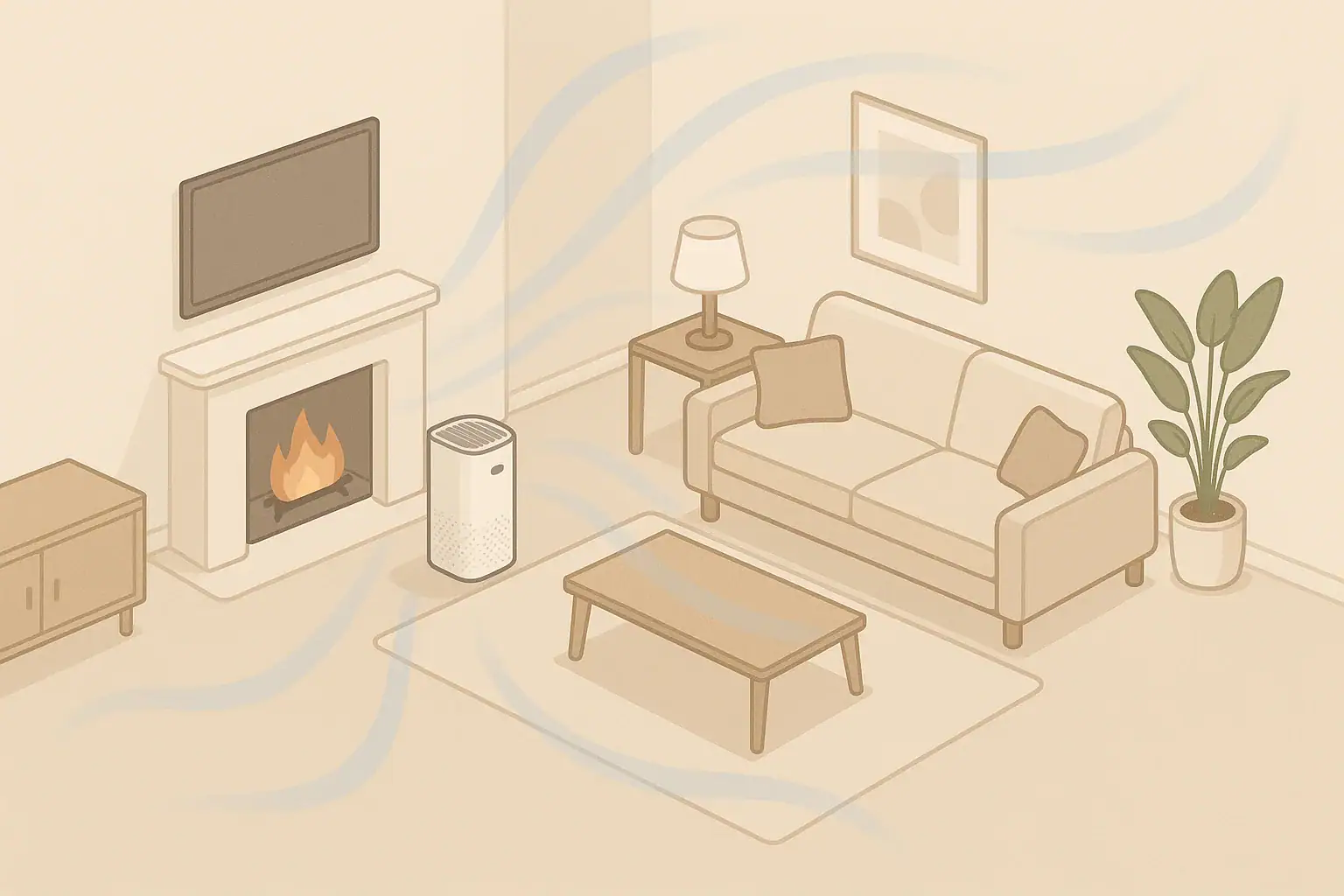
An air purifier can reduce ash dust and smoky fireplace smell, but it works best on airborne particles and only helps odors when it has enough activated carbon.
Fireplace smell is usually a mix of fine smoke particles, settled ash, soot film, and gases from combustion residues. A purifier can be useful after a normal fire or a brief smoky event, but it cannot fix draft problems, remove carbon monoxide, or clean soot from surfaces.
Quick answer
- For smoke particles and ash dust, look for a sealed HEPA-style particle filter and plan for about 4–6 air changes per hour in the main room as general guidance.
- Estimate CADR with this rough formula: room cubic feet × target ACH ÷ 60. Higher targets may be useful during short cleanup periods.
- For odor, activated carbon matters. Thin carbon sheets may reduce mild smells, while heavier carbon beds generally last longer for odor control.
- Ventilate briefly when outdoor air is acceptable, then run the purifier on a higher setting until the room smells normal again.
- If smoke spills into the room repeatedly, treat that as a fireplace draft or maintenance issue, not just an air purifier problem.
Why smoky fireplace smell lingers indoors
A smoky fireplace smell can remain after the fire is out because smoke does not behave like a single pollutant. It includes fine particles, larger ash dust, semi-volatile compounds, and odor-causing gases that can settle on walls, rugs, curtains, furniture, and the inside of the fireplace opening.
Fine smoke particles can stay suspended in air for a while, especially in a closed room. Larger ash dust tends to settle faster, then becomes airborne again when people walk, sweep, or move nearby objects. Odors may also reappear when the room warms up or when airflow pulls air from the firebox into the living space.
This is why an air purifier may make the room feel cleaner but still not fully remove the smell. Air cleaning handles what passes through the purifier. It does not scrub the brick, mantel, upholstery, carpet, damper area, or chimney liner.
What an air purifier can and cannot remove
For fireplace-related air quality, the two main filter functions are particle removal and gas adsorption. A HEPA-type particle filter captures airborne ash, soot, dust, and fine smoke particles. Activated carbon adsorbs some odor-causing gases and vapor-phase compounds. Both functions are useful, but they solve different parts of the problem.
HEPA filters for ash dust and smoke particles
A true HEPA-style filter is designed for very small particles. In practical home use, it can reduce airborne smoke particles and fine ash dust if the room air reaches the filter often enough. The purifier also needs a reasonably sealed filter path so air does not bypass the filter around loose edges.
H13 and H14 labels are sometimes used for higher-efficiency filters, but efficiency alone is not the whole story. Airflow matters. A very restrictive filter in a small unit may clean less air per minute than a well-sized unit with balanced airflow and filtration.
Activated carbon for smoky odor
Smell control depends on the amount and quality of carbon, contact time, and how much odor is being produced. A thin deodorizing prefilter may help with light background odor, but it can saturate quickly after a smoky fireplace event. A larger carbon section generally has more capacity, but even that is a consumable filter, not a permanent odor remover.
Odor also clings to surfaces. If soot or ash residue remains in the fireplace area, the purifier may reduce airborne smell but the room can continue to pick up odor from those surfaces.
What a purifier cannot do
- It cannot remove carbon monoxide or make combustion problems safe.
- It cannot correct a blocked flue, poor draft, negative house pressure, or improper fireplace operation.
- It cannot remove settled soot from walls, fabrics, rugs, or the firebox.
- It cannot replace source control, ventilation, and basic cleaning.
| Issue | What helps most | Filter role | Important limit |
|---|---|---|---|
| Fine smoke particles | HEPA-style filtration plus adequate airflow | Captures airborne particles passing through the unit | Does not clean surfaces |
| Light ash dust | Careful cleanup and particle filtration | Reduces dust that becomes airborne | Sweeping can resuspend dust |
| Smoky odor | Activated carbon and source cleanup | Adsorbs some odor compounds | Carbon becomes saturated |
| Soot film on surfaces | Surface cleaning with appropriate methods | Limited indirect help | Airflow cannot remove stuck residue |
| Repeated smoke spill | Draft, flue, and ventilation troubleshooting | May reduce remaining particles | Does not fix the cause |
| Combustion gases | Proper fireplace operation and safety devices | Not a reliable control | Purifiers do not remove carbon monoxide |
Sizing and placement for a smoky fireplace smell
Air purifier sizing is usually based on clean air delivery rate, often called CADR, and the room volume. For smoke cleanup, a practical target is often around 4–6 air changes per hour for the room where the smell is strongest. This is general planning guidance, not a guarantee of odor removal.
Use this simple estimate: multiply the room length, width, and ceiling height to get cubic feet. Then multiply by the target air changes per hour and divide by 60. For example, a 15 by 20 foot room with an 8 foot ceiling is 2,400 cubic feet. At 5 air changes per hour, the planning CADR is about 200 cubic feet per minute.
Open floor plans need extra care. If the living room, dining area, and kitchen are connected, size for the connected area or use more than one unit. A purifier in a corner of a large open space may clean the air near itself but leave stagnant zones elsewhere.
Placement tips
- Place the purifier in the room where smoke smell is strongest, not hidden behind furniture.
- Keep air intake and outlet areas clear by at least a foot or two when possible.
- Avoid placing the purifier inside the fireplace alcove or where ash can directly fall into it.
- Run the unit on a higher setting during and after a smoky event, then reduce speed for normal use.
- If using two units, place them to support circulation across the room rather than side by side.
Noise matters because a purifier only works while it is running. A unit that is tolerable on medium speed often performs better in real life than one that is sized only for a loud maximum setting people rarely use.
Common mistakes and troubleshooting cues
The most common mistake is expecting a purifier to solve an active fireplace problem. If smoke regularly rolls into the room when starting a fire, opening the door, or when the furnace turns on, the cause may involve chimney draft, damper position, house pressure, or exhaust fans. In that case, air cleaning is secondary.
Another mistake is using particle filtration alone for an odor complaint. A particle filter can reduce smoke haze and ash dust, but odor molecules are much smaller than filter pores and need adsorption media such as activated carbon. Even then, carbon is limited by capacity.
Watch for these practical cues:
- Smell improves, then returns: odor source may be in the firebox, chimney area, fabric, carpet, or settled dust.
- Dust appears near the purifier quickly: ash may be getting resuspended during cleanup or from a leaky fireplace area.
- Filter darkens faster than usual: the unit is capturing soot and smoke particles, which may shorten filter life.
- Odor is strongest on damp days: humidity and chimney airflow can change how smells move indoors.
- Smoke spills when exhaust fans run: the house may be under negative pressure and pulling air down the chimney.
Basic monitoring can help with particles, but it has limits. A PM2.5 monitor can show whether fine particle levels rise during a smoky event and fall after ventilation and filtration. A typical TVOC reading may respond to odors, cleaners, and many other vapors, so it should be treated as a trend indicator rather than a precise fireplace odor meter.
Practical cleanup checklist for ash dust and odors
Start with source control. Allow ashes to cool fully and follow fireplace safety guidance for ash handling. Avoid dry sweeping fine ash in a way that sends particles into the room. Gentle cleaning habits matter because resuspended ash can make the air purifier work harder.
After a normal fire
- Make sure the fire is completely out and ashes are handled safely before cleaning.
- Remove ash using appropriate fireplace tools and a suitable ash container.
- Use a damp wipe on nearby hard surfaces if a light residue is present.
- Vacuum rugs and upholstery with a well-filtered vacuum if soot or ash dust has settled.
- Run the purifier in the room on a higher setting for several hours, then reassess odor.
For lingering smell
- Check whether the damper is fully closed only after the fire is out and safe, and follow normal fireplace operation guidance.
- Ventilate briefly when outdoor air quality and weather are reasonable.
- Wash washable fabrics that absorbed smoke odor.
- Replace or refresh carbon filters if odor reduction has noticeably weakened.
- Consider whether the chimney, firebox, or hearth needs professional cleaning.
Humidity can influence comfort and odor perception. A common indoor comfort range is roughly 30–50 percent relative humidity. Very damp conditions can make many household odors seem more noticeable, while very dry air can make dust easier to stir up. A purifier is not a humidifier or dehumidifier, so humidity problems need separate tools.
Real-world fireplace smell scenarios
Scenario 1: One smoky startup
A brief smoky startup can leave a noticeable smell even after the fire burns normally. In this case, open a window briefly if outdoor air is acceptable, then run a properly sized purifier on high. A HEPA-style filter should help reduce particles, while carbon may reduce remaining odor. If the smell fades and does not return, this is usually a cleanup event rather than an ongoing air problem.
Scenario 2: Ash dust after cleaning
If the room smells dusty and gray residue appears after fireplace cleaning, the issue may be resuspended ash. Wet wiping nearby hard surfaces, careful vacuuming, and running the purifier can help. Check the prefilter sooner than usual because ash can load the first filter layer quickly.
Scenario 3: Odor returns when the fireplace is not in use
If a smoky smell appears on windy days, damp days, or when exhaust fans run, airflow may be moving through the chimney in the wrong direction. An air purifier can reduce what enters the room, but it cannot stop the pathway. This is a cue to check draft conditions, damper operation, and fireplace maintenance.
Scenario 4: Open-plan living area
In a connected living room and kitchen, one small purifier may not move enough air through the whole space. Use the full connected volume for CADR planning, or consider multiple units placed for better circulation. Odor control may still depend on carbon capacity and surface cleaning.
Safety, ozone, and filter maintenance limits
Fireplaces involve combustion, so safety comes before air cleaning. A purifier is not a carbon monoxide alarm and should not be treated as a protection device for combustion gases. Use properly installed alarms as recommended by local code and the alarm manufacturer, and have fireplaces and chimneys inspected or cleaned when needed by qualified professionals.
Be cautious with ozone-generating devices marketed for odor removal. Ozone should not be intentionally generated in occupied indoor spaces for routine home air cleaning. Ionizers and UV-C features may be presented as add-ons, but they are not substitutes for adequate particle filtration, carbon for odor, ventilation, and source control. If a device has optional ionization, review whether it can operate with that feature off.
Filter upkeep is especially important around smoke and ash. Smoke particles can darken filters, and activated carbon can reach odor capacity before the particle filter looks dirty. A filter that is overloaded, poorly seated, or surrounded by leakage will reduce real-world performance.
General maintenance ranges vary by use, but fireplace smoke usually counts as heavier service. Check filters more often during heating season, keep intake grilles clean, and avoid washing filters unless the product instructions specifically say they are washable. Many HEPA-style filters are not washable and can be damaged by water.
| Filter or part | Typical interval range | What may shorten it | Reminder |
|---|---|---|---|
| Pre-filter screen | Every 2–4 weeks to check or clean | Ash dust, pet hair, lint | Keep airflow openings clear |
| Disposable prefilter | 1–3 months | Frequent fires or visible dust loading | Replace if coated or clogged |
| HEPA-style particle filter | 6–12 months | Smoke events, heavy dust, high fan use | Do not wash unless allowed |
| Activated carbon filter | 3–6 months | Persistent smoky odor or cooking odors | Replace when odor control weakens |
| Air intake grille | Monthly during fireplace season | Dusty rooms or nearby ash handling | Vacuum or wipe gently |
| Room surfaces | As needed after smoke spill | Soot film and settled ash | Cleaning reduces odor sources |
Frequently asked questions
Will an air purifier remove the smoky smell from a fireplace?
It can reduce smoky smell, but results depend on the filter design and the size of the carbon layer. A HEPA-style filter removes airborne smoke particles, while activated carbon helps with odor compounds. If the smell is coming from soot on surfaces or from an ongoing draft problem, a purifier will only help partially.
What filter is best for fireplace smell?
For fireplace smell, a sealed particle filter and a meaningful amount of activated carbon are the most useful combination. The particle filter handles ash, soot, and smoke particles, while carbon helps with odor. Thin carbon sheets may help with mild smells, but heavier carbon beds usually perform better for lingering odor.
How long should I run the purifier after a smoky fire?
Run it on a higher setting for several hours after the fire, then keep it going until the room odor and visible haze have improved. The exact time depends on room size, airflow, and how much smoke entered the space. If the smell returns quickly, the issue may be a recurring source rather than leftover air pollution.
Can an air purifier fix smoke coming in from the fireplace?
No, it cannot fix the cause of smoke entering the room. Repeated smoke spill usually points to draft, damper, chimney, or house pressure issues. In that situation, the purifier may reduce lingering particles, but the fireplace system itself needs attention.
Do I need a HEPA purifier for ash dust?
A HEPA-style filter is a good choice for airborne ash dust because it captures fine particles effectively. The unit should also move enough air for the room size, or the cleanup will be slow. Avoid sweeping ash dry if you can, since that can put more dust back into the air.
Summary: what matters most
An air purifier for fireplace smell is most useful when it is sized for the room, has strong particle filtration, includes enough activated carbon for odor, and runs long enough for room air to circulate through it several times.
The main limit is source control. If smoke or odor keeps entering from the fireplace, chimney, or settled soot, the purifier will only manage part of the problem. Combine filtration with careful ash cleanup, brief ventilation when conditions allow, surface cleaning, and proper fireplace maintenance.
For practical planning, aim for about 4–6 air changes per hour in the affected room, place the purifier where airflow is unobstructed, check filters more often during fireplace season, and treat repeated smoke spill as a draft or safety issue rather than an odor problem alone.
Related guides: Do Air Purifiers Help With Smoke and Odors? • Air Purifier Placement: Where to Put It for Best Results • How to Choose the Right Air Purifier for Your Room Size • Activated Carbon Filters Explained: VOCs, Odors, and What They Can’t Do
Recommended next:
- Best Air Purifiers for Allergies: What to Look For (CADR, HEPA, Carbon)
- How to Choose the Right Air Purifier for Your Room Size
- Air Purifier Placement: Where to Put It for Best Results
- Do Air Purifiers Help With Smoke and Odors?
- Air Purifier Noise: What dB Levels Are Quiet Enough for Sleep?
- Best Air Purifiers for Pets: Dander, Odors, and Filter Costs
- More in Air Purifiers →
- Clear sizing logic (room size → CADR/ACH)
- HEPA vs carbon explained for real use-cases
- Humidity + ventilation basics to reduce mold risk