
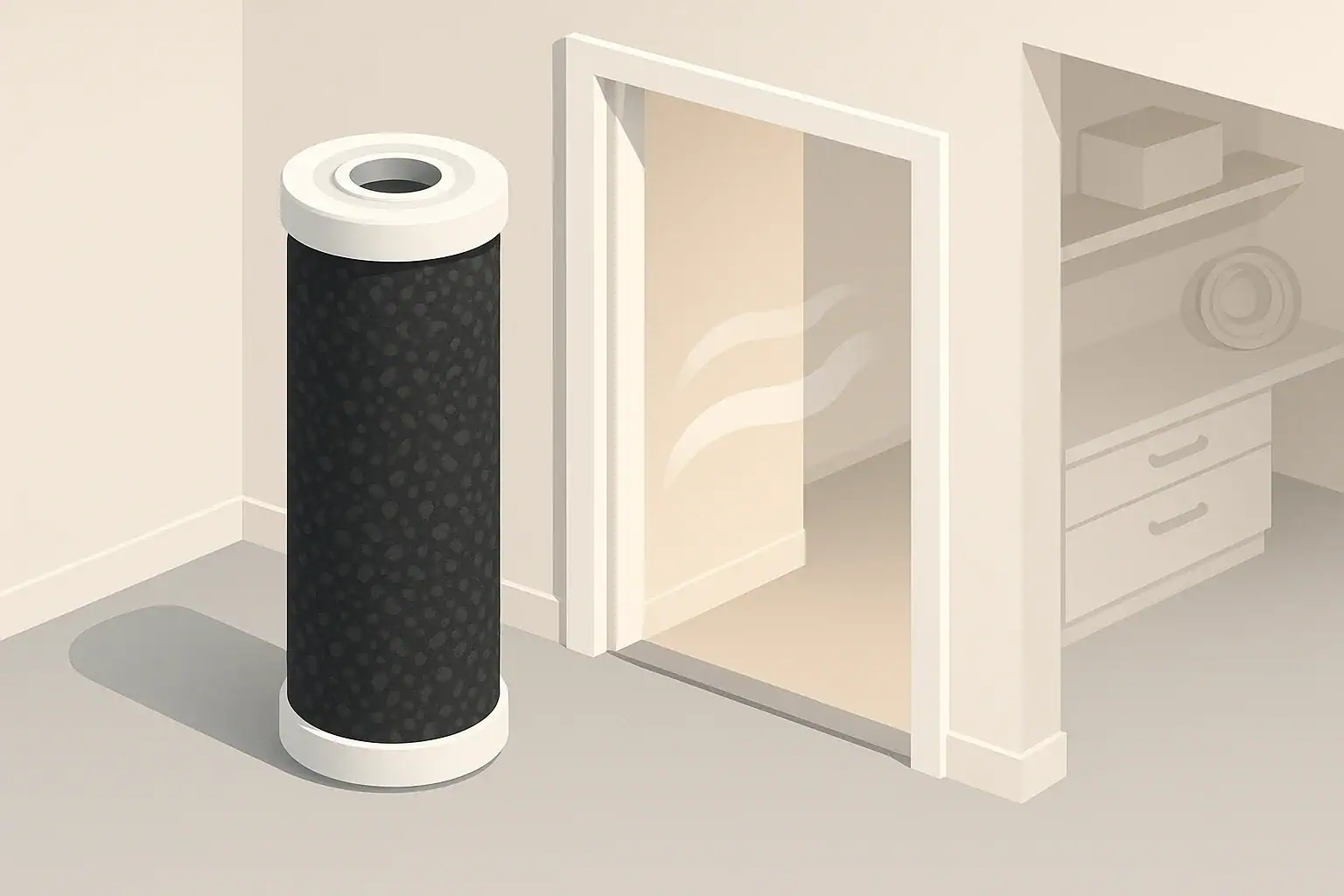
Garage VOCs can enter the home through leaks around the garage-to-house door, shared walls or ceilings, utility penetrations, and pressure differences that pull garage air indoors.
In an attached garage, vapors from fuel, solvents, paints, cleaners, pesticides, and some stored materials can mix with garage air. The practical goal is to reduce sources, seal the connection to the living space, ventilate the garage to the outdoors when needed, and use filtration in the home as a supporting step.
Quick answer
- Keep the garage-to-house door well sealed: no visible light around the perimeter, a continuous door sweep, and a latch that pulls the door firmly closed.
- Reduce sources first: store fuels, paints, and solvents in tightly closed containers, and avoid idling vehicles or running engines in the garage.
- Ventilate the garage outdoors after fume-producing tasks; 15 to 60 minutes is a practical general range, depending on odor strength and airflow.
- For nearby indoor rooms, a portable purifier can help with particles at about 4 to 5 air changes per hour; VOC control requires meaningful activated carbon or other sorbent media.
- If garage odors appear when a dryer, range hood, or bath fan runs, pressure imbalance may be pulling garage air into the home.
What Garage VOCs Entering the Home Means
Volatile organic compounds, or VOCs, are carbon-containing chemicals that can evaporate into air at ordinary indoor temperatures. Garages often contain VOC sources because they are used for vehicles, tools, fuels, coatings, adhesives, and seasonal storage.
Not every garage odor means there is a serious problem, and many VOCs cannot be identified by smell alone. The useful approach is not to panic, but to treat the attached garage as a semi-outdoor space that should be separated from the living area as much as practical.
Garage air can move indoors even when the door stays closed. Air follows pressure differences. If the home is under slight negative pressure because exhaust fans are running, air may be drawn through small cracks and gaps from the garage side.
How Garage Air Moves Indoors
Most attached homes have multiple pathways between the garage and living space. The obvious path is the connecting door, but there may also be gaps at baseboards, plumbing penetrations, electrical boxes, attic hatches, ducts, and framing joints.
Pressure differences matter
A home can pull air from the garage when indoor exhaust is stronger than incoming replacement air. Common contributors include clothes dryers, kitchen range hoods, bath fans, fireplaces, and leaky return ducts. Wind and stack effect can also change pressure from hour to hour.
Door seals are a first line of separation
A garage-to-house door should close fully and seal evenly on all sides. Weatherstripping, a door sweep, and a properly adjusted threshold reduce air leakage. If the door is part of a required fire separation assembly, use compatible parts and avoid changes that interfere with its rating or self-closing function.
Filtration has limits with gases
HEPA filters are designed for particles such as dust and smoke particles, not VOC gases. Activated carbon and other sorbent media can adsorb some odors and VOCs, but capacity varies widely by media amount, airflow, humidity, and the specific chemical. Filtration is most useful after source control and air sealing.
| Situation | Most useful first step | Why it matters | Notes |
|---|---|---|---|
| Odor strongest near garage door | Improve perimeter seals and sweep | Reduces direct air leakage | Check for visible light and uneven contact |
| Odor appears during dryer or range hood use | Check pressure and makeup air | Exhaust can pull garage air indoors | Observe patterns before making changes |
| Recent painting, fuel storage, or solvent use | Remove or tightly close sources | Less vapor is created | Ventilate garage outdoors after use |
| Indoor dust or smoke particles near entry | Use HEPA particle filtration | Captures particles, not gases | Size for the room, not the whole house |
| Persistent mild odors indoors | Add activated carbon filtration | Adsorbs some gaseous compounds | Replace media when odors return |
| Shared wall has gaps or penetrations | Seal accessible cracks with appropriate materials | Limits hidden air movement | Do not block combustion air or alter appliances |
Common Mistakes and Troubleshooting Cues
A common mistake is buying an air purifier before reducing garage sources. A purifier inside the home may improve the air in one room, but it does not stop vapors from leaving open containers or leaking around a door.
Another mistake is assuming that any carbon filter is automatically effective for VOCs. Thin deodorizing pads have limited capacity. A filter with more sorbent media generally lasts longer, but replacement timing still depends on actual loading and airflow. For more on that tradeoff, see Activated Carbon Filters Explained: VOCs, Odors, and What They Can’t Do.
Troubleshooting is easier when you look for patterns. Note when odors occur, which fans are running, whether the garage is warmer than the house, and whether the odor is stronger at floor level, near the door, or near utility penetrations.
- Door cue: light visible around the closed door suggests an air leakage path.
- Pressure cue: odors increase when exhaust appliances run.
- Source cue: odors are strongest near stored fuel, paint, cleaners, or waste containers.
- Filter cue: odors return soon after installing a carbon filter, suggesting high loading or limited carbon capacity.
Practical Checklist for Door Seals, Pressure, and Source Control
Start with the easiest actions that reduce the amount of vapor available to enter the home. Good storage habits often cost less and work better than trying to clean up contaminated air later.
Source control steps
- Keep gasoline, solvents, paints, adhesives, and pesticides tightly closed.
- Store high-odor materials away from the garage-to-house door when practical.
- Dispose of unneeded chemicals through appropriate local household hazardous waste programs.
- Do not idle vehicles, lawn equipment, or generators in the garage.
- Let recently finished, painted, or glued items off-gas outdoors or in a well-ventilated non-living area when practical.
Door and wall air sealing steps
- Inspect the door sweep, threshold, and side weatherstripping twice a year.
- Confirm the door closes and latches without needing to be pushed hard.
- Seal small, accessible gaps between the garage and living space with materials appropriate for the surface and fire-separation requirements.
- Avoid cutting, drilling, or modifying rated doors, walls, or ceilings without understanding code and safety implications.
Ventilation and Filtration Options That Fit the Problem
Ventilation and filtration are different tools. Ventilation dilutes and removes garage air by exhausting it outdoors or bringing in outdoor air. Filtration passes indoor air through media that captures particles or adsorbs some gases.
Garage ventilation
Opening the overhead garage door briefly can help after a high-odor activity, but it may not be appropriate in all weather or security situations. A dedicated garage exhaust strategy can be useful when it vents directly outdoors and does not discharge into an attic, crawlspace, or living area.
If a powered fan is considered, sizing and installation should account for garage volume, makeup air, backdrafting concerns, and local code. This is especially important where combustion appliances are nearby. Do not modify appliances, flues, or safety systems to create airflow.
Indoor filtration
For rooms adjacent to the garage, a portable air cleaner can help reduce particles if it is sized for the room. CADR planning is usually based on room volume and desired air changes per hour. For general particle reduction, many homeowners use a planning range around 4 to 5 ACH for a bedroom or living area. If you need help matching purifier output to room size, this guide on How to Choose the Right Air Purifier for Your Room Size is a good next step.
For VOCs and odors, look for the concept rather than a label alone: a sealed airflow path, enough activated carbon or sorbent media to matter, and a maintenance plan. Carbon media can become saturated, and high humidity can reduce performance for some compounds.
Real-World Examples
Example 1: Odor near a mudroom door
A homeowner notices a fuel-like odor near the interior garage door after mowing. The likely first steps are to close the fuel container tightly, move it farther from the house entry, inspect the door sweep, and ventilate the garage outdoors after refueling equipment.
Example 2: Odor when the clothes dryer runs
If the odor appears mainly when the dryer is on, the home may be drawing replacement air from the garage. The practical response is to inspect door seals, identify other leakage paths, and consider whether the home has adequate makeup air for exhaust appliances.
Example 3: Stored paint and hobby materials
Paints, stains, adhesives, and cleaners can release odors even when they are not being used, especially if lids are damaged. Reducing inventory, sealing containers, and using a lidded storage bin can lower the vapor load. A carbon-equipped purifier in the adjacent room may help with remaining mild odors, but it should not be the only control.
Safety, Standards, and Technology Cautions
Attached garages are often part of a home’s fire and air separation strategy. Doors, walls, and ceilings between the garage and living area may need to meet local code requirements. When repairs involve rated doors, penetrations, or large gaps, it is sensible to use compatible materials and qualified help when needed.
Be cautious with devices marketed for odor removal by producing ozone or reactive ions. Ozone is a lung irritant and should not be intentionally generated in occupied spaces. Ionizers and UV-C features should be evaluated carefully, including whether they produce ozone, whether air actually passes through the treatment zone, and what maintenance is required.
Low-cost TVOC sensors can be useful for spotting trends, but they are not laboratory instruments and do not identify individual chemicals. Treat TVOC readings as screening information, not as a precise safety limit. If a strong or unusual odor is sudden, persistent, or associated with a fuel spill, leave the area and follow appropriate safety guidance.
Maintenance Planner for Seals, Filters, and Storage
Garage VOC control works best as a routine, not a one-time project. Materials age, door seals compress, containers rust, and filters load over time. A simple maintenance schedule helps keep the garage-to-home boundary working as intended.
Check the garage after seasonal changes because temperature swings can affect door alignment and storage conditions. Also review the setup after adding a new exhaust fan, dryer, range hood, or large air-moving appliance that could change pressure indoors.
| Item | Typical interval range | What changes it | Reminder |
|---|---|---|---|
| Door sweep and weatherstripping | Inspect every 6 months | Door use, temperature, settling | Replace if cracked, loose, or uneven |
| Threshold and latch alignment | Inspect every 6 to 12 months | Seasonal movement, wear | Door should close firmly without gaps |
| Stored fuels and solvents | Review every 3 to 6 months | Hobby use, yard equipment, spills | Remove unneeded or leaking containers |
| Garage ventilation path | Check seasonally | Dust, blocked vents, fan use | Exhaust should go outdoors only |
| HEPA particle filter | Often 6 to 12 months | Dust load, smoke, runtime | Follow device guidance and airflow cues |
| Activated carbon media | Often 3 to 6 months | Odor load, humidity, media amount | Replace sooner if odors return |
| Indoor air monitor | Review trends monthly | Placement, sensor drift, humidity | Use trends, not single readings alone |
Related guides: Ventilation vs Air Purifier: When You Need One, the Other, or Both • Activated Carbon Filters Explained: VOCs, Odors, and What They Can’t Do • Do Air Purifiers Help With Smoke and Odors?
Frequently asked questions
How do garage VOCs entering the home usually happen?
They usually move through gaps around the garage-to-house door, cracks in shared walls or ceilings, and openings for utilities or ducts. Pressure differences make the problem worse when exhaust fans or other appliances pull air from the garage into the house.
What should I fix first if I smell garage fumes indoors?
Start by reducing the source: close and move fuels, solvents, paints, and other high-odor materials, and avoid running engines in the garage. Next, improve the door seal and look for obvious leakage paths before relying on filtration.
Can a HEPA air purifier remove garage VOCs?
HEPA filters are effective for particles, but they do not remove gaseous VOCs. For odors and some VOCs, the purifier needs substantial activated carbon or another sorbent media, and even then performance depends on airflow, humidity, and media amount.
Why do garage odors appear when the dryer or range hood runs?
Those appliances can create negative pressure in the home by exhausting indoor air. If the house does not have enough makeup air, it may draw replacement air from the garage through leaks or gaps.
Is it safe to use ozone or ionizer devices for garage odors?
Devices that intentionally generate ozone are not recommended in occupied spaces because ozone can irritate the lungs. Ionizers and similar technologies should be evaluated carefully for ozone production, actual airflow through the device, and maintenance needs.
How often should I check garage door seals and VOC-related storage?
Inspect door sweeps, weatherstripping, and latch alignment at least twice a year, especially after seasonal changes. Review stored fuels, solvents, and other chemicals every few months so damaged or unnecessary containers are not left in place.
Summary: Practical Takeaways
Garage VOCs entering the home are usually a pathway and pressure problem combined with stored sources. The most reliable order of operations is source control, air sealing, appropriate ventilation, and then filtration as a supporting measure.
For the garage-to-house door, aim for continuous contact at the sweep and weatherstripping, no visible light around the closed door, and a latch that pulls the door tight. For ventilation, move garage air outdoors when odors are created, while avoiding changes that interfere with combustion safety or building code requirements.
For filtration, use HEPA media for particles and activated carbon or other sorbent media for some VOCs and odors. Replace filters based on use, odor return, and manufacturer guidance. A calm, routine checklist is usually more effective than relying on one device to solve every garage air quality concern.
Recommended next:
- Activated Carbon Filters Explained: VOCs, Odors, and What They Can’t Do
- How Much Activated Carbon Do You Need to Remove Odors?
- Carbon Filter vs HEPA: What Each One Removes (And What It Doesn’t)
- Formaldehyde in Homes: Sources, Risks, and How to Reduce It
- Activated Carbon Types: Pellet vs Granular vs Impregnated Carbon
- How Much Carbon Do You Need for Odors? Weight, Depth, and Contact Time
- More in Carbon Filters & VOCs →
- Clear sizing logic (room size → CADR/ACH)
- HEPA vs carbon explained for real use-cases
- Humidity + ventilation basics to reduce mold risk