
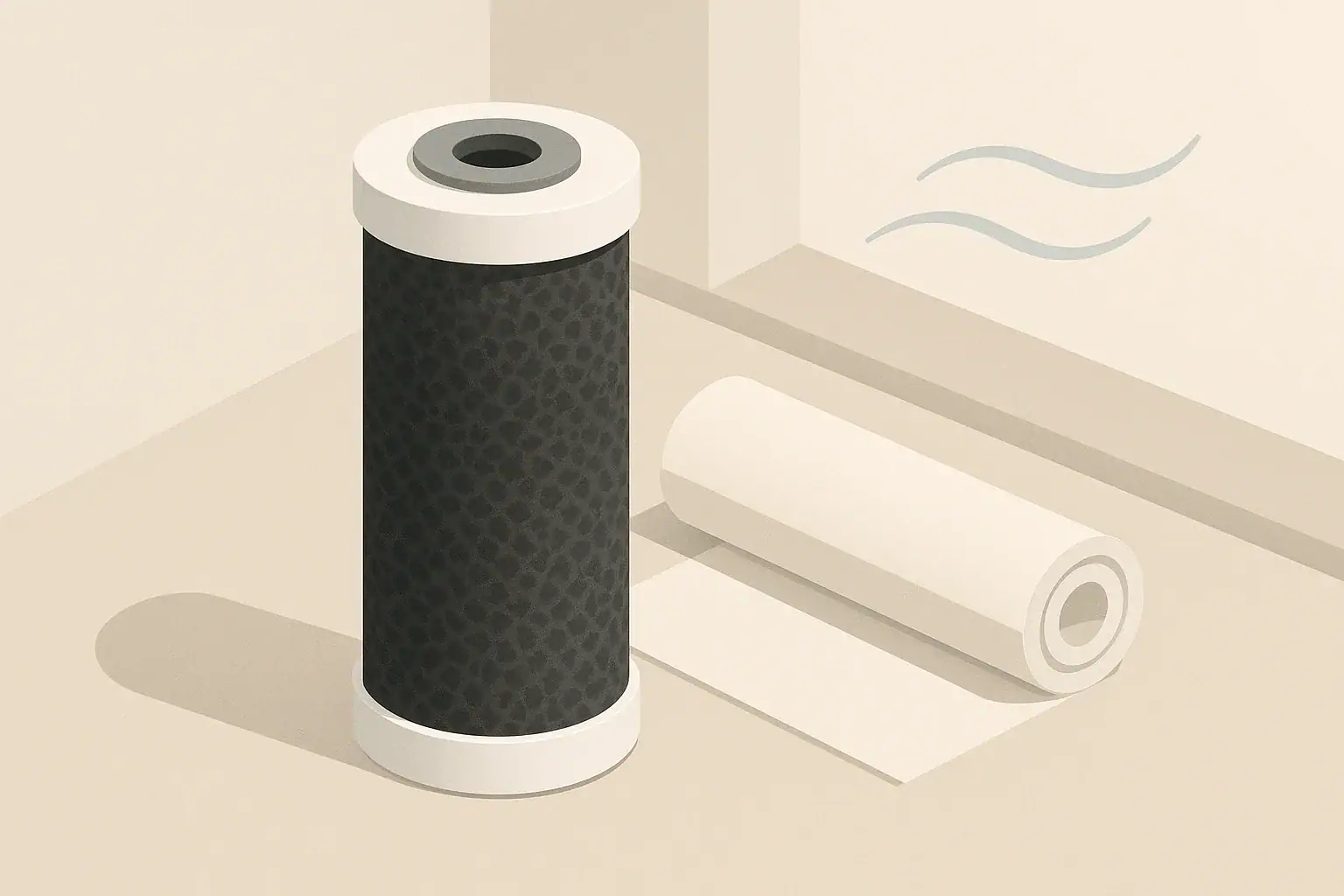
New carpet smell usually comes from volatile organic compounds, or VOCs, released by carpet fibers, backing, cushion pad, adhesives, and installation materials.
For most homes, the practical response is source control, ventilation, time, and targeted filtration rather than panic. Odors are often strongest during the first few days, then taper as materials off-gas. Rugs and carpets vary widely, so the best plan is to reduce exposure during installation and keep air moving afterward.
- Ventilate during and after installation; 48 to 72 hours of extra outdoor air is a practical starting point when weather and security allow.
- Keep indoor humidity roughly 30% to 50% to support comfort and reduce damp carpet risk.
- Use a properly sized air purifier if needed; HEPA helps particles, while meaningful activated carbon is the main filter type for many odors and VOCs.
- Ask installers to unroll or air out materials before installation when possible, especially in bedrooms and nurseries.
- If odor persists for weeks or seems linked to dampness, check for moisture, adhesive issues, or poor ventilation rather than only adding fragrance.
What New Carpet Smell Means
New carpet smell is a mixture of odors from newly manufactured or recently installed materials. The smell can come from the carpet face fiber, primary and secondary backing, latex compounds, cushion pad, seam tape, tack strips, adhesives, and nearby packaging.
VOCs are carbon-based chemicals that can evaporate into air at room temperature. Some have strong odors at low levels, while others may have little smell. That means odor is a useful cue, but it is not a precise measurement of total VOC concentration.
Carpet is not the only indoor VOC source. Fresh paint, composite wood furniture, cleaning products, air fresheners, flooring adhesives, and stored solvents can all contribute. When carpet is installed at the same time as painting, remodeling, or new furniture delivery, the combined odor can be stronger than carpet alone.
Carpet and Rug VOC Basics: Sources, Timing, and Airflow
Where VOCs can come from
Different carpet and rug components can off-gas at different rates. Synthetic fibers, stain-resistant treatments, backing materials, rubberized rug pads, and adhesives may each add their own odor profile. Area rugs can also arrive tightly wrapped, so odors may be concentrated when the packaging is opened.
Installation choices matter. A loose-laid area rug usually has fewer installation-related materials than wall-to-wall carpet glued over a large surface. Stretch-in carpet over a cushion pad may avoid full-spread adhesive, but the pad and carpet still need air-out time.
Why smell often changes over time
Many new-material odors are strongest at first because the most volatile compounds evaporate quickly. Warm temperatures, low air exchange, and closed rooms can make the smell more noticeable. Ventilation dilutes indoor air and helps carry released compounds outdoors.
A practical way to think about it is this: source control comes first, ventilation is the main dilution tool, and filtration can be a support tool. A purifier with only a particle filter may improve dust and fibers, but it is not designed as the primary tool for gases. Activated carbon or other gas-phase media is the relevant filtration category for many VOC and odor concerns.
| Situation | Primary step | Why it matters | Note |
|---|---|---|---|
| Before installation | Request low-emission materials and air-out time | Reduces source strength when available | Ask about carpet, pad, and adhesive |
| First 48 to 72 hours | Increase outdoor air | Dilutes early off-gassing | Use windows, fans, or HVAC outdoor air if suitable |
| Closed bedroom | Ventilate before sleeping in the room | Prevents odor buildup in a small space | Security and weather come first |
| Noticeable dust or fibers | Vacuum with good filtration | Removes loose particles | Follow carpet care instructions |
| Persistent odor | Check moisture and installation materials | Dampness or adhesive issues can prolong smell | Do not mask with heavy fragrance |
| Odor control support | Use activated carbon filtration | Carbon can adsorb some gases | Capacity and contact time vary |
| Particle control support | Use HEPA filtration | Captures fine particles, not most gases | Size the unit for the room |
Common Mistakes and Troubleshooting Cues
One common mistake is treating all indoor air problems as particle problems. HEPA filters are useful for fine particles such as dust, smoke particles, and fibers, but most VOCs are gases. For odor reduction, look for gas-phase filtration such as activated carbon, while recognizing that capacity varies by filter size, media amount, airflow, and replacement timing.
Another mistake is closing the room to contain the smell without any planned air exchange. Closing a door can protect the rest of the home temporarily, but the room itself may accumulate odors. If you isolate a newly carpeted room, pair that with window ventilation or mechanical exhaust when conditions allow.
Fragrance is also easy to overuse. Scented sprays, plug-ins, and heavily fragranced cleaners can add more VOCs while covering the original smell. A low-odor cleaning routine is usually a better fit during the first week after installation.
When to look beyond normal off-gassing
Some clues suggest the issue may not be simple new-carpet odor. A musty smell, damp pad, wet baseboards, or condensation near the floor points toward moisture. A sharp adhesive smell that does not fade may call for a conversation with the installer about the adhesive, cure time, and ventilation conditions.
If the smell is localized to one rug pad, backing, or adhesive spot, remove or separate the suspect item if possible and air it out in a ventilated area. For rented homes or apartments, document the timeline and communicate with the property manager before making changes.
Practical Air Quality Steps After Carpet or Rug Installation
Start before installation if you can. Ask for product information on carpet, pad, and adhesives, and choose low-emission options when available. If the installer can store or unroll materials in a ventilated area before installation, that may reduce the strongest initial odor indoors.
- Ventilate early: Open windows on opposite sides of the home when weather and outdoor air conditions are acceptable.
- Use fans safely: A window fan exhausting outward can help move indoor air outside. Keep cords, rain, pets, and children in mind.
- Run HVAC circulation: If your system allows fan-only operation, it can mix air and pass it through the central filter, though it does not replace outdoor air.
- Keep temperature moderate: Very warm rooms can make odors more noticeable. Use normal comfort settings rather than extreme heating.
- Control humidity: Aim for about 30% to 50% relative humidity as general indoor comfort guidance.
- Vacuum after settling: Vacuum once loose fibers and dust have settled, following the carpet manufacturer’s care instructions.
For an air purifier, match the unit to the room and the goal. If the concern is lint, dust, or fine particles, room size and clean air delivery rate matter. If the concern is smell, the device needs enough activated carbon or similar media to be relevant, and the filter must be replaced before it is spent.
Real-World Examples: Bedrooms, Apartments, and Area Rugs
New wall-to-wall carpet in a bedroom
A bedroom is often a smaller enclosed room, so odor can build overnight. A practical plan is to ventilate heavily during the day, keep the door open when privacy is not needed, and delay sleeping in the room for a short period if the odor is strong and another space is available. A purifier can support particle control and, if equipped with carbon, some odor reduction.
Apartment with limited window options
Apartments can be harder because windows may be on one side only, and hallway ventilation may be limited. Use safe window opening when outdoor conditions allow, run bathroom or kitchen exhaust fans briefly if they vent outdoors, and avoid adding scented products. If outdoor air quality is poor, use shorter ventilation periods when conditions improve rather than leaving windows open continuously.
Large area rug over hard flooring
For an area rug, unroll it in a ventilated space before placing it in the main room if practical. Check the rug pad separately, because pads made from rubber-like or synthetic materials can have their own odor. Rug pads should be dry, compatible with the floor finish, and replaced if they remain tacky, damp, or unusually strong-smelling.
Safety, Standards, and Product Choices
When shopping, look for clear information about emissions testing, carpet cushion, adhesives, and recommended ventilation after installation. Low-emission certifications can be useful comparison tools, but they do not mean a product has no emissions or no odor. They indicate that the product was tested against a defined program or standard at the time of evaluation.
Be cautious with devices or settings that intentionally generate ozone. Ozone is not a routine home solution for new carpet smell and can react with indoor materials. Air purifiers marketed for homes should be used according to their instructions, and any ionizer or similar feature should be evaluated carefully, especially if ozone generation is mentioned.
UV-C features, when present in some air-cleaning devices, are generally aimed at biological contaminants on surfaces inside the device rather than carpet VOCs in a room. They are not a substitute for ventilation, source control, or carbon media for odors. Do not modify appliances, defeat safety interlocks, or use lamps outside their intended housings.
Maintenance and Upkeep for Carpets, Rugs, and Filters
After the first week, routine upkeep becomes more important than intensive ventilation. Vacuuming helps remove tracked-in dust, fibers, and particles that settle into carpet. Use a vacuum setting appropriate for the carpet pile so the machine cleans effectively without damaging fibers.
Keep carpets dry. Clean spills promptly, avoid over-wetting during spot cleaning, and allow cleaned areas to dry fully. Damp carpet or pad can create odor problems that are different from new material off-gassing.
If you use an air purifier, plan for filter costs and replacement intervals. A clogged prefilter reduces airflow. A spent carbon filter may stop helping with odors even if air still passes through it. Central HVAC filters should also be checked on a schedule, especially after remodeling or flooring work, because installation dust can load filters quickly.
| Filter type | Typical interval range | What changes it | Reminder |
|---|---|---|---|
| Purifier prefilter | 2 to 4 weeks for cleaning | Dust, pets, renovation debris | Wash only if the manual allows it |
| HEPA or particle filter | 6 to 12 months | Runtime, smoke, dust load | Replace when airflow drops or indicator triggers |
| Activated carbon filter | 3 to 6 months | Odor load, carbon amount, airflow | Odor return can be a practical cue |
| HVAC return filter | 1 to 3 months | System use, filter size, household dust | Check sooner after flooring work |
| Vacuum filter | Per manual, often several months | Fine dust and carpet fiber load | Clean or replace to maintain suction |
| Dehumidifier filter | Monthly cleaning check | Humidity season and dust | Important if drying damp areas |
Related guides: Activated Carbon Filters Explained: VOCs, Odors, and What They Can’t Do • Ventilation vs Air Purifier: When You Need One, the Other, or Both • How to Choose the Right Air Purifier for Your Room Size
Frequently asked questions
How long does new carpet smell VOCs usually last?
For many homes, the strongest new carpet odor is noticeable for the first few days and then gradually fades over one to several weeks. The exact timeline depends on the carpet, pad, adhesive, room temperature, and how much fresh air the space gets. If the smell remains strong for weeks, it is worth checking for moisture or installation issues.
Does opening windows help reduce new carpet smell VOCs?
Yes. Outdoor air exchange is one of the most effective ways to dilute VOCs and move them out of the room. Cross-ventilation, safe use of fans, and HVAC fan circulation can all help when weather and outdoor air quality allow.
Will a HEPA air purifier remove carpet VOCs?
HEPA filters are good for particles such as dust, fibers, and some renovation debris, but they do not remove most gases well. For odor and VOC reduction, activated carbon or other gas-phase media is the more relevant filter type. A purifier can still be useful if it combines particle filtration with enough carbon for the room size.
Can carpet padding or adhesive cause the smell, not just the carpet itself?
Yes. Carpet pad, seam tape, adhesives, and backing materials can all contribute to the odor profile. In some cases, one of those materials is the main source of the smell rather than the carpet face fiber.
When should I worry that the smell is not normal off-gassing?
A musty odor, visible dampness, condensation near the floor, or a smell that gets worse instead of fading may point to moisture or installation problems. A sharp adhesive odor that persists can also be a sign to contact the installer. If the smell is localized to one area, inspect that area first.
Summary: Practical Takeaways for Carpet and Rug VOCs
New carpet smell is usually a temporary mix of VOCs and odors from carpet materials, pads, adhesives, and packaging. The most useful steps are to choose lower-emission materials when possible, ventilate during the first few days, keep humidity in a reasonable range, and avoid adding scented products that complicate the air mixture.
Use the right tool for the job. Outdoor air exchange is the main dilution strategy for VOCs, activated carbon can support odor reduction, and HEPA filtration helps with particles rather than gases. If an odor persists, becomes musty, or seems tied to dampness, check for moisture and installation issues instead of relying only on air cleaning.
Recommended next:
- Activated Carbon Filters Explained: VOCs, Odors, and What They Can’t Do
- How Much Activated Carbon Do You Need to Remove Odors?
- Carbon Filter vs HEPA: What Each One Removes (And What It Doesn’t)
- Formaldehyde in Homes: Sources, Risks, and How to Reduce It
- Activated Carbon Types: Pellet vs Granular vs Impregnated Carbon
- How Much Carbon Do You Need for Odors? Weight, Depth, and Contact Time
- More in Carbon Filters & VOCs →
- Clear sizing logic (room size → CADR/ACH)
- HEPA vs carbon explained for real use-cases
- Humidity + ventilation basics to reduce mold risk