
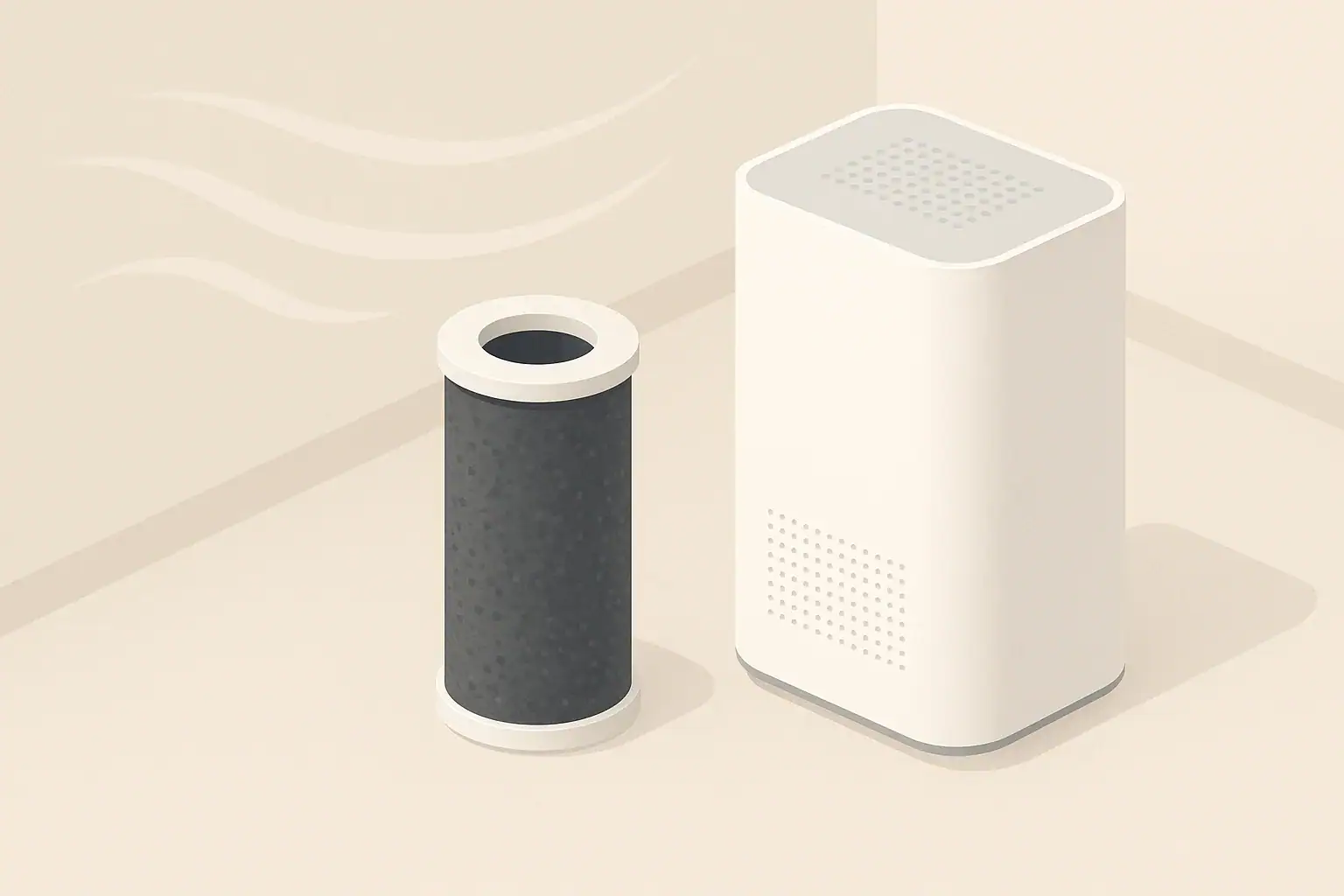
To lower indoor VOC peaks after cleaning sprays and disinfectants, reduce the amount released, ventilate during and after use, and use activated carbon filtration as a supporting tool.
Cleaning product VOCs can rise quickly because sprays create small droplets and expose more product surface area to room air. The practical goal is not to make a perfect reading on a sensor, but to shorten the peak, move vapors outdoors, and avoid unnecessary re-spraying.
- Ventilate while cleaning when possible, then continue for about 15–60 minutes; use 1–2 hours for strong odors or small rooms.
- Use the smallest effective amount of product and apply to a cloth when the label allows, instead of spraying broadly into the air.
- Run a purifier with a meaningful activated carbon stage on high during cleanup and shortly after; HEPA alone mainly targets particles, not most gases.
- Keep people and pets out of the just-cleaned area until surfaces are dry and the room smells normal for that home.
- Do not mix products, especially bleach with ammonia or acids; follow label directions for dwell time and ventilation.
What Cleaning Product VOC Peaks Mean Indoors
VOCs, or volatile organic compounds, are gases that evaporate from liquids and solids at normal indoor temperatures. Many household cleaning products can release VOCs, including fragranced sprays, glass cleaners, degreasers, floor cleaners, disinfecting sprays, and some wipes after their liquid is exposed to air.
A VOC peak is a temporary rise after a source is used. Spraying a cleaner on a countertop, wiping a large floor area, or disinfecting several touch points in a small bathroom can produce a short-lived increase. The peak usually falls as outdoor air dilutes the room, surfaces dry, and vapors are exhausted or captured by sorbent materials such as activated carbon.
Indoor VOC sensors, often labeled TVOC, can show trends, but they do not identify each compound or prove safety. They are most useful for noticing patterns: which activities cause spikes, how long the room takes to settle, and whether ventilation changes reduce the duration of the peak.
How VOCs Move After Sprays and Disinfectants
VOCs behave differently from dust or smoke particles. A standard particle filter can be excellent for fine particles, but most gaseous compounds pass through it unless the purifier also includes enough sorbent media, commonly activated carbon. That is why a cleaning odor may remain even when a purifier is running with a clean particle filter.
Release, dilution, and removal
After a product is sprayed, three things happen at the same time. First, the product releases vapors from droplets and wet surfaces. Second, room air dilutes those vapors through leakage, open windows, exhaust fans, or mechanical ventilation. Third, some compounds may be adsorbed by carbon or absorbed into soft materials, where they can slowly re-emit later.
Why room size and air changes matter
A small bathroom can reach a stronger odor faster than an open kitchen because the same amount of product is spread through less air. Air changes per hour, often shortened to ACH, describe how many times room air is replaced or cleaned in an hour. For cleaning events, a temporary boost in air exchange is often more useful than a low, steady setting.
As a general planning idea, aim for noticeable air movement from the cleaned room toward outdoors. Cross-ventilation from two openings can clear odors faster than one cracked window, but outdoor conditions, security, noise, pollen, and weather all affect what is practical.
| Control option | Best for | Practical use | Limit to know |
|---|---|---|---|
| Use less product | Reducing the source | Measure or spray only where needed | Must still follow label directions |
| Spray onto cloth | Reducing airborne mist | Use when the product label allows it | Not suitable for every disinfecting task |
| Bathroom or kitchen exhaust fan | Local removal | Run during use and 15–60 minutes after | Effect depends on fan flow and makeup air |
| Open windows | Dilution with outdoor air | Create crossflow when conditions allow | Outdoor air may bring pollen, smoke, or humidity |
| Activated carbon filtration | Odors and some gases | Run on higher speed during the peak | Carbon can saturate and needs replacement |
| HEPA filtration | Fine particles and droplets | Useful as part of general air cleaning | Does not remove most VOC gases by itself |
| Time and surface drying | Natural decline | Keep air moving until surfaces are dry | Slow in closed or humid rooms |
Common Mistakes That Keep VOC Levels Elevated
Many indoor peaks come from ordinary habits rather than unusual product use. The fixes are often simple and do not require special equipment.
- Over-spraying: More product does not always improve cleaning. It can leave extra residue and extend the drying period.
- Cleaning in a closed room: A closed bathroom or laundry room can concentrate odors quickly. Even a partly open door and an exhaust fan can help.
- Relying on fragrance as a cleanliness signal: A strong scent can make a room seem clean while also adding more VOCs.
- Using a purifier with only a particle filter: HEPA-style filtration is useful for particles, but a carbon stage is the key air-cleaning feature for many odors and gases.
- Leaving wet rags or wipes indoors: Used materials can continue releasing odors. Dispose of or store them according to the product label.
- Mixing cleaning products: Mixing can create harmful gases or unwanted reactions. Use one product at a time and rinse when directed.
A Practical Checklist to Lower Peaks
The best approach is source control first, ventilation second, and filtration third. This order matters because it is easier to prevent a large release than to remove it after the room is filled with vapors.
Before cleaning
- Read the label for ventilation, surface contact time, dilution, and safety instructions.
- Choose unscented or lower-fragrance options when they meet the cleaning task.
- Open a nearby window or turn on an exhaust fan if conditions allow.
- Start the air purifier before spraying if it has an activated carbon filter.
- Remove items that do not need to be exposed, such as pillows, towels, or soft toys near the work area.
During cleaning
- Apply product close to the surface to reduce mist.
- Spray onto a cloth when allowed by the product label.
- Work in sections rather than coating a large area all at once.
- Keep doors open when safe and practical, unless you are intentionally exhausting air from a small room.
- Avoid using multiple scented products in the same session.
After cleaning
- Continue ventilation for about 15–60 minutes, or longer if odor remains.
- Run carbon-equipped air cleaning on a higher setting during the first part of the peak.
- Let surfaces dry fully before closing the room.
- Take trash, used wipes, or soaked paper towels out of the living area when appropriate.
- If using a monitor, watch the trend rather than treating one number as an exact exposure measure.
Real-World Examples by Room
Different rooms need different strategies because the source size, ventilation path, and surface area vary.
Small bathroom disinfecting
A small bathroom has limited air volume and often a strong local exhaust option. Run the exhaust fan before you begin, keep the door slightly open if the fan needs makeup air, and continue the fan for 30–60 minutes after use. If the room has no fan or window, use less spray, apply carefully, and allow more time before closing it up.
Kitchen counters after cooking
Kitchens often have larger air volume but more surfaces. If the range hood vents outdoors, it may help during short cleaning tasks nearby. For general counters, apply cleaner to a cloth when suitable, wipe sections, and avoid layering a disinfectant over a fragranced degreaser unless the labels specifically support that sequence.
Bedroom or nursery surface cleaning
Bedrooms include fabrics that can hold odors. Clean hard surfaces earlier in the day when ventilation is easier, keep bedding away from spray drift, and allow surfaces to dry before the room is used for sleep. A purifier with both particle and carbon filtration can be run temporarily on a higher setting, then returned to a quieter setting.
Apartment cleaning with limited windows
In apartments, cross-ventilation may be limited. Use bathroom and kitchen exhaust where available, open a window briefly if outdoor air is acceptable, and clean one zone at a time. If a hallway or shared ventilation path is involved, avoid pushing strong odors toward neighbors or common areas.
Safety and Standards Considerations
Cleaning and disinfecting products are designed for specific uses. The safest air-quality strategy is to use them as labeled, avoid unnecessary mixing, and avoid technologies that intentionally add reactive chemicals to indoor air.
Do not mix bleach with ammonia, vinegar, acids, toilet cleaners, or other products unless a label explicitly instructs it. Mixing can create irritating or dangerous gases. If a label calls for dilution, use the stated dilution rather than guessing.
Be cautious with ionizers, ozone generators, and devices that intentionally produce ozone or reactive species. Ozone is not needed to lower routine cleaning VOC peaks in occupied homes and can react with some indoor chemicals. If a purifier includes optional ionization or similar features, review the instructions and consider whether the device can operate with those features off.
UV-C features, where present, are usually enclosed inside equipment and are not a substitute for source control, ventilation, or carbon adsorption. Do not modify devices, bypass safety switches, or use exposed UV-C lamps in occupied spaces.
Maintenance, Filters, and Monitoring
Activated carbon does not last forever. As carbon becomes loaded with captured compounds, it has less remaining capacity and may allow odors to pass through sooner. Replacement timing depends on the amount of carbon, airflow, product use, cooking odors, smoke events, humidity, and how often the purifier runs.
For homes that clean frequently or use strong-smelling products, carbon may need more attention than the particle filter. Some purifiers use a thin carbon sheet mainly for light odors, while others use deeper carbon beds. Without relying on brand claims, the general principle is that more suitable sorbent media usually provides more capacity, all else equal.
Pre-filters also matter. Dust buildup can reduce airflow, which weakens both particle removal and carbon contact. Vacuum or wash pre-filters only if the instructions allow it, and let any washable parts dry fully before reinstalling.
Monitors can help you compare routines, but TVOC readings are not universal. Two monitors can respond differently to the same cleaner. Use them as trend tools: note the baseline before cleaning, the peak after spraying, and the time it takes to return near the usual level.
| Metric | What it can indicate | Common pitfall | Action idea |
|---|---|---|---|
| TVOC | General trend in mixed gases | Not a full chemical analysis | Compare before, peak, and after cleaning |
| PM2.5 | Fine particles or aerosol residue | May miss gases and odors | Use particle filtration and ventilation if elevated |
| CO2 | Ventilation pattern from occupancy | Not a VOC measurement | Use as a clue for fresh-air exchange |
| Humidity | Drying conditions and comfort | High humidity can slow drying | Aim for a generally moderate indoor range |
| Odor observation | Practical sign of lingering vapors | Fragrance can mask other odors | Continue ventilation until odor is reduced |
| Time to baseline | How long the peak lasts | Baseline changes through the day | Test one routine change at a time |
Related guides: Ventilation vs Air Purifier: When You Need One, the Other, or Both • Activated Carbon Filters Explained: VOCs, Odors, and What They Can’t Do • Do Air Purifiers Help With Smoke and Odors?
Frequently asked questions
How long should I ventilate after using cleaning sprays?
For many routine cleaning jobs, ventilation for about 15 to 60 minutes after use is a practical starting point. Strong odors, small rooms, or heavy spraying may need 1 to 2 hours or more. Keep ventilation going until the surfaces are dry and the room smell has mostly cleared.
Does a HEPA purifier remove cleaning product VOCs after sprays?
HEPA filtration is effective for particles, droplets, and some aerosol residue, but it does not remove most VOC gases by itself. For odor and gas reduction, the purifier needs a meaningful activated carbon stage or other sorbent media. Ventilation and lower product use are usually the first-line controls.
Is it better to spray cleaner directly or onto a cloth?
Applying cleaner to a cloth can reduce airborne mist and limit how much product is released into the room, but only if the product label allows that method. Some disinfectants require the surface to stay wet for a specific contact time, so label directions matter. For general cleaning, targeted application usually creates less peak VOC exposure than broad spraying.
Can I use an air purifier instead of opening windows after cleaning?
An air purifier can help, especially if it includes a substantial activated carbon filter, but it is not a full substitute for fresh-air ventilation. Open windows or exhaust fans dilute VOCs and move them outdoors, which purifiers cannot do as quickly in many cases. The best results usually come from ventilation plus filtration.
Why does a cleaner still smell strong even after the floor looks dry?
Odor can persist after drying because some VOCs remain in the air, can slowly evaporate from surfaces, or can be held in soft materials like rugs and towels. Fragrance can also linger longer than the actual cleaning step. Continued ventilation and carbon filtration can help shorten that lingering period.
What is the biggest mistake people make with cleaning product VOCs after sprays?
Over-spraying in a closed room is one of the most common causes of a strong VOC peak. It increases both the amount released into the air and the time needed for drying and removal. Using less product, improving airflow, and avoiding unnecessary repeat spraying usually works better.
Summary Takeaways
Cleaning product VOC peaks are usually short-term events that can be managed with simple habits. The most effective steps are to use the right amount of product, avoid unnecessary spray mist, ventilate while surfaces dry, and support the process with activated carbon filtration when available.
HEPA filtration is useful for particles, but carbon is the relevant filter type for many odors and gases. Exhaust fans, open windows, and sensible product use often do the most work immediately after sprays and disinfectants.
If you use an air quality monitor, treat TVOC as a trend indicator rather than a precise safety score. A practical routine is to clean with ventilation on, run filtration during the peak, remove used materials promptly, and return the room to normal use after surfaces are dry and the air has settled.
Recommended next:
- Activated Carbon Filters Explained: VOCs, Odors, and What They Can’t Do
- How Much Activated Carbon Do You Need to Remove Odors?
- Carbon Filter vs HEPA: What Each One Removes (And What It Doesn’t)
- Formaldehyde in Homes: Sources, Risks, and How to Reduce It
- Activated Carbon Types: Pellet vs Granular vs Impregnated Carbon
- How Much Carbon Do You Need for Odors? Weight, Depth, and Contact Time
- More in Carbon Filters & VOCs →
- Clear sizing logic (room size → CADR/ACH)
- HEPA vs carbon explained for real use-cases
- Humidity + ventilation basics to reduce mold risk