
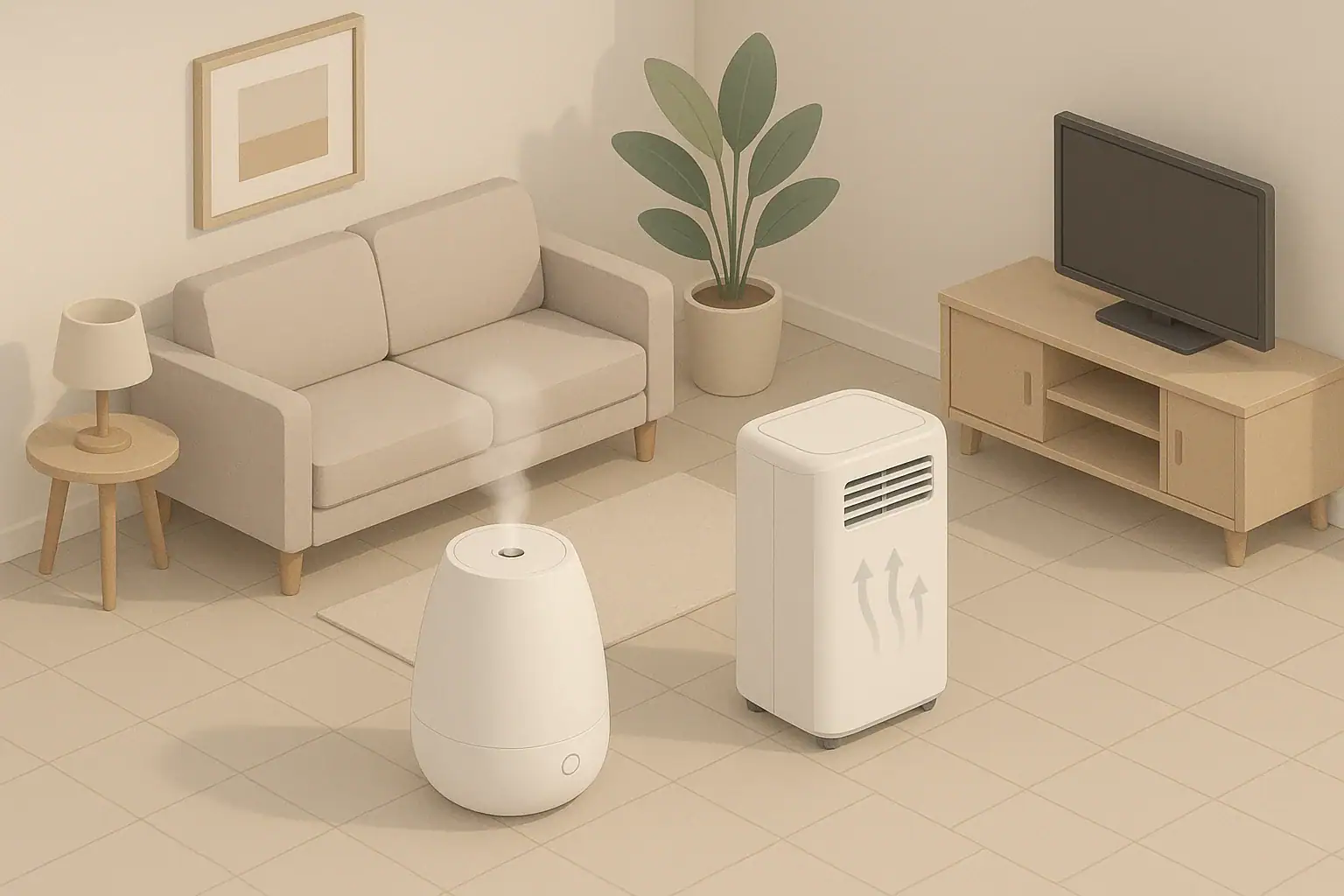
Why Indoor Humidity Matters
Indoor humidity is simply the amount of water vapor in the air inside your home. It has a big impact on how comfortable a room feels and how your home materials age over time. Unlike temperature, humidity is not always obvious until it is too high or too low.
Most home comfort guidelines suggest keeping indoor relative humidity roughly in a moderate range, often around the middle between very dry and very damp conditions. Within this range, the air tends to feel more comfortable, and many common moisture-related problems are less likely to develop or grow quickly.
When humidity strays far outside this comfortable band, you may notice:
- Dry air: static shocks, tight-feeling skin, dry lips, or creaky wood floors
- Damp air: musty smells, clammy feeling, or condensation on windows
Humidifiers and dehumidifiers are tools that help bring humidity back toward a more comfortable middle ground. To choose the right one, you first need to understand what each device does.
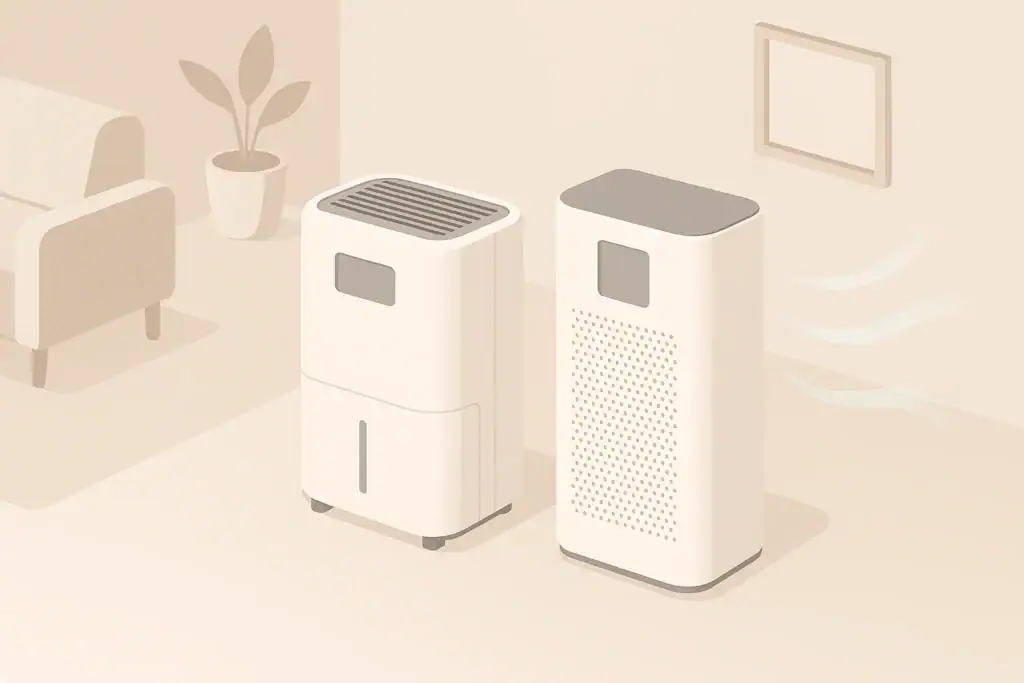
Humidifier vs Dehumidifier: What They Do
A humidifier adds moisture to the air. It is typically used during dry seasons or in dry climates where indoor air feels parched, especially when heating systems run for long periods. Humidifiers turn water into a fine mist or vapor and release it into the room, raising the humidity level.
A dehumidifier removes moisture from the air. It is used in damp spaces or humid seasons where the air feels sticky or where moisture problems, such as condensation on windows or a musty odor, are common. Dehumidifiers pull air through the unit, cool it to condense moisture, collect that water in a tank or drain line, and then release drier air back into the room.
In short:
- Use a humidifier when the air is too dry.
- Use a dehumidifier when the air is too damp.
The challenge is correctly identifying which situation you have in each room or season.
Example values for illustration.
| Sign you notice | Likely humidity issue | Device to consider | Simple next step |
|---|---|---|---|
| Frequent static shocks and very dry-feeling air in winter | Air likely too dry | Humidifier | Add humidifier, re-check with a basic hygrometer |
| Condensation on inside of windows on cool mornings | Air likely too damp near glass | Dehumidifier | Run dehumidifier and improve air circulation |
| Musty odor in basement or closet | Persistent dampness | Dehumidifier | Use dehumidifier and look for moisture sources |
| Lips, hands, and nose feel dry even at normal temperatures | Low indoor humidity | Humidifier | Increase humidity slowly and monitor levels |
| Visible mold spots on walls or along baseboards | Excess moisture over time | Dehumidifier | Reduce humidity and address leaks or damp materials |
| Wood floors or furniture shrinking or separating seasonally | Seasonal dryness | Humidifier | Use humidifier during driest months only |
How to Tell If Your Air Is Too Dry
Dry indoor air is common in colder climates and during winter, especially when heating systems run frequently. Warmed air holds more water, so as outdoor air is heated indoors without adding moisture, its relative humidity drops.
Everyday signs of low humidity
You may be dealing with dry air if you notice:
- Frequent static shocks when touching metal objects or other people
- Very dry, tight-feeling air, especially in the morning
- Cracking or shrinking of wood floors, trim, or furniture gaps
- Dry lips or dry feeling in your nose and throat when you wake up
These signs are not proof on their own, but they are helpful clues that your indoor humidity might be lower than is comfortable.
Using a hygrometer
A small humidity meter, often called a hygrometer, is the simplest way to confirm whether the air is dry. Many basic models display temperature and relative humidity.
In winter, indoor humidity often falls to low levels, especially in heated rooms. If your readings are consistently on the very low side, a humidifier may help bring conditions back toward a more moderate range.
Rooms most prone to dryness
Not every room in a home dries out equally. Areas most likely to have very low humidity include:
- Bedrooms with forced-air heating and closed doors overnight
- Living rooms with fireplaces or wood stoves
- Upstairs rooms where warm air collects
You may not need a humidifier in every room. Focus first on the spaces where you spend the most time or notice the strongest dry-air signs.
How to Tell If Your Air Is Too Damp
High indoor humidity is common in warm, humid climates and in areas of the home that are below grade or poorly ventilated. Even in cooler climates, activities such as showering, cooking, and drying laundry indoors can add significant moisture to the air.
Everyday signs of high humidity
Possible indicators of excess indoor moisture include:
- Air that feels clammy or sticky, even at moderate temperatures
- Condensation or fogging on windows, especially in the mornings or on cooler days
- Musty or earthy odors, especially in basements, closets, or bathrooms
- Visible dark spots or discoloration on walls, ceilings, or around windows
- Clothing or towels that take a very long time to dry indoors
If these conditions persist rather than appearing briefly during certain activities, a dehumidifier or improved ventilation may be helpful.
Where high humidity tends to appear
Some parts of a home are more prone to dampness than others:
- Basements and crawl spaces: Often cooler and closer to soil moisture, with limited sunlight and airflow.
- Bathrooms: Showers and baths add a lot of moisture in a short time.
- Laundry areas: Drying clothes indoors can release a surprising amount of water vapor.
- Kitchens: Boiling water, dishwashing, and cooking all contribute moisture.
In these areas, ventilation and moisture control work together. Sometimes a dehumidifier is the main solution, and sometimes ventilation alone can significantly reduce humidity peaks.
Humidifier Basics: Types, Placement, and Use
If your readings or everyday signs point toward dry air, a humidifier can help. There are several common types, each with its own considerations.
Common types of humidifiers
- Evaporative humidifiers: Use a saturated wick and a fan to evaporate water into the air. The air picks up only as much moisture as it can hold, which provides some natural self-limiting behavior.
- Ultrasonic humidifiers: Use high-frequency vibration to create a fine mist. They are often quiet and energy-efficient, but the mist may carry dissolved minerals if you use hard tap water.
- Warm mist or steam humidifiers: Heat water to produce steam. They can add noticeable warmth to a small area but use more energy than cool-mist options.
- Whole-house systems: Installed on a central heating system to distribute moisture throughout the home. These require professional installation and regular maintenance.
Placement tips for humidifiers
To use a portable humidifier effectively:
- Place it on a stable, level surface a few feet off the floor if possible.
- Keep it away from direct contact with walls, curtains, or electronics.
- Allow enough space around the unit for air to circulate.
- Aim the mist into open room space, not directly at furnishings or windows.
Avoiding over-humidifying
It is possible to raise humidity too much in a room, especially if the space is small versus the humidifier output. To avoid this:
- Use a simple hygrometer to monitor humidity as you run the unit.
- Start with lower output settings and increase gradually if needed.
- Turn the humidifier down or off if you see persistent condensation on windows or cool surfaces nearby.
Over-humidifying can make spaces feel damp and uncomfortable and may contribute to moisture-related issues, so aim for balance rather than “as much humidity as possible.”
Dehumidifier Basics: Types, Placement, and Use
If your home feels damp or your humidity readings stay high, a dehumidifier can help bring moisture levels down toward a more comfortable range. As with humidifiers, there are several types.
Common types of dehumidifiers
- Compressor (refrigerant) dehumidifiers: Draw air across cold coils to condense moisture. These are common for basements and living spaces in moderate to warm conditions.
- Desiccant dehumidifiers: Use moisture-absorbing materials instead of cooling coils. Some are regenerable and are often used in cooler spaces where compressor units are less efficient.
- Whole-house dehumidifiers: Integrated with ductwork or installed as standalone units tied into a home’s HVAC system. These typically require professional installation.
Placement tips for dehumidifiers
For portable compressor-style units:
- Place the unit in the dampest part of the room with some open space around it.
- Keep doors within the target area more open than closed to improve air mixing.
- If your model includes a drain hose option, route it safely to a floor drain or sink if available.
- Avoid placing the unit directly against walls, furniture, or curtains that block air intake and exhaust.
Balancing dehumidification and ventilation
Dehumidifiers remove moisture that is already in the indoor air. Ventilation, by contrast, exchanges indoor air with outdoor air. Depending on the season and climate, ventilation can either help or worsen indoor humidity:
- In dry, cool weather, bringing in outdoor air may reduce indoor humidity.
- In hot, humid weather, outdoor air may be more humid than indoor air, so ventilation alone may not reduce humidity.
In many homes, a mix of targeted dehumidification and thoughtful ventilation works best.
How to Measure and Monitor Humidity
Choosing between a humidifier and a dehumidifier is easier when you can see what your indoor humidity actually is. Even a simple monitor gives more reliable information than guessing based on feel alone.
Using simple hygrometers
Basic hygrometers are widely available and can be placed in different rooms to compare conditions. For everyday home use:
- Place the sensor away from direct sunlight, heating vents, and exterior doors.
- Give the device time to stabilize when you move it to a new room.
- Check readings at different times of day, especially morning and evening.
No home device is perfectly precise, but consistent readings over time can reveal patterns, such as:
- Very low readings during heating season
- High readings in basements during summer
- Humidity spikes after showers or cooking
Combining humidity control with air purification
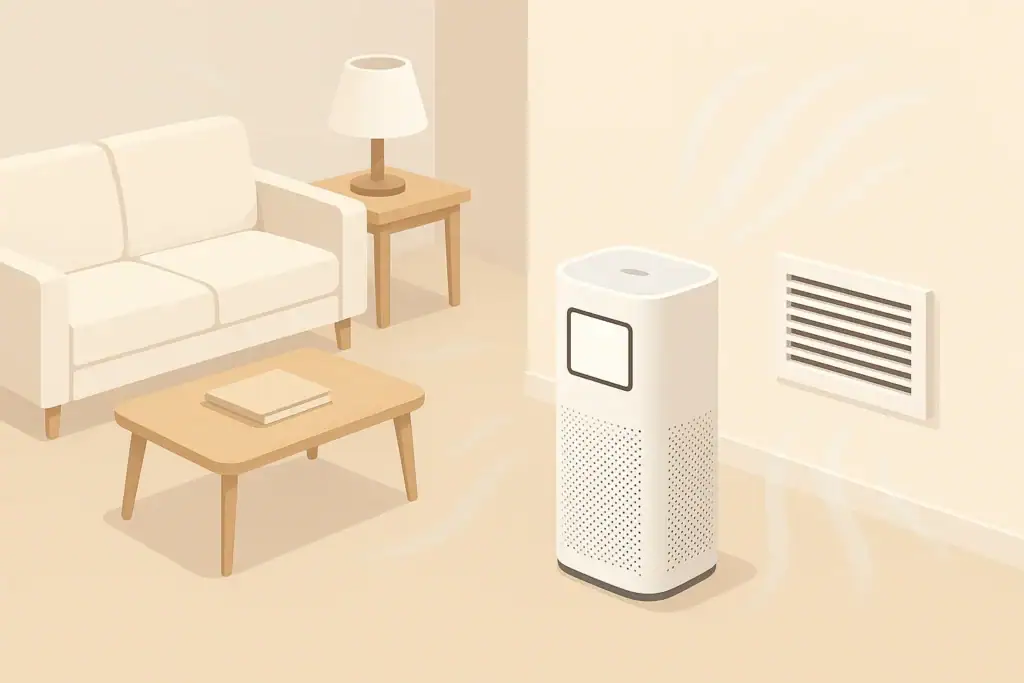
Humidifiers and dehumidifiers complement, but do not replace, air purifiers. Purifiers focus on reducing particles such as dust, smoke, and pollen from the air using filters. Humidity control focuses on the amount of moisture in the air. Both factors contribute to how comfortable and “fresh” indoor air feels.
In many homes, you might use:
- An air purifier in main living spaces or bedrooms to handle particles
- A dehumidifier in a basement or damp area to manage moisture
- A humidifier in one or two dry rooms during winter
Adjusting each tool based on season and room conditions helps maintain a more stable indoor environment.
Example values for illustration.
| Goal | Simple actions | Tools | Notes |
|---|---|---|---|
| Reduce damp feeling in basement | Run dehumidifier, keep interior doors open for airflow | Portable dehumidifier, hygrometer | Check for leaks or standing water first |
| Limit window condensation in winter | Lower humidity slightly, improve air circulation near windows | Humidifier with lower setting, fan | Aim for balance, not perfectly dry glass |
| Manage moisture after showers | Use exhaust fan, keep door slightly open after use | Bathroom fan, hygrometer if desired | Run fan long enough to clear steam from mirrors |
| Reduce musty smell in closet | Increase airflow, avoid storing damp items | Small fan, moisture absorber | Consider dehumidifier nearby if space stays damp |
| Improve comfort in dry bedroom | Run humidifier at low setting overnight | Humidifier, bedside hygrometer | Adjust output if condensation appears on nearby surfaces |
| Stabilize humidity across seasons | Use humidifier in dry months, dehumidifier in damp months | Both devices, simple monitors | Review readings monthly and adjust run times |
Maintenance and Safety Tips for Both Devices
Humidifiers and dehumidifiers both require routine care to work well and avoid avoidable issues over time.
Humidifier maintenance basics
- Use clean water: Follow the manufacturer’s guidance on water type. Some users prefer low-mineral water to reduce white dust from ultrasonic models.
- Clean regularly: Empty and rinse the tank daily during use, and follow deeper cleaning instructions on a weekly or other recommended schedule.
- Replace wicks or cartridges: Evaporative models often use wicks or filters that need periodic replacement.
- Store dry between seasons: Before putting the unit away, clean thoroughly and let all parts dry completely.
Dehumidifier maintenance basics
- Empty and clean the bucket: If your unit uses a collection bucket, empty it frequently and rinse to prevent film buildup.
- Check and clean the air filter: Many units have a washable or replaceable filter; a clogged filter reduces performance.
- Inspect drain hoses: If using a continuous drain, ensure the hose slopes downward and remains unclogged.
- Keep coils and air paths clear: Dust buildup can reduce efficiency; follow manufacturer instructions for safe cleaning.
General safety considerations
- Use a grounded outlet and avoid overloading power strips.
- Keep cords and units away from standing water.
- Do not cover air intakes or exhaust vents.
- Follow all manufacturer instructions and safety warnings.
With regular attention, both humidifiers and dehumidifiers can support more comfortable indoor conditions and help you manage seasonal changes in your home’s air.
Frequently asked questions
How do I decide between a humidifier and a dehumidifier for my whole house?
Check relative humidity in multiple rooms with a hygrometer over several days; aim for roughly 30–50% RH as a comfortable band. Use a humidifier when readings and symptoms show consistent low humidity, and use a dehumidifier when readings are consistently high or you notice damp signs like condensation and musty odors. For whole-house solutions, consult an HVAC professional about integrated systems that work with your existing ductwork.
Can I run a humidifier and dehumidifier at the same time in different rooms?
Yes—running each device in separate rooms to address local conditions is acceptable and often effective. Just monitor humidity levels with hygrometers and avoid excessive overlap in small, connected spaces where the units could counteract each other. Consider how central HVAC and ventilation will move air between rooms when planning usage.
What humidity level should I target to reduce mold risk but avoid dry air?
A general target is about 40–50% relative humidity; this reduces the likelihood of mold growth while staying comfortable for most people. Values consistently above about 60% raise mold and dust mite risks, while values below about 30% tend to feel uncomfortably dry. Adjust slightly for seasonal comfort and monitor for condensation or other moisture signs.
Are there health or indoor air risks if I use a humidifier or dehumidifier incorrectly?
Yes. Over-humidifying or failing to clean a humidifier can encourage mold, dust mites, or bacteria and may aerosolize minerals from hard water. Neglecting dehumidifier maintenance, such as not emptying and cleaning the collection bucket or filters, can also promote microbial growth. Regular cleaning and monitoring humidity levels reduce these risks.
How often should I clean and maintain humidifiers and dehumidifiers?
For humidifiers, rinse and empty the water tank daily during use and perform a deeper clean weekly or per the manufacturer’s schedule; replace wicks or cartridges as recommended. For dehumidifiers, empty and rinse the bucket frequently, clean or check filters monthly, and inspect drain hoses and coils periodically. Regular maintenance preserves performance and reduces health risks.
Recommended next:
- HEPA vs Activated Carbon: Best Setup for Allergies, Odors, and Smoke
- Air Purifier vs Dehumidifier: Which One Solves Musty Air?
- Humidifier vs Dehumidifier: When to Add Moisture vs Remove It
- Air Purifier vs Ozone Generator: Safety, Effectiveness, and Myths
- HEPA vs Carbon Filters: When Each One Matters Most
- Air Purifier vs Ventilation: Which Fixes Stuffy Bedrooms Better?
- More in Comparisons →
- Clear sizing logic (room size → CADR/ACH)
- HEPA vs carbon explained for real use-cases
- Humidity + ventilation basics to reduce mold risk



About this site
Home Air Quality Lab publishes practical, independent guides about indoor air quality—clear sizing, safer use, and real-world expectations.
Affiliate disclosure
Some links on this site may be affiliate links. If you buy through these links, we may earn a small commission at no extra cost to you. This helps support our content. Learn more.