
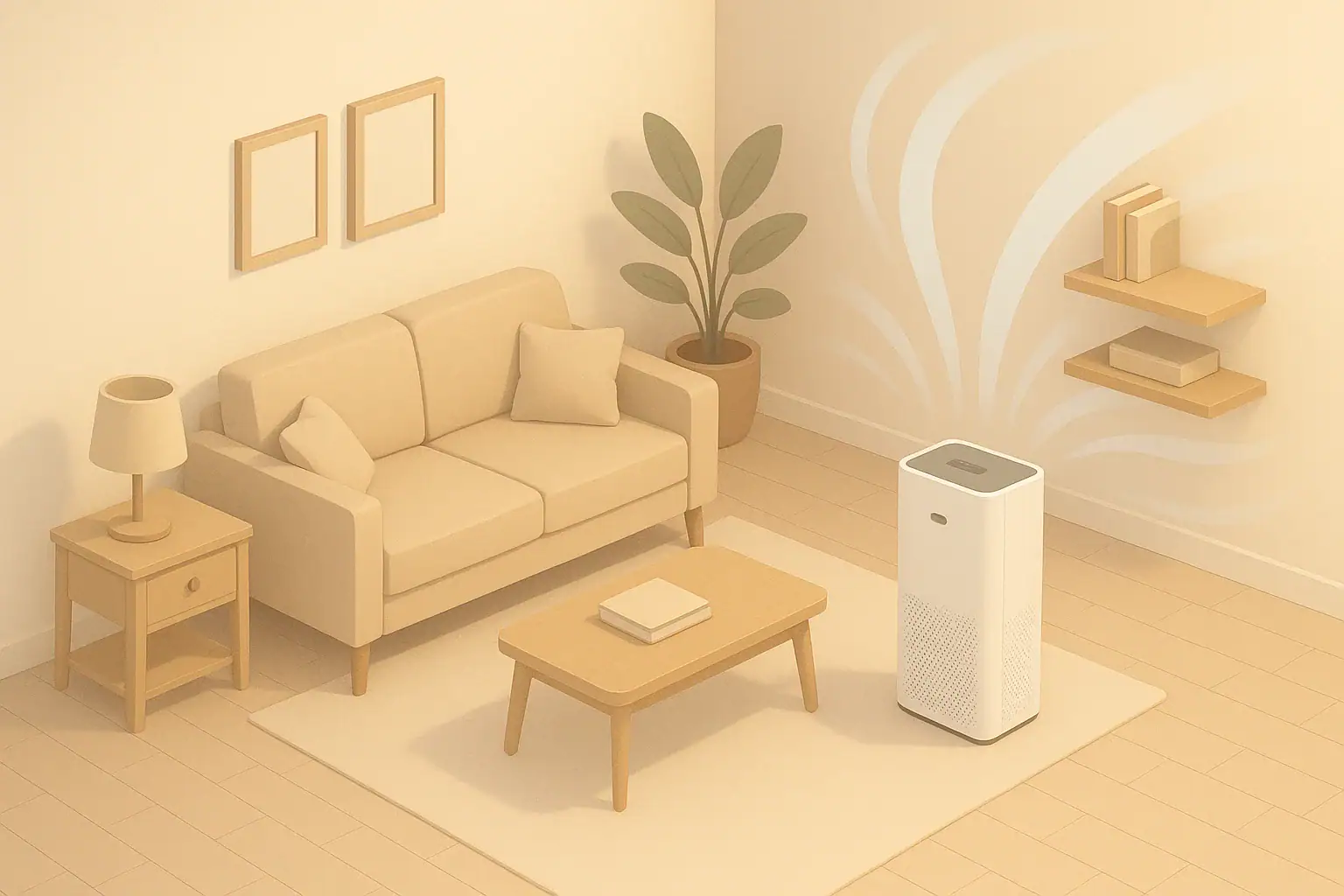
The best air purifiers for wildfire smoke have a strong smoke CADR, a sealed HEPA filter, and enough capacity for the room you actually use them in. During wildfire season, a properly sized purifier can cut indoor smoke particles (PM2.5) dramatically, especially in bedrooms and main living areas where you spend the most time. Odor and gas filters help with smell, but particle removal is the first priority for health protection.
This guide explains which specifications really matter for wildfire smoke, how to match an air purifier to your room size, and how to run it when outdoor air quality is poor. You will see concrete examples, simple sizing steps, and maintenance tips so you can get the most out of any purifier you already own or plan to buy. The goal is not perfection, but a practical setup that keeps indoor air noticeably cleaner and easier to breathe when the air outside turns hazy.
Why Wildfire Smoke Needs Special Attention Indoors
Wildfire smoke is not the same as everyday household dust or pollen. It is dominated by very fine particles (often in the PM2.5 range and smaller) plus a mix of gases and volatile organic compounds. These tiny particles stay suspended in the air for hours, leak through small gaps in buildings, and can travel deep into the lungs when inhaled.
When outdoor air is smoky, indoor air often becomes your main refuge. But unless you actively manage it, smoke can quickly infiltrate through open windows, bathroom and kitchen vents, and even small cracks around doors. An air purifier designed for fine particle removal can significantly lower indoor PM2.5 levels, especially in closed rooms, creating cleaner “safe zones” in your home.
For wildfire smoke, the performance of an air purifier depends on three main ideas:
- How efficiently it captures tiny particles (filter type and quality)
- How much clean air it can move per minute (Clean Air Delivery Rate, or CADR)
- How well it is matched to your room size and layout (air changes per hour, or ACH)
Understanding these basics helps you avoid paying for features that sound impressive but do little to reduce smoke exposure when you really need it.
Key Specs and How Air Purifiers Work Against Wildfire Smoke
Most room air purifiers for wildfire smoke use mechanical filtration: a fan pulls dirty air through filters, and cleaner air is pushed back into the room. For smoke, two specifications matter far more than marketing language or extra features.
Fine Particle Filtration (HEPA or Equivalent)
The core job is to capture the fine particles that make up wildfire smoke haze. For this, you want a high-efficiency particle filter:
- HEPA or equivalent filter: Designed to capture a very high percentage of small particles, including smoke, dust, and pollen.
- Higher-grade HEPA (often labeled H13 or similar): Can capture an even larger fraction of ultrafine particles, which may be useful for priority rooms or sensitive occupants.
- Pre-filter: A coarse first layer that catches hair, lint, and larger dust so the main HEPA filter does not clog as quickly.
Filter integrity matters as much as filter media. If air can leak around the edges of the filter, smoke bypasses the media and cleaning efficiency drops. A well-designed purifier will have gaskets, tight-fitting frames, or other sealing features to reduce this bypass.
Be cautious with vague labels such as “HEPA-type” or “HEPA-style” without clear performance claims. For wildfire smoke, a genuinely high-efficiency fine particle filter with good sealing is worth prioritizing.
Clean Air Delivery Rate (CADR) and Room Sizing
CADR (Clean Air Delivery Rate) combines filter efficiency and airflow into a single number, usually given in cubic feet per minute (CFM). For wildfire smoke, the smoke CADR is the most relevant value.
A higher smoke CADR means the purifier can process more air per minute and reduce indoor smoke levels faster. This is especially important when outdoor air quality index (AQI) readings are very high and you want to bring indoor PM2.5 down quickly.
To make CADR more intuitive, it helps to relate it to air changes per hour (ACH)—how many times per hour the purifier can theoretically move a room’s entire air volume through the filters. For wildfire smoke, many people aim for several air changes per hour in bedrooms and main living areas during bad smoke days.
| Approx. Room Size (ft²) | Ceiling Height (ft) | Target ACH Range | Approx. Smoke CADR Needed (CFM) | Typical Setup |
|---|---|---|---|---|
| 120 (small bedroom) | 8 | 5–8 ACH | 80–130 | One compact purifier on medium–high |
| 200 (large bedroom / office) | 8 | 5–8 ACH | 130–210 | One mid-size purifier; close door during smoke |
| 350 (small living room) | 8 | 4–7 ACH | 190–330 | Larger purifier or two smaller units |
| 500 (open-plan area) | 9 | 4–6 ACH | 300–450 | One high-CADR unit plus partial room zoning |
| 700+ (large open-plan) | 9 | 4–6 ACH | 450–650+ | Multiple units and strategic door closing |
These values are planning ranges, not strict rules. Real homes have leaks, open doors, and furniture that reduce ideal performance, so it is common to choose a purifier with more CADR than the bare minimum.
Particles vs Odors and Gases
Wildfire smoke contains both solid particles and gases. HEPA filters target the particles; they do not remove gases or smells. To reduce smoke odor, you need a gas-phase filter such as activated carbon or similar sorbent media.
- Thin carbon pads can help, but often saturate quickly during multi-day smoke events.
- Thicker carbon beds or cartridges generally have more capacity and may hold odor longer before breakthrough.
- Even with carbon, some smoke smell may remain when outdoor levels are extremely high or the building is leaky.
For most households, a purifier with both a high-efficiency particle filter and a meaningful amount of activated carbon offers a balanced approach: particle protection plus some odor relief.
Real-World Examples of Using Air Purifiers for Wildfire Smoke
Seeing how these specs play out in everyday situations can make them easier to apply. Below are common scenarios and how an air purifier can be used effectively in each.
Scenario 1: Small Bedroom “Clean Room”
A 10 × 12 foot bedroom with an 8-foot ceiling has a volume of about 960 cubic feet. During a smoke event, you want this room to be a cleaner retreat, especially for sleep.
- Choose a purifier with a smoke CADR in the 100–150 CFM range or higher.
- Keep the bedroom door and windows closed during the worst smoke periods.
- Run the purifier on medium or high for the first hour, then reduce to a quieter setting if needed for sleep.
- Place the unit a couple of feet from the wall, with a clear path to the bed’s breathing zone.
In this setup, many people notice a visible reduction in haze in the room and a drop in PM2.5 readings on basic monitors compared with the rest of the home.
Scenario 2: Main Living Room in an Open-Plan Space
Consider a 15 × 20 foot living area that opens into a hallway and kitchen. Even if the labeled coverage on a purifier box seems large, open layouts effectively increase the volume the unit must handle.
- Target a higher smoke CADR, for example 250–350 CFM or more, depending on how open the space is.
- When smoke is heavy, close off side rooms and unused areas to reduce the total volume connected to the space.
- Position the purifier where air can circulate across the main seating area, not hidden behind furniture.
- Use the higher fan settings when you first close windows or when AQI spikes, then step down to medium once levels stabilize.
Because open spaces are harder to control, some households use two units: one focused on the living room and another in a hallway or adjacent room to help pull smoke-laden air through filters more evenly.
Scenario 3: Combining Central HVAC with Room Purifiers
Many homes rely on a central heating and cooling system. During wildfire smoke events, you can often improve performance by combining it with room air purifiers:
- Use a higher-efficiency furnace filter rated for fine particles, within the limits recommended for your system.
- Set the HVAC fan to run continuously or on a recirculation mode during the worst smoke hours so indoor air passes through the filter more often.
- Place room purifiers in bedrooms and main living areas to add extra cleaning where people spend the most time.
This combined approach can provide more even whole-home coverage, while room purifiers help achieve higher effective ACH in priority rooms.
Scenario 4: Temporary Shelter or Rental During a Fire
If you are staying in a temporary space or rental during a wildfire event, you may not be able to alter the building. A portable room purifier is often the most practical tool you can bring with you.
- Choose at least one room (often a bedroom) to act as a primary clean-air zone.
- Block obvious gaps under doors with towels and close windows as much as possible.
- Run the purifier on a higher setting when you first arrive and after any time the room has been open to smoky air.
Even in less-than-ideal buildings, this approach can create a noticeably cleaner microenvironment for rest and recovery.
Common Mistakes and Troubleshooting Wildfire Smoke Control
Even with a good purifier, a few common missteps can limit how much protection you actually get. Recognizing them early can save both frustration and filter life.
Frequent Mistakes When Choosing or Using a Purifier
- Undersizing for the room: Buying a small unit based on price or compact size, then expecting it to handle a large open-plan space.
- Relying only on low fan speed: Running the purifier on its quietest setting even when AQI is very high, which may not provide enough air changes per hour.
- Ignoring leaks and open windows: Leaving windows cracked or bathroom vents running on outside air, which constantly pulls in new smoke.
- Waiting too long to clean pre-filters: Letting the pre-filter clog with dust and pet hair, which reduces airflow and makes the HEPA filter work harder.
- Expecting HEPA to remove all odors: Assuming that if particles are low, smell will disappear, even though gases require carbon or other sorbent media.
Simple Troubleshooting Cues
If your home still feels smoky even with a purifier running, these questions can help you diagnose what to adjust:
- Is the purifier large enough for the room, based on its smoke CADR and your room size?
- Are doors and windows fully closed in the rooms you are trying to protect?
- Is the purifier running on a high enough fan speed during peak smoke hours?
- Are the filters clean and properly seated, with no visible gaps or misalignment?
- Is the purifier blocked by furniture, curtains, or walls that limit airflow?
| Observed Problem | Likely Cause | Practical Adjustment |
|---|---|---|
| Room still hazy after hours of use | Purifier undersized or fan too low | Increase fan speed; move unit closer; consider higher-CADR unit or second purifier |
| Strong smoke smell despite low visible haze | Carbon filter saturated or too thin | Replace or upgrade carbon filter; reduce infiltration by sealing gaps |
| Purifier loud but little improvement | Severe leaks or open windows/vents | Close windows, fireplace dampers, and outside-air vents; use door sweeps or towels |
| Dust buildup on surfaces near purifier outlet | Pre-filter clogged, diverting airflow paths | Clean pre-filter; check HEPA for loading; reposition outlet away from walls |
| Allergy or irritation indoors even on clear days after fires | Old filters saturated from past smoke events | Replace HEPA and carbon filters before next smoke season |
Monitoring tools, such as basic PM2.5 displays on some purifiers or standalone monitors, can help confirm whether changes in placement, fan speed, or sealing actions are making a measurable difference.
Safety Basics When Using Air Purifiers for Wildfire Smoke
Most mechanical air purifiers are straightforward to use, but a few safety and health considerations are worth keeping in mind, especially when running them for many hours or days at a time.
Avoid Ozone-Producing Devices
For wildfire smoke, you do not need ozone to clean the air. Devices marketed primarily as ozone generators or that intentionally produce significant ozone should be avoided for occupied spaces. Ozone is a respiratory irritant and can react with indoor chemicals to form additional byproducts.
Some air purifiers include optional ionizers or similar features. If you are unsure how much ozone they may produce, many users choose to disable these modes and rely on HEPA and carbon filtration, which are well-established for smoke particles and many odors.
Electrical and Placement Safety
- Plug purifiers directly into a wall outlet rather than into overloaded power strips.
- Keep the intake and outlet clear of curtains, bedding, and paper to avoid blocking airflow or creating a fire hazard.
- Do not place purifiers where they can easily tip into water sources such as bathtubs or sinks.
- Maintain adequate space around the unit for cooling and airflow, as specified in the manual.
Health Expectations and Limits
Air purifiers can significantly reduce indoor particle levels but cannot guarantee a particular health outcome. People with asthma, heart disease, or other conditions sensitive to smoke should follow medical guidance and emergency information during wildfire events.
Purifiers also do not replace evacuation orders or other safety directives. Think of them as one layer in a broader smoke protection plan that also includes staying informed about outdoor conditions, limiting strenuous activity during severe smoke, and creating at least one cleaner indoor room.
Maintenance and Long-Term Use Through Multiple Smoke Seasons
Wildfire seasons can last weeks or months, and some regions experience them every year. Planning for long-term use helps keep performance consistent and avoids surprises when smoke arrives suddenly.
Filter Care During Active Smoke Events
- Pre-filters: Check and clean every few weeks during heavy use. A quick vacuum or rinse (if allowed) keeps airflow strong.
- HEPA filters: Expect shorter lifespans when running the purifier many hours per day. If airflow drops or indicator lights signal replacement, do not postpone during smoke season.
- Carbon filters: Odor control often fades before the HEPA looks dirty. If smoke smell returns quickly after turning the purifier on, the carbon stage may be saturated.
Off-Season Storage
When smoke season ends, you may not need to run purifiers as intensively. How you store them affects how ready they will be next year:
- Wipe dust from the housing and ensure filters are dry before storage.
- Store units in a dry, indoor space to avoid moisture damage or mold on filters.
- If filters are near the end of their life, consider replacing them before the next smoke season so you are prepared.
Planning Ahead for Filter Availability
During large wildfire events, replacement filters can become harder to find. It is often practical to keep at least one spare set of HEPA and carbon filters on hand for each purifier you rely on for smoke control.
Over several seasons, consider how filter costs, noise level at higher fan speeds, and ease of maintenance fit your household. The best long-term purifier is one you are willing to run whenever outdoor air quality worsens and that you can keep supplied with filters without difficulty.
Putting It All Together: Practical Takeaways and Specs Checklist
Choosing the best air purifiers for wildfire smoke is less about chasing every new feature and more about getting the basics right: strong smoke CADR, high-efficiency filtration, good placement, and consistent use during bad air days.
For most homes, a realistic strategy is to prioritize one or two key rooms—often bedrooms and a main living area—and ensure those spaces can reach reasonable air changes per hour when smoke is heavy. Combined with sealing obvious leaks, managing windows, and following local health guidance, this can substantially reduce your overall smoke exposure indoors.
Specs to Look For in an Air Purifier for Wildfire Smoke
- Filter Type: True HEPA or equivalent fine particle filter, plus a washable or replaceable pre-filter.
- Smoke CADR: High enough for your room size to reach several air changes per hour; larger or open rooms may need 250+ CFM or multiple units.
- Gas/Odor Control: Activated carbon or similar sorbent media, with enough mass to handle multi-day smoke events.
- Sealing and Build: Tight filter fit, gaskets, or similar features to minimize air bypass around filters.
- Noise at Useful Speeds: A fan setting that delivers strong cleaning while still tolerable for sleep or conversation.
- Energy Use: Reasonable power draw for continuous operation on low or medium during smoke season.
- Filter Availability: Replacement HEPA and carbon filters that are easy to source and simple to change.
- Safety Features: No intentional ozone generation, stable base, and clear ventilation around the unit.
If you already own a purifier, compare it against this checklist and the room size guidance above. Small changes—such as moving it to a better location, running it on a higher setting during peaks, or refreshing filters before smoke season—can make a noticeable difference in how clean your indoor air feels when wildfires affect your area.
Frequently asked questions
What specifications should I prioritize when choosing an air purifier for wildfire smoke?
Prioritize a high smoke CADR, a true HEPA or equivalent fine-particle filter with tight sealing, and enough capacity for the room to achieve several air changes per hour. For odors and gases, look for a meaningful amount of activated carbon, but particle removal should be your primary concern for health protection.
How do I determine the right purifier size or CADR for my room?
Calculate your room volume (floor area × ceiling height) and decide how many air changes per hour (ACH) you want; then choose a purifier whose smoke CADR provides that ACH (roughly: CFM = volume × ACH / 60). Aim for higher CADR than the bare minimum to allow for home leaks and open layouts.
Is it a mistake to run an air purifier on its quietest setting during heavy smoke?
Yes — the quietest setting often provides too few air changes during high smoke periods. Run the purifier on medium or high when AQI is poor until levels stabilize, then reduce speed for sleep or comfort.
Will a HEPA filter remove smoke odors and gases?
No — HEPA removes particles but not most gases or volatile compounds that cause odors. To reduce smell, use a purifier with activated carbon or another gas sorbent; thicker carbon beds perform better and last longer than thin pads.
Are ozone-generating or ionizing purifiers safe to use during wildfire smoke?
Avoid ozone-generating devices for occupied spaces because ozone is a respiratory irritant and can form harmful byproducts indoors. If a purifier includes an ionizer or ozone mode, disable it and rely on mechanical HEPA and carbon filtration for smoke events.
How often should I replace HEPA and carbon filters during prolonged smoke events?
Check pre-filters every few weeks and clean as recommended; HEPA filters may need replacement sooner if airflow drops or indicator lights come on, and carbon filters often saturate faster and lose odor control first. Keep spare filters available during extended smoke periods to maintain performance.
- Clear sizing logic (room size → CADR/ACH)
- HEPA vs carbon explained for real use-cases
- Humidity + ventilation basics to reduce mold risk
- How to Choose the Right Air Purifier for Your Room Size (With CADR & ACH)
- Best Air Purifiers for Pets: Dander, Odors, and Filter Costs Explained
- Best Air Purifiers for Large Rooms: Sizing, Setup, and Avoiding Underpowered Units
- Quiet Air Purifiers for Bedrooms: What Sleep Mode Really Does (And What It Doesn’t)