
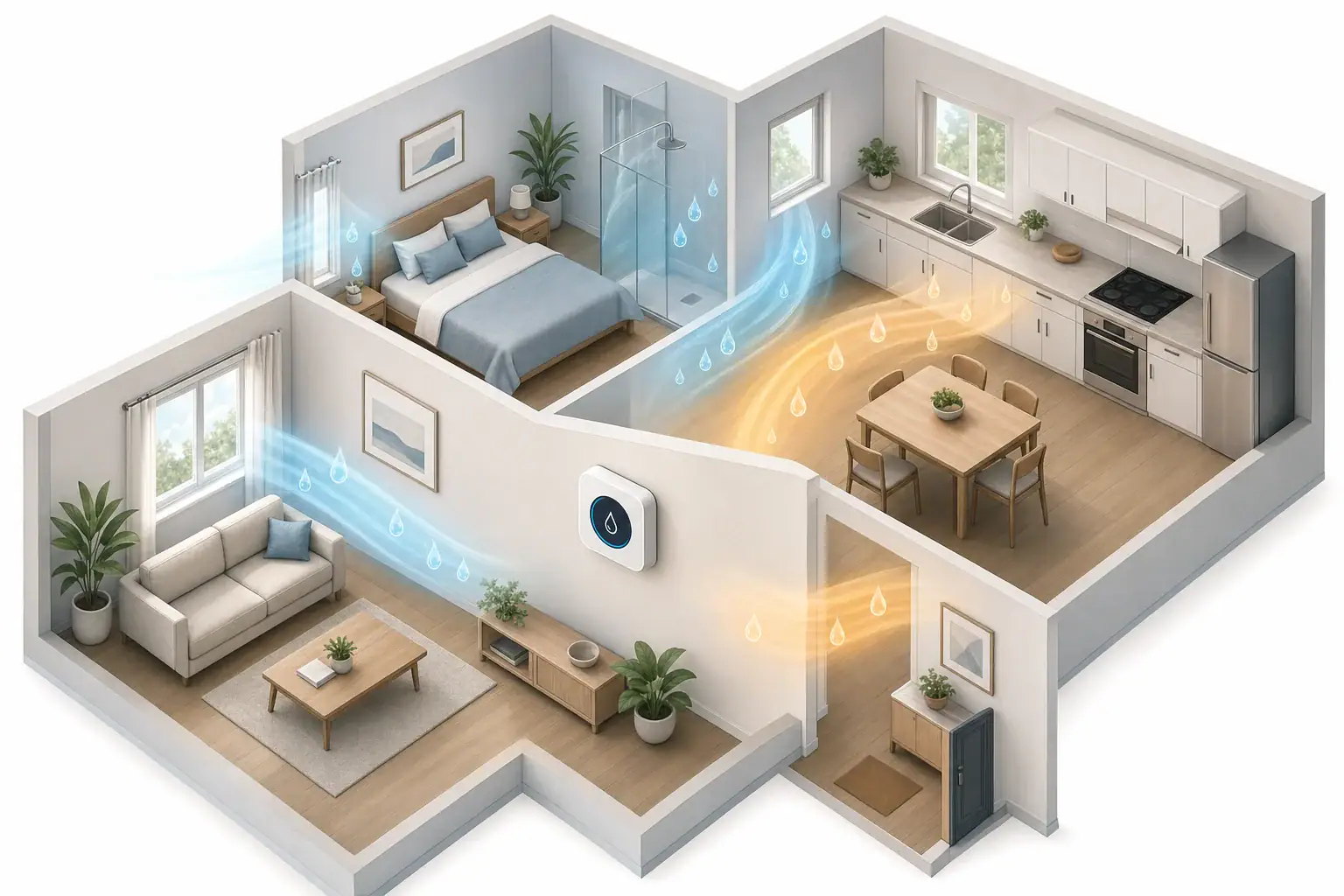
What does humidity percentage mean?
The percentage on a home humidity monitor normally means relative humidity, or RH. It is the ratio of the water-vapor pressure actually present to the saturation water-vapor pressure at the same temperature, expressed as a percentage.
Put simply, RH tells you how close the air is to saturation at its current temperature. The National Weather Service glossary defines relative humidity as a temperature-dependent ratio. It is not the percentage of the air made of water, and it does not directly state the air’s total moisture content.
So, 50% RH does not mean half the air is water. It means the measured water-vapor pressure is half of the saturation vapor pressure for that temperature. At 100% RH, the air is saturated at the measured temperature; the air has not simply “turned into water.”
Why the percentage changes when temperature changes
The amount of water vapor needed for saturation rises as temperature rises. Therefore, the same amount of vapor represents a smaller fraction of saturation after air is warmed. When air cools, the saturation value falls, so the same vapor can represent a larger fraction of saturation.
The EPA’s Moisture Control Guidance makes this point directly: changing air temperature changes relative humidity even when the absolute amount of water vapor stays the same. This is why an RH reading alone cannot tell you whether moisture was added or removed.
Hypothetical temperature-change example
This simplified teaching example assumes an enclosed sample of air with no moisture added or removed and no condensation. It uses rounded, notional moisture units rather than a precision calculation.
- At 68°F (20°C), suppose the air contains 17 units of water vapor and saturation at that temperature is 17 units. The RH is 17 ÷ 17 × 100 = 100%.
- Warm the same air to 86°F (30°C), without changing its water-vapor amount. If saturation at the warmer temperature is 30 units, the RH is 17 ÷ 30 × 100 ≈ 57%.
The vapor amount in this example remains 17 units, while RH falls because the temperature-dependent saturation value increases. The rounded values are adapted from an educational example in an NWS-hosted weather theory handbook; they illustrate the relationship rather than serving as a home calculation tool.
Relative humidity, absolute humidity, and dew point
| Measurement | What it represents | Common expression | What temperature alone can do |
|---|---|---|---|
| Relative humidity | Actual vapor pressure compared with saturation vapor pressure at the same temperature | % RH | Changes because the saturation reference changes with temperature |
| Absolute humidity | Mass of water vapor per volume of moist air | Usually g/m³ | Describes vapor concentration; it can vary when air volume or density changes |
| Dew point | The temperature at which the present vapor would reach saturation at constant pressure | °F or °C | Does not change merely because air is warmed or cooled before condensation |
These measures answer different questions. Two rooms can have the same RH but different vapor concentrations if they have different temperatures. A room can also show a changing RH reading while its moisture amount is approximately unchanged.
How to read daily humidity patterns at home
Read temperature and RH together. If temperature rises while RH falls, or temperature falls while RH rises, the shift may be driven mainly by temperature. The National Weather Service notes that, when dew point or absolute humidity stays unchanged, RH is generally highest during the coolest part of the day and lowest during the warmest part.
Real homes are not closed samples. Showering and cooking can add water vapor. Air conditioning and dehumidification can remove it. Outdoor-air exchange can change indoor moisture in either direction. Those events may reinforce or override the usual temperature-driven pattern.
Checklist for interpreting a reading
- Record temperature and RH together; do not interpret the percentage by itself.
- Compare readings from the same location when looking for a pattern.
- Check whether temperature and RH moved in opposite directions.
- Note recent showers, cooking, HVAC operation, open windows, or other events that could change moisture.
- Review several hours or days of history rather than relying on a single moment.
- Treat a sustained, unexplained change as a reason to look more closely, not as a diagnosis by itself.
If you need help assessing whether two devices disagree or how to position a monitor, see Humidity Sensor Accuracy: Why Cheap Hygrometers Disagree and Where to Place an Air Quality Monitor.
Frequently asked questions
Does 50% humidity mean half of the air is water?
No. A 50% RH reading means the actual water-vapor pressure is half the saturation vapor pressure at the current temperature. It does not mean that water makes up half of the air.
Why can humidity rise at night if nothing changed in the room?
If the room cools while its water-vapor amount stays about the same, the saturation vapor pressure decreases. The existing vapor then becomes a larger percentage of saturation, so the RH reading rises.
Does 100% relative humidity mean the air has become liquid water?
No. It means the air is saturated at its measured temperature. Condensation may occur when saturated air is cooled or contacts a sufficiently cool surface, but a 100% RH reading does not mean the air itself is liquid water.
Summary
Your home humidity percentage is usually a relative, temperature-dependent measurement. It shows how close air is to saturation at the current temperature, not how much of the air is water. Pair RH with temperature and recent household activity to make sense of changes over time.
Recommended next:
- Indoor Air Quality Monitors: What to Measure (PM2.5, CO2, VOCs, Humidity)
- CO2 Monitors for Homes: What Good Numbers Look Like and Why They Matter
- VOC Sensors Explained: Why Readings Vary and How to Use Them Safely
- Where to Place an Air Quality Monitor: Height, Distance, and Rooms
- PM2.5 Sensor Accuracy: Why Readings Differ Between Devices
- CO2 Monitor Buying Guide: What to Look For (NDIR vs “eCO2”)
- Clear sizing logic (room size → CADR/ACH)
- HEPA vs carbon explained for real use-cases
- Humidity + ventilation basics to reduce mold risk