
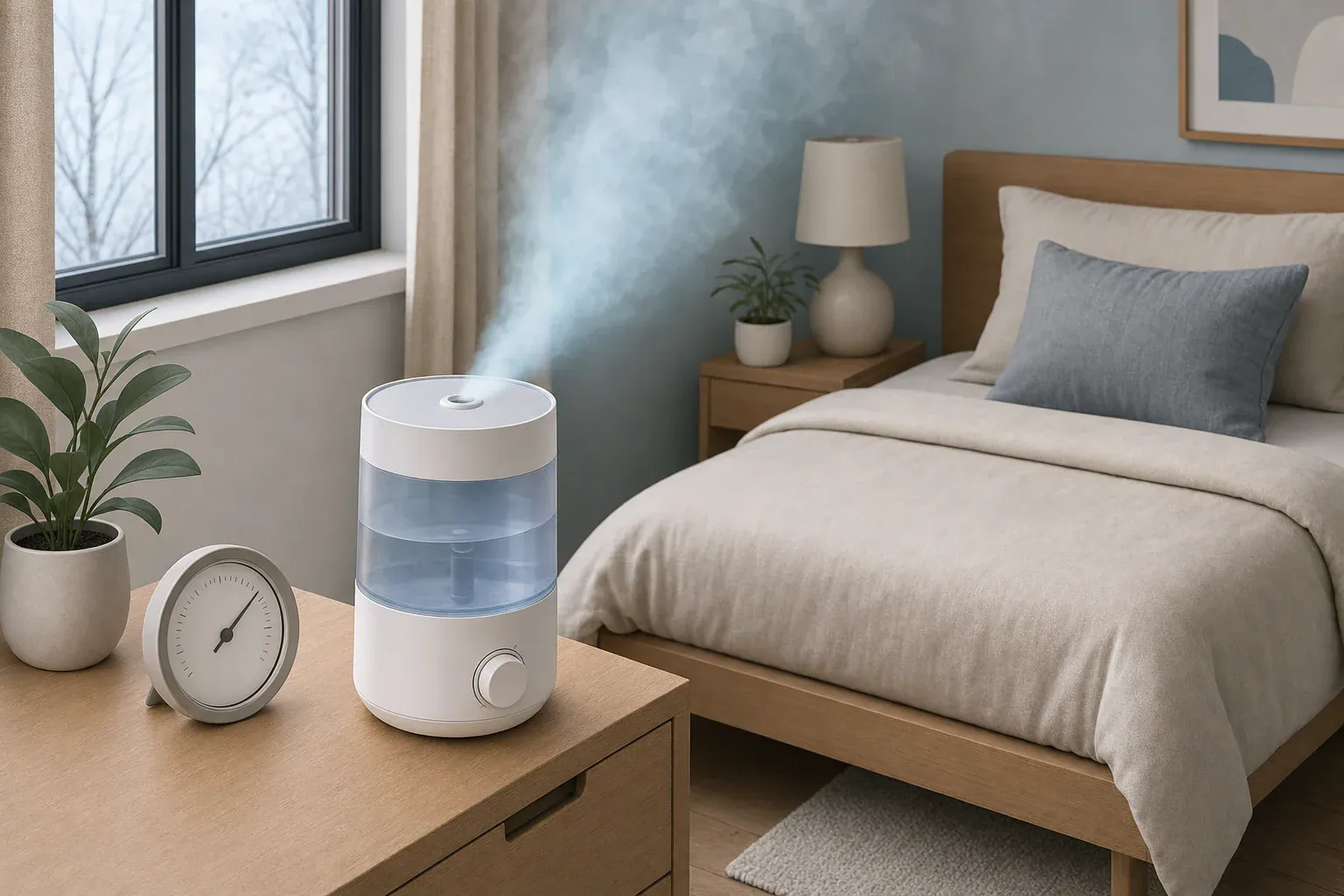
Does a humidifier help with cough comfort?
Sometimes. Dry air can irritate the nose and throat, and humidified air may provide temporary comfort or help loosen mucus, according to MedlinePlus guidance on humidifiers and health. But a humidifier does not treat the cause of a cough. Mayo Clinic notes that cool-mist humidifiers may ease coughing and congestion during a cold, while also noting that more research is needed.
The practical question is not whether more moisture is always better. It is whether the room is dry, whether humidity can be raised without creating dampness, and whether the device is clean. If the room is already adequately humid, adding more moisture may offer little comfort and can worsen indoor moisture conditions.
Decide from relative humidity and room conditions
Use a hygrometer to measure relative humidity (RH) rather than relying on how the air feels. The U.S. Environmental Protection Agency (EPA) recommends keeping indoor humidity between 30% and 50%.
| Reading or condition | Practical response |
|---|---|
| Below 30% RH, with dry surfaces and no condensation | A cautious humidifier trial may be reasonable. Use low output and monitor RH as it enters the 30%–50% range. |
| 30%–50% RH, with dry surfaces | Do not add humidity solely because someone is coughing. Extra moisture may provide little additional comfort. |
| Above 50% RH, condensation, a musty odor, or damp fabrics | Reduce or stop humidification and address the excess moisture. EPA identifies high humidity as a condition that can encourage mold growth. |
| Tank odor, visible film or scale, or white dust near the unit | Stop using the unit. Empty and clean it according to its manual, then check the model’s water and maintenance instructions before restarting. |
Condensation is a useful warning sign even when the hygrometer appears acceptable. Humidity can vary around a room, especially near a cold window, exterior wall, or the humidifier’s direct mist plume.
Hygrometer checklist before and during use
- Measure RH in the occupied part of the room before turning on the humidifier.
- Keep the hygrometer out of the direct mist plume so its reading better represents the room.
- Recheck RH during use rather than setting the unit once and leaving it unattended.
- Look at windows, walls, bedding, curtains, and nearby furniture for condensation or dampness.
- Notice whether comfort changes as RH moves into the 30%–50% range.
- Do not keep increasing output when RH is already adequate or comfort has not improved.
Worked room scenario
Hypothetical example: A bedroom reads 27% RH. Its windows and nearby fabrics are dry, and the humidifier is clean and in good operating condition. The user starts at low output and checks the hygrometer during use.
Once RH enters the EPA’s 30%–50% range, the user holds or reduces the output instead of continuing to raise humidity. If RH approaches the upper end of that range, a window fogs, or fabric becomes damp, the unit is reduced or stopped. If correcting the dry condition does not make the cough feel less irritating, adding more moisture is not justified.
This is a room-condition example, not a performance forecast. The time needed to change RH depends on the humidifier’s output, room size, ventilation, outdoor conditions, and moisture movement through the home.
Water choice depends on the humidifier type
Follow the manual for the exact model. EPA explains in its home humidifier use-and-care guidance that ultrasonic and impeller humidifiers can disperse minerals from tap water into the air. Distilled water generally has fewer minerals. Water marketed as purified, spring, or mineral water is not necessarily low in minerals.
Evaporative and steam units are not expected to disperse substantial mineral amounts in the same way, but they still need the water and maintenance practices specified by their manufacturers. Do not add salt, essential oils, medications, or disinfectants unless the instructions for that exact model expressly allow them. For more on the trade-offs, see Humidifier Water Choices: Tap vs Filtered vs Distilled.
Keep the humidifier from becoming an air-quality problem
Standing water and mineral deposits can allow unwanted material to build up in a humidifier. The CDC’s portable humidifier guidance advises emptying water daily, cleaning the unit regularly, allowing parts to air-dry after cleaning, and following manufacturer directions. The U.S. Consumer Product Safety Commission also advises unplugging a humidifier before cleaning and thoroughly rinsing cleaning products from it.
- Empty the reservoir daily instead of repeatedly topping off old water.
- Clean the unit on the schedule and with the method in its manual.
- Unplug it before cleaning.
- Rinse cleaning products thoroughly as directed before operating the unit.
- Replace filters, wicks, or cartridges on the model’s specified schedule.
- Stop using the unit if odor, film, scale, or unexplained residue returns quickly, then troubleshoot it using the manual.
For a fuller maintenance routine, see How to Clean a Humidifier Properly.
When more humidity is unlikely to help
- The room is already within 30%–50% RH.
- The cough does not feel linked to dry-air irritation or does not feel less irritating after dry room conditions are corrected.
- There is condensation, a musty odor, damp material, or visible moisture.
- The humidifier is dirty, damaged, leaking, or producing residue.
- Symptoms seem worse while the unit is running.
Humidification is a room-condition adjustment, not a way to identify or address the cause of a cough.
When to seek medical advice
A humidifier should not delay medical evaluation of a persistent or worsening cough. MedlinePlus advises contacting a health professional for a cough that lasts more than 10 to 14 days, worsens, is rapidly violent, occurs with significant fever, or produces blood. Seek emergency help for difficulty breathing. See MedlinePlus guidance on coughs for its full list of warning signs.
Frequently asked questions
Should I use a humidifier if the room is already at 30% to 50% RH?
Usually not solely because of a cough. When RH is already within that range and the room is dry, extra moisture may offer little added comfort and can create condensation or dampness.
Can a humidifier cure a cough or shorten a cold?
No. It may temporarily make dry-air irritation feel less bothersome, but it does not treat the cause of a cough. Evidence is not sufficient to promise that an ordinary room humidifier will reduce cough frequency or shorten an illness.
What should I do if windows fog or fabrics become damp while using a humidifier?
Reduce the output or stop the humidifier and address the excess moisture. Condensation and damp materials can signal overly humid conditions in part of the room, even if a hygrometer elsewhere gives an acceptable reading.
Bottom line
A clean humidifier may make a dryness-related cough feel less irritating when measured indoor RH is below 30%. Keep the room within the EPA’s 30%–50% range, respond promptly to condensation or dampness, and stop adding moisture when it does not improve comfort. It is not treatment for the cough’s cause.
Recommended next:
- Best Humidity Level for Winter: Comfort vs Health vs Mold Risk
- Ultrasonic vs Evaporative Humidifiers: Pros, Cons, and Which to Buy
- Humidifier White Dust: Causes, Health Concerns, and Fixes
- How to Clean a Humidifier Properly (And How Often You Really Should)
- Ideal Indoor Humidity in Winter: Comfort vs Mold Risk
- Humidifier Cleaning Routine: How to Prevent Slime and Odors
- Clear sizing logic (room size → CADR/ACH)
- HEPA vs carbon explained for real use-cases
- Humidity + ventilation basics to reduce mold risk