
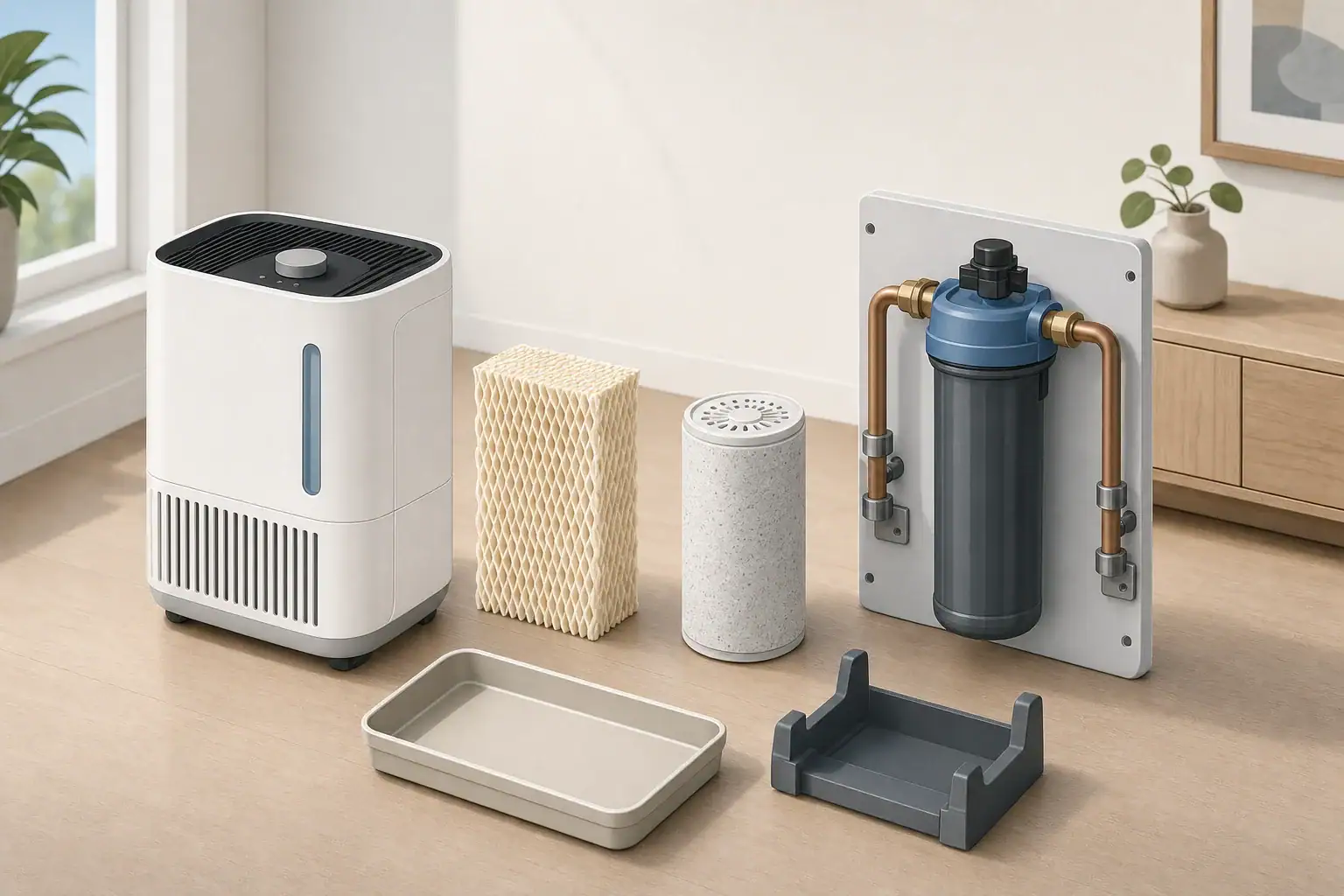
Identify humidifier filters before cleaning or ordering
“Filter” can mean several different parts. Start by finding the complete humidifier model number and the part number printed on the installed media or listed in the owner’s manual. A similar-looking part is not necessarily compatible.
Common examples include:
- Evaporative wick: A paper-like element that absorbs water while air moves through it.
- Demineralization cartridge or cassette: A model-specific consumable used in some humidifiers.
- Whole-house water panel: An evaporative insert in certain duct-mounted humidifiers.
- Holder, tray, feed tube, drain tube, screen, or frame: Hardware that may be reusable even when the media it holds is disposable.
Check the parts diagram before discarding anything. Note arrows, colored marks, cartridge connections, and how the part sits in its holder. Shape, thickness, folds, seals, and orientation can matter as much as approximate dimensions.
Clean or replace? A humidifier filter comparison
| Part type | Usual role | Default decision | What to verify |
|---|---|---|---|
| Evaporative paper wick | Holds water for evaporation into moving air | Usually replace; rinse or soak only if that model’s manual permits it. | Required part number, approved care method, hardening or crusting, odor, damage, and any manual-listed output signs |
| Demineralization cartridge or cassette | Model-specific mineral-management media | Replace unless the manufacturer gives a specific maintenance procedure. | Part number, replacement indicator or interval, physical damage, and manufacturer-listed condition signs |
| Whole-house water panel | Evaporative surface in a duct-mounted humidifier | Replace the panel; clean reusable tray or insert only as directed. | Exact panel number, orientation marks, panel condition, and feed or drain tube condition |
| Holder, tray, feed tube, or drain tube | Positions media or routes water | Inspect and clean only by the approved procedure; replace damaged parts. | Cracks, deformation, brittleness, leaks, or a blockage not resolved by the manufacturer’s procedure |
| Foam screen, prefilter, or aroma pad | Varies by product | Unknown without the manual. | The listed part name, material, location, and care instructions |
Inspect safely and preserve the installation details
- Record the model and part number. Keep the full model designation, not just the brand name.
- Shut the unit down as its instructions require. For a portable humidifier, unplug it with dry hands before opening it. For a furnace-mounted humidifier, use its stated power- and water-shutoff procedure.
- Document orientation before removal. A quick photo of arrows, colored spots, connections, and the holder can prevent an incorrect reinstall.
- Separate disposable media from reusable hardware. Do not throw away a frame, tray, or insert simply because the wick or panel inside it is spent.
- Compare condition with the manual. Look for tears, crushing, loss of shape, hard mineral buildup, odor, poor absorption, or other signs the manufacturer names for that part.
- Do not improvise a cleaning chemical. Vinegar, soap, disinfectant, and descaling products can be prohibited for some media. Use a treatment only when the manual for that exact part allows it.
Why replacement intervals are model-specific
The U.S. Environmental Protection Agency advises owners to follow manufacturer maintenance and replacement directions. Its home humidifier guidance also says the effectiveness and useful life of demineralization devices may vary widely. That is why a calendar interval from another humidifier should not be transferred to yours.
Manufacturer instructions can differ substantially:
- For the HCM710 using an HAC-504 Filter A, the Honeywell HCM710 owner’s manual recommends replacement after 30–60 days, depending on use and water quality. It identifies a hard or crusty wick, odor, and decreased output as replacement signs.
- For the Ultra3’s MD1-0018 cartridge, the Vornado Ultra3 owner’s guide gives guidance of about one month with continuous heavy use or two months with intermittent use, and calls for earlier replacement if white residue accumulates.
Those examples apply only to the named models and parts. They illustrate how a manufacturer may combine elapsed use with an indicator or condition sign; they are not universal humidifier-filter schedules.
Decision checklist: clean, keep, or replace?
- Is it disposable media? If the manual identifies it as a replacement wick, cartridge, cassette, or panel, follow that part’s replacement instructions.
- Does the manual expressly permit rinsing or soaking? If it does not, do not assume that cleaning is safe or effective.
- Is the media torn, crushed, misshapen, or unable to seat correctly? Replace it with the specified compatible part.
- Has a model-specific indicator or interval been reached? Replace the part as directed.
- Does the manual associate the observed odor, buildup, or output change with the media? Follow its replacement direction after checking that the part is installed correctly.
- Is only the color different? Discoloration alone is not a universal replacement test. Check the manual and the part’s other condition signs.
- Is the issue in a tray, tube, or holder instead? Treat it as reusable hardware only if the manufacturer’s instructions say it can be cleaned.
Worked inspection example: a wick with model-specific instructions
Hypothetical example and assumptions: Assume a portable Honeywell HCM710 has the specified HAC-504 Filter A installed, the owner has its current manual, and the wick has no tears or installation damage. This is an example of reading one model’s instructions, not a recommendation for all humidifiers.
- Unplug the unit with dry hands and remove the wick according to the HCM710 instructions. Keep its surrounding holder if it is reusable hardware.
- Inspect the wick for the signs named in that manual: hard or crusty material, odor, or decreased output associated with the filter.
- If buildup is only beginning, the manual permits a cool-water soak as a temporary way to loosen mineral buildup. It says not to use vinegar, soap, descaling products, or disinfecting products on that wick.
- If the wick is hard or crusty, odorous, or linked to decreased output, replace it with HAC-504 Filter A. Install it without wringing it and reassemble the unit as the manual shows.
The important result is the method: identify the exact media, use the allowed care steps, and let that product’s condition signs and instructions govern the decision.
Confirm fit and orientation before installation
Match the replacement to the complete humidifier model and listed media number. Then compare the replacement with the original for shape, folds, connection points, frame requirements, seals, and orientation marks. A product listing that gives only approximate dimensions does not establish compatibility.
Orientation can be essential. The AprilAire No. 10 Water Panel instructions specify that the colored spot faces up. The same instructions distinguish the new, replaceable water panel from the distribution tray and scale-control insert, which are cleaned and reused, and call for inspection of the feed and drain tubes.
Disposal and seasonal storage
Do not assume a used wick, water panel, or mineral cartridge is recyclable. Check the manufacturer’s disposal information and local waste-program rules. If neither gives a separate disposal route, follow applicable local household-waste requirements.
Before storage, EPA guidance says to discard used cartridges, cassettes, or filters and to clean the humidifier according to its instructions. Keep reusable frames, holders, and trays that belong to the unit. For the cleaning procedure itself, see How to Clean a Humidifier Properly; for off-season preparation, see Storing Humidifiers and Dehumidifiers Off-Season.
Summary
Identify the humidifier model and exact media part before deciding whether to clean or replace it. Replace disposable wicks, cartridges, and water panels according to their own instructions and condition signs. Clean holders, trays, screens, and tubes only when the manufacturer permits it. A model manual takes priority over a generic interval or cleaning tip.
Frequently asked questions
Can I clean a humidifier wick instead of replacing it?
Only if the owner’s manual for that exact wick permits cleaning or soaking. Some paper wicks are disposable, and an allowed soak may be temporary rather than a substitute for replacement. Do not use vinegar, soap, disinfectant, or descaler unless the instructions specifically authorize it.
How do I know whether a humidifier filter will fit?
Match the replacement to the complete humidifier model number and listed media part number. Also compare its shape, thickness, folds, connection points, frame requirements, seals, and orientation markings. Similar dimensions alone do not establish compatibility.
Should I replace humidifier filters before seasonal storage?
EPA advises discarding used cartridges, cassettes, or filters before storage and cleaning the humidifier according to its directions. Keep reusable frames, holders, trays, and other hardware unless the manufacturer identifies them as replacement parts.
Recommended next:
- Best Humidity Level for Winter: Comfort vs Health vs Mold Risk
- Ultrasonic vs Evaporative Humidifiers: Pros, Cons, and Which to Buy
- Humidifier White Dust: Causes, Health Concerns, and Fixes
- How to Clean a Humidifier Properly (And How Often You Really Should)
- Ideal Indoor Humidity in Winter: Comfort vs Mold Risk
- Humidifier Cleaning Routine: How to Prevent Slime and Odors
- Clear sizing logic (room size → CADR/ACH)
- HEPA vs carbon explained for real use-cases
- Humidity + ventilation basics to reduce mold risk