
Can a do-it-yourself humidifier change room humidity?
Open water, damp fabric, and moisture remaining after a shower can evaporate into indoor air. Whether that produces a meaningful change in a room depends on the exposed wet area, water temperature, air movement, air dryness, room volume, and air exchange. Evaporation measurements are affected by these conditions, as described in the U.S. Geological Survey’s evaporation guidance.
There is no reliable universal claim that a bowl or towel will raise relative humidity by a particular number of percentage points in a set time. A nearby sensor can also detect a small local moisture pocket without showing that the room changed. The practical test is a repeatable before-and-after comparison using one hygrometer in the same representative location.
Record temperature with each reading. Relative humidity is temperature-dependent, so a change in room temperature can change the displayed RH even when the amount of water vapor in the air has not changed.
DIY humidifier methods compared
| Method | What it can do | Main limitation | Low-risk control |
|---|---|---|---|
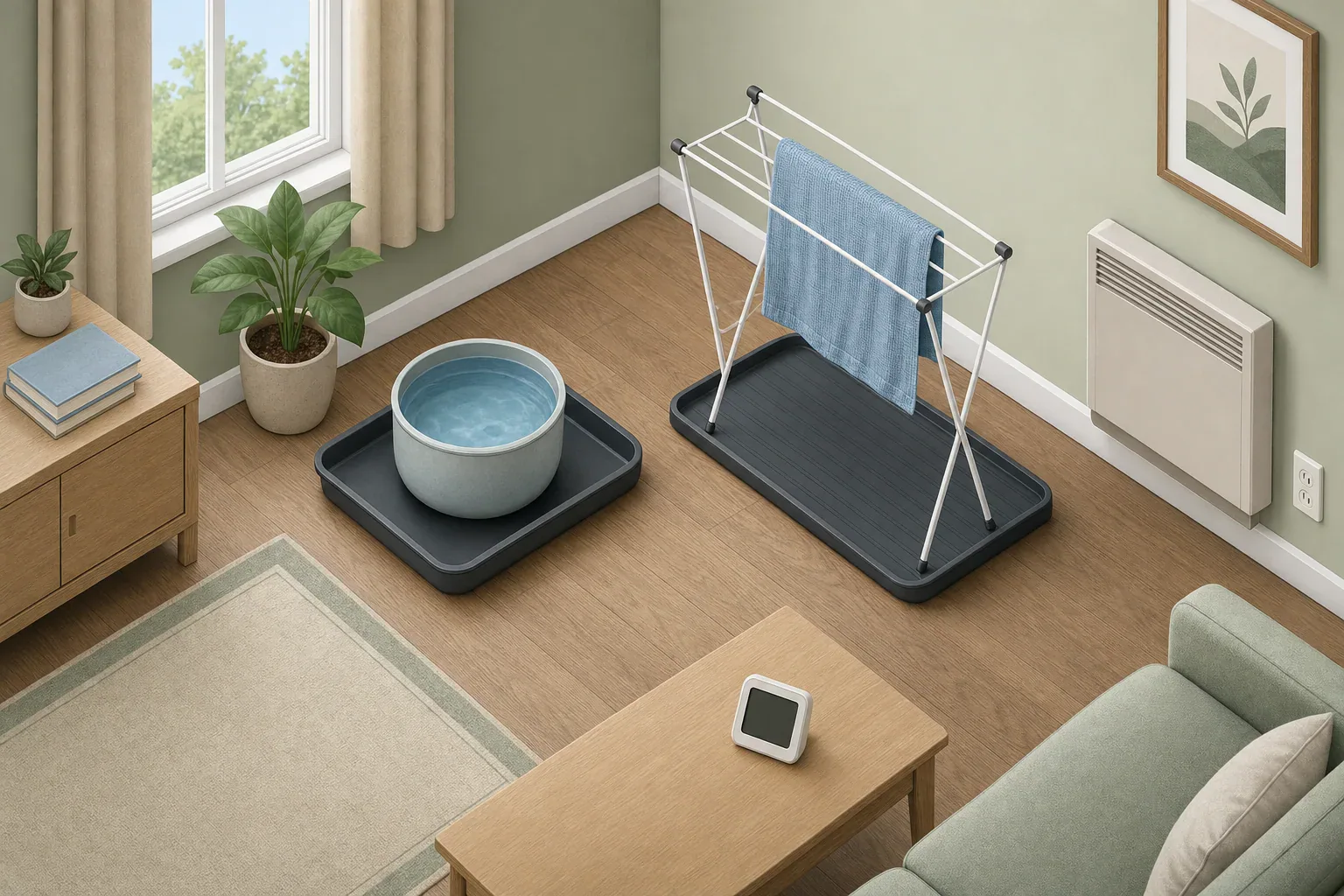
| Open water container | Provides an exposed surface from which water can evaporate. | Its room-level effect may be too small to distinguish from normal RH variation, especially where air is exchanged frequently. | Use a stable container on a washable, water-resistant tray, far from electronics, outlets, and walkways. |
| Water in a warmer room location | Warmer conditions can affect evaporation. | A heating appliance, register, radiator, or stove is not automatically a safe place for water. | Do not put water on heating equipment. Keep water and wet materials away from portable electric heaters and follow the equipment manufacturer’s instructions. |
| Damp-cloth evaporation | Spreads water over fabric until the cloth dries. | The effect declines as the cloth dries, and drips can wet finishes and absorbent materials. | Use a clean, wrung-out cloth on a freestanding, nonheated rack over a drip tray. |
| Bathroom moisture transfer | Opening an interior door after bathing may allow some moisture to mix with adjacent air. | The moisture increase may be brief and can leave the bathroom or nearby surfaces damp. | Do not disable normal bathroom ventilation or leave wet surfaces wet to humidify another room. |
Safe limits for passive moisture methods
Stop adding moisture if room RH reaches 50%, and stop sooner if water condenses on windows, walls, or pictures, or if nearby materials become damp. The U.S. Environmental Protection Agency’s humidifier guidance gives these limits because excess moisture can support biological growth and damage materials. The limit concerns room moisture, not the particular device or method used to add it.
A lower RH may be necessary in cold weather. EPA notes that excessive indoor humidity can condense on cold surfaces, and its home moisture-control guidance shows that colder outdoor conditions can require lower indoor humidity to avoid condensation. Window quality, insulation, and outdoor temperature all affect when condensation begins.
Stop immediately after a spill, if a container is unstable, if water reaches electrical equipment or finished materials, or if a tray, cloth, or nearby surface remains damp or develops an odor or visible film.
Method-specific safety and hygiene
Open water containers
Choose a level location where the container cannot be kicked, tipped, or reached by children or pets. Avoid shelves above electronics and locations where spilled water could reach an outlet, power strip, cord, paper, or flooring that can be damaged.
Standing water and wet surfaces can support molds and bacteria. EPA notes this in its overview of biological pollutants indoors. As a conservative hygiene practice, empty the container, wash it, rinse it, and let it dry rather than continually topping it off. EPA’s humidifier-care guidance similarly recommends using fresh water daily and not allowing water to stand for extended periods. An open bowl is not an ultrasonic humidifier, however, so appliance-specific aerosol claims should not be assumed for a bowl.
Water and heat sources
Do not use a portable electric heater as part of a DIY moisture setup. The U.S. Consumer Product Safety Commission’s portable electric-heater guidance says to keep electric heaters away from water, place them on stable, level surfaces, and keep combustible materials at least three feet away. Never drape a damp cloth over any heater, and do not place a water container on a radiator, register, stove, or heating appliance unless its manufacturer specifically permits that use.
Damp cloths
A clean, wrung-out cloth on a nonheated drying rack can evaporate water without a powered device. Put a waterproof drip tray beneath it and keep the setup away from walls, furniture, outlets, cords, and heaters. Launder the cloth after use and allow it to dry fully before storing it. Discontinue the method if it leaves a surface persistently damp.
Bathroom moisture
Opening an interior bathroom door after bathing can move some humid air into an adjoining area, but it is not controlled or sustained humidification. Do not turn off or block normal exhaust ventilation solely to retain moisture. If the bathroom mirror, walls, ceiling, or window stay wet, focus on drying and ventilating the bathroom rather than sending more moisture elsewhere. See Bathroom Mold Prevention: Exhaust Fan Timing and Humidity Control for bathroom-specific moisture management.
Checklist for consistent before-and-after RH readings
- Use one hygrometer. Read its manual for stated accuracy, operating limits, and the time it needs to settle after being moved.
- Choose one fixed location. Use a dry, representative part of the room rather than a spot next to the water, damp cloth, bathroom doorway, heater, sunny window, or HVAC vent.
- Avoid misleading placement. This follows the general placement principle in AcuRite’s humidity-monitor instructions, which advise keeping the monitor away from direct sun, heat sources, vents, and humidity sources.
- Record a baseline. Note RH and temperature at the same interval before adding moisture.
- Change one factor. Test one passive method at a time rather than using a bowl, cloth, and bathroom moisture together.
- Keep conditions comparable. As practical, keep doors, windows, HVAC operation, cooking, bathing, and occupancy similar for each comparison.
- Leave the monitor in place. Do not move it toward the moisture source for the after-reading.
- Repeat on another comparable occasion. A result that does not recur may reflect ordinary changes in temperature, weather, or ventilation.
- Compare the change with stated accuracy. A small change that is close to the hygrometer’s stated accuracy may be measurement uncertainty rather than a room-wide effect.
- Inspect surfaces. Check windows, exterior-wall corners, curtains, rugs, and nearby furniture for condensation or dampness.
How to interpret the result
A repeatable increase at the fixed monitoring location suggests that the method added enough moisture to be detected under those conditions. It does not establish a guaranteed output rate or prove that every part of the home changed equally. If readings do not show a repeatable difference, adding more containers may add spill risk and cleaning work without solving the limitation.
If RH rises toward 50% or condensation appears, stop rather than trying to extend the test. For more context on humidity targets and cold-weather condensation, see Best Indoor Humidity Level to Prevent Mold and How to Stop Condensation on Windows.
What passive methods do not replace
Passive methods do not provide a rated moisture output, automatic humidity control, or a dependable answer for every room. This guide does not cover homemade powered foggers, electrical assemblies, or manufactured humidifier selection, sizing, placement, water choice, or cleaning. If a controlled, measurable moisture output is needed, use a purpose-built product according to its manual rather than modifying electrical equipment or combining water with a heat source.
Frequently asked questions
Will a bowl of water humidify an entire room?
A bowl can evaporate water, but its room-level effect may be too small to distinguish from normal humidity variation, particularly in a large or well-ventilated space. Use one hygrometer in a fixed representative location and repeat the comparison under similar conditions.
Does a wet towel work better than a bowl of water?
A damp cloth spreads water over fabric until it dries, but no universal room-output comparison is supported. Use a clean, wrung-out cloth on a freestanding nonheated rack over a drip tray, away from outlets, heaters, walls, and furniture.
Can I put water on or beside a heater to make it evaporate faster?
Do not put water on a radiator, register, stove, or heating appliance unless its manufacturer explicitly allows it. Keep water and damp materials away from portable electric heaters, and never drape a cloth over a heater.
When should I stop using a DIY humidifier method?
Stop at 50% RH, or sooner if condensation appears on windows, walls, or pictures, or if materials nearby become damp. A lower RH may be necessary when cold surfaces begin to collect condensation.
Summary
A passive DIY method may add measurable moisture, but its output is variable and should not be assumed from the setup alone. Test one low-risk method at a time, measure from a fixed representative location, refresh and dry wet materials, keep water away from heating and electrical equipment, and stop at 50% RH or at the first sign of condensation.
Recommended next:
- Best Humidity Level for Winter: Comfort vs Health vs Mold Risk
- Ultrasonic vs Evaporative Humidifiers: Pros, Cons, and Which to Buy
- Humidifier White Dust: Causes, Health Concerns, and Fixes
- How to Clean a Humidifier Properly (And How Often You Really Should)
- Ideal Indoor Humidity in Winter: Comfort vs Mold Risk
- Humidifier Cleaning Routine: How to Prevent Slime and Odors
- Clear sizing logic (room size → CADR/ACH)
- HEPA vs carbon explained for real use-cases
- Humidity + ventilation basics to reduce mold risk