
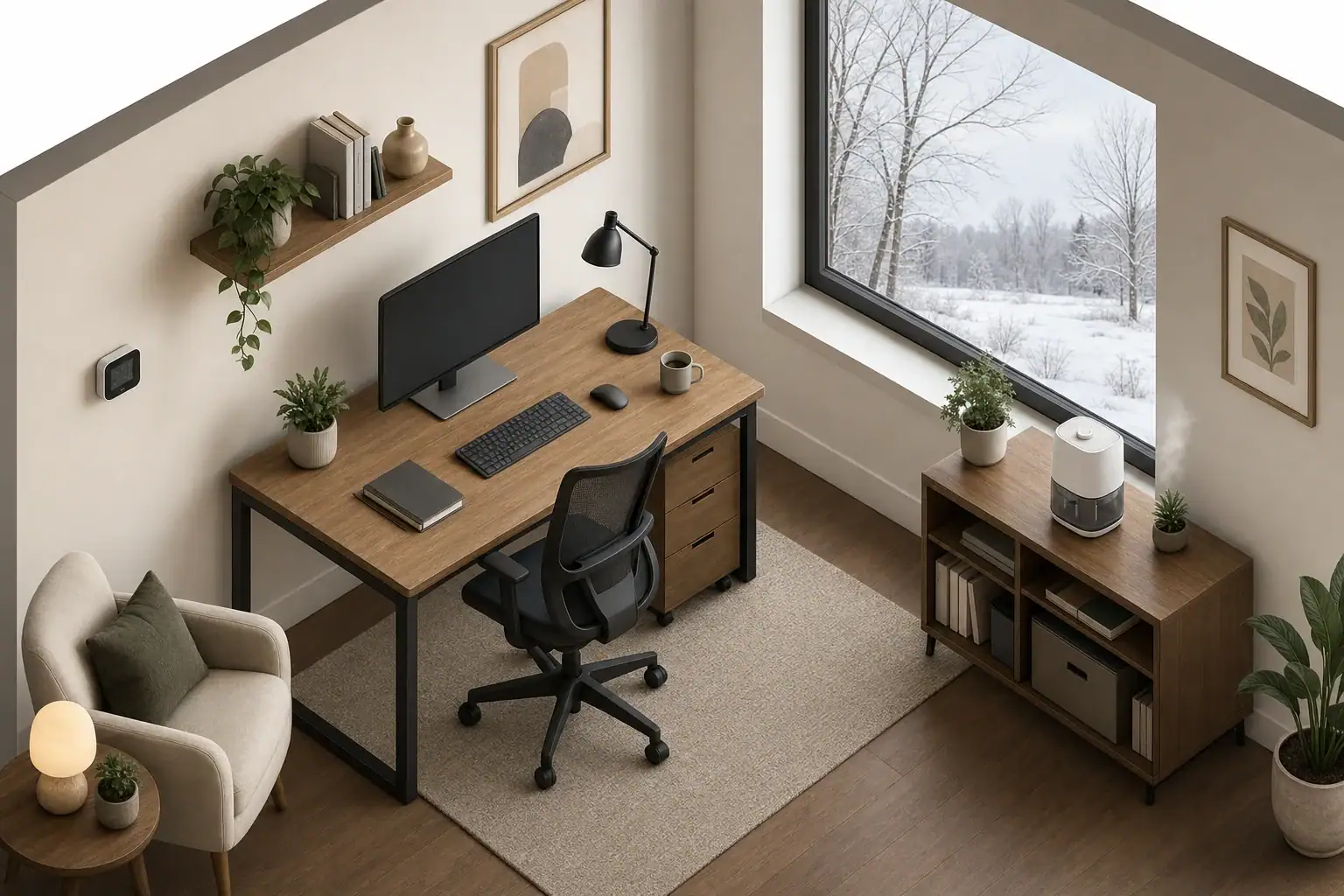
Can a humidifier help with dry eyes?
Yes—sometimes. A humidifier may improve comfort when unusually dry indoor air is contributing to faster tear evaporation. This is most plausible when discomfort is worse in heated or air-conditioned rooms, around a fan or supply vent, or during prolonged screen use.
The TFOS DEWS II dry-eye management report identifies low relative humidity and air movement as environmental conditions that can increase tear instability and evaporation. It includes humidification as one possible environmental adjustment, not as a remedy for every cause of dry-eye symptoms.
Direct evidence for symptom relief is limited. In a randomized crossover study of 44 computer users, one hour of localized desktop humidification improved reported comfort for some participants and improved one tear-film measure. Two other tear measures did not differ significantly. Because this was a small, short-term study of a local device during computer work, it does not establish long-term benefits, an ideal humidity level, or results for every humidifier or person.
Dry-air clues versus warning signs
Patterns in a room can suggest that dry air is contributing, but they cannot diagnose dry-eye disease or rule out another eye problem.
| Clues room conditions may contribute | Reasons to seek professional advice |
|---|---|
| A hygrometer shows low relative humidity in the room where symptoms occur. | Symptoms persist, worsen, or interfere with daily activities. |
| Discomfort is worse in heated or air-conditioned rooms. | The eye is very red or significantly painful. |
| Symptoms improve after leaving the dry environment. | There is light sensitivity, discharge, blurred vision, or another vision change. |
| A fan, vent, or draft blows toward the face. | Symptoms started after an injury, chemical exposure, or a suspected object in the eye. |
| Dry skin, chapped lips, or static electricity occur at the same time. | There is a sudden change in vision. |
The American Academy of Ophthalmology advises evaluation for persistent or worsening dry-eye symptoms and for symptoms that affect normal activities. Pain, marked redness, light sensitivity, discharge, or blurred or changing vision should not be managed by increasing room humidity. Eye injury, chemical exposure, or sudden vision changes need prompt professional advice.
Use a measurement-first humidity trial
There is no established best indoor humidity level specifically for dry eyes. The U.S. Environmental Protection Agency (EPA) recommends keeping indoor relative humidity roughly between 30% and 50% for general moisture management. Its humidifier guidance says not to exceed 50% while using a humidifier. These are moisture-management limits, not a promise of eye relief.
- Record a baseline. Note the room’s relative humidity and when discomfort occurs before using the humidifier.
- Reduce direct airflow first. Redirect a fan or HVAC vent that blows toward your face. A continuing draft can increase evaporation even if room humidity rises.
- Increase output gradually. If the room is dry, start with a low practical setting and check the hygrometer rather than judging by visible mist.
- Compare similar conditions. Track humidity and comfort while doing a similar activity in the same room, such as working at the same desk.
- Watch for excess moisture. Lower the output, relocate the unit, or stop using it if windows or nearby surfaces develop condensation, furnishings become damp, or a musty odor appears.
Example: If a representative room reading is below the EPA’s general range and discomfort reliably occurs at that desk, a cautious trial could mean redirecting the vent, operating the humidifier on a low setting, and rechecking the room reading. If moisture appears on a window or nearby surface, reduce or stop output rather than trying to reach a higher number. This is an observation method, not a test for an eye condition.
Where to place a hygrometer
Put the hygrometer in the room where you spend time, around normal breathing-zone height, with open airflow around it. Keep it away from windows, exterior doors, direct sunlight, HVAC outlets, and the humidifier’s direct plume. Otherwise, it may measure a cold, drafty, or locally damp spot instead of typical room conditions.
This placement approach is adapted from the EPA’s general guidance on siting indoor air sensors; it is not a clinical dry-eye protocol. If readings differ markedly across the room, compare more than one location before changing humidifier output.
Desktop and overnight humidifier use
A desktop unit may alter conditions near a workstation without changing humidity throughout the room. Keep the hygrometer outside the direct plume, and do not aim mist or fan airflow at your face. Follow the product manual for placement, clearance, and operating instructions.
Running a humidifier overnight does not guarantee relief by morning. If you use one while sleeping, check humidity at bedtime and again in the morning, and inspect nearby windows and surfaces for moisture. Morning discomfort alone does not prove that bedroom air is the cause.
Humidity measurement and cleaning checklist
- Measure humidity before deciding that more moisture is needed.
- Place the hygrometer away from the humidifier plume, windows, doors, vents, and direct sun.
- Recheck room humidity after the unit has been operating.
- Keep relative humidity at or below the EPA’s 50% upper limit for humidifier use.
- Reduce output or stop if condensation, damp furnishings, or a musty odor develops.
- Empty, dry, and refill a portable humidifier daily, as the EPA advises.
- Clean a portable unit every third day and follow its manufacturer instructions for the exact process.
- Use low-mineral water when appropriate for the device and recommended by its instructions.
- Inspect filters, reservoirs, seals, and nearby surfaces; replace or service parts on the manufacturer’s schedule.
Cleaning methods are not interchangeable among humidifiers. Reservoir materials, filters, wicks, heating elements, and approved cleaning agents vary by model. Do not substitute a generic vinegar, bleach, peroxide, or descaling routine for the procedure in your unit’s manual. For more general maintenance context, see Humidifier Safety: Bacteria Risk, Cleaning, and Safe Humidity Limits.
What a humidifier cannot tell you
A response to humidification—or no response—is not a diagnostic test. A humidifier cannot determine whether symptoms relate to reduced tear production, eyelid oil-gland problems, medicines, contact lenses, incomplete eyelid closure, inflammation, injury, or another eye condition.
It also does not purify the air or remove allergens. Its role is limited to adding moisture, so it may be unnecessary when a representative room reading is already in a moderate range. More moisture is not automatically better: excess indoor moisture can create condensation and dampness problems.
When to stop home experimentation
Stop treating humidity as the main variable if discomfort continues after clearly dry room conditions have been corrected, becomes more frequent, or affects reading, driving, work, or other everyday activities. Arrange an eye-care evaluation rather than continually increasing humidifier output.
Seek prompt professional advice for significant pain or redness, light sensitivity, discharge, blurred or changing vision, or symptoms after an injury, chemical exposure, or suspected object in the eye.
Related guides: Humidifier Placement: Near Bed, Near Vent, or Center of Room? • Humidifier Running All Night: Benefits, Risks, and Settings • Best Indoor Humidity Level to Prevent Mold
Frequently asked questions
Should I use a humidifier if my room is already moderately humid?
Probably not as the main response to dry-eye symptoms. If a representative hygrometer reading is already in a moderate range, adding more moisture may create dampness without addressing the cause of the discomfort.
Can I run a humidifier overnight for dry eyes?
You can assess overnight use cautiously, but it does not guarantee relief by morning. Check humidity before bed and in the morning, inspect nearby surfaces for moisture, and reduce or stop output if condensation or dampness develops.
Where should I place a hygrometer when testing a humidifier?
Place it in the occupied room around normal breathing-zone height with open airflow. Keep it away from windows, doors, HVAC outlets, direct sunlight, and the humidifier’s direct plume so the reading better represents the room.
Bottom line
A carefully maintained humidifier may be a useful environmental aid when a hygrometer confirms dry indoor air and symptoms track that environment. Measure first, make restrained adjustments, keep humidity at or below the EPA’s humidifier-use limit, and stop if condensation or dampness develops. Persistent or concerning eye symptoms need professional evaluation because humidity cannot identify or manage the underlying cause.
Recommended next:
- Best Humidity Level for Winter: Comfort vs Health vs Mold Risk
- Ultrasonic vs Evaporative Humidifiers: Pros, Cons, and Which to Buy
- Humidifier White Dust: Causes, Health Concerns, and Fixes
- How to Clean a Humidifier Properly (And How Often You Really Should)
- Ideal Indoor Humidity in Winter: Comfort vs Mold Risk
- Humidifier Cleaning Routine: How to Prevent Slime and Odors
- Clear sizing logic (room size → CADR/ACH)
- HEPA vs carbon explained for real use-cases
- Humidity + ventilation basics to reduce mold risk