
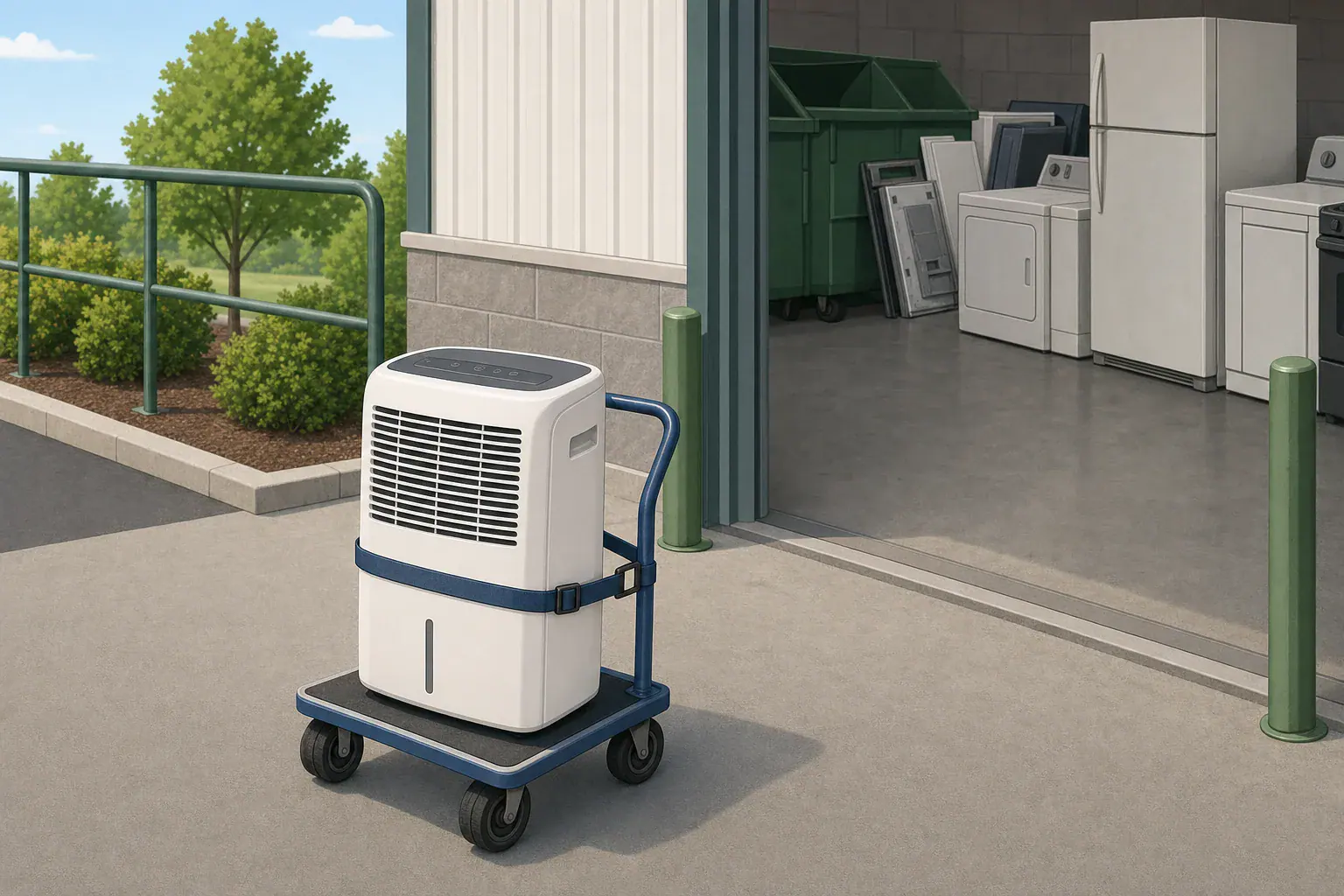
How to dispose of a dehumidifier without releasing refrigerant
Most conventional compressor dehumidifiers are refrigerated household appliances. Do not cut tubing, dismantle the cabinet, puncture components, or intentionally release refrigerant. Keep the unit intact and arrange disposal through a program that specifically accepts refrigerant appliances.
The U.S. Environmental Protection Agency (EPA) lists dehumidifiers among refrigerated household appliances and advises owners to check with municipalities, utilities, retailers, and recyclers. There is no single national curbside rule for consumers: whether local trash collection is available depends on state and local programs.
Check whether the unit contains refrigerant
Look for the model rating plate, usually on the back or side of the unit, and check the manual if it is available. A compressor dehumidifier commonly has a line for refrigerant, an R-number, a refrigerant charge by weight, or compressor information. GE Appliances, for example, says its dehumidifiers list refrigerant type and amount on the model rating plate.
Not every moisture-control product has a refrigerant circuit. Disposable moisture-absorber tubs do not, and some small electric units use a different design. If the label is missing or you are uncertain, give the model number and a description of the appliance to the receiving program. Treat an uncertain unit as refrigerant-bearing unless the program confirms otherwise. A unit that no longer cools is not proof that its sealed system is empty.
Why the disposal route matters
EPA safe-disposal procedures require refrigerant to be recovered before a refrigerant appliance is buried, shredded, or dismantled. The final disposer must recover the refrigerant or verify that it was recovered previously. EPA’s safe-disposal guidance for household appliances explains these responsibilities for disposal facilities.
For an owner, the practical step is to use a receiving program that accepts the appliance intact and can explain its recovery process. A facility may recover refrigerant itself, use a downstream contractor, or require proof of prior recovery. Do not assume that a general scrap yard or electronics-recycling event accepts refrigerated appliances.
EPA’s waste-stream rules do not mean that every discarded small appliance must first go to an EPA-certified HVAC technician. Ask the facility who handles recovery and whether it requires any documentation before arranging separate service.
Compare dehumidifier disposal routes
| Route | When it may fit | Confirm before you go |
|---|---|---|
| Municipal appliance program | Your city or county offers appliance drop-off or scheduled collection | Residency, appointment, fee, accepted locations, and intact-unit requirements |
| Electric utility program | Your utility has an appliance-recycling offer for eligible customers | Account eligibility, working-condition rules, size limits, and pickup conditions |
| Retailer or manufacturer take-back | You are replacing the appliance or an applicable take-back program exists | Purchase requirement, covered models, haul-away cost, and refrigerant handling |
| Appliance recycler or scrap facility | The facility explicitly accepts sealed refrigerant appliances | Whether it recovers refrigerant or requires proof of prior recovery |
| Recovery service followed by recycling | A recycler will accept the appliance only after recovery | Required documentation, total cost, and confirmation that the recycler will then accept it |
Do not leave the appliance at the curb unless the local program has authorized or scheduled collection. EPA recommends scheduled pickup because an unattended appliance can be damaged before the designated handler receives it.
Call-ahead checklist
Have the model number and any rating-plate refrigerant information ready. Ask the program:
- Do you accept intact household dehumidifiers?
- Do you accept nonworking units?
- Does the unit need to remain sealed and intact?
- Who recovers the refrigerant?
- Must refrigerant be removed before arrival, and if so, what proof is accepted?
- Is there a fee, appointment, proof-of-residency, or utility-account requirement?
- Is service drop-off, curbside pickup, or in-home pickup?
- What transport or preparation instructions apply?
- Can you accept a unit with visible cabinet or tubing damage?
Record the program name, address, appointment time, quoted fee, and the department or person who confirmed acceptance. Conditions and fees can change, including between facilities operated by the same local program.
Worked example: verify a drop-off before loading
Hypothetical example: A homeowner has a portable compressor dehumidifier and finds a county appliance-recycling page. Before moving it, they read the rating plate, note the model number and refrigerant line, and call the listed facility.
- They ask whether the facility accepts an intact, nonworking dehumidifier rather than assuming an electronics drop-off will take it.
- They ask for the current fee, whether an appointment and proof of residency are required, and whether the quoted location is open on the planned day.
- They ask who recovers refrigerant and whether any recovery documentation is needed before drop-off.
- They confirm whether the program has special instructions for moving the unit and for reporting visible damage.
- Only after receiving those answers do they secure the appliance for the trip.
This process is more reliable than relying on an old fee listing or a generic recycling search result. Utility programs can be especially conditional. For example, Atlantic City Electric’s appliance-recycling program sets customer, working-condition, and bundled-pickup conditions for eligible dehumidifiers, illustrating why current program terms must be checked.
Move the unit without damaging it
- Unplug the appliance and drain loose water from the bucket or drain connection.
- Leave the cabinet, compressor, coils, valves, and tubing intact.
- Secure the appliance against shifting, crushing, or puncture during transport.
- Follow the orientation and handling directions in the actual model manual.
- If the cabinet or tubing is visibly damaged, call the receiving program before loading or moving it.
Instructions can vary by model and refrigerant. For example, the manual for Midea’s MAD50PS1BQGR model warns against piercing or burning the appliance and says refrigerant should be recovered rather than discharged. Those instructions are model-specific, so consult the manual for the unit you own.
Frequently asked questions
Can I put a dehumidifier out with regular trash?
Do not assume regular trash collection accepts it. Local rules control curbside disposal, and a compressor dehumidifier may require scheduled collection or drop-off at a program that accepts refrigerant appliances. Confirm the instructions with your local program before placing it at the curb.
Will a recycler accept a dehumidifier that no longer works?
Some programs accept intact nonworking units, while others, particularly incentive-based utility programs, may require working equipment. Ask whether the facility accepts your unit’s condition and whether it requires refrigerant recovery before arrival.
What should I do if the dehumidifier is damaged?
Do not cut, crush, or dismantle it. Contact the intended receiving program, describe the visible damage, and follow its instructions before moving the appliance. The program can determine whether it accepts the unit and how it should be handled.
Do I need to hire an HVAC technician before recycling a dehumidifier?
Not necessarily. A municipal program or appliance recycler may perform refrigerant recovery or use a contractor, while another facility may require prior recovery and documentation. Ask the receiving facility about its process before booking a separate service.
Disposal summary
Identify the appliance, keep its sealed refrigerant system intact, and choose a program that explicitly accepts dehumidifiers or other refrigerated appliances. Confirm acceptance, fees, eligibility, pickup or drop-off conditions, recovery responsibility, and transport instructions before moving it.
Related guides: Desiccant vs. Compressor Dehumidifiers • How Does a Dehumidifier Work? • Storing Humidifiers and Dehumidifiers Off-Season
Recommended next:
- How to Size a Dehumidifier (Sq Ft, Pints/Day, and Real-World Tips)
- Desiccant vs Compressor Dehumidifiers: Which Is Better for Cold Rooms?
- Basement Dehumidifier Guide: Targets, Drainage, and Energy Use
- Dehumidifier Running Cost: How Much Electricity Will It Use?
- Dehumidifier Sizing: Liters/Day, Room Type, and Dampness Levels
- Basement Dehumidifier Setup: Drainage, Placement, and RH Targets
- Clear sizing logic (room size → CADR/ACH)
- HEPA vs carbon explained for real use-cases
- Humidity + ventilation basics to reduce mold risk