
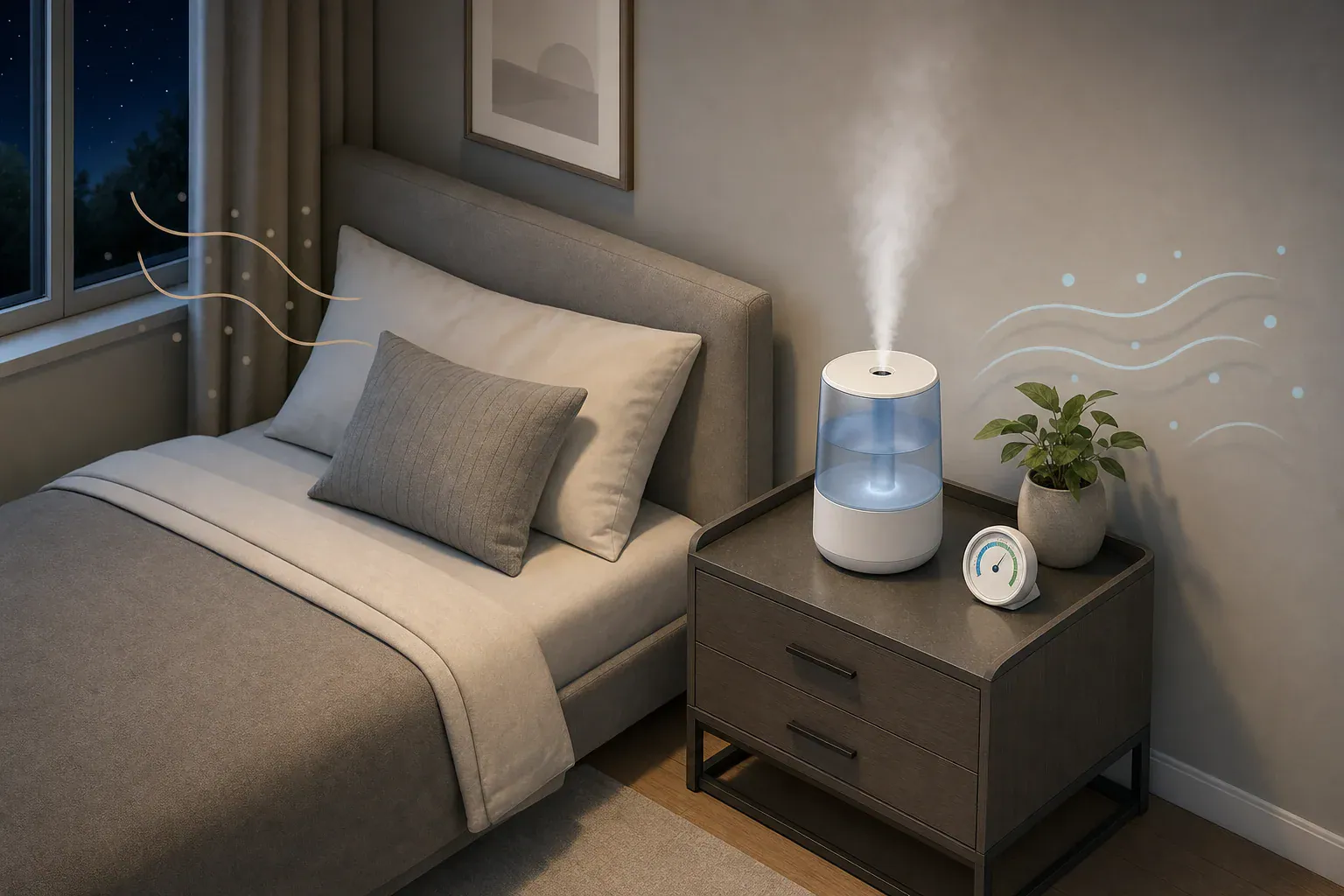
Does a humidifier help with snoring?
Possibly—but only in a narrow situation. A room humidifier may make breathing more comfortable if bedroom air is dry enough to irritate the nose or throat, or if dryness accompanies mild nasal stuffiness. The U.S. Environmental Protection Agency (EPA) says home humidifiers can relieve dry-nose and dry-throat discomfort. That does not establish that an ordinary bedroom humidifier reliably reduces snoring.
Snoring can have many contributors, including sleep position, alcohol, nasal congestion, and upper-airway narrowing. A humidifier cannot correct airway anatomy or treat obstructive sleep apnea. Evidence about humidification built into breathing equipment should not be assumed to apply to a room humidifier.
When a humidifier is—and is not—likely to help
| Situation | Likely humidifier role |
|---|---|
| Measured bedroom air is dry, with a dry nose or throat | May improve dryness-related comfort. Any change in snoring is uncertain. |
| Dryness and snoring seem worse during the heating season | A measured home trial may be reasonable if the room is actually dry. |
| A cold or allergies cause nasal symptoms | May ease dryness, but does not treat the underlying infection or allergy. |
| Snoring clearly tracks with back sleeping or alcohol use | Unlikely to address the main contributor. |
| Persistent loud snoring, breathing pauses, gasping, or daytime sleepiness | Do not rely on humidification; discuss these symptoms with a healthcare professional. |
Dry mouth on waking is not proof that the bedroom is dry. Mouth breathing and other factors can cause it. Check the room with a hygrometer, and interpret a single device cautiously; readings can vary by placement and sensor accuracy. See why inexpensive humidity sensors can disagree.
A measured home trial for dryness-associated snoring
This is a practical observation method, not a medical test. Its purpose is to see whether changes in measured humidity, dryness symptoms, and snoring appear to move together.
- Record baseline nights. For several nights before using the humidifier, note bedtime and morning relative humidity, nasal or throat dryness, stuffiness, and snoring. Use the same observation method each night—for example, the same partner rating.
- Confirm that moisture is needed. Start only when the bedroom seems dry and the hygrometer supports that observation. The EPA recommends using a hygrometer and keeping indoor relative humidity at no more than 50%.
- Use the lowest practical output. Raise moisture gradually rather than running the unit at maximum output. If the room reaches 50% relative humidity, lower the setting or turn the unit off.
- Keep other factors steady where practical. Keep the bedroom, bedtime routine, sleep position, and alcohol use similar during baseline and trial nights. Otherwise, a change in snoring cannot reasonably be attributed to humidity alone.
- Log morning results. Record humidity, dryness, stuffiness, snoring, and any condensation or dampness on nearby surfaces.
- Look for a repeatable pattern. A useful result would be improved comfort across several appropriately humidified nights, without condensation or new symptoms. One quieter night does not show that the humidifier caused the difference.
Set up and maintain the humidifier safely
Follow the instructions for the specific model. Put it on the firm, level, water-resistant surface specified in its manual, keep required clearances, and direct mist away from bedding, walls, furniture, and electrical items. Manufacturer requirements vary by device; for example, one Vicks model manual specifies a firm, level, water-resistant surface and a minimum distance from walls, but that distance is not universal.
The EPA advises users of portable humidifiers to empty, dry, and refill the tank daily, and to clean the unit every third day. It also notes that low-mineral or distilled water can reduce mineral dispersal. The EPA’s humidifier care guidance should be read alongside the appliance manual, especially if the manual gives a more specific cleaning process.
The Centers for Disease Control and Prevention also advises emptying humidifier water daily and regularly cleaning and air-drying the appliance because germs can spread through mist from a poorly maintained unit. See the CDC humidifier cleaning resource. For water-choice details, see distilled versus tap water in humidifiers.
Do not add essential oils, fragrances, or other substances unless the manufacturer specifically permits them for that model.
When to reduce output or stop the trial
- Lower the output or relocate the unit if condensation forms on windows, walls, furniture, or nearby surfaces. This is consistent with EPA guidance.
- Stop using it if bedding or flooring becomes damp, or if a musty odor develops. Clean and dry the unit before considering further use.
- Stop if coughing, wheezing, allergy symptoms, or other respiratory symptoms appear or worsen. Seek medical advice if symptoms persist or are concerning.
- Do not add more moisture once the room reaches 50% relative humidity.
When snoring needs medical discussion
Snoring alone does not diagnose sleep apnea. However, the National Heart, Lung, and Blood Institute lists frequent loud snoring, breathing that starts and stops, gasping, and daytime sleepiness as symptoms of sleep apnea. Discuss these signs with a healthcare professional rather than extending a humidifier experiment.
Even if humidified air seems to improve dryness or makes snoring seem less noticeable, it does not rule out another cause. Do not let a temporary comfort improvement delay an assessment of persistent or disruptive snoring.
Frequently asked questions
What humidity setting should I use for snoring?
There is no evidence-based humidifier setting that treats snoring. Use the lowest output that improves dryness-related comfort, measure the room with a hygrometer, and do not let indoor relative humidity exceed 50%.
Can a humidifier treat sleep apnea?
No. A room humidifier does not treat obstructive sleep apnea or correct airway narrowing. Frequent loud snoring, breathing pauses, gasping, or daytime sleepiness warrant discussion with a healthcare professional.
Should I use distilled water in a humidifier?
Low-mineral or distilled water can reduce mineral dispersal from a humidifier. Regardless of water type, empty, dry, refill, and clean the appliance as directed by the manufacturer and public-health guidance.
Bottom line
A bedroom humidifier is best viewed as a limited comfort trial when measured air is dry and nasal or throat dryness accompanies snoring. Track humidity and symptoms, keep relative humidity at or below 50%, and maintain the unit carefully. It is not a general remedy for snoring or a treatment for sleep apnea.
Related guides: Best Humidity Level for Winter: Comfort vs Health vs Mold Risk • How to Clean a Humidifier Properly • Humidifier Placement: Near Bed, Near Vent, or Center of Room?
Recommended next:
- Best Humidity Level for Winter: Comfort vs Health vs Mold Risk
- Ultrasonic vs Evaporative Humidifiers: Pros, Cons, and Which to Buy
- Humidifier White Dust: Causes, Health Concerns, and Fixes
- How to Clean a Humidifier Properly (And How Often You Really Should)
- Ideal Indoor Humidity in Winter: Comfort vs Mold Risk
- Humidifier Cleaning Routine: How to Prevent Slime and Odors
- Clear sizing logic (room size → CADR/ACH)
- HEPA vs carbon explained for real use-cases
- Humidity + ventilation basics to reduce mold risk