
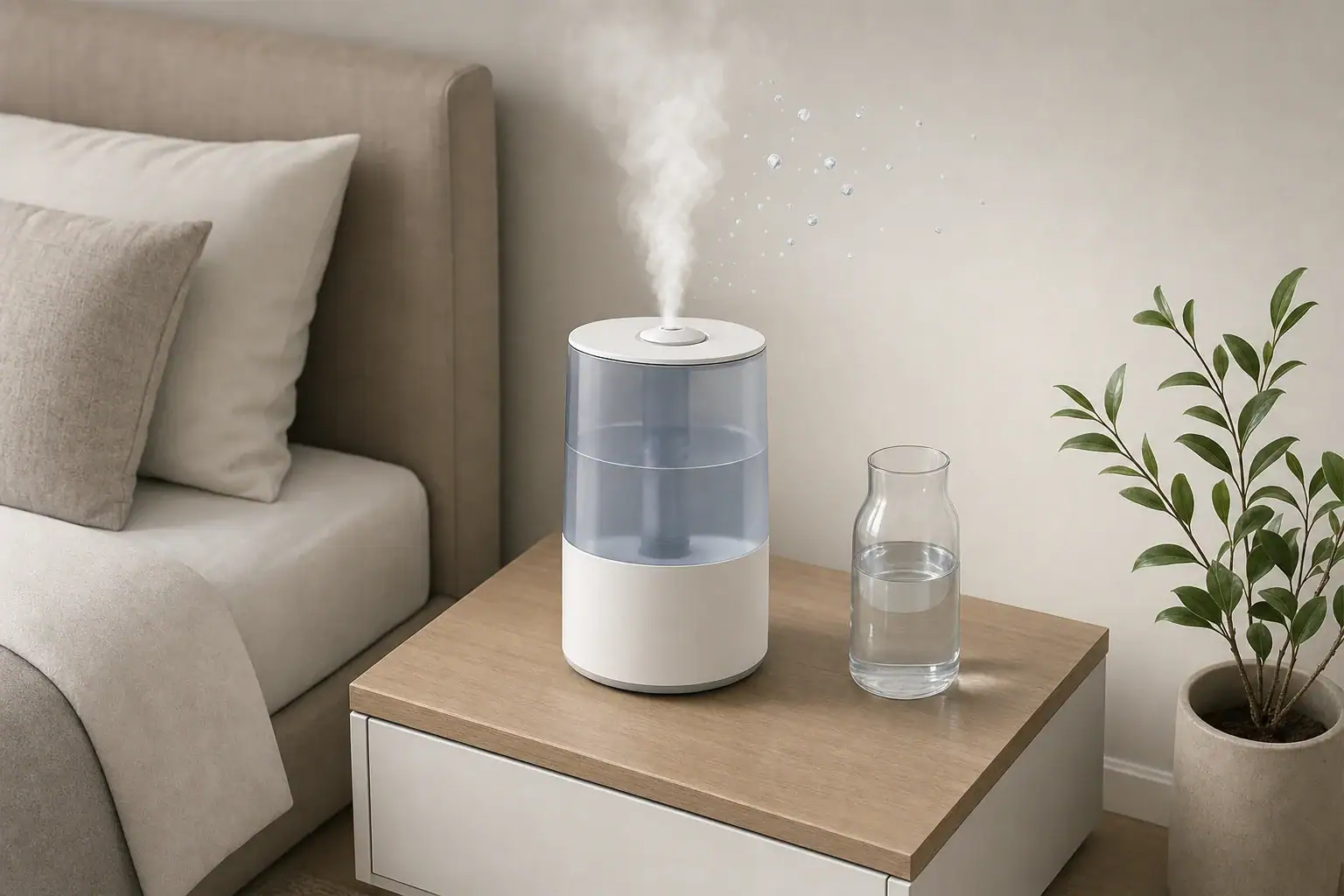
Distilled water is generally the better choice for humidifiers because it contains far fewer dissolved minerals than tap water, reducing white dust and mineral buildup.
Tap water may still be acceptable when the humidifier instructions permit it, especially in evaporative models, but maintenance needs may increase. The practical choice depends on water hardness, humidifier type, operating time, and how often the unit is cleaned.
Quick answer
- Use distilled or low-mineral water to minimize white dust, especially in ultrasonic humidifiers.
- Aim for roughly 30% to 50% indoor relative humidity as general guidance.
- Reduce output if humidity exceeds 50% or condensation appears on windows and nearby surfaces.
- Empty, rinse, and refill the tank daily when the humidifier is in regular use.
- Clean the unit about every three days, or according to its instructions and visible buildup.
Distilled Water vs Tap Water: The Main Difference
Tap water usually contains naturally occurring dissolved minerals, including calcium and magnesium. The amount varies by local water source and treatment system. Water with a higher concentration of these minerals is commonly described as hard water.
Distilled water is made by turning water into vapor and condensing that vapor back into liquid. This process removes most dissolved minerals. It does not mean that an opened container remains sterile, so clean handling and routine humidifier maintenance are still necessary.
The difference matters because a humidifier does not always leave minerals behind in the tank. Some designs can disperse tiny mineral particles along with water droplets. After the droplets evaporate, the dry particles may settle on furniture, electronics, floors, and other surfaces as white dust.
Filtered water is not automatically equivalent to distilled water. Common pitcher, faucet, and refrigerator filters may improve taste or reduce selected substances without removing most dissolved minerals. Reverse-osmosis and demineralization systems can reduce mineral content substantially, but their results depend on system condition and water quality.
How Humidifiers Create White Dust and Scale
White dust is most closely associated with ultrasonic humidifiers. These units use rapid vibration to produce a fine mist from the water in the reservoir. If the water contains minerals, some of those minerals can travel into the room with the mist.
The amount of dust depends on several factors:
- Water hardness: More dissolved mineral content generally means greater white-dust potential.
- Daily water use: A unit that disperses one gallon per day introduces more water-derived material than one using a fraction of that amount.
- Operating time and output: Long runtimes and high mist settings can increase deposits.
- Room airflow: Fans, supply vents, and open doors can spread fine residue beyond the immediate area.
- Cleaning frequency: Existing scale can make surfaces harder to clean and can interfere with normal operation.
Scale is different from airborne white dust. Scale is the chalky or crusty material left inside the tank, base, heating chamber, or wick area as water evaporates. Distilled water reduces both problems, although small deposits can still develop from contamination, residual water, or incomplete mineral removal.
Example values for illustration.
| Water choice | Mineral level | White-dust potential | Practical note |
|---|---|---|---|
| Distilled water | Very low | Low | Usually the simplest option for limiting residue |
| Tap water | Varies by location | Low to high | Hard water can create substantial dust and scale |
| Basic filtered water | Often similar to tap water | Varies | Many filters do not remove dissolved minerals |
| Reverse-osmosis water | Generally low | Generally low | Performance depends on membrane condition |
| Demineralized water | Low | Low | Check the label and appliance instructions |
| Softened water | Minerals altered, not eliminated | Still possible | May add sodium or potassium to the water |
How Humidifier Type Changes the Water Choice
Ultrasonic humidifiers
Ultrasonic units have the strongest reason to use distilled or similarly low-mineral water. Because they mechanically create droplets from reservoir water, minerals and contaminants in that water can also become airborne. A demineralization cartridge may reduce residue, but its effectiveness and replacement interval depend on water hardness and usage.
Evaporative humidifiers
Evaporative models draw water through a wick while a fan moves air across the wet material. Many minerals remain in the wick rather than entering the room, so visible white dust is usually less common. However, tap water can shorten wick life by leaving stiff, discolored, or crusty deposits.
Distilled water may reduce wick buildup, but it does not eliminate the need to inspect and replace the wick. A permanently wet or heavily scaled wick can lose output and develop odors.
Warm-mist and steam humidifiers
Warm-mist units heat water before releasing moisture. Minerals are generally left behind in the heating chamber, where they form scale instead of widespread white dust. Hard tap water may therefore require more frequent descaling.
These appliances also introduce a burn risk from hot water or steam. They should be placed on a stable surface away from children, pets, bedding, curtains, and traffic paths.
How to Choose Water Without Guessing
Start with the humidifier’s instructions. Some units are designed for tap water, while others specifically recommend distilled or demineralized water. Follow any restrictions concerning water additives, cartridges, cleaning agents, or acceptable water sources.
If the instructions allow several options, use this practical checklist:
- Choose distilled water if an ultrasonic unit produces visible white residue.
- Consider low-mineral water if local tap water is hard or scale forms within a few days.
- Continue with tap water if the appliance permits it, residue is minimal, and routine cleaning remains manageable.
- Do not assume softened water is mineral-free. Conventional softeners exchange hardness minerals for sodium or potassium rather than removing all dissolved material.
- Avoid unapproved additives. Essential oils, fragrances, disinfectants, and inhalation products can damage a unit or release substances it was not designed to disperse.
Cost and convenience also matter. A humidifier using half a gallon each night would require about 15 gallons over 30 nights. That example can help a household compare the recurring cost of purchased distilled water with the cleaning time and replacement parts associated with tap water.
Water sold as purified may be processed by distillation, reverse osmosis, deionization, or another method. Check the stated treatment method rather than relying only on the word purified.
Troubleshooting White Dust, Scale, and Low Output
White powder appears around the room
First, confirm whether the humidifier is ultrasonic. Switch to distilled or verified low-mineral water, wipe nearby surfaces with a damp cloth, and clean the reservoir and base. If the model uses a demineralization cartridge, inspect or replace it according to its instructions.
Air purifiers may capture some airborne particles, but they do not address the source. Changing the water or humidification method is the more direct way to control mineral dust.
Crust forms inside the base
Scale indicates that water is evaporating and leaving minerals behind. Unplug the appliance and follow its descaling procedure. A manufacturer-approved soak may loosen deposits, but cleaning solutions should never be mixed unless the instructions explicitly call for it.
The humidifier runs but output falls
Reduced output can result from a scaled ultrasonic plate, coated heating element, clogged wick, blocked air intake, or incorrect assembly. Clean accessible components as directed. Replace consumable wicks or cartridges rather than scraping, modifying, or bypassing them.
There is a musty or stale odor
Odor often signals standing water, residue, or a saturated wick. Empty the tank, clean and dry the unit, and replace a wick that remains odorous after approved maintenance. Distilled water limits minerals but does not prevent microbial growth in neglected water.
Practical Water Choices in Common Home Scenarios
Bedroom with an ultrasonic humidifier
Distilled water is generally the practical choice when the unit runs near furniture, electronics, or dark surfaces where white dust is easy to see. Keep the mist outlet away from bedding, walls, and the sleeper’s face. Use a separate humidity meter if the built-in control does not reflect conditions across the room.
Living room with an evaporative humidifier
Tap water may be workable because the wick captures much of the mineral residue. Inspect the wick weekly during frequent use. If it becomes rigid quickly or output declines, lower-mineral water may reduce replacement frequency.
Home with very hard tap water
Hard water can create rapid deposits in any humidifier type. Distilled, reverse-osmosis, or appropriately demineralized water can simplify upkeep. If tap water is used, expect more frequent descaling and potentially shorter wick or cartridge life.
Occasional use during dry weather
For short, intermittent operation, either permitted water choice may be reasonable. The important step is not leaving unused water in the tank between sessions. Empty, rinse, and dry the appliance before storage.
Safe Humidity and Maintenance Planning
Water choice cannot compensate for excessive humidification. A general indoor target is about 30% to 50% relative humidity, although the comfortable and practical level varies with outdoor temperature, building construction, and room conditions.
During cold weather, condensation on windows or exterior walls may appear before the room reaches 50%. Treat condensation as a cue to reduce output, improve air circulation, or operate the humidifier for fewer hours. Damp surfaces should not remain wet.
For regular maintenance:
- Unplug the appliance before cleaning or moving it.
- Empty stagnant water and refill with fresh water daily during use.
- Rinse the tank and wipe accessible wet surfaces as directed.
- Clean approximately every three days, or more often if film or scale appears.
- Use only cleaning and descaling methods approved for the unit.
- Rinse thoroughly so cleaning residue is not dispersed into the room.
- Let components dry before extended storage.
- Inspect cords, plugs, seals, wicks, and cartridges for wear.
Place the humidifier on a stable, water-resistant surface with clearance around the air intake and mist outlet. Do not direct mist toward outlets, power strips, electronics, walls, wood furniture, or fabrics. Avoid extension cords unless the appliance instructions and applicable electrical guidance specifically allow them.
Humidifiers do not normally need ionization, ozone generation, or ultraviolet features to add moisture. Do not modify a unit or bypass its safety controls. Any optional feature should be used only as instructed, and it does not replace cleaning or humidity monitoring.
Example values for illustration.
| Goal or cue | Simple action | Useful tool | Maintenance note |
|---|---|---|---|
| Room below 30% | Increase output gradually | Humidity meter | Recheck after conditions stabilize |
| Room at 30% to 50% | Maintain or reduce runtime | Humidity meter | Continue daily water changes |
| Room above 50% | Lower output or turn unit off | Humidity meter | Check nearby surfaces for dampness |
| Window condensation | Reduce humidity and improve airflow | Visual inspection | Dry wet surfaces promptly |
| White dust | Use distilled or low-mineral water | Damp cleaning cloth | Clean the tank and base |
| Visible scale or film | Descale using approved instructions | Cleaning supplies | Increase cleaning frequency if needed |
Related guides: Best Indoor Humidity Level to Prevent Mold (With Seasonal Targets) • How to Clean a Humidifier Properly (And How Often) • Humidifier Placement: Near Bed, Near Vent, or Center of Room? • Humidifier Safety: Bacteria Risk, Cleaning, and Safe Humidity Limits
Key Takeaways
Distilled water is usually the most straightforward choice for reducing white dust and mineral scale, particularly in ultrasonic humidifiers. Tap water can be practical in some evaporative or warm-mist models when the instructions allow it, but harder water generally increases cleaning and part-replacement needs.
Whichever water is used, keep indoor relative humidity around 30% to 50% as general guidance and lower the setting if condensation or damp surfaces appear. Fresh water, regular cleaning, correct placement, and timely wick or cartridge replacement matter more than water choice alone.
Frequently asked questions
Is distilled water necessary for an ultrasonic humidifier?
Distilled water is not always required if the appliance instructions allow tap water, but it is usually the best option for ultrasonic humidifiers. Ultrasonic models can disperse dissolved minerals with the mist, which may create white dust and buildup. Low-mineral water can reduce those issues and simplify cleaning.
Can I use filtered water instead of distilled water in a humidifier?
It depends on the type of filter. Many basic pitcher, faucet, and refrigerator filters do not remove enough dissolved minerals to prevent white dust or scale. Water processed by reverse osmosis or demineralization may be a suitable lower-mineral alternative when the humidifier instructions permit it.
Why does tap water leave white dust around my humidifier?
White dust is usually dried mineral residue from the water, especially calcium and magnesium. It is most common with ultrasonic humidifiers because they create a fine mist directly from reservoir water. Switching to distilled or verified low-mineral water can reduce the residue.
Is softened water safe to use in a humidifier?
Softened water is not necessarily mineral-free because conventional water softeners typically exchange hardness minerals for sodium or potassium. It may still leave residue or contribute to buildup, depending on the water and humidifier type. Follow the appliance instructions and consider distilled or demineralized water if deposits are a recurring problem.
How often should I clean a humidifier when using tap water?
Empty, rinse, and refill the tank with fresh water daily during regular use. Clean the unit about every three days, or more often if scale, film, odor, or reduced output appears. Hard tap water may require more frequent descaling and wick or cartridge replacement.
Recommended next:
- Best Humidity Level for Winter: Comfort vs Health vs Mold Risk
- Ultrasonic vs Evaporative Humidifiers: Pros, Cons, and Which to Buy
- Humidifier White Dust: Causes, Health Concerns, and Fixes
- How to Clean a Humidifier Properly (And How Often)
- Ideal Indoor Humidity in Winter: Comfort vs Mold Risk
- Humidifier Cleaning Routine: How to Prevent Slime and Odors
- Clear sizing logic (room size → CADR/ACH)
- HEPA vs carbon explained for real use-cases
- Humidity + ventilation basics to reduce mold risk