
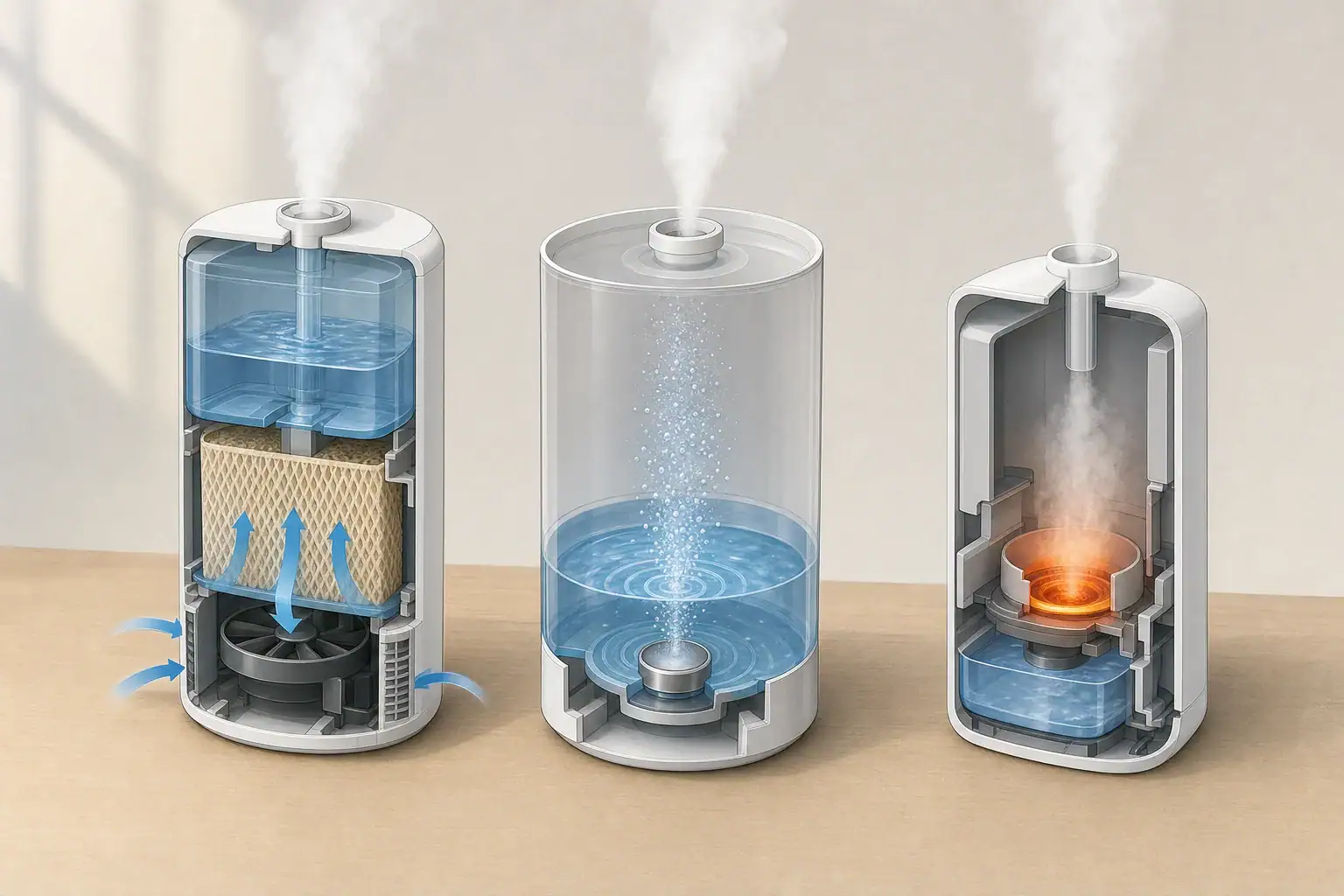
How does a humidifier work from tank to room?
Most humidifiers follow the same broad path: they store water, feed it to a conversion area, release moisture from that area, and rely on room air movement for mixing. The conversion method differs by type. The U.S. Environmental Protection Agency’s guide to home humidifiers distinguishes fan-driven evaporative units, ultrasonic units that use vibration, and electrically heated steam units.
- Store water: A tank or reservoir holds liquid water.
- Feed the mechanism: Gravity, a valve, a float, or a channel directs water to a wick, small basin, or heating chamber. The exact path is model-specific.
- Convert the water: The appliance evaporates it, atomizes it into droplets, or heats it into water vapor.
- Release moisture: A fan, airflow passage, or outlet moves the moisture away from the appliance.
- Mix with room air: Air currents and temperature differences affect where the added moisture goes.
- Respond to RH: If equipped with a humidistat, the unit may stop, restart, or change output based on relative humidity (RH) near its sensor.
How an evaporative wick humidifier works
An evaporative humidifier presents a large wet surface to moving air. Water in the reservoir wets a porous wick, and a fan draws room air through or across that wick. Water changes to water vapor at the wet surface, and the airflow carries that vapor into the room.
Wicks can draw water through small porous spaces by capillary action. The U.S. Geological Survey explanation of capillary action describes the roles of adhesion, cohesion, and surface tension in this movement. The amount and rate of wick wetting depend on the wick and appliance design.
In one example of this arrangement, a Honeywell evaporative-humidifier manual describes a float-regulated reservoir, an absorbent wick, and a fan that pulls air through the saturated wick. Other models can use different water paths or controls.
Evaporative output is usually not visible because water vapor is a gas. No visible plume does not mean the unit is adding no moisture.
How an ultrasonic humidifier makes mist
An ultrasonic humidifier directs water to a vibrating transducer, sometimes called a nebulizer. The vibration disrupts the water surface and produces fine liquid droplets. Airflow or the droplets’ motion carries this aerosol through the outlet.
The visible cool-mist plume is therefore not automatically steam and is not necessarily all water vapor at the outlet. As droplets travel and mix with air, some may evaporate. The extent and speed of that evaporation vary with local temperature, existing humidity, droplet characteristics, and air movement.
A hybrid design may contain both ultrasonic and heating components. For example, a Vicks hybrid humidifier manual describes ultrasonic mist production and a separate heating chamber for its warm setting. That architecture should not be assumed for every humidifier.
How a steam humidifier works
A steam humidifier admits water to a heating chamber and heats it until it becomes water vapor. The vapor travels through an outlet into the surrounding air or, for some whole-home systems, into an air-distribution path.
Water vapor is invisible. A visible cloud may appear after water vapor enters cooler air and condenses into tiny suspended droplets. Outlet temperatures and vapor paths vary by design, so a visible cloud alone does not identify the appliance’s internal mechanism.
Humidifier mechanism comparison
| Mechanism | What leaves the conversion area | Main driver | Usually visible at the outlet? |
|---|---|---|---|
| Evaporative wick | Water vapor carried by airflow | Capillary wetting and fan-driven evaporation | Usually no |
| Ultrasonic | Fine liquid droplets | Vibrating transducer or nebulizer | Often |
| Steam | Water vapor | Electrical heating and boiling | A cloud may form in cooler air |
| Humidistat | No moisture; it is a control component | RH sensor and control circuit | Not applicable |
How a humidistat cycles humidifier output
A humidistat measures RH near its sensor. In a basic on/off control sequence, a humidifier runs while the measured RH is below the selected setting, stops when the setting is reached, and can restart after the reading falls. Some models adjust output rather than simply switching on and off.
The sensor reading may not equal the average RH across the room. ASHRAE guidance on humidity measurement notes that drafts and local heat or moisture sources can affect a sensor and that measurement locations should represent the space being assessed. A sensor near an outlet, sunny area, exterior surface, or draft can therefore report conditions unlike those elsewhere in the room.
Why visible mist does not prove even room distribution
A visible plume shows where suspended droplets are concentrated at that moment. It does not establish the RH throughout a room. An invisible evaporative output can add moisture, while a visible ultrasonic plume can remain localized before its droplets evaporate and mix.
Relative humidity is also temperature-dependent. The National Weather Service definition of humidity explains that RH is the amount of water vapor relative to the amount air can hold at a given temperature. Compare RH with temperature, especially when readings come from different parts of a room.
How to check room RH instead of judging the plume
Use separate humidity gauges to compare conditions in different parts of the occupied area. The EPA recommends measuring indoor humidity with a humidity gauge; its general guidance is to keep indoor RH between 30% and 50%.
- Choose at least three fixed points: near, middle, and farther from the humidifier.
- Keep meters out of the direct plume and away from drafts, sunlight, exterior walls, and localized heat or moisture sources.
- Record RH and temperature at every point before operation.
- Use the same meters, locations, and chosen operating interval for the next readings.
- Record RH and temperature again at every point.
- Compare the change at each point, the simple average, and the difference between the highest and lowest reading.
- Record visible condensation separately. It is a local observation, not a measurement of room-average RH.
- Compare outside readings with the built-in display rather than assuming the appliance sensor represents the entire room.
Hypothetical RH-check example
Assumptions: Three meters remain in fixed locations; each later reading is taken after the same chosen operating interval; and temperature at each location stays similar enough that comparing RH is useful. These figures demonstrate arithmetic only. They do not predict humidifier performance.
| Location | Baseline RH | Later RH | Change |
|---|---|---|---|
| Near | 30% | 41% | +11 percentage points |
| Middle | 31% | 37% | +6 percentage points |
| Farther away | 32% | 34% | +2 percentage points |
The baseline average is (30 + 31 + 32) ÷ 3 = 31% RH. The later average is (41 + 37 + 34) ÷ 3 = 37.3% RH. Although the average increased, the later readings range from 34% to 41% RH, a spread of 7 percentage points. That result indicates different conditions at the three measurement points.
Summary
Humidifiers use one of three common mechanisms: wick humidifiers evaporate water into moving air, ultrasonic humidifiers generate fine liquid droplets, and steam humidifiers heat water into vapor. A humidistat responds to RH at its sensor, not necessarily to room-average conditions. Multi-point RH and temperature readings provide a more meaningful distribution check than a visible mist plume.
Related guides: Ultrasonic vs. Evaporative Humidifiers • Warm Mist vs. Cool Mist Humidifiers • Why Humidity Sensors Disagree
Frequently asked questions
Is cool mist the same as steam?
No. In an ultrasonic humidifier, visible cool mist begins as fine liquid droplets made by a vibrating transducer. A steam humidifier heats water into vapor; a visible cloud can form later when that vapor encounters cooler air and condenses into droplets.
Why does an evaporative humidifier usually have no visible mist?
An evaporative unit moves air across a wet wick, where water evaporates into water vapor. Water vapor is invisible, so the unit can add moisture without producing a visible plume.
Does visible mist mean the whole room has the same humidity?
No. A plume shows concentrated droplets near the outlet at that moment, not RH throughout the room. Compare RH and temperature at fixed near, middle, and farther measurement points to assess conditions across the space.
Why can a humidifier stop while another part of the room seems dry?
The humidistat responds to RH at or near its own sensor. Local airflow, sunlight, temperature, or proximity to the outlet can make that reading differ from conditions elsewhere in the room.
Recommended next:
- Best Humidity Level for Winter: Comfort vs Health vs Mold Risk
- Ultrasonic vs Evaporative Humidifiers: Pros, Cons, and Which to Buy
- Humidifier White Dust: Causes, Health Concerns, and Fixes
- How to Clean a Humidifier Properly (And How Often You Really Should)
- Ideal Indoor Humidity in Winter: Comfort vs Mold Risk
- Humidifier Cleaning Routine: How to Prevent Slime and Odors
- Clear sizing logic (room size → CADR/ACH)
- HEPA vs carbon explained for real use-cases
- Humidity + ventilation basics to reduce mold risk