
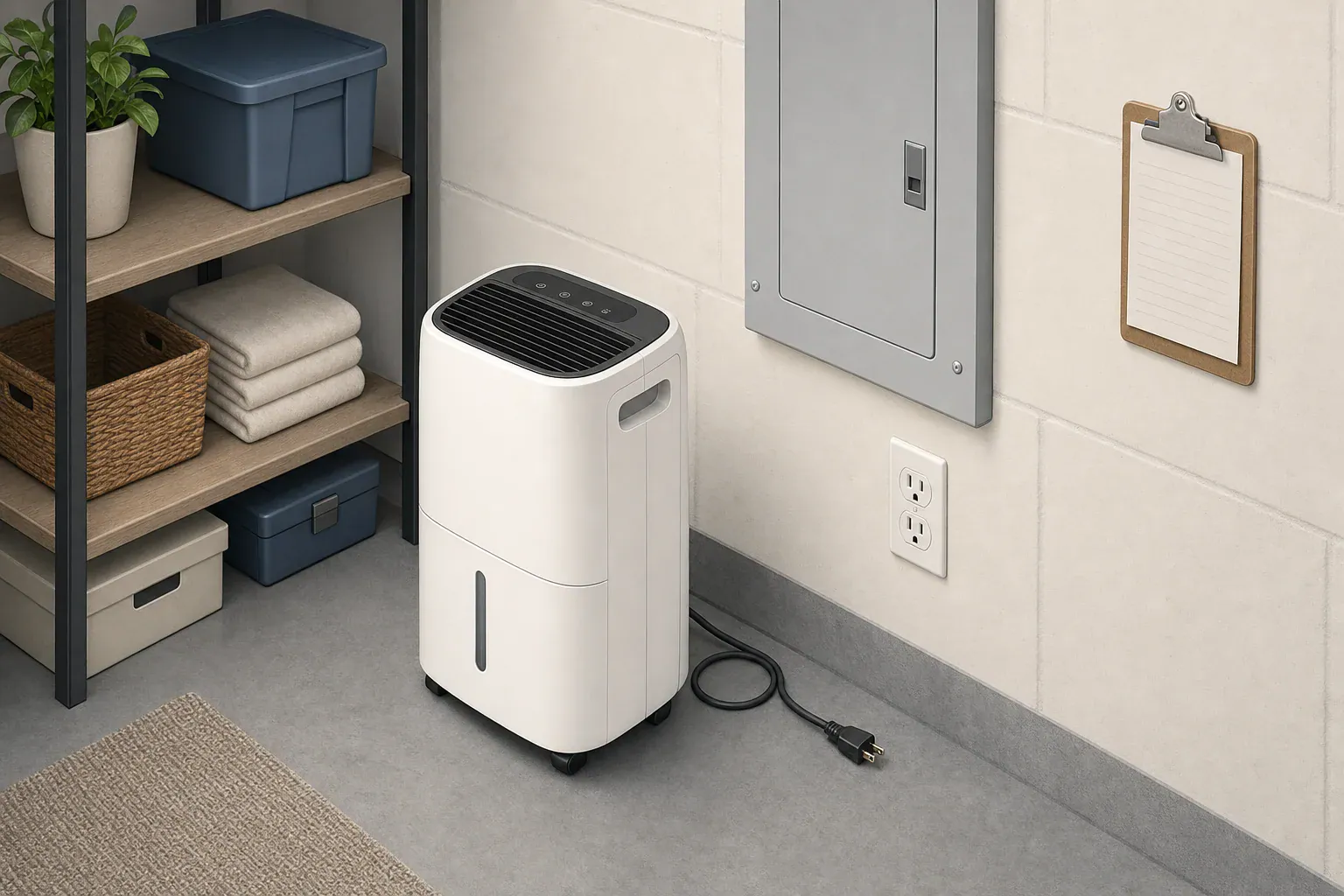
When a dehumidifier trips the circuit breaker
A circuit breaker trip can result from too many devices on one branch circuit, an unsuitable connection, a problem with the dehumidifier, or a problem with the outlet or household wiring. The timing does not identify the cause by itself: an immediate trip does not prove a particular internal failure, and a delayed trip does not prove an overload.
Start by turning the unit off and unplugging it. The U.S. Consumer Product Safety Commission (CPSC) says that an appliance that repeatedly trips a circuit breaker should be unplugged and repaired or replaced. Do not repeatedly reset a breaker to keep the appliance running.
Stop before resetting if you find a warning sign
With the dehumidifier unplugged, inspect only what is visible. Do not open the appliance, outlet, or electrical-panel cover. Leave the unit unplugged if you find any of the following:
- A cut, crushed, frayed, or otherwise damaged power cord
- Melted, darkened, bent, or pitted plug blades
- A plug that fits loosely in the outlet
- Discoloration, unusual warmth, an unusual odor, or moisture at the plug or outlet
- An exact model and date-code match to a product recall
CPSC advises consumers not to use an unusually warm outlet until it has been inspected by a qualified electrician. For recall screening, compare the complete model and date-code information on the appliance against the CPSC dehumidifier recall and warning page. A brand name alone is not enough to establish that a unit is recalled.
Safe checks when a dehumidifier trips the circuit breaker
- Record the appliance information. Write down the model, serial number, and electrical ratings from the nameplate. Use the manual for that exact model when checking outlet type, circuit requirements, and compressor restart instructions.
- Check the connection. Plug the unit directly into the grounded wall outlet required by its manual. Do not use an adapter, power strip, or extension cord as a troubleshooting shortcut. For example, Frigidaire’s dehumidifier guidance says not to use extension cords or power strips because the connection can overheat; requirements still vary by model.
- Identify other loads. Note which lights, outlets, and appliances lost power when the breaker tripped. They may share the same branch circuit. This is useful evidence of a possible shared-load issue, but it does not rule out a dehumidifier, outlet, or wiring problem.
- Read labels; do not test live wiring. Record the dehumidifier nameplate volts, amps, and watts. You may also record the breaker marking visible after opening the panel door while leaving the panel cover installed. Do not remove the cover, measure current in the panel, or replace a breaker yourself.
- Follow the manual’s restart instructions. Restart delays and circuit requirements are model-specific. A Whirlpool use-and-care guide for specified models, for instance, gives its own circuit and restart-delay instructions. Do not apply those details to a different dehumidifier.
The CPSC Guide to Home Wiring Hazards recommends identifying the appliances that lost power and reviewing their nameplate ratings when considering whether a branch circuit is overloaded. It also specifically says not to install a higher-amperage fuse or circuit breaker as a workaround.
When one cautious reset may be reasonable
CPSC does not define a universal number of allowable resets. One cautious reset can be a limited observation step only if there is no visible damage, heat, odor, discoloration, looseness, moisture, or recall match, and the dehumidifier is connected exactly as its manual requires.
- Unplug the dehumidifier.
- Switch off or unplug other known appliances on the affected circuit.
- Observe any restart delay required by the dehumidifier manual.
- Reset the breaker with its normal handle, without removing the electrical-panel cover.
- Reconnect the dehumidifier directly to the specified wall outlet.
If the breaker trips again, leave the dehumidifier unplugged. Do not keep resetting the breaker, install a larger breaker, bypass GFCI or AFCI protection, or substitute an extension cord for a direct wall connection.
What the trip pattern can—and cannot—tell you
| Observation | What it may indicate | Safe next step |
|---|---|---|
| Other appliances or outlets also lose power | They may share a branch circuit; this does not prove an overload. | Record the affected devices and remove other known loads before any single cautious reset. |
| The trip happens at plug-in, fan start, or compressor start | The timing is useful information for service, but does not identify a failed part. | Record the timing. Stop using the unit if the trip repeats. |
| The trip happens after the unit has run for a while | A shared load and an appliance or electrical fault remain possible. | Do not diagnose the cause from the delay alone. |
| The trip repeats with other known loads removed | The dehumidifier, outlet, wiring, or protective device needs evaluation. | Leave the unit unplugged and arrange qualified service. |
| The breaker will not reset with the dehumidifier unplugged | Disconnecting the appliance has not resolved the condition. | Leave the unit unplugged and contact a qualified electrician. |
| GFCI or AFCI protection opens | The protective device responded to a condition it is designed to detect; the trip alone does not identify the source. | Do not defeat the protection or move the unit to an unprotected connection. |
Can continuous mode contribute?
On models with that feature, continuous mode can keep the compressor operating instead of cycling according to a humidity setting. Frigidaire describes Continuous Run this way for its products. Longer operation can increase the time that the dehumidifier overlaps with other loads on a shared circuit. That is a reasonable detail to record, not proof that continuous mode, the circuit, or the compressor is defective.
A repeated breaker trip remains a stop-use condition even if it happens only in continuous mode. For help choosing between operating modes after the electrical issue has been resolved, see Dehumidifier Auto Mode vs Continuous Mode.
Should you try another outlet?
A nearby outlet can be on the same circuit, while an outlet on a different circuit may have different protection or may not meet the appliance manual’s requirements. Randomly moving the dehumidifier is therefore not a conclusive test.
Use another location only when the exact manual permits it, the outlet is known to meet the model’s requirements, and there have been no warning signs or repeated trips. Do not use an extension cord to reach another outlet. A qualified electrician can determine whether outlets share a circuit and whether the circuit is suitable.
Printable service checklist
Record observations without opening the appliance or panel and without making live electrical measurements. This information can help an appliance servicer or electrician assess the problem.
| Item | Your notes |
|---|---|
| Model and serial number | |
| Recall checked: yes or no | |
| Nameplate volts, amps, and watts | |
| Breaker marking visible with panel cover installed | |
| Other devices or outlets that lost power | |
| Trip occurred at plug-in, fan start, compressor start, or after running | |
| Continuous mode enabled: yes or no | |
| Cord, plug, or outlet heat, odor, discoloration, damage, or looseness | |
| Result after one cautious reset with other known loads removed |
Who should inspect the problem?
- Appliance service: The trip follows the dehumidifier on a known suitable circuit, or it repeats after other known loads have been disconnected.
- Qualified electrician: The outlet is loose, discolored, or unusually warm; the breaker will not reset with the dehumidifier unplugged; the circuit arrangement is uncertain; or other outlets and appliances are affected.
- Manufacturer or recall administrator: The complete model and date-code information match a recall, or the unit remains eligible for product support.
Bottom line
A single trip does not reveal the exact cause. Check for recalls and visible warning signs, confirm the direct wall-outlet connection required by the exact manual, and document other loads on the circuit. If a cautious reset results in another trip, leave the dehumidifier unplugged and have the appliance or household circuit evaluated instead of changing the breaker or bypassing protection.
Related guides: Dehumidifier Running Cost: How Much Electricity Will It Use? • How to Size a Dehumidifier (Sq Ft, Pints/Day, and Real-World Tips)
Recommended next:
- How to Size a Dehumidifier (Sq Ft, Pints/Day, and Real-World Tips)
- Desiccant vs Compressor Dehumidifiers: Which Is Better for Cold Rooms?
- Basement Dehumidifier Guide: Targets, Drainage, and Energy Use
- Dehumidifier Running Cost: How Much Electricity Will It Use?
- Dehumidifier Sizing: Liters/Day, Room Type, and Dampness Levels
- Basement Dehumidifier Setup: Drainage, Placement, and RH Targets
- Clear sizing logic (room size → CADR/ACH)
- HEPA vs carbon explained for real use-cases
- Humidity + ventilation basics to reduce mold risk