
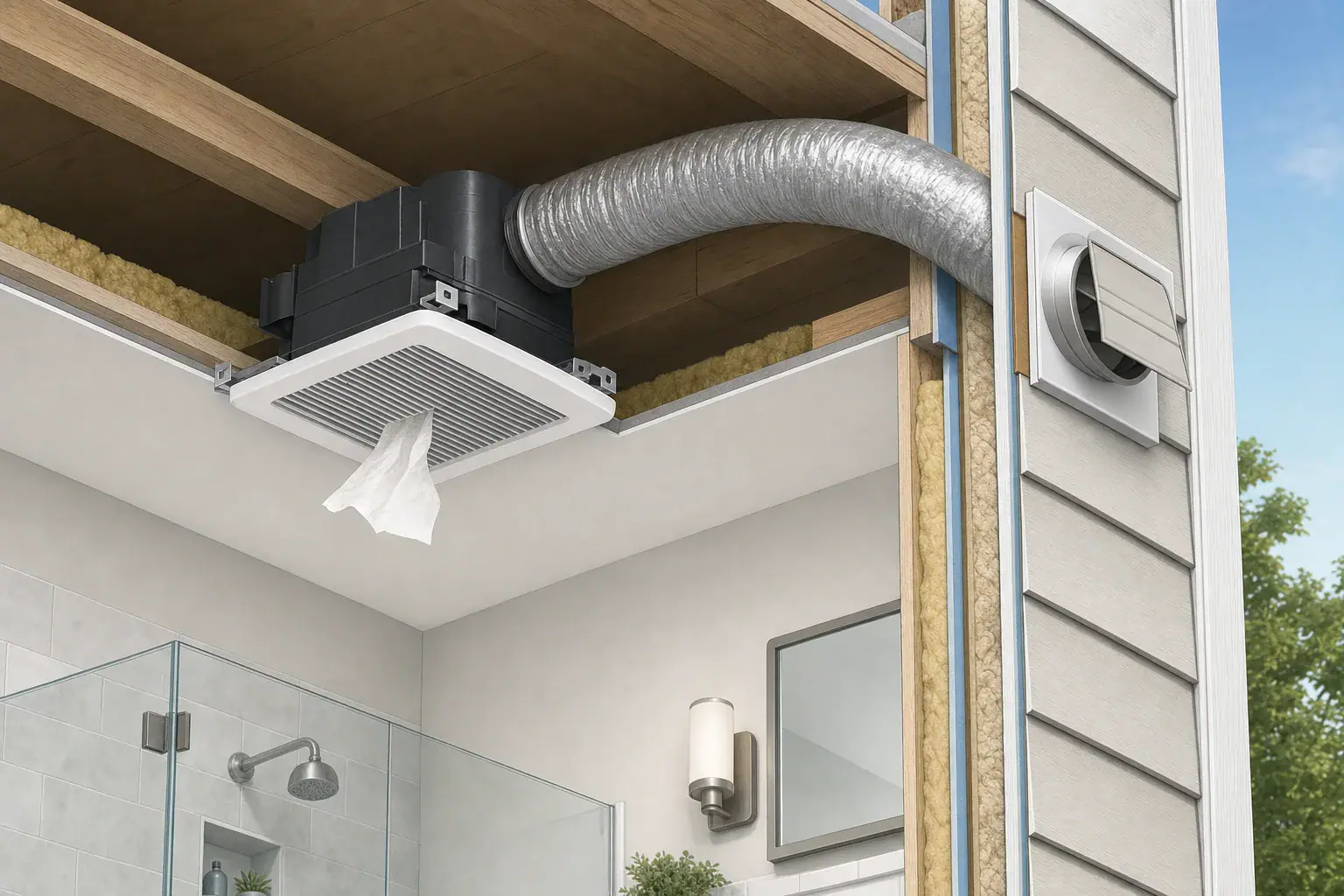
Start with a simple airflow check
A bathroom exhaust fan that runs but does not pull air usually has a dirty grille, a stuck exterior damper, a restricted or disconnected duct, or a blower problem. A tissue test can confirm weak intake, but it cannot measure the fan’s airflow rate.
- Open the bathroom door and any adjustable supply-air register.
- Turn on the exhaust fan and let it run for about a minute.
- Hold one square of dry, lightweight tissue flat against the intake grille without pushing it through the openings.
- Note whether the tissue stays in place, pulls only at one section, or falls away.
- Repeat the test with the bathroom door in its normal position.
If the tissue holds with the door open but falls when the door is nearly closed, the room may not have an adequate path for replacement air. If it does not hold in either position, continue with the grille, damper, and duct checks.
Interpret the results carefully
| Observation | Likely area to check |
|---|---|
| Tissue holds firmly across most of the grille | The fan is drawing air at the intake, though this does not verify rated airflow |
| Tissue pulls only at one edge | Dirty grille, blocked intake area, or blower-wheel buildup |
| Tissue holds only when the door is open | Restricted replacement-air path into the bathroom |
| Fan sounds normal but tissue falls | Duct restriction, stuck damper, disconnected duct, or damaged blower |
| Fan hums, rattles, or changes speed | Blower or motor service may be needed |
Check and clean the intake grille
Dust can mat over the grille and collect on the blower wheel behind it. Turn the fan off and remove only the parts covered by the manufacturer’s cleaning instructions. Clean a removable grille with a vacuum brush or damp cloth, let it dry, and reinstall it correctly.
Do not reach into the housing or work on wiring, switches, or the motor. If the blower wheel is inaccessible, damaged, or heavily coated, arrange service by a qualified technician.
Observe the exterior damper
Find where the duct terminates outdoors. With the fan running, observe a wall termination from a safely accessible location at ground level. Its flap should open and there should be some indication of outgoing air.
- Flap stays closed: It may be stuck by paint, dirt, corrosion, or a mechanical fault.
- Flap opens only slightly: The duct may be restricted, or the fan may be producing weak pressure.
- Flap opens but airflow seems weak: Check for a long duct run, tight bends, sagging flexible duct, or internal buildup.
- Air moves at the grille but not outdoors: A duct connection may have separated.
Do not attempt to reach a roof termination or another inaccessible outlet. A contractor can inspect those locations and confirm whether the damper operates freely.
Inspect accessible duct sections
With the fan off, visually inspect only ductwork that is readily accessible without entering a confined area or disturbing electrical components. Look for:
- Loose or separated joints
- Crushed or sharply bent flexible duct
- Long, unsupported sections that sag
- Multiple tight elbows close to the fan
- Visible blockage near an accessible connection
- A duct that ends in an unintended indoor space rather than at an exterior termination
Hidden duct defects generally require inspection by a ventilation or HVAC contractor. Avoid inserting tools into the duct because they can damage flexible material or push an obstruction farther into the run.
Consider the fan and duct together
If the grille is clean, the damper opens, and the duct appears connected, the installed duct route may still create more resistance than the fan can handle. Excessive length, small duct diameter, rough flexible duct, and repeated bends can reduce delivered airflow. Compare the installation with the fan manufacturer’s duct-size and routing instructions.
A fan that is unusually noisy, slow to start, or weak with the duct temporarily verified clear may have a worn motor or damaged blower assembly. Replacement or electrical diagnosis should be handled by a qualified technician.
Related guides: Bathroom Mold Prevention: Exhaust Fan Timing and Humidity Control • Exhaust Fan Best Practices: Bathrooms and Kitchens That Actually Clear Air • Bathroom Fan Timer Settings to Prevent Mold After Showers
Frequently asked questions
Should a bathroom fan hold a tissue tightly against the grille?
A tissue that stays in place indicates that the fan is drawing air at the grille, but it does not confirm the fan is delivering its rated airflow. Uneven pull across the grille or a tissue that falls can point to an intake, duct, damper, or blower issue.
Why does my bathroom fan pull air only when the door is open?
The bathroom may not have enough replacement air when the door is closed. Check whether the door position, door undercut, or another available air path changes the tissue-test result.
Can a bathroom exhaust fan run but still have a blocked duct?
Yes. The motor can run even when a damper is stuck, the duct is crushed or disconnected, or buildup restricts the route to the exterior. Checking the exterior termination from a safe, accessible location can help distinguish weak intake from a duct-path problem.
When should a bathroom fan be inspected by a professional?
Arrange professional evaluation if the fan hums, rattles, changes speed, starts slowly, or remains weak after the grille and accessible duct sections have been checked. A technician can assess concealed ductwork, the blower assembly, and electrical components.
Summary
Use the tissue test as a quick screening check, then compare results with the door open and closed. Clean the grille, observe the exterior damper, and inspect accessible duct sections for separation, crushing, sagging, or sharp bends. If those checks do not identify the problem, the blower or concealed ductwork may need professional evaluation.
- Clear sizing logic (room size → CADR/ACH)
- HEPA vs carbon explained for real use-cases
- Humidity + ventilation basics to reduce mold risk