
Which Type Fits the Job?
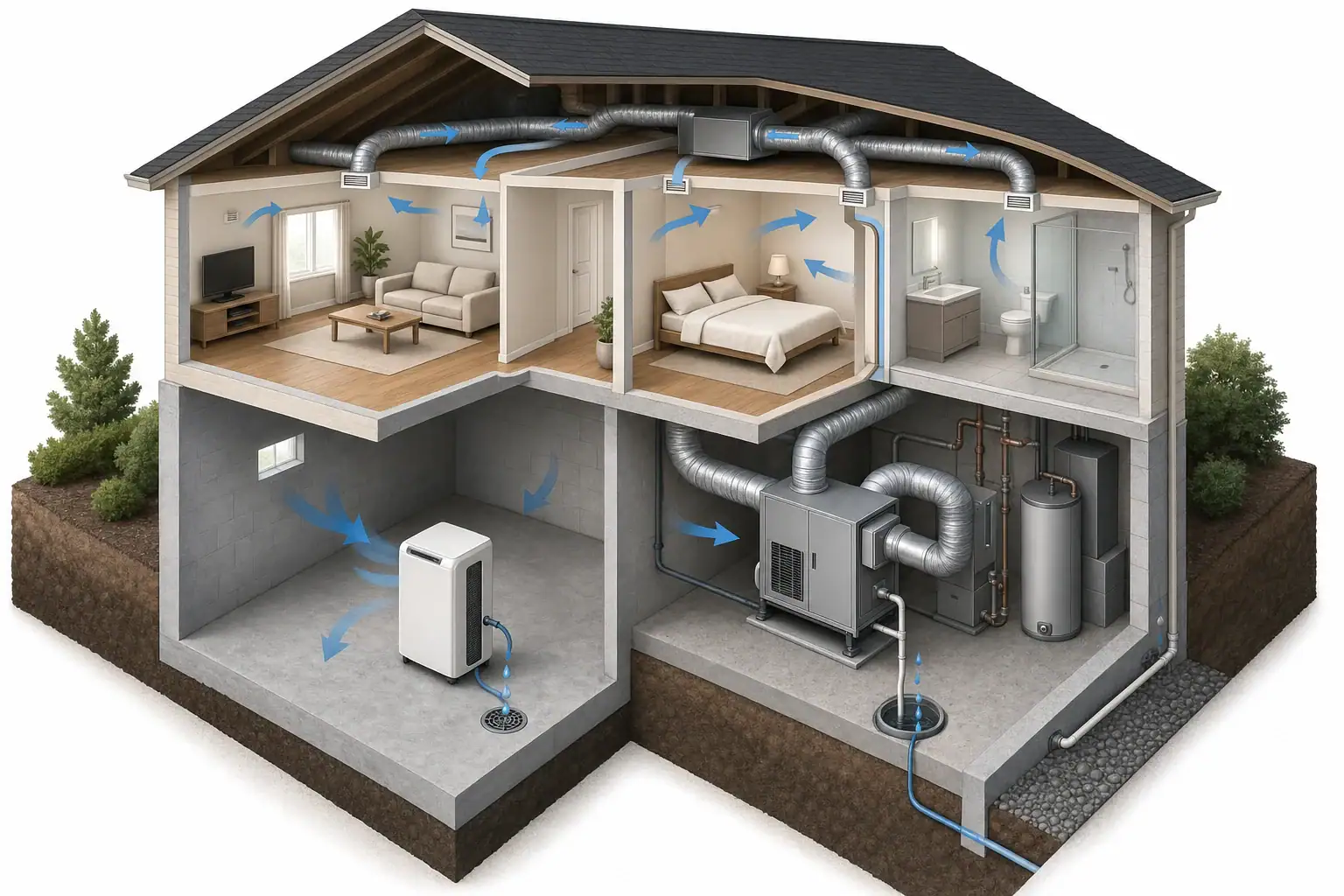
A portable dehumidifier is usually the practical choice for one room, a basement, or an isolated damp area. A whole-house dehumidifier is better suited to recurring moisture across multiple connected rooms when the home has compatible ductwork, a suitable drain, and space for professional installation.
Neither type automatically provides uniform humidity everywhere. Floor-plan barriers, closed doors, airflow, equipment capacity, climate, and the source of the moisture all affect results.
Coverage and Airflow
Portable units treat the air that can reach them. They work best as room or zone appliances, although an open floor plan may allow one unit to influence a larger adjoining area. Closed doors, separate floors, and restricted airflow limit coverage.
Whole-house models typically connect to a central duct system or use dedicated ducts. This allows them to process air from several rooms, but performance depends on duct layout, airflow, system controls, and installation design. Rooms with limited return-air paths can still behave differently from the rest of the home.
Do not select either type from floor-area claims alone. Compare moisture-removal capacity under the stated test conditions, then consider the home’s temperature, moisture load, air leakage, and room configuration. Oversizing can add cost and complicate humidity control, while undersizing can lead to long run times without resolving the problem.
Side-by-Side Trade-Offs
| Factor | Portable unit | Whole-house unit |
|---|---|---|
| Typical coverage | One room or a defined zone | Multiple rooms served by a compatible air-distribution system |
| Drainage | Collection bucket, gravity hose, or built-in pump when provided | Usually a permanent gravity drain or condensate pump |
| Installation | Generally plug-in setup with clearance and drain requirements | Duct, drain, electrical, airflow, and control integration |
| Placement flexibility | Can be moved between suitable locations | Fixed equipment serving a designed area |
| Noise location | Compressor and fan operate in the occupied room | Equipment is often installed away from primary living spaces, though duct and mechanical noise remain possible |
| Maintenance access | Filter, bucket, hose, and intake are usually easy to reach | Service access must be preserved at the installed location |
Drainage Requirements
Portable drainage
A bucket offers simple setup but requires regular emptying. Confirm that the model has an automatic shutoff if unattended bucket operation matters.
For continuous gravity drainage, the hose must follow the manufacturer’s requirements and lead to an approved drain without kinks or unintended uphill sections. A built-in condensate pump can lift water only within the limits specified for that unit. Do not assume a gravity-drain model can pump upward.
Whole-house drainage
A whole-house unit normally needs a permanent condensate route. Gravity drainage is simplest when the installation location and approved drain allow the required slope. Otherwise, a properly selected condensate pump may be necessary.
Drain materials, traps, overflow protection, and termination points depend on the equipment instructions and applicable local requirements. These details should be included in the installation plan rather than improvised after the unit is mounted.
Installation Differences
Portable setup
- Place the unit on a stable, level surface with the clearances specified by the manufacturer.
- Use a suitable grounded receptacle and follow the manual’s electrical instructions.
- Keep the air intake and discharge unobstructed.
- Confirm that the bucket, gravity hose, or pump arrangement works before leaving continuous drainage unattended.
- Position the unit where air can circulate through the intended zone.
Whole-house installation
A ducted dehumidifier requires more than attaching ducts. A qualified HVAC contractor should evaluate available airflow, duct connection points, equipment location, electrical needs, drainage, service clearances, controls, and interaction with the heating and cooling system.
Ask how the proposed design will move dry air through the home when the central heating or cooling equipment is not running. Also ask whether the unit will use existing ducts, dedicated ducts, or a combination. The answer affects coverage, control behavior, and installation complexity.
Controls and Room-to-Room Conditions
A portable unit senses conditions near the appliance, which may not represent a distant room. A whole-house control may sense humidity at a wall control, in return air, or within the equipment, depending on the design.
Use a separate hygrometer to compare problem areas before and after installation. If one room remains consistently different, investigate airflow and local moisture sources rather than repeatedly lowering the main setting.
Maintenance and Access
Both types need accessible filters and unobstructed air paths. Portable units may also require bucket cleaning and hose inspection. Whole-house systems need service access for the filter, drain system, internal components, and any condensate pump.
Maintenance intervals vary by model and operating conditions. Follow the equipment manual rather than relying on a universal schedule. A drain that is difficult to inspect or equipment installed in a cramped location can make routine care less reliable.
A Practical Selection Process
- Map the moisture pattern. Determine whether the issue is confined to one area or appears throughout several rooms.
- Check airflow barriers. Note closed doors, separate floors, finished walls, and rooms without effective return-air paths.
- Identify a drainage route. Decide whether bucket emptying is acceptable or continuous drainage is necessary.
- Review installation constraints. Consider receptacles, floor space, noise tolerance, duct access, mechanical-room space, and service clearances.
- Compare rated capacity carefully. Use comparable test conditions and account for the actual moisture load rather than floor area alone.
- Address moisture sources. Plumbing leaks, water entry, and uncontrolled outdoor-air leakage require appropriate correction; a dehumidifier does not repair them.
A portable unit is often the lower-complexity starting point when the affected area is limited or the moisture pattern is uncertain. Whole-house equipment becomes more compelling when several connected spaces need recurring control and the home can support a properly designed installation.
Related guides: Best Indoor Humidity Level to Prevent Mold (With Seasonal Targets) • Drain Hose vs Bucket: Which Dehumidifier Setup Is Best? • Dehumidifier Capacity Estimator: Room Dampness to Liters/Day
Frequently asked questions
Can a portable dehumidifier control humidity throughout an entire house?
Usually, a portable unit is best for one room or a defined zone where air can circulate to and from the appliance. It may influence adjoining open spaces, but closed doors, separate floors, and airflow restrictions limit whole-home results.
Does a whole-house dehumidifier run when the air conditioner is off?
It can, depending on the equipment and how the ductwork and controls are designed. Ask the installer how dry air will be distributed when the heating and cooling system is not operating.
When is continuous drainage more practical than using a bucket?
Continuous drainage is generally more practical when the unit will run often or cannot be checked regularly for bucket emptying. A gravity hose needs the required slope, while a pump must be rated to lift water for the planned route.
Summary
Choose a portable dehumidifier for targeted, flexible control with simpler installation, accepting in-room noise and more hands-on drainage or maintenance. Choose a whole-house dehumidifier for broader ducted coverage when permanent drainage, professional installation, and suitable air distribution are available. Base the decision on where moisture occurs, how air moves between rooms, and how condensate will be handled—not on floor-area claims alone.
- Clear sizing logic (room size → CADR/ACH)
- HEPA vs carbon explained for real use-cases
- Humidity + ventilation basics to reduce mold risk