
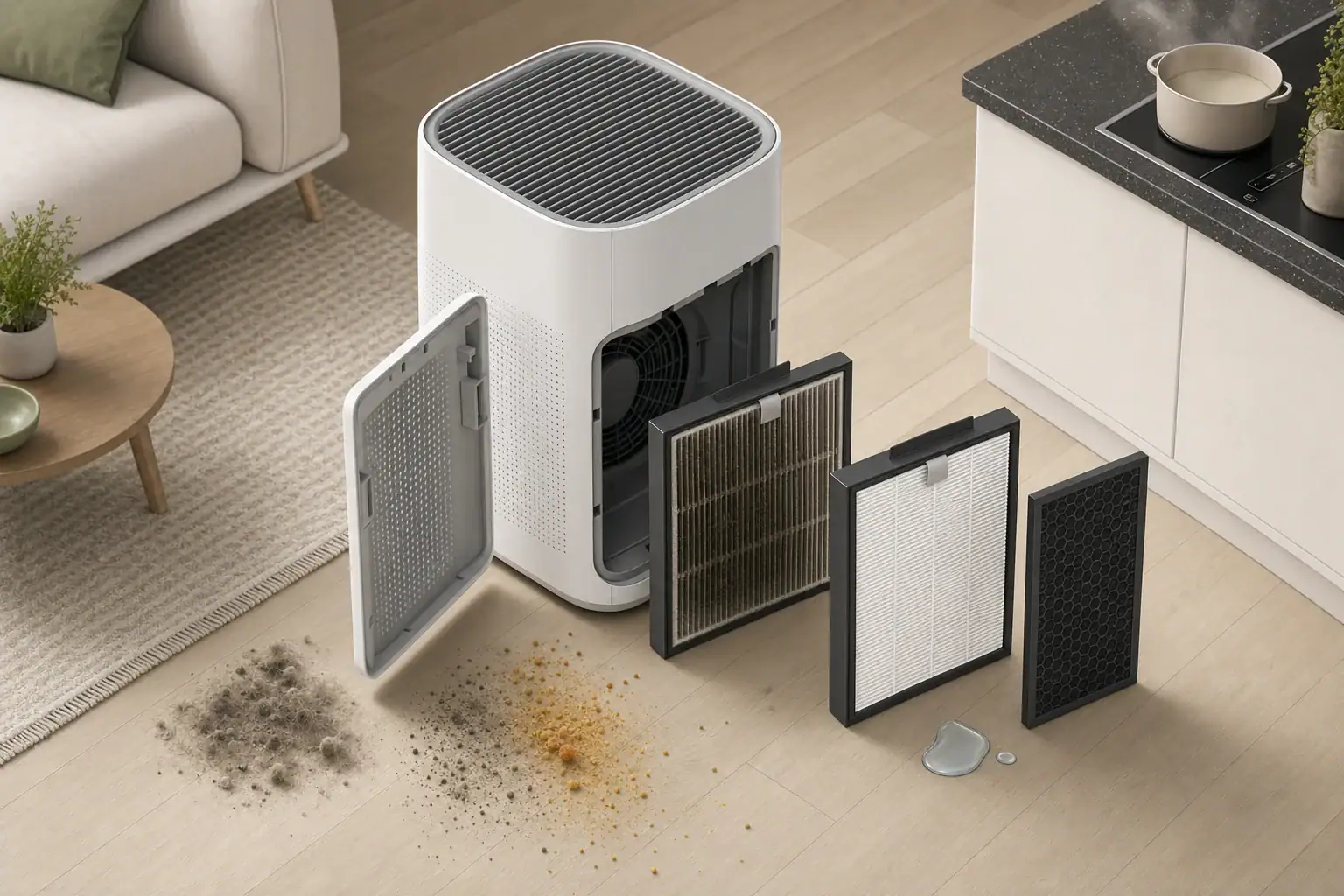
What the color may be telling you
A HEPA filter turns black when it captures a high concentration of dark particles. Rapid, even blackening often points to soot, smoke particles, or carbon dust, while gradual gray-brown discoloration is more typical of household dust. Moisture usually causes spots, odors, staining, or distorted filter media rather than a uniform black layer. Color alone cannot identify the material or confirm mold.
How quickly the filter changes color also depends on fan runtime, airflow, indoor activities, outdoor particle levels, and filter size. A dark filter is not automatically defective; it may simply be collecting what is present in the air.
Match the pattern to likely sources
| Filter appearance | Possible explanation | What to check |
|---|---|---|
| Even, dry gray or black coating | Routine dust mixed with fine combustion particles | Candles, incense, smoking, cooking smoke, fireplaces, attached garages, or outdoor pollution entering the home |
| Dark and slightly greasy or tacky | Cooking aerosol or smoke residue | Range-hood use, frequent frying, or smoke moving from nearby rooms |
| Fine black powder near a carbon stage | Loose activated-carbon particles | Condition and placement of the carbon prefilter or carbon pellets |
| Localized spots, waviness, or a musty odor | Moisture exposure or deposited debris | Leaks, condensation, humidifier placement, or a filter installed while damp |
| Dark bands or uneven edge loading | Airflow pattern, poor fit, or leakage around the filter | Filter orientation, frame seals, access-panel fit, and the specified filter size |
Common reasons for rapid blackening
- Combustion indoors: Candles, incense, tobacco smoke, fireplaces, and cooking can release dark particles. Even a small recurring source may become noticeable on white filter media.
- Outdoor particles: Traffic exhaust, seasonal smoke, and other outdoor particles can enter through open windows, doors, gaps, or mechanical ventilation.
- Long operating hours: A purifier running continuously processes more air and may darken sooner than one used occasionally.
- A small filter serving a particle-heavy space: The same amount of captured material appears more concentrated on a smaller surface.
- Carbon dust: A damaged, loose, or incorrectly installed carbon stage may transfer black particles to the HEPA filter behind it.
- Moisture: A nearby humidifier, condensate problem, or water leak can wet the filter and trap debris in irregular patches.
How to narrow down the cause
- Turn the equipment off before inspection. Unplug a portable air cleaner and follow its manual. For central equipment, use the manufacturer’s filter-access procedure and avoid opening electrical or combustion compartments.
- Look at the pattern without rubbing the media. Note whether the coating is uniform, concentrated at an edge, powdery, greasy, spotted, or visibly damp. Avoid shaking, vacuuming, or using compressed air on a disposable HEPA filter.
- Inspect upstream components. Check the prefilter and carbon stage for damage or incorrect placement. Confirm that the airflow arrow and filter orientation match the instructions.
- Review recent activities. Consider cooking, candle or fireplace use, smoking, renovation dust, open windows, unusual outdoor smoke, or a change in purifier runtime.
- Check nearby surfaces. Dark residue around vents, walls, ceilings, or the appliance can suggest a broader particle source rather than ordinary filter loading.
- Install a replacement if required. Record the date and take a photo. If the new filter develops the same pattern quickly, that comparison can help identify a recurring source.
Moisture and suspected growth
Black spots do not prove that mold is present. Dust, soot, mineral residue, and moisture staining can look similar. A wet or musty filter should not remain in service unless its manufacturer specifically provides a drying or cleaning procedure. Most disposable HEPA filters are not washable.
Correct the moisture source before installing another filter. Recurring dampness may require inspection of condensate drainage, duct insulation, plumbing, or humidifier placement. The EPA’s mold cleanup guidance explains that moisture control is central to addressing indoor mold problems.
When equipment or combustion needs attention
Persistent soot on filters and nearby surfaces, especially around a fuel-burning appliance, warrants evaluation by a qualified HVAC or combustion-appliance technician. Do not adjust burners, venting, or safety controls yourself.
A particle filter does not detect or reliably control carbon monoxide. If a carbon-monoxide alarm activates, follow the alarm’s instructions and the emergency guidance provided by local authorities. The CPSC Carbon Monoxide Information Center provides additional safety information.
Replace by condition and instructions, not color alone
Use the replacement interval, indicator, or airflow guidance provided for the equipment. Replace the filter sooner if it is wet, damaged, producing persistent odor, heavily loaded, or associated with noticeably restricted airflow. Do not substitute a higher-resistance filter in central HVAC equipment without confirming that the system can accommodate it.
For broader context on what filtration can and cannot do, see the EPA guidance on air cleaners and filters in the home.
Related guides: Candles and Incense: How Much Particulate Pollution Do They Create? • HEPA Filter Direction and Sealing: Why Air Bypass Reduces Performance • HEPA Filter Smells Musty: Causes, Risks, and When to Replace It
Frequently asked questions
Does a black HEPA filter mean it has mold?
No. Black color alone cannot identify mold, because soot, smoke particles, ordinary dust, carbon dust, and moisture staining can appear dark. Localized spots combined with dampness, distortion, or a musty odor make it important to investigate moisture, but they still do not confirm the material.
Why did my HEPA filter turn black soon after replacement?
Fast darkening can occur when the unit runs for long periods in air containing smoke, soot, cooking aerosol, outdoor pollution, or loose carbon particles. Check the prefilter and carbon stage, review recent indoor activities and outdoor conditions, and verify that the filter fits and faces the correct direction.
Should I replace a black HEPA filter immediately?
Follow the equipment manufacturer’s replacement guidance rather than color alone. Replace it sooner if it is wet, damaged, has a persistent odor, is heavily loaded, or appears to be restricting airflow.
Bottom line
A uniformly black HEPA filter most often reflects captured dark particles, while patchy staining, dampness, or odor points more toward a moisture problem. Inspect the pattern, check combustion and carbon sources, verify filter fit, and compare a replacement over time. Recurring soot, wet filters, or residue near fuel-burning equipment calls for professional inspection rather than repeated filter changes alone.
- Clear sizing logic (room size → CADR/ACH)
- HEPA vs carbon explained for real use-cases
- Humidity + ventilation basics to reduce mold risk