
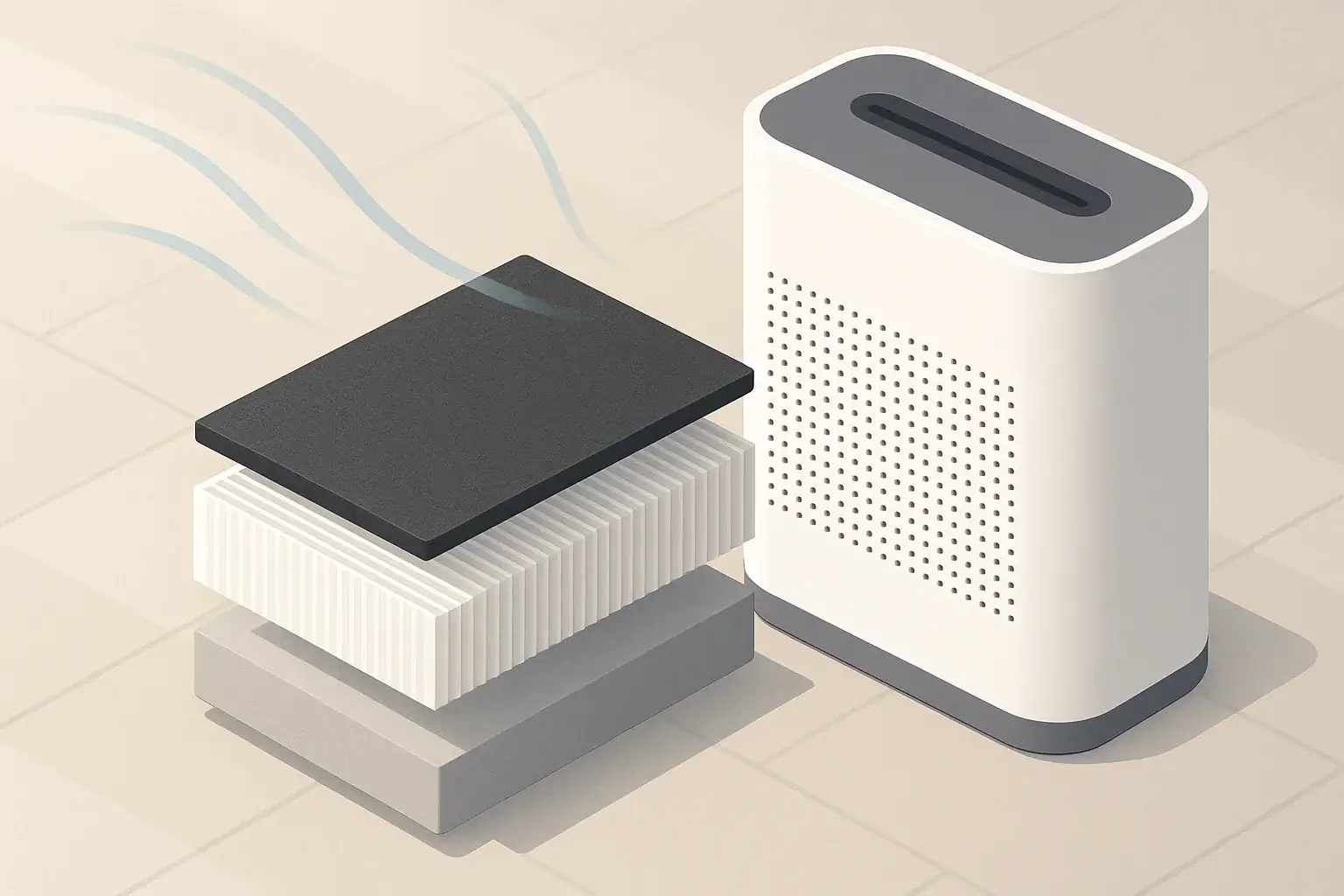
A HEPA filter that smells musty usually points to moisture, trapped dust, nearby moldy materials, or an overdue filter rather than normal filter operation.
The smell may come from the HEPA filter itself, the prefilter, the carbon filter, the purifier housing, or damp air passing through the unit. A musty odor does not prove that the filter is growing mold, but it is a practical cue to inspect humidity, cleanliness, airflow, and replacement timing.
- Keep indoor relative humidity around 30% to 50% when practical; persistent levels above 60% make musty odors more likely.
- Replace a non-washable HEPA filter if it smells musty after basic housing cleaning and 24 to 48 hours of dry operation.
- Do not rinse a HEPA filter unless the manual clearly says it is washable; many HEPA filters are damaged by water.
- Check the prefilter, carbon filter, intake grille, and room surfaces before assuming the HEPA layer is the only source.
- Typical HEPA replacement intervals are often about 6 to 12 months, but heavy dust, smoke, pets, dampness, or continuous use can shorten that range.
What a musty HEPA filter smell usually means
A musty smell is commonly associated with damp dust, stagnant air, microbial growth on nearby materials, or an odor that has been absorbed into filter media. In an air purifier, the odor can be carried by air flowing through the machine even when the main HEPA filter is not the original source.
HEPA filters are designed to capture fine particles, not to neutralize gases or odors. If the filter has collected household dust and then became damp, the material around the captured particles can begin to smell stale. A purifier that sits in a humid room, basement, laundry area, or near a humidifier has a higher chance of picking up this odor.
The key question is whether the smell is temporary, caused by something nearby, or persistent enough that replacement is the practical option. A calm inspection can usually narrow it down without guessing.
How HEPA filters, moisture, and odors interact
A true HEPA filter is a dense particle filter. It can capture dust, pollen-sized particles, smoke particles, pet dander fragments, and other airborne particles, but it is not primarily an odor filter. Odor control usually depends on activated carbon or another sorbent layer, when present.
Moisture changes the situation. Damp filter media can trap smells more strongly, airflow can distribute the odor, and wet dust can develop a stale scent. Even if the HEPA layer remains structurally intact, a musty smell can make the purifier uncomfortable to use.
HEPA versus carbon for smells
HEPA filtration and carbon filtration do different jobs. HEPA targets particles. Activated carbon can adsorb some odor-causing gases, but its capacity is limited and it can become saturated. A purifier with both filter types may still smell musty if the carbon is exhausted, the HEPA filter is damp, or the housing needs cleaning.
Why humidity matters
For general home comfort and dampness control, many indoor air quality references use about 30% to 50% relative humidity as a practical target range. Short periods outside that range are common, but sustained humidity above about 60% can make musty odors and damp materials more likely. A basic humidity monitor can help confirm whether the room is actually damp.
| What you notice | Likely area to check | Why it matters | Practical first step |
|---|---|---|---|
| Musty smell only when purifier runs | Filter stack and housing | Airflow may be carrying odor from inside the unit | Unplug, inspect filters, and clean removable dust from grilles |
| Smell remains when purifier is off | Room surfaces and humidity | The purifier may be moving odors already in the room | Check humidity, damp textiles, closets, windows, and walls |
| Odor began after humidifier use | Nearby moisture source | Extra moisture can dampen dust and filter media | Separate devices and keep humidity near 30% to 50% |
| Odor after storage | Stored filter or purifier cabinet | Closed storage can trap stale air and moisture | Inspect before use and replace filters that smell persistently musty |
| Musty smell plus visible dust buildup | Prefilter and intake grille | Dust-loaded surfaces can hold odors | Clean washable prefilters only as directed and dry fully |
| Odor returns quickly after cleaning | HEPA or carbon element | The odor may be embedded in media | Plan replacement rather than repeated cleaning attempts |
Common causes of a musty HEPA filter
Several ordinary household conditions can make a HEPA filter smell musty. The cause is often a combination of moisture, dust load, and time.
High indoor humidity
Rooms that regularly run above about 60% relative humidity are more likely to develop musty odors. Basements, bathrooms, laundry rooms, and poorly ventilated bedrooms can all have elevated moisture. If the purifier is placed in one of these spaces, the filter can absorb the room’s stale smell.
A filter used past its practical life
As a HEPA filter loads with particles, airflow resistance can increase and odor can become more noticeable. A filter may still pass air but feel stale because it has collected months of dust and household particles. If the filter has been in use longer than the recommended interval, replacement is usually more effective than trying to refresh it.
Wet cleaning or accidental moisture
Many HEPA filters are not washable. Rinsing, spraying, soaking, or vacuuming too aggressively can damage the media or leave moisture inside the pleats. Even a small spill, condensation event, or placement next to a misting humidifier can create a lingering musty smell.
Odors from the room, not the purifier
A purifier may draw in air from a closet, damp wall, carpet, pet bed, trash area, or window condensation zone. In that case, the filter can seem like the source because the fan concentrates the odor at the outlet. If the room smells musty before the purifier turns on, address the room condition first.
If the musty air starts from the room itself, an air purifier vs dehumidifier for musty air comparison can help you decide which fix matters more.
Risks and signs you should not ignore
A musty HEPA filter is mainly a sign to investigate moisture and maintenance. It does not automatically mean the air purifier is unsafe, and it does not confirm a specific contaminant. Still, there are practical reasons to respond promptly.
First, a damp or odor-loaded filter can make the room less pleasant and reduce confidence in the purifier. Second, moisture can reduce the usefulness of some filter materials, especially carbon layers that are already saturated. Third, the odor may point to a broader dampness issue in the room that deserves attention.
Stop using the filter and replace it if you see visible mold-like growth on the filter media, if the filter is wet, if the smell is strong and persistent, or if the purifier was exposed to a leak or flood. If there is visible growth on building materials, recurring water intrusion, or a strong musty smell that returns after cleaning, consider getting help from a qualified building or remediation professional.
What to do when the filter smells musty
Start with a simple, low-risk troubleshooting process. Do not modify the appliance, bypass safety parts, or use ozone-producing methods to remove odors.
Step-by-step checklist
- Turn off and unplug the purifier. Let the fan stop fully before opening the unit.
- Inspect the filter stack. Look for dampness, staining, heavy dust, warping, or visible growth.
- Check the prefilter. If it is washable, clean it only as directed and let it dry completely before reinstalling.
- Do not wash a standard HEPA filter. Replace it if it is damp, musty, damaged, or past its service life.
- Wipe the housing. Use a dry or slightly damp cloth on accessible plastic surfaces, then let the unit dry fully before use.
- Measure humidity. If the room is often above 60%, reduce moisture with ventilation, source control, or dehumidification.
- Run the unit in a dry, clean room. If the odor remains after 24 to 48 hours, replacement is the practical choice.
If your purifier uses a separate carbon filter, check it as well. Carbon can hold odors and may need replacement sooner than the HEPA filter, especially in kitchens, rooms with smoke exposure, or spaces with frequent odor sources.
Real-world examples and troubleshooting cues
Bedroom with a humidifier nearby
A purifier sitting next to an ultrasonic or evaporative humidifier may pull in damp air continuously. If humidity rises above the intended range, the filter and prefilter can smell stale. Move the devices apart, avoid aiming mist toward the purifier, and use a humidity monitor to keep the room in a moderate range.
Basement purifier that smells stale
Basements often have cooler surfaces and limited air exchange. A purifier may reduce airborne particles but will not solve a damp basement by itself. If the filter smells musty, check for high humidity, stored textiles, cardboard, wall dampness, and floor drains. Dehumidification and moisture control may be more important than simply increasing purifier speed.
Purifier after wildfire smoke or cooking odors
Smoke and cooking particles can load filters quickly, and associated odors can linger in carbon or dust. A HEPA filter that smells musty after a heavy pollution event may actually be carrying a mixed stale odor. Replace filters sooner if airflow drops, odor persists, or the event was heavy enough to visibly darken prefilters.
After a smoke-heavy period, this wildfire smoke indoors guide is a useful follow-up if you want a cleaner recovery plan.
Unit pulled out of storage
A purifier stored in a closet, garage, or damp room can smell musty even before it has much recent use. Filters stored in humid conditions may not be worth keeping. If the smell is obvious when you open the unit, replacement is usually simpler than trying to air out old media.
Safety notes for odors, ozone, ionizers, and UV-C
Do not use ozone generators or intentional ozone treatments to deodorize a HEPA filter or room. Ozone can react with indoor materials and is not a routine home filter maintenance method. Choose mechanical cleaning, moisture control, and replacement instead.
Ionizers and UV-C features, when present in some air-cleaning devices, should be approached cautiously and used only according to the manufacturer’s instructions. They are not substitutes for replacing a damp or odor-loaded HEPA filter. If a purifier has optional electronic features, the most practical odor steps remain the same: inspect, clean accessible surfaces, control humidity, and replace filters when needed.
Also avoid adding fragrances, essential oils, disinfectant sprays, or deodorizing powders to a HEPA filter. These can damage filter materials, create residues, or send unintended substances through the fan. A filter should smell neutral, not perfumed.
Replacement timing and upkeep
There is no single replacement interval that fits every home. Filter life depends on run time, fan speed, room dust, pets, smoke exposure, humidity, and whether the purifier is sized well for the room. A unit running continuously in a dusty or damp space will usually need attention sooner than one used occasionally in a clean bedroom.
Use the manufacturer’s schedule as a starting point, then adjust based on conditions. If the filter smells musty, looks damaged, has been wet, or continues to smell after basic cleaning of the unit, replacement is reasonable even if the calendar interval has not passed.
Good upkeep reduces odor problems. Keep the purifier on a stable surface with open space around the intake and outlet. Avoid placing it directly beside humidifiers, wet laundry, litter boxes, trash bins, or damp windows. Vacuum the room regularly and clean washable prefilters only when the instructions allow it.
| Filter type | Typical interval range | What may shorten it | Reminder |
|---|---|---|---|
| Non-washable HEPA filter | About 6 to 12 months | Heavy dust, pets, smoke, damp rooms, continuous use | Replace if musty, wet, damaged, or visibly loaded |
| Activated carbon filter | About 3 to 6 months | Cooking odors, smoke, strong household odors, high humidity | Carbon can saturate before it looks dirty |
| Washable prefilter | About every 2 to 4 weeks for cleaning | Pet hair, high lint, dusty rooms | Dry completely before reinstalling |
| Disposable prefilter | About 1 to 3 months | Visible dust matting, pet hair, smoke particles | Replace when airflow is restricted or odor remains |
| Stored spare filter | Use within its clean, dry storage life | Damp storage, torn packaging, odor absorption | Store sealed in a dry indoor location |
| Filter after water exposure | Replace promptly | Leaks, flooding, condensation, accidental washing | Do not try to salvage a wet standard HEPA filter |
Related guides: Best Air Purifiers for Allergies: What to Look For (CADR, HEPA, Carbon) • How Often Should You Replace a HEPA Filter? • Activated Carbon Filters Explained: VOCs, Odors, and What They Can’t Do
Frequently asked questions
Can a HEPA filter smell musty without having mold on it?
Yes. A HEPA filter can smell musty from damp dust, stale air, or odors absorbed into the filter media even if there is no visible mold. The purifier housing, prefilter, carbon layer, or the room itself can also be the source.
Should I wash a HEPA filter if it smells musty?
Only if the manufacturer specifically says the HEPA filter is washable. Many standard HEPA filters are damaged by water and may hold moisture that makes the smell worse. If the filter is non-washable and still smells after dry cleaning of the unit, replacement is usually the safest option.
How do I know whether the smell is from the filter or the room?
If the room smells musty before the purifier turns on, the issue may be in the room rather than the machine. If the odor mainly appears when the purifier runs, check the filter stack, intake grille, carbon filter, and housing first. Humidity readings above about 60% also suggest a room moisture problem.
What humidity level helps prevent a musty HEPA filter smell?
A practical indoor relative humidity target is often around 30% to 50%. Sustained humidity above about 60% makes damp dust and musty odors more likely. A humidifier, leaks, condensation, or poor ventilation can push a room into that higher-risk range.
When should I replace a HEPA filter that smells musty?
Replace it if the smell persists after cleaning accessible parts of the purifier and running it in a dry room for 24 to 48 hours. Replacement is also reasonable if the filter is wet, damaged, visibly dirty, or past its normal service interval. If there is visible mold-like growth or the unit was exposed to water intrusion, do not keep using the filter.
Can activated carbon remove a musty smell from a HEPA filter?
Activated carbon can reduce some odors, but it cannot fix a damp or degraded HEPA filter. If the carbon is saturated or the filter media is wet, the smell may return. In those cases, moisture control and replacement are more effective than trying to mask the odor.
Summary: practical takeaways
A musty HEPA filter is usually a maintenance and moisture signal. The most common causes are high humidity, damp dust, an overdue filter, odor-loaded carbon, storage in a humid place, or a musty room that the purifier is drawing from.
Keep humidity in a moderate range when possible, inspect the whole purifier rather than only the HEPA layer, and avoid washing filters unless they are clearly labeled washable. If the smell persists after basic cleaning and dry operation, or if the filter is wet, damaged, moldy-looking, or past its normal service window, replacing it is the practical next step.
A purifier works best as part of a broader indoor air quality routine: source control, ventilation when conditions allow, moisture management, correct placement, and timely filter changes.
Recommended next:
- True HEPA vs HEPA-Type: What the Labels Really Mean
- HEPA H13 vs H14: Differences, Efficiency, and When It Matters
- How Often Should You Replace a HEPA Filter?
- Do HEPA Filters Remove Viruses, Bacteria, and Allergens?
- HEPA Grades Explained (H10–H14): What’s Relevant for Homes?
- True HEPA vs HEPA-Type vs “HEPA-Like”: Label Tricks to Avoid
- More in HEPA Filters →
- Clear sizing logic (room size → CADR/ACH)
- HEPA vs carbon explained for real use-cases
- Humidity + ventilation basics to reduce mold risk