
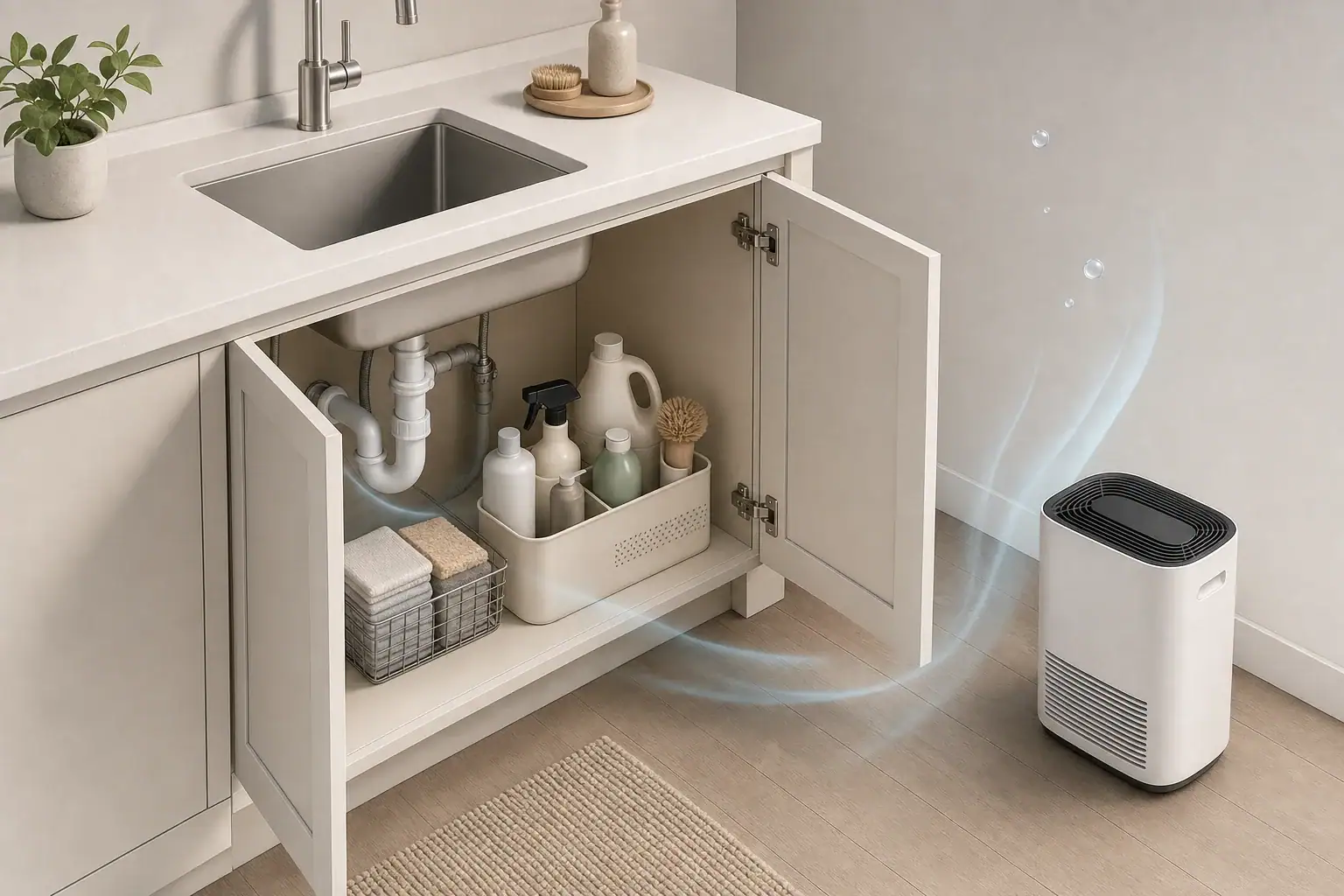
An under-sink musty smell usually means moisture is lingering from a leak, condensation, a damp item, or poor airflow.
The source may be a slow plumbing leak, wet cabinet material, an old spill, or microbial growth on a persistently damp surface. Finding and stopping the moisture matters more than masking the odor.
- Inspect supply lines, shutoff valves, drains, seals, and the cabinet base while water is running.
- Aim for indoor relative humidity around 30% to 50% when practical and generally below 60%.
- Dry wet materials within about 24 to 48 hours to limit further dampness and growth.
- Use dry paper towels to reveal slow drips that may be difficult to see.
- Consider professional help for extensive damage, contaminated water, or visible growth covering more than about 10 square feet.
What an Under-Sink Musty Smell Usually Means
A musty odor is commonly associated with materials that have stayed damp long enough to support mold or bacterial growth. Under a sink, moisture can soak into particleboard, plywood, drywall, paper products, shelf liners, or stored cloths. The odor may remain even after the surface appears dry because moisture can persist inside porous material.
Not every unpleasant cabinet odor is mold-related. A sour or stale smell may come from a wet sponge, old cleaning residue, a trash container, or a forgotten spill. A sewer-like odor is different and can indicate a drain, trap, disposal, overflow channel, or venting problem rather than damp cabinet material.
Odor alone cannot identify the exact source or determine the type of growth present. Use it as a prompt to inspect for moisture, staining, softened material, corrosion, and plumbing defects.
How to Find the Leak or Moisture Source
Empty the cabinet before inspecting it. Remove shelf liners, paper products, towels, and containers so the cabinet floor and back wall are visible. Check stored items for dampness or residue before returning them.
Inspect with the plumbing dry
Start by drying all accessible pipes, fittings, valves, and cabinet surfaces. Place clean, dry paper towels beneath likely drip points. Moisture marks on the paper can reveal a slow leak without requiring plumbing disassembly.
Look at the faucet supply lines, shutoff valves, filter connections, sprayer hose, drain basket, garbage disposal connection if present, dishwasher hose, P-trap, and joints in the drainpipe. Also check where the faucet and sink rim meet the countertop.
Test while water is running
Run cold water, hot water, and then a full basin drain test while observing the plumbing. Some supply leaks appear only when a valve is open, while drain leaks may appear only when a large volume of water passes through the pipe.
Condensation is another possibility. Cold supply pipes can collect moisture in warm, humid conditions. Unlike a fitting leak, condensation often forms across a wider section of pipe and may vary with weather or indoor humidity.
Example values for illustration.
| Observation | Likely source | First action |
|---|---|---|
| Drip near a valve or supply line | Pressurized plumbing leak | Stop using the affected fixture if needed and arrange repair |
| Water appears during draining | Drain fitting, trap, or seal | Observe the joint and have the connection corrected |
| Moisture along much of a cold pipe | Condensation | Lower room humidity and improve air circulation |
| Dry plumbing but a wet cabinet base | Old spill, sink rim leak, or hidden seepage | Remove stored items and trace staining upward |
| Musty shelf liner or cloth | Damp stored material | Discard or wash it and dry the cabinet |
| Sewer-like odor without dampness | Drain, trap, overflow, or vent issue | Check drain use and request plumbing evaluation if persistent |
| Swollen or crumbling cabinet panel | Repeated or prolonged wetting | Stop the moisture and assess whether replacement is needed |
Common Troubleshooting Mistakes
Covering the odor with fragrance does not address the moisture source. Scented products may temporarily compete with the smell while allowing the cabinet, wall, or flooring to remain damp.
Another common mistake is checking the cabinet only when the plumbing is not in use. Intermittent leaks may require running the faucet, filling the sink, draining it, and operating connected fixtures such as a dishwasher. Do not leave the test unattended.
A dry cabinet surface does not always mean the problem has ended. Particleboard can retain water along cut edges, fastener holes, seams, and the wall behind the cabinet. Watch for swelling, delamination, dark staining, peeling finishes, or recurring odor after the doors have been closed.
Air purifiers also have a limited role. A particle filter may capture some airborne particles, and activated carbon may reduce certain odors temporarily, but neither stops a leak nor dries wet cabinet material. An air purifier should not be treated as the primary fix for dampness.
Under-Sink Leak, Mold, and Ventilation Checklist
Stop active water
- Identify whether the water comes from a supply connection, drain, sink seal, appliance hose, spill, or condensation.
- Avoid using the fixture if continued use causes water to spread.
- Use the local shutoff valve only if it operates normally and can be reached safely.
- Arrange plumbing repair when a fitting, valve, hose, or drain component is defective.
Remove wet contents
Take everything out of the cabinet. Dispose of saturated cardboard, paper shelf liners, and other low-value porous items that cannot be fully cleaned and dried. Wash reusable containers and allow them to dry before storage.
Clean accessible surfaces
For a small area on a hard, nonporous surface, use water and a mild detergent, following the surface manufacturer’s care instructions. Avoid mixing cleaning products. In particular, never combine bleach with ammonia, acids, or other cleaners because hazardous fumes can result.
Routine bleaching is not a substitute for moisture control. Porous material that is swollen, crumbling, deeply stained, or persistently odorous may need to be removed and replaced after the leak is corrected.
Dry the cabinet
Wipe up standing water and keep the doors open during the drying period. A room fan can increase airflow if it can be positioned safely away from water. A dehumidifier in the surrounding room may help when relative humidity is elevated; follow its clearance, drainage, and electrical instructions rather than placing it in a cramped cabinet.
A practical goal is to dry affected materials within roughly 24 to 48 hours. Thick or enclosed materials may take longer and may require moisture assessment or removal.
Real-World Under-Sink Odor Scenarios
The odor returns after the cabinet is cleaned
If the smell disappears with the doors open but returns after they are closed, moisture may remain in the cabinet base, back panel, wall cavity, or stored contents. Recheck humidity and plumbing over several use cycles. A new liner should not be installed until the underlying panel is fully dry.
The cabinet is dry, but the drain smells
A drain odor may be mistaken for a musty cabinet. Run water into infrequently used drains to refill the trap. Clean removable sink strainers and accessible overflow areas according to the fixture instructions. Persistent sewer-like odor, gurgling, or repeated trap problems should be evaluated by a plumber.
Cold pipes drip on humid days
Widespread moisture on a cold pipe suggests condensation, especially when indoor relative humidity is high. Use kitchen and bathroom exhaust fans that vent outdoors, address sources of excess moisture, and consider room dehumidification. Pipe insulation may be appropriate in some settings, but installation should follow applicable plumbing and building requirements.
The cabinet floor is swollen
Swelling usually indicates that a wood-based panel absorbed water. Drying may stop further damage, but it will not necessarily restore the panel’s shape or strength. Replacement can be appropriate if the material is soft, unstable, or cannot be cleaned.
Safety and When to Get Professional Help
Do not touch wet outlets, wiring, disposals, dishwashers, or other electrical equipment. If water has reached electrical components, avoid the area and contact a qualified electrician or appropriate service professional. Do not work in standing water around energized equipment.
Professional assessment is sensible when the moisture source is hidden, water damage extends into a wall or floor, the cabinet repeatedly becomes wet, or the visible affected area is extensive. A commonly used general threshold for considering professional mold remediation is an area larger than about 10 square feet, although smaller problems can also require help when access or contamination complicates cleanup.
Water from sewage, drain backups, or other contaminated sources requires different precautions from a clean supply-line leak. Avoid direct contact and obtain appropriate cleanup assistance.
Do not use an ozone generator to treat a musty smell in an occupied home. Ozone can irritate the respiratory system and does not correct the leak or remove damaged material. Ionizers and ultraviolet devices are also not replacements for plumbing repair, physical cleaning, drying, and humidity control.
Preventing the Musty Smell From Returning
Inspect the cabinet periodically rather than waiting for an odor. A quick check every month or two, and after plumbing or appliance work, can reveal water marks, corrosion, loose containers, or damp liners early. Test the cabinet again after unusually heavy sink or dishwasher use.
Keep only dry, necessary items under the sink. Avoid packing products tightly around pipes because crowded storage can hide leaks and restrict visual inspection. Use a removable, washable tray to make small drips easier to notice, but do not let a tray conceal ongoing water accumulation.
For general indoor comfort and dampness control, aim for relative humidity around 30% to 50% when practical. Conditions vary by climate and season, but sustained levels above about 60% can make condensation and dampness more likely. A basic humidity monitor can help identify patterns, although placement near a wet pipe or exterior wall may not represent the whole room.
Cabinet doors can be left open temporarily during drying. They should not need to remain open permanently when the plumbing is sound and room humidity is controlled. Do not cut holes, alter cabinetry, or modify an appliance solely to address odor without considering building, fire, pest, and moisture implications.
Example values for illustration.
| Goal | Simple actions | Useful tool | Note |
|---|---|---|---|
| Find active drips | Dry fittings and place paper beneath them | Paper towel and flashlight | Test during supply and drain use |
| Limit indoor dampness | Target roughly 30% to 50% relative humidity | Humidity monitor | Season and climate affect what is practical |
| Avoid prolonged high humidity | Use exhaust ventilation or room dehumidification | Exhaust fan or dehumidifier | Generally try to remain below 60% |
| Dry a recent leak | Remove wet items and increase safe airflow | Fan and absorbent cloths | Aim for about 24 to 48 hours |
| Track recurrence | Recheck after several sink and dishwasher cycles | Removable drip tray | Do not let the tray hide an ongoing leak |
| Manage damaged material | Assess swollen or persistently odorous panels | Moisture assessment if needed | Some porous materials require replacement |
Related guides: Air Purifier vs Dehumidifier: Which One Solves Musty Air? • How to Size a Dehumidifier (Sq Ft, Pints/Day, and Real-World Tips) • Musty Smell in Closets: Moisture Sources and Simple Remedies
Summary of the Under-Sink Musty Smell Checklist
Start by emptying the cabinet, drying the plumbing, and checking supply lines, valves, drains, seals, appliance hoses, and cold-pipe condensation. Test while water is running because many leaks are intermittent.
Correct the moisture source before cleaning and drying the cabinet. Remove saturated porous items, keep the area safely ventilated during drying, and monitor room humidity with a general target of about 30% to 50% when practical.
If the odor returns, material remains wet, damage extends beyond the cabinet, or water has contacted electrical components or contains contamination, obtain qualified help rather than relying on fragrance, filtration, or repeated surface cleaning.
Frequently asked questions
Why does my under-sink cabinet smell musty even when I cannot see a leak?
A hidden slow leak, old spill, condensation, or damp cabinet material can cause an under-sink musty smell without visible standing water. Dry the plumbing and cabinet surfaces, then use paper towels beneath fittings and test the sink while running water and draining a full basin. Also check shelf liners, stored cloths, cabinet seams, and the back wall for retained moisture or staining.
How can I tell whether the moisture under my sink is condensation or a plumbing leak?
Condensation usually appears across a broad area of a cold pipe and may be worse on warm, humid days. A plumbing leak is more likely to form at a valve, fitting, hose, or drain joint and may appear only while water is flowing or draining. Dry the area first so new moisture is easier to trace.
Will cleaning the cabinet remove an under-sink musty smell?
Cleaning can remove residue and surface odor, but it will not solve the problem if moisture remains or returns. Stop the leak or condensation first, remove wet porous items, and dry the cabinet thoroughly. Swollen, crumbling, or persistently odorous particleboard may need replacement after the moisture source is corrected.
How long should I dry an under-sink cabinet after a leak?
A practical goal is to dry recently wet materials within about 24 to 48 hours. Keep cabinet doors open, remove wet contents, wipe up water, and increase safe airflow in the room. Thick wood-based panels, wall cavities, and enclosed spaces can take longer and may need professional assessment if they remain damp.
When should I call a plumber or water-damage professional for a musty smell under the sink?
Contact a plumber when you find an active leak, recurring drain leak, sewer-like odor, gurgling, or a suspected hidden plumbing problem. Seek qualified water-damage or remediation help when damage extends into walls or floors, water is contaminated, electrical components got wet, or visible growth is extensive. Professional evaluation is also sensible when the odor returns despite correcting obvious moisture sources and drying the cabinet.
Recommended next:
- Best Indoor Humidity Level to Prevent Mold (With Seasonal Targets)
- Air Purifier for Mold Spores: What Works and What Doesn’t
- How to Stop Condensation on Windows (And Why It Matters for Mold)
- Basement Dampness 101: RH Targets, Dehumidifiers, and Ventilation
- Condensation on Windows: Causes, Dew Point, and Fixes That Work
- Bathroom Mold Prevention: Exhaust Fan Timing and Humidity Control
- Clear sizing logic (room size → CADR/ACH)
- HEPA vs carbon explained for real use-cases
- Humidity + ventilation basics to reduce mold risk