
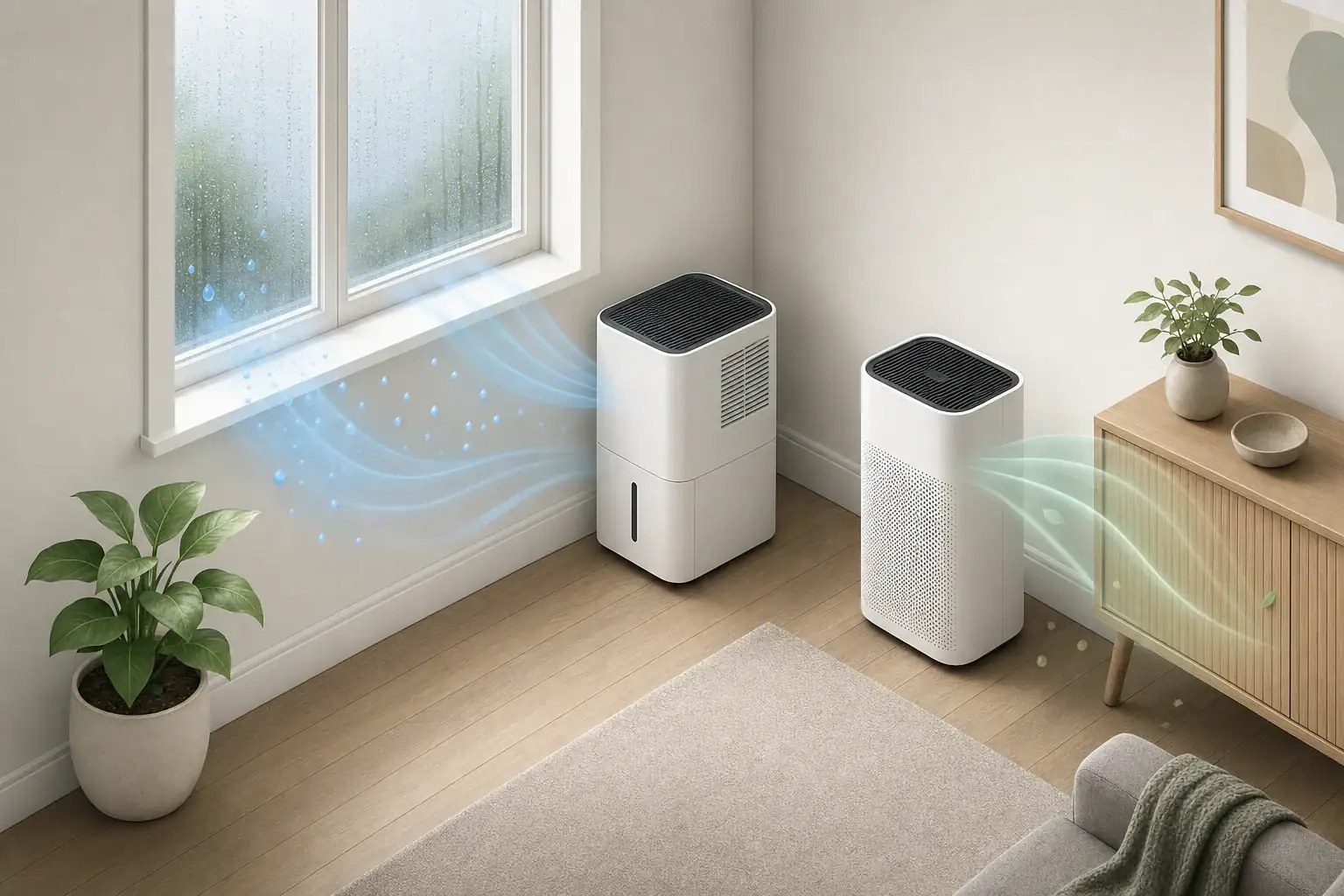
Window condensation usually means warm, moisture-laden indoor air is contacting glass or frames that are cold enough for water to form, which can increase mold risk if surfaces stay damp.
Occasional moisture does not prove that mold is present, but repeated or persistent condensation is a useful humidity and ventilation warning. The practical response is to dry the area, identify the moisture source, and keep indoor humidity appropriate for outdoor conditions.
Quick answer
- Aim for roughly 30% to 50% indoor relative humidity as general guidance, while keeping it below 60% for extended periods.
- During cold weather, some homes may need humidity closer to 30% to 40% to prevent window condensation.
- Wipe wet glass and frames promptly, then check curtains, sills, seals, and nearby walls for lingering dampness.
- Use kitchen and bathroom exhaust fans, improve air circulation, and address leaks before relying on air-cleaning equipment.
- A dehumidifier removes moisture; an air purifier may capture some airborne particles but does not dry surfaces or correct the moisture source.
What Window Condensation Means for Indoor Air
Condensation forms when a surface temperature falls below the dew point of nearby air. The dew point is the temperature at which air can no longer hold its existing amount of water vapor, causing liquid water to collect on a cooler surface.
Windows often show the problem first because glass, metal spacers, and frames can be colder than surrounding walls. Condensation may appear along the bottom edge, around frame corners, or across most of the pane during very cold weather.
Interior condensation commonly points to one or more of the following:
- Indoor relative humidity is high for the outdoor temperature.
- Cold glass or poorly insulated frames create a low surface temperature.
- Indoor air is not circulating across the window.
- Moisture from cooking, bathing, laundry, plants, or occupants is accumulating faster than ventilation removes it.
- A leak or building-envelope problem is adding moisture near the window.
Condensation between sealed panes is different. It can indicate failure of the insulated glass seal rather than excessive room humidity. Exterior condensation on the outside face of an efficient window can also occur under certain weather conditions and does not necessarily signal an indoor moisture problem.
How Humidity, Dew Point, and Surface Temperature Interact
Relative humidity, or RH, describes how much water vapor air contains compared with the maximum it could hold at the same temperature. Because warm air can hold more moisture than cold air, RH changes when air temperature changes even if no water is added or removed.
For example, indoor air at about 70°F and 50% RH has a dew point near 50°F. If part of a window falls below that temperature, condensation can develop there. This is an illustrative calculation; actual surface temperatures vary across panes, frames, and corners.
A general indoor target of 30% to 50% RH works for many homes. In a cold climate, however, 50% RH may be too high for some windows. Lowering humidity toward 30% to 40% during cold spells may reduce condensation, while extremely low humidity can feel uncomfortable and may affect wood furnishings.
Measure RH in the occupied room rather than directly on a wet sill, beside a humidifier, or in the airflow from a supply vent. A basic hygrometer is most useful for observing trends. Consumer sensors can differ, so sustained patterns matter more than a single reading.
Example values for illustration.
| Observation | Likely factor | First response |
|---|---|---|
| Moisture after showers | Short humidity spike | Run the bathroom exhaust fan and dry the sill |
| Moisture after cooking | Steam and limited exhaust | Use a vented range hood and cover pots |
| Condensation most mornings | Overnight moisture and cold glass | Check bedroom RH and improve circulation |
| Only one window is affected | Local cold spot, seal, or leak | Inspect the frame, weatherstripping, and wall |
| Water between panes | Insulated glass seal failure | Seek window assessment rather than dehumidifying alone |
| Several windows stay wet | Whole-home moisture load | Increase ventilation or use suitable dehumidification |
Common Causes and Troubleshooting Clues
Everyday moisture production
Cooking without effective exhaust, long showers, drying clothes indoors, and unvented fuel-burning appliances can add substantial moisture. Many houseplants or an uncovered aquarium can also contribute, although their effect depends on room size and ventilation.
Compare the timing of condensation with daily activities. If it appears mainly after bathing or cooking and clears quickly, source control and local exhaust may be enough. If it remains for hours, the overall moisture load may be too high.
Restricted airflow near the glass
Closed blinds, heavy curtains, furniture, and deep window coverings can trap cooler, humid air against glass. Open coverings periodically and leave space for room air to move. Avoid directing a humidifier toward a window or exterior wall.
Leaks and building defects
Rain entry, damaged flashing, plumbing leaks, and failed caulk can resemble condensation. Warning clues include staining that worsens after rain, soft materials, peeling finishes, or moisture on walls when the glass itself is dry.
Do not assume all water near a window comes from indoor humidity. Persistent localized dampness should be investigated because reducing room RH will not repair a leak.
How to Reduce Condensation and Mold Risk
Begin with moisture control rather than trying to treat airborne symptoms alone. A practical sequence is to dry, measure, ventilate, dehumidify if necessary, and inspect for defects.
- Dry wet surfaces promptly: Wipe glass, frames, and sills with a clean cloth. Dry nearby fabrics rather than leaving them against the window.
- Use exhaust at the source: Operate bathroom fans during bathing and for a period afterward. Use a kitchen hood that exhausts outdoors when producing steam.
- Track humidity: Check RH at different times for several days, including mornings, after showers, and during cooking.
- Increase circulation: Open curtains or blinds, move furniture away from cold exterior walls, and keep supply and return vents unobstructed.
- Adjust humidification: Reduce or stop humidifier use when windows become wet. Follow appliance cleaning instructions to prevent residue buildup.
- Use dehumidification when needed: Choose equipment suitable for the space, keep doors and windows appropriately closed while it runs, and drain or empty collected water safely.
- Repair water entry: Correct failed seals, flashing, roof issues, plumbing leaks, or drainage problems rather than repeatedly drying the same area.
Ventilation decisions should account for outdoor conditions. Opening windows can help when outdoor air is drier, but it may add moisture during humid weather. In cold conditions, brief ventilation can lower indoor moisture, although energy use and comfort should be considered.
Real-World Window Condensation Examples
Bedroom windows wet in the morning
Two occupants sleep with the door closed, blinds shut, and no active ventilation. Moisture from breathing accumulates while the glass cools overnight. Useful steps include measuring morning RH, opening the blinds enough for airflow, checking that HVAC registers are open, and using appropriate ventilation or dehumidification.
Kitchen window fogs during meal preparation
Boiling water produces a temporary moisture spike. Covering pots, using the outdoor-vented range hood, and continuing exhaust briefly after cooking can limit accumulation. A short-lived fog that clears is less concerning than water that remains on wood trim.
One corner repeatedly develops dark spotting
A cold frame corner may collect water while the rest of the window looks dry. Clean and dry the area, verify that curtains are not trapping moisture, and inspect for gaps or leaks. Recurrence despite moderate room RH may justify an assessment of the window or surrounding construction.
Basement windows remain damp in summer
Warm outdoor air entering a cool basement can raise RH and condense on cold materials. Leaving windows open may make the problem worse. Monitoring RH and using controlled dehumidification often provides a clearer response than ventilation based only on outdoor temperature.
Purifiers, Dehumidifiers, and Ventilation Have Different Roles
A dehumidifier directly removes water vapor and is generally the relevant device when indoor RH remains high. It does not repair leaks, and its effectiveness depends on capacity, room conditions, drainage, and airflow.
Ventilation replaces indoor air with outdoor air. Local exhaust is especially useful for bathrooms and kitchens because it removes moisture near the source. Whole-home or apartment ventilation results depend on the system design and whether outdoor air is actually drier than indoor air.
A particle air purifier may capture some airborne dust and mold-related particles when properly sized and operated, but it cannot remove moisture from a sill or stop growth on damp material. HEPA filtration addresses particles, while activated carbon is intended for certain gases and odors; neither substitutes for moisture control.
Portable units marketed with ionization or similar electronic features require caution because some technologies can produce ozone. Ozone is not needed to manage condensation and should not be intentionally generated in occupied spaces. UV-C systems also do not dry building materials, and performance depends on exposure, design, and safety controls.
Cleaning, Monitoring, and Ongoing Maintenance
Inspect windows regularly during cold spells and humid seasons. Look at the lower frame, tracks, locks, nearby drywall, and the back of curtains. Dust and debris can hold moisture, so clean tracks and drainage paths according to the window manufacturer’s care guidance.
For a small amount of surface growth on a cleanable, nonporous material, use an appropriate household cleaning method, dry the surface completely, and correct the moisture source. Never mix cleaning chemicals. Porous materials such as saturated drywall, insulation, or some fabrics may be difficult to clean fully and may require removal.
Extensive growth, repeated water damage, contaminated HVAC components, sewage exposure, or an unclear moisture source may warrant professional assessment. An affected area of roughly 10 square feet is often used as a general planning point for considering additional guidance, but conditions and material types matter.
Maintain dehumidifiers, exhaust fans, HVAC filters, and air purifiers according to their instructions. Dirty filters and blocked grilles reduce airflow. If using a condensate hose or pump, inspect it for kinks, leaks, and proper drainage rather than assuming the system is operating correctly.
Example values for illustration.
| Goal | Simple actions | Tool or check | Note |
|---|---|---|---|
| Keep general humidity moderate | Target about 30% to 50% RH | Room hygrometer | Cold weather may require a lower target |
| Control shower moisture | Use exhaust and keep the door positioned for airflow | Bathroom fan check | Confirm that the fan exhausts properly |
| Control cooking steam | Cover pots and use outdoor exhaust | Range hood airflow check | Recirculating hoods do not remove water vapor outdoors |
| Dry recurring window moisture | Wipe surfaces and open coverings | Daily visual inspection | Investigate if moisture returns frequently |
| Manage humid rooms | Use suitable dehumidification | RH trend over several days | Keep the reservoir and drain clean |
| Find hidden water entry | Compare dampness with rain and plumbing use | Frame and wall inspection | Repair the source rather than masking it |
Related guides: Best Indoor Humidity Level to Prevent Mold (With Seasonal Targets) • How to Stop Condensation on Windows (And Why It Matters for Mold) • How to Size a Dehumidifier (Sq Ft, Pints/Day, and Real-World Tips) • Ventilation vs Air Purifier: When You Need One, the Other, or Both
Window Condensation and Mold Risk Takeaways
Window condensation is an early indicator that indoor moisture, cold surfaces, and airflow are out of balance. It is not automatic proof of mold, but repeated wetting can create suitable conditions for growth on dust, paint, wood, drywall, fabrics, and other materials.
Use indoor RH as a practical trend rather than an absolute rule. Roughly 30% to 50% RH is common general guidance, but colder weather and less efficient windows may require lower humidity to keep surfaces dry.
Prompt drying, source exhaust, appropriate ventilation, dehumidification, and leak repair address the underlying conditions. Air purification can support particle control, but it should remain secondary to keeping materials dry and correcting persistent moisture sources.
Frequently asked questions
Does window condensation mean there is mold in my home?
No. Condensation alone does not confirm mold, but repeated dampness can create conditions that allow mold to grow on dust, paint, wood, drywall, fabrics, or other materials. Wipe moisture promptly and inspect the sill, frame, curtains, and nearby wall for recurring dampness or visible growth.
What indoor humidity level helps prevent window condensation?
For many homes, roughly 30% to 50% relative humidity is general guidance, with humidity kept below 60% for extended periods. During cold weather, some homes need levels closer to 30% to 40% because colder glass and frames reach the dew point more easily. The best target is one that keeps window surfaces dry while maintaining reasonable comfort.
Why are my bedroom windows wet every morning?
Moisture from breathing can build up overnight, especially when the bedroom door is closed, blinds are shut, and air circulation is limited. Cold nighttime temperatures can lower the inner glass surface below the dew point. Check morning humidity, open coverings enough for airflow, and verify that heating and ventilation registers are not blocked.
Is condensation between window panes caused by high indoor humidity?
Usually, no. Moisture or fogging between sealed panes can indicate a failed insulated-glass seal, allowing moisture into the space between the panes. Reducing indoor humidity may still help ordinary interior condensation, but it generally will not correct a failed window seal.
Will an air purifier stop mold caused by window condensation?
An air purifier may capture some airborne particles, but it does not remove water vapor, dry a wet sill, or repair a leak. Controlling window condensation requires moisture management, such as exhaust ventilation, appropriate dehumidification, better airflow, prompt drying, and repair of water entry. Air cleaning should be secondary to correcting the damp conditions.
Recommended next:
- Best Indoor Humidity Level to Prevent Mold (With Seasonal Targets)
- Air Purifier for Mold Spores: What Works and What Doesn’t
- How to Stop Condensation on Windows (And Why It Matters for Mold)
- Basement Dampness 101: RH Targets, Dehumidifiers, and Ventilation
- Condensation on Windows: Causes, Dew Point, and Fixes That Work
- Bathroom Mold Prevention: Exhaust Fan Timing and Humidity Control
- Clear sizing logic (room size → CADR/ACH)
- HEPA vs carbon explained for real use-cases
- Humidity + ventilation basics to reduce mold risk