
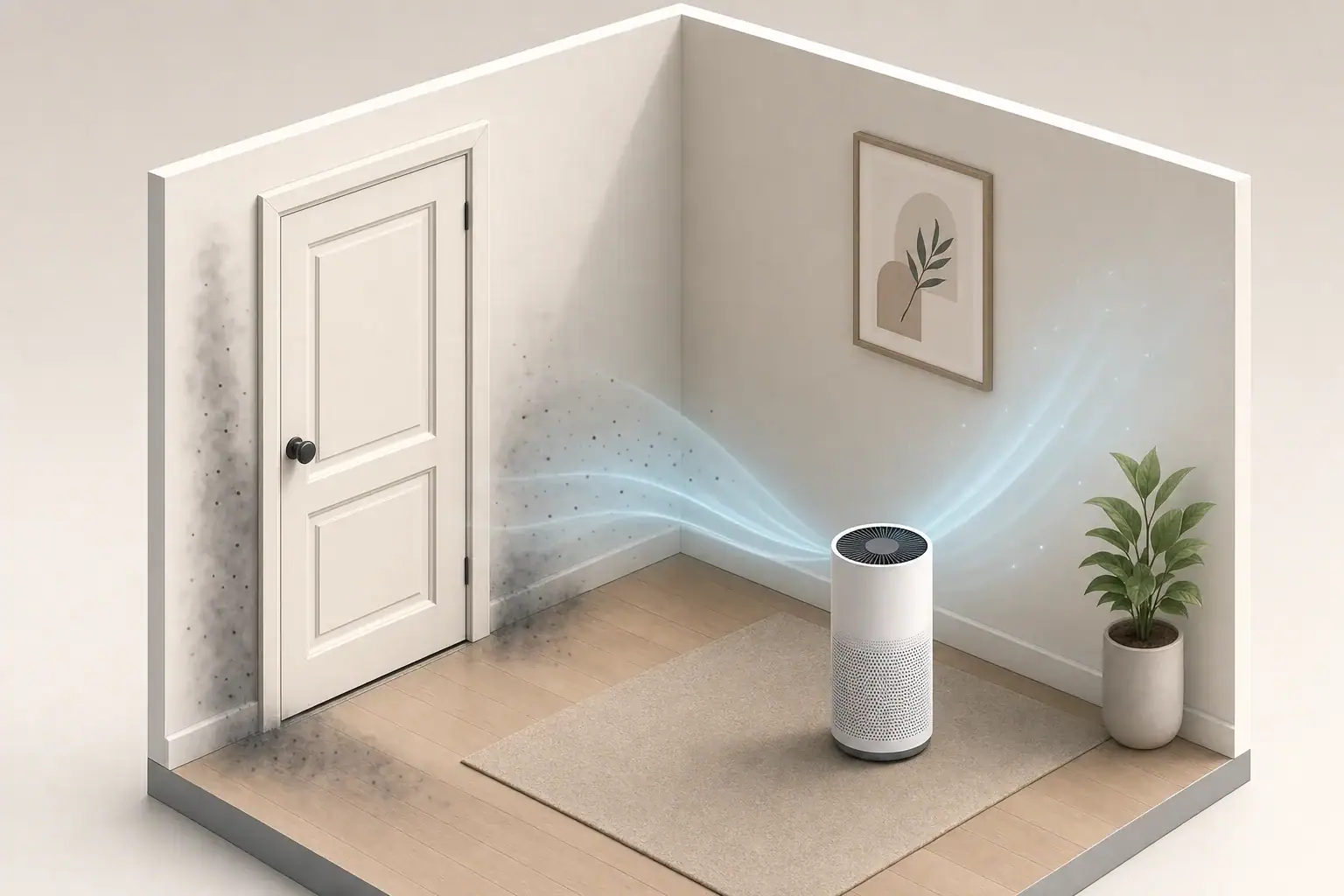
To limit wildfire smoke seeping through doors, close adjustable gaps with intact weatherstripping and a door sweep, then use correctly sized particle filtration in a designated clean-air room.
Temporary sealing can help during a smoke event, but it should never block an exit, interfere with a fire-rated door, or eliminate combustion air required by fuel-burning equipment. Filtration remains important because no occupied home is completely airtight.
- Inspect the top, sides, and bottom of exterior doors; replace compressed or missing weatherstripping and adjust the sweep so it contacts the threshold without preventing closure.
- During smoky periods, keep exterior doors and windows closed when practical and set compatible central HVAC systems to recirculate.
- For a clean-air room, use a general planning target of about 4–6 air changes per hour, recognizing that leakage, layout, and purifier speed affect results.
- Estimate required smoke CADR with: room area × ceiling height × target ACH ÷ 60.
- Use a portable PM2.5 monitor, if available, to compare indoor conditions over time rather than relying only on odor or visible haze.
Why Wildfire Smoke Enters Around Doors
Wildfire smoke contains fine particles and gases that can move indoors through open doors, gaps in the building enclosure, mechanical ventilation, and normal air leakage. A door does not need to have an obvious crack for smoke to pass through. Small gaps around the jamb, threshold, mail slot, or attached-garage entry can create a continuous leakage path.
Air pressure determines the direction of leakage. Exhaust fans, clothes dryers, fireplaces, and some HVAC configurations can depressurize a home, drawing outdoor air inward through door gaps. Wind can also push smoke against one side of a building and through available openings.
Odor is not a reliable measurement of particle concentration. Some smoke gases are noticeable at low levels, while fine particles may remain elevated even after the smell has faded. A PM2.5 monitor can provide a more consistent trend, although consumer monitors are best used for relative changes rather than laboratory-grade accuracy.
Find Door Leaks and Plan a Clean-Air Room
Begin with a visual and physical inspection while the outdoor air is relatively clear. Look for daylight around the door, loose weatherstripping, a sweep that misses the threshold, or a latch that does not pull the door evenly against its seals. A thin sheet of paper closed in different parts of the frame can reveal areas with weak compression; it should meet noticeable resistance when pulled.
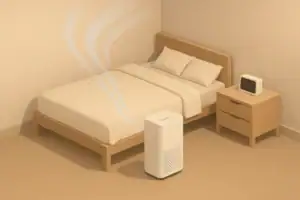
Choose one room as the primary clean-air space when whole-home control is difficult. A bedroom or living area with few exterior openings, a closable door, and enough electrical capacity for a purifier is often practical. The room should still allow normal entry and emergency exit.
Calculate filtration from the room volume rather than floor area alone. For example, a 12-by-15-foot room with an 8-foot ceiling contains 1,440 cubic feet. At a planning target of 5 ACH, the calculation is 1,440 × 5 ÷ 60, or about 120 cubic feet per minute of smoke CADR. This is an illustrative target, not a guarantee of a particular indoor reading.
Example values for illustration.
| Observation | Likely path or issue | Practical response |
|---|---|---|
| Daylight at door sides | Missing or compressed weatherstripping | Replace with correctly sized door weatherstripping |
| Gap below the door | Worn sweep or uneven threshold | Adjust or replace the sweep without impairing closure |
| Smoke rises when exhaust runs | Home depressurization | Limit optional exhaust use during smoky periods |
| One room stays cleaner | Smaller enclosed volume | Use it as the clean-air room |
| Particle readings remain elevated | Insufficient filtration or ongoing leakage | Increase purifier speed and recheck openings |
| Odor remains but particles fall | Smoke gases or absorbed odors | Use ventilation later when outdoor air improves |
Quick Door-Sealing Checklist for Smoke Events
Use durable seals for recurring leakage
Adhesive-backed or kerf-mounted weatherstripping can close gaps along the top and sides of a typical exterior door. The material should compress when the door latches but should not require excessive force. A sweep or door-bottom seal should meet the threshold across the full width.
Check the threshold, hinges, and latch alignment before adding an unusually thick seal. A misaligned door may leak because it does not sit squarely in the frame. Basic adjustment or professional repair may provide a better result than stacking multiple layers of weatherstripping.
Use temporary measures carefully
For an infrequently used secondary exterior door, removable sealing tape may reduce leakage during a short smoke event. Test it on a small area because adhesives can damage paint and finishes. Do not tape a required exit, a door that residents may need, or any opening that must remain operable under local safety rules.
A rolled towel at the bottom of a door is only a temporary measure. It can shift, create a trip hazard, and provide an inconsistent seal. It should not replace a properly fitted sweep.
Control how often the door opens
Each opening exchanges a substantial amount of air. Combine trips when practical, keep keys and deliveries organized, and close the door promptly without slamming it. In multifamily buildings, keep corridor and stairwell doors operating as designed; they may be part of the building’s fire and pressure-control system.
Size and Place Filtration for a Cleaner Room
Particle filtration addresses the fine particles associated with smoke. A portable purifier should publish a smoke CADR or another clearly stated particle-delivery rate. CADR represents cleaned airflow, so both filter efficiency and airflow matter.
A general clean-air-room target of 4–6 ACH is often practical during smoke events. Higher rates may lower particles faster, but noise, drafts, energy use, and room leakage affect what is sustainable. If the purifier will normally run on a quieter medium setting, size it for adequate delivery at that setting rather than relying only on its maximum rating.
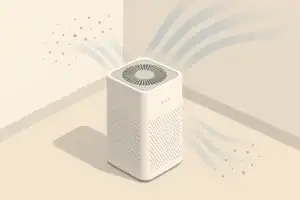
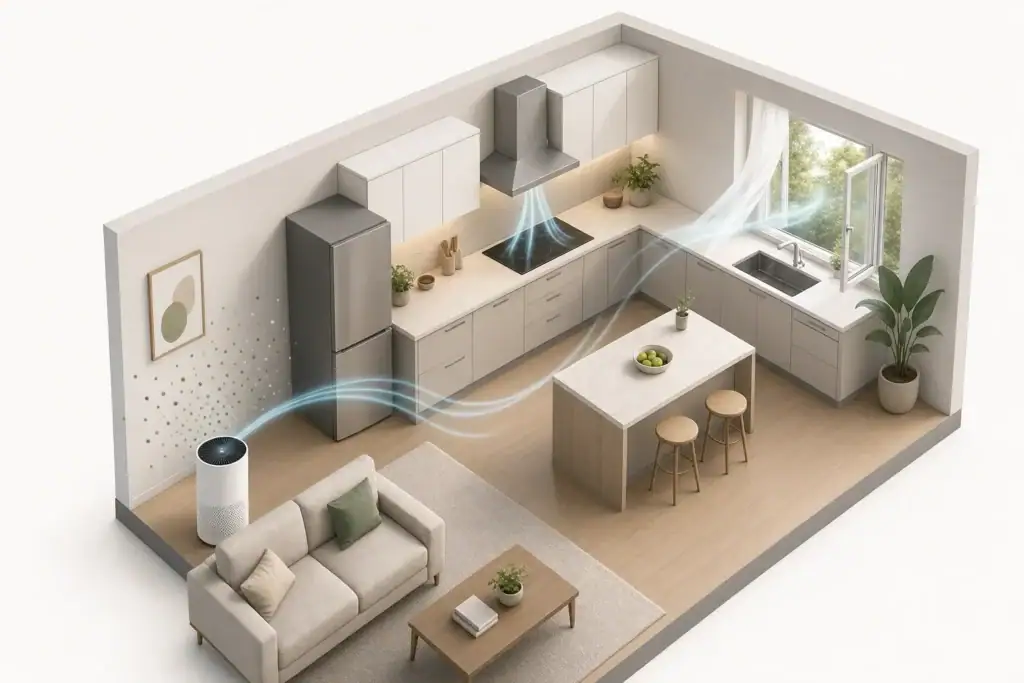
Place the purifier in the occupied room with several inches of clearance around air intakes and outlets. Avoid pushing it behind furniture or directly into curtains. Near-door placement can intercept some incoming particles, but the unit should not obstruct the doorway or create a tripping hazard. In larger or open-plan areas, two distributed units may mix air more evenly than one unit placed in a remote corner. Proper air purifier placement can help avoid obstructed airflow.
A well-sealed HEPA-grade particle filter can capture smoke particles as air passes through it. Labels such as H13 or H14 describe filter-media classifications in certain test frameworks, but whole-device airflow and leakage also matter. A highly efficient filter in a poorly sealed housing may allow bypass around the media.
Activated carbon can reduce some odors and gases, but thin carbon sheets have limited capacity. Carbon performance varies with the amount and type of media, airflow, humidity, and specific compounds. Particle filtration should remain the primary focus for PM2.5 control.
Common Mistakes and Troubleshooting Cues
- Sealing only the visible bottom gap: Smoke may also enter around the sides, top, lockset, utility penetrations, or nearby windows.
- Running optional exhaust equipment: Kitchen and bathroom exhaust fans can increase inward leakage. Use them when needed for cooking or moisture, but avoid unnecessary operation during heavy outdoor smoke.
- Using a purifier that is too small: A unit may move air without providing enough clean airflow for the room volume. Recalculate CADR using ceiling height and target ACH.
- Operating only on the lowest setting: Quiet mode may provide much less clean airflow. Compare PM2.5 trends at different usable speeds.
- Blocking purifier airflow: Furniture, walls, curtains, and clutter can restrict intake or recirculate cleaned air over a short path.
- Opening windows because the room smells stale: Check outdoor smoke conditions first. Carbon dioxide may rise in a closed occupied room, but outdoor-air ventilation is best timed for periods when outside air is cleaner.
- Assuming a dirty filter works better: Some particle filters collect efficiently as they load, but airflow can decline. Reduced airflow lowers the amount of cleaned air delivered.
If indoor PM2.5 remains high, check whether a door or window is ajar, whether the purifier filter is installed correctly, and whether the HVAC fan is introducing outdoor air. Also consider attached garages, fireplace dampers, range hoods, and other pressure-related pathways. Make only user-accessible changes described by the equipment or building instructions.
Examples for Apartments, Bedrooms, and Open Plans
Apartment with a smoky corridor
If smoke odor or particles appear strongest at the entry door, inspect its perimeter seals and ask building management about damaged weatherstripping or pressure problems. Do not alter a fire-rated apartment door or prevent it from self-closing. Place filtration inside the apartment without blocking the entry path.
Bedroom used as a clean-air room
Close the bedroom door, run a suitably sized purifier continuously, and minimize traffic. For a 150-square-foot room with an 8-foot ceiling, 5 ACH corresponds to about 100 cfm of clean airflow. Actual performance will depend on leakage, furnishings, purifier setting, and filter condition.
Open-plan living area
Use the volume of all connected space when doors cannot isolate the target area. A 600-square-foot open plan with a 9-foot ceiling contains 5,400 cubic feet and would require about 450 cfm for 5 ACH. Multiple units may be more practical and can improve air distribution.
House with central HVAC
If the system supports it, use a well-fitting particle filter such as MERV 13 or the highest efficiency recommended by the equipment manufacturer. Confirm that the filter fits without gaps. Set the system to recirculate where possible, but do not modify ducts, disable outdoor-air requirements, or install a filter that exceeds the system’s airflow capability.
Safety, Filter Maintenance, and Ongoing Checks
Do not seal doors or vents that supply required combustion air to fuel-burning appliances. Maintain working carbon monoxide alarms according to local requirements and their instructions. If sealing changes are extensive, or if a home has naturally vented combustion equipment, consult a qualified building or HVAC professional.
Avoid intentionally ozone-generating air cleaners. Ozone can react with indoor materials and is not needed for particle filtration. Ionization and some electronic cleaning features may have variable performance; if used, look for clear emissions testing and an option to disable the feature. UV-C is not a substitute for particle filtration and should remain enclosed to prevent direct exposure.
Inspect filters more often during prolonged smoke because loading may accelerate. Follow the device instructions and replace a filter when indicated by time, visible loading, persistent odor, damage, or reduced airflow. A timer light is a reminder, not a direct measurement of filter condition.
Vacuum nearby floors with a sealed, particle-filtered vacuum when practical, and damp-dust hard surfaces after outdoor conditions improve. Clean reusable prefilters only as directed and let them dry completely before reinstalling them. Never wash a filter unless it is specifically designed for washing.
Example values for illustration.
| Filter type | Example check or service interval | What may shorten it |
|---|---|---|
| Washable prefilter | Check every 2–4 weeks | Pets, dust, and continuous operation |
| Disposable prefilter | Check monthly | Heavy smoke or visible debris |
| Portable particle filter | Inspect every 1–3 months; replacement often 6–12 months | Prolonged smoke and high fan speeds |
| Thin carbon sheet | Check about every 1–3 months | Persistent odors and high humidity |
| Deep carbon filter | Review about every 3–6 months | High gas exposure and continuous use |
| Central HVAC filter | Check monthly; replace per system guidance | Continuous fan use and smoke loading |
Related guides:
Wildfire Smoke Indoors: Step-by-Step Plan to Lower PM2.5 Fast •
Best Air Purifiers for Wildfire Smoke: What Specs Matter Most •
CADR Calculator: Room Size + Ceiling Height + ACH Target •
Filter Replacement Schedules: HEPA, Carbon, and Pre-Filters
Frequently asked questions
What is the best way to stop wildfire smoke seeping through the bottom of a door?
Install or adjust a door sweep so it contacts the threshold across the full width while allowing the door to close and latch normally. Also inspect the side and top weatherstripping, since smoke can bypass a bottom seal through gaps around the frame. A towel can offer limited short-term help at a secondary door, but it is not a durable or consistent seal.
Can I tape around my exterior door during a wildfire smoke event?
Removable sealing tape may reduce leakage around an infrequently used secondary exterior door for a short period. Do not tape a required exit, a door that occupants may need to use, or a fire-rated door, and test tape first because it can damage finishes. Temporary tape should not replace correctly fitted weatherstripping and a door sweep.
Why does smoke enter around my door when the door looks closed?
Small gaps at the jamb, threshold, lockset, or door bottom can allow smoky outdoor air indoors even when daylight is not obvious. Wind and negative indoor pressure from exhaust fans, dryers, fireplaces, or some HVAC settings can increase inward leakage. Check seal compression with a paper test and limit optional exhaust use during heavy smoke when practical.
Should I run an air purifier if I have sealed my doors against wildfire smoke?
Yes. Door sealing reduces one pathway, but occupied homes still have air leakage through other openings and may receive particles when doors are opened. Use particle filtration sized for the room volume; a planning target of roughly 4–6 air changes per hour is often used for a clean-air room.
Is it safe to seal an apartment entry door to keep wildfire smoke out?
Do not alter a fire-rated apartment entry door, interfere with its self-closing function, or block the entry route. Report damaged weatherstripping or suspected building pressure problems to property management. A portable particle purifier placed inside the apartment can reduce indoor particles without changing the door’s required safety function.
Summary of the Sealing and Filtration Plan
Start by closing durable leakage paths around the door with correctly fitted weatherstripping and a sweep. Keep exits usable, preserve required combustion air, and avoid altering fire-rated or building-managed doors.
Pair sealing with particle filtration sized to the occupied volume. A planning range of 4–6 ACH, calculated from room volume and smoke CADR, provides a practical starting point. Run the purifier at a sustainable speed, monitor PM2.5 trends when possible, and inspect filters more frequently during extended smoke events.
- Clear sizing logic (room size → CADR/ACH)
- HEPA vs carbon explained for real use-cases
- Humidity + ventilation basics to reduce mold risk
About this site
Home Air Quality Lab publishes practical, independent guides about indoor air quality—clear sizing, safer use, and real-world expectations.
Affiliate disclosure
Some links on this site may be affiliate links. If you buy through these links, we may earn a small commission at no extra cost to you. This helps support our content. Learn more.