
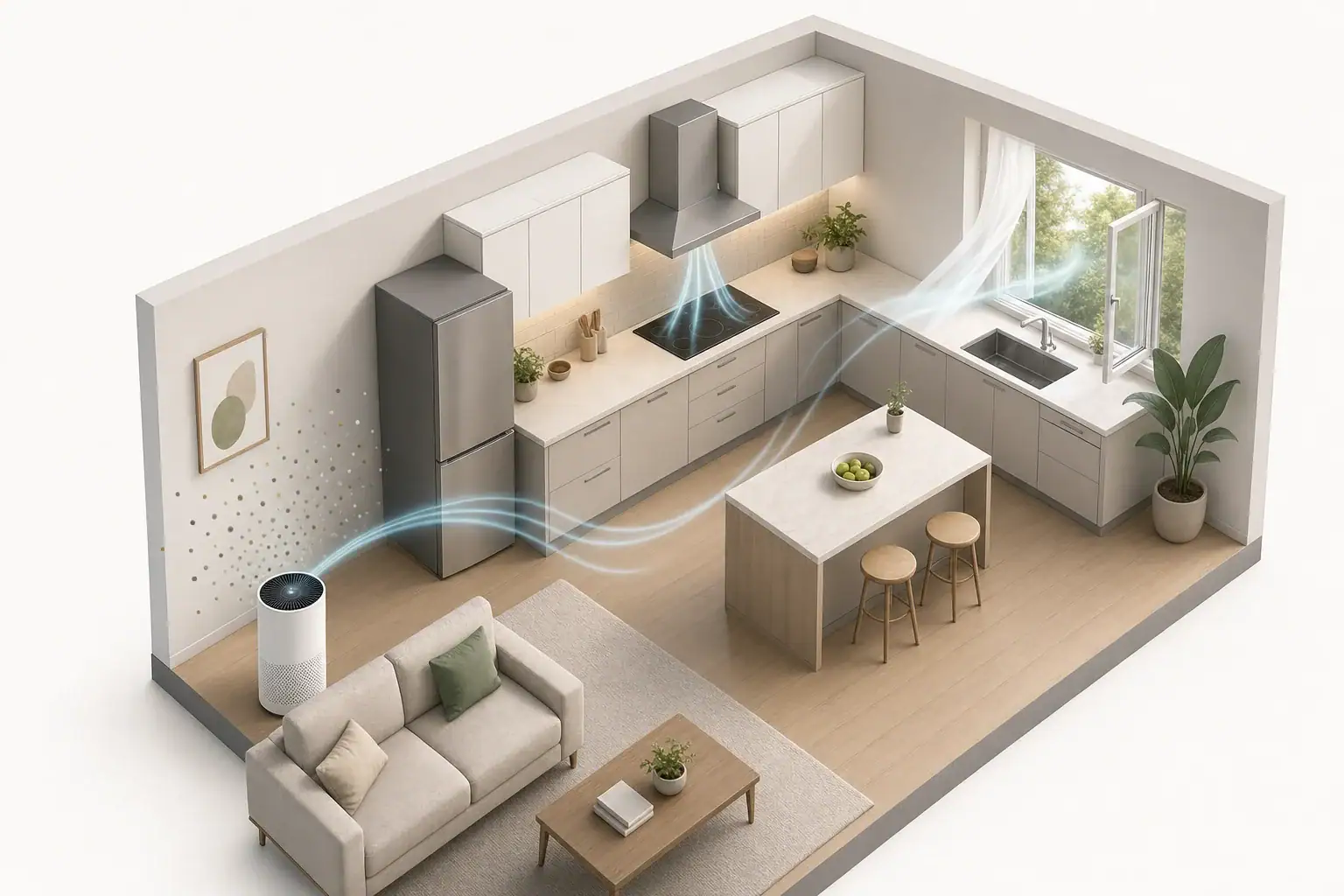
Frying food can cause a rapid indoor PM2.5 spike, and the most effective response is to capture the cooking plume, ventilate outdoors, and filter the remaining particles. The size and duration of the increase depend on cooking temperature, oil, food moisture, ventilation, and room layout. A particle monitor can help confirm when air quality is returning toward its normal baseline.
- Start an outdoor-venting range hood about 1–2 minutes before frying and use the highest practical setting.
- Keep the hood or other exhaust ventilation running for roughly 10–30 minutes afterward, or until monitor readings trend toward the pre-cooking baseline.
- If outdoor air is suitable, create cross-ventilation with two openings rather than relying on one slightly open window.
- For supplemental particle filtration, about 4–6 equivalent air changes per hour is a practical planning range during cooking cleanup.
- Keep a portable purifier out of the direct greasy plume, with clear space around its intake and outlet.
Why frying food causes PM2.5 spikes
PM2.5 refers to airborne particles with aerodynamic diameters of 2.5 micrometers or smaller. Frying can produce particles through heated oil, aerosolized food material, browning, and smoke from overheated ingredients or residue. Some larger oil droplets may also remain suspended before settling on nearby surfaces.
Particle production usually increases as cooking temperatures rise. Visible smoke is an obvious sign of high emissions, but a pan can release fine particles without producing a visible cloud. Searing, stir-frying, shallow frying, and deep frying may all cause measurable increases.
The cooking appliance also matters. Electric cooking can generate particles from food and oil. Gas burners add combustion-related pollutants, including nitrogen dioxide and carbon monoxide, which a basic PM2.5 sensor does not measure. A low PM2.5 reading therefore does not confirm that every cooking-related pollutant is low.
Open-plan rooms can dilute the initial plume across a larger volume, but they also allow particles to spread farther. In a small closed kitchen, the monitor may show a sharper increase because the same emission is concentrated in less air.
How to measure the spike and estimate cleanup airflow
A consumer PM2.5 monitor is most useful for comparing trends in the same location. Note the reading before cooking, watch the peak, and track how long it takes to approach the earlier baseline. Exact readings can vary with sensor design, placement, humidity, and airborne oil droplets.
Place the monitor away from direct steam, splatter, and the immediate range-hood airflow. A location several feet from the stove at breathing-zone height usually provides a more representative room trend than a monitor placed beside the pan. Keep its location consistent when comparing meals or ventilation methods.
Using ACH and CADR as planning tools
Air changes per hour, or ACH, describes how many room volumes are moved or cleaned in one hour. For a portable particle purifier, a simple estimate is:
Required CADR in cubic feet per minute = room volume × target ACH ÷ 60
For example, a 200-square-foot room with an 8-foot ceiling has a volume of 1,600 cubic feet. At 5 ACH, the illustrative clean-air target is about 133 cubic feet per minute. This calculation estimates particle filtration, not odor or gas removal.
Outdoor exhaust and portable filtration serve different purposes. Exhaust can remove particles, moisture, odors, and some gaseous pollutants at the source. A particle filter recirculates indoor air and primarily addresses particles. Using both can be helpful when frying produces a substantial spike.
Example values for illustration.
| Situation | Primary action | Supplemental action |
|---|---|---|
| Outdoor-venting hood available | Run it before, during, and after frying | Use particle filtration for residual PM2.5 |
| Recirculating hood only | Use it to capture some grease | Open windows when outdoor air is suitable |
| No range hood | Use controlled cross-ventilation | Run a suitably sized particle purifier |
| Outdoor PM2.5 is elevated | Limit window ventilation | Emphasize filtration and source control |
| Small enclosed kitchen | Close doors to limit particle spread | Exhaust directly outdoors if possible |
| Open-plan cooking area | Capture the plume early | Size filtration for the connected space |
Common ventilation and monitoring mistakes
Waiting until smoke is visible is a common mistake. Starting the hood before the pan heats establishes airflow before emissions begin. The hood should remain on throughout cooking, even if the noise encourages use of a lower setting.
Another mistake is assuming every range hood exhausts outdoors. Recirculating models pass air through grease and sometimes carbon filters before returning it to the room. They can reduce grease deposition and some odors, but they do not provide the same pollutant removal as outdoor exhaust.
Opening one window may have limited effect if there is no clear airflow path. A second opening on another side of the room or home can improve air movement. However, wind direction, outdoor temperature, outdoor pollution, and building pressure can change the result.
Monitor placement can also create misleading readings. Steam and concentrated oil droplets close to the pan may produce an unusually high response. Conversely, placing the sensor directly beside a purifier outlet may make the entire room appear cleaner than it is.
- Do not block purifier intakes with furniture, curtains, or walls.
- Do not place a purifier where hot oil or water can splash into it.
- Do not treat odor disappearance as proof that particle levels have returned to baseline.
- Do not assume a central HVAC fan replaces outdoor kitchen exhaust.
Ventilation steps before, during, and after frying
Before cooking
- Check whether outdoor air is suitable for window ventilation.
- Turn on the outdoor-venting hood about 1–2 minutes before heating the pan.
- Use rear burners when practical because many hoods capture the rear plume more effectively.
- Confirm that hood filters are installed and not heavily coated with grease.
- Turn on supplemental particle filtration and select a higher practical airflow setting.
While frying
- Use the lowest temperature that produces the intended cooking result.
- Avoid allowing oil, crumbs, or residue to smoke.
- Keep pans under the hood’s capture area.
- Use a lid or splatter screen when appropriate for the recipe and safe cooking practice.
- Keep interior doors closed if doing so limits particle movement without interfering with required airflow.
After cooking
- Move the pan off the hot burner and turn off the appliance.
- Continue exhaust ventilation for roughly 10–30 minutes as general guidance.
- Keep the purifier at a higher setting until PM2.5 trends toward its earlier level.
- Wipe settled grease from safe, cool surfaces so it is not repeatedly heated.
- If readings stay elevated, check for a continuing source before simply increasing fan speed.
Cleanup time is not fixed. A small meal under effective exhaust may clear quickly, while high-temperature frying in an open-plan home may take longer. The monitor trend is generally more useful than a universal timer.
Real-world frying and ventilation examples
Apartment with a recirculating hood
In an apartment without outdoor kitchen exhaust, start the recirculating hood to capture some grease and create cross-ventilation when outdoor conditions permit. Position a portable purifier outside the immediate splatter zone so room air can circulate through it. Closing bedroom doors can reduce particle movement into sleeping areas.
House with an outdoor-venting range hood
Start the hood before preheating and use a setting that consistently captures the visible or inferred plume. If the room monitor still rises sharply, use a higher fan setting, cook on a rear burner when practical, or reduce the heat. Continue ventilation after the burner is off.
Open-plan kitchen and living room
For purifier sizing, include the connected area through which air moves freely rather than counting only the kitchen floor space. A unit sized for a small kitchen may provide too few equivalent air changes once particles spread through a much larger living area.
Cold, hot, or smoky outdoor conditions
Opening windows is not always the preferred option. During outdoor smoke, elevated outdoor PM2.5, or temperature extremes, emphasize source capture and indoor particle filtration. Brief ventilation may still be useful in some situations, but compare indoor and outdoor conditions rather than assuming outside air is cleaner.
Safety limits of purifiers and cooking controls
A mechanical particle filter can reduce airborne cooking particles, but it does not replace a range hood that vents outdoors. Standard particle filters are not designed to remove carbon monoxide or nitrogen dioxide. Activated carbon may reduce some odors and gases, but effectiveness depends on carbon quantity, contact time, airflow, and the specific compound.
Homes with fuel-burning appliances should have appropriate carbon monoxide alarms installed and maintained according to applicable safety guidance. A general air-quality monitor or PM2.5 sensor is not a substitute for a listed carbon monoxide alarm.
Ionizers, electrostatic features, and some plasma-based devices require caution because certain designs can generate ozone. Ozone is not needed for routine cooking-particle control. Mechanical filtration that does not intentionally produce ozone is the simpler option for general home use.
UV-C systems are mainly intended to inactivate certain microorganisms under suitable exposure conditions. They do not physically remove grease particles, PM2.5, carbon monoxide, or cooking odors. Enclosed designs also require proper construction to prevent direct exposure and limit unintended ozone production.
Never modify a range hood, stove, vent, purifier, alarm, or building exhaust system to increase airflow. Follow appliance instructions and building requirements, and use qualified help for ventilation or combustion-appliance concerns.
Maintenance that supports effective particle removal
Grease buildup can reduce hood airflow and increase odors when residue is reheated. Clean reusable metal grease filters at the interval specified for the appliance, with more frequent attention when frying is common. Replace disposable hood filters rather than washing them unless their instructions explicitly allow cleaning.
Portable purifier prefilters can collect dust, hair, and some larger cooking residue. Inspect them regularly and clean them only by an approved method. A heavily loaded prefilter or particle filter can restrict airflow, which reduces the amount of clean air delivered to the room.
Filter replacement schedules are starting points rather than guarantees. Frying frequency, fan speed, household dust, pets, wildfire smoke, and operating hours all affect filter loading. A persistent airflow decline, filter indicator, visible loading, or odor breakthrough may justify inspection.
Particle monitors also need basic upkeep. Keep sensor openings free of dust and grease, and avoid household sprays near the device. If readings become unusually slow or inconsistent, move the monitor to clean indoor air and follow its approved cleaning or reset procedure.
Example values for illustration.
| Metric | What it indicates | Common pitfall | Action idea |
|---|---|---|---|
| PM2.5 | Fine-particle trend | Steam or oil droplets can affect readings | Track the decline toward baseline |
| PM10 | Larger airborne-particle trend | Does not identify the particle source | Check cooking and cleaning activities |
| CO2 | Occupancy and general ventilation proxy | Does not measure cooking PM2.5 | Use as supporting ventilation context |
| TVOC | Broad sensor response to some gases | Readings are not compound-specific | Compare trends rather than exact identity |
| Relative humidity | Moisture level and steam influence | High humidity may affect particle sensors | Interpret short cooking peaks cautiously |
| Carbon monoxide alarm | Dedicated combustion safety warning | A PM monitor cannot replace it | Maintain and respond per alarm guidance |
Related guides:
Cooking PM2.5 Spikes: What to Do Before, During, and After Cooking •
Exhaust Fan Best Practices: Bathrooms and Kitchens That Actually Clear Air •
Do Air Purifiers Help With Cooking Smoke and Grease Particles? •
Air Purifier Sizing for Open Floor Plans: A Step-by-Step Method
Key takeaways for clearing PM2.5 after frying
Control cooking particles as close to the source as possible. Start outdoor exhaust before frying, keep the pan under the hood, avoid unnecessary smoking, and continue ventilation after cooking ends.
Use a PM2.5 monitor to evaluate trends rather than treating one reading as a complete assessment. If supplemental filtration is needed, size it for the connected room volume and aim for roughly 4–6 equivalent air changes per hour as a practical cleanup range.
Ventilation decisions should also account for outdoor air quality. When outdoor particle levels are elevated, source capture and indoor filtration may be preferable to wide-open windows. Maintain hood filters, purifier filters, monitors, and carbon monoxide alarms so each device can perform its intended role.
Frequently asked questions
How long does PM2.5 stay elevated after frying food?
PM2.5 may decline within minutes or remain elevated for much longer, depending on the amount of frying, room size, exhaust performance, and filtration. Continue using outdoor exhaust for roughly 10–30 minutes as general guidance, then use monitor trends to judge whether readings are approaching the pre-cooking baseline.
Should I open windows after frying food to lower PM2.5?
Opening windows can help when outdoor air is cleaner than indoor air and there is a clear airflow path through the home. Cross-ventilation with two openings is generally more effective than one slightly open window, but windows may be less helpful during wildfire smoke, high outdoor PM2.5, or severe weather.
Does a recirculating range hood remove PM2.5 from frying?
A recirculating hood may capture some grease and reduce some odors, but it does not remove air from the home in the way an outdoor-venting hood does. For frying-related PM2.5, combine it with suitable window ventilation when conditions allow and a properly sized mechanical particle purifier.
Where should a portable air purifier go after frying food?
Place the purifier away from direct heat, splatter, steam, and the concentrated greasy plume from the pan. Leave clear space around the intake and outlet so it can circulate room air effectively, and avoid placing it immediately beside a PM monitor because that can create an unrepresentative reading.
Why is my PM2.5 monitor still high after the frying pan is off?
Particles can remain suspended and continue mixing through connected rooms after cooking stops, especially in open-plan spaces or where airflow is limited. The monitor may also respond to steam and airborne oil droplets, so review the trend over time and check for continuing sources such as a hot pan, smoking residue, or inadequate exhaust.
- Clear sizing logic (room size → CADR/ACH)
- HEPA vs carbon explained for real use-cases
- Humidity + ventilation basics to reduce mold risk


About this site
Home Air Quality Lab publishes practical, independent guides about indoor air quality—clear sizing, safer use, and real-world expectations.
Affiliate disclosure
Some links on this site may be affiliate links. If you buy through these links, we may earn a small commission at no extra cost to you. This helps support our content. Learn more.