
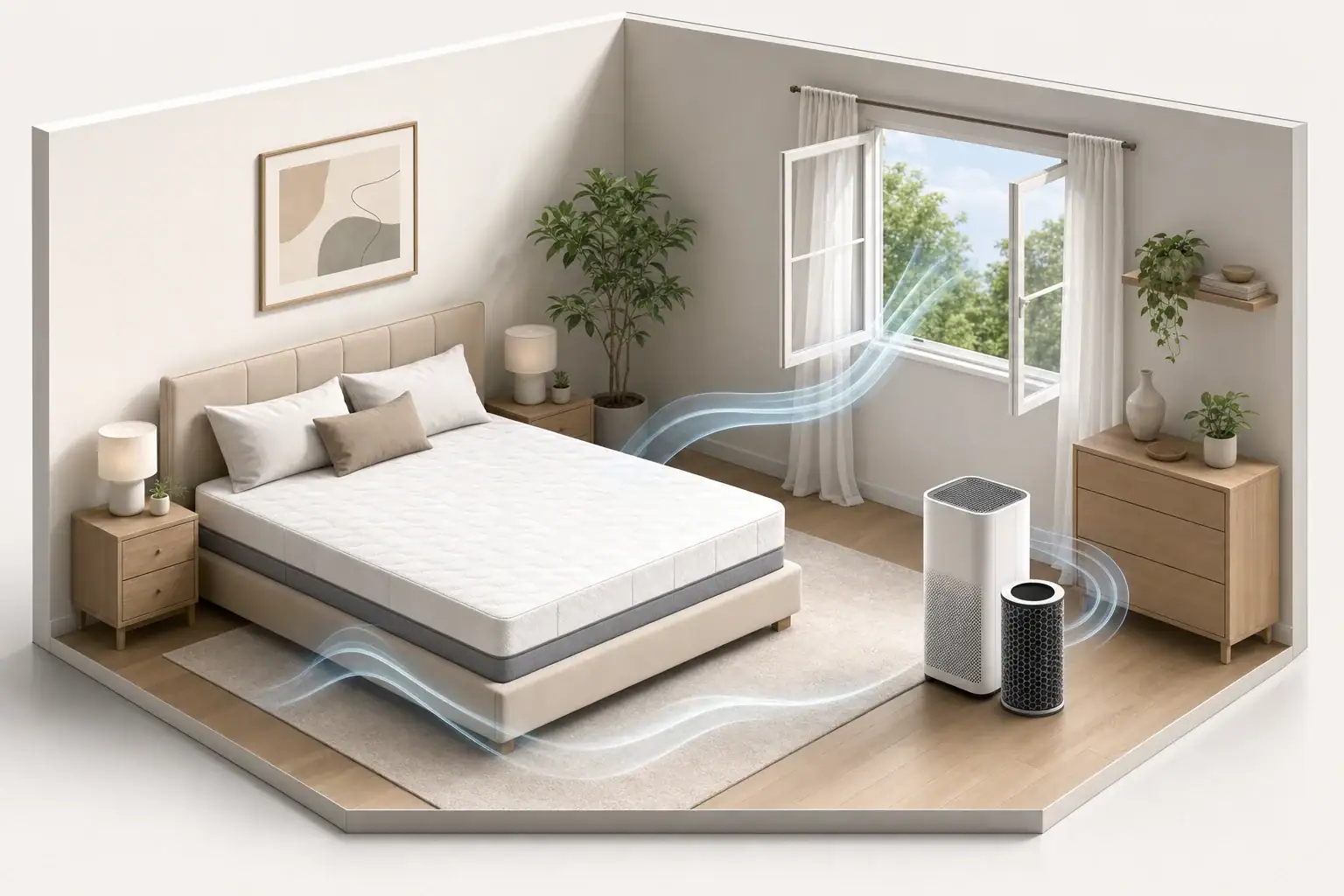
Ventilate the room continuously when practical, and use a purifier with a substantial activated-carbon filter for supplemental control of new mattress odors and volatile organic compounds.
New mattress off-gassing usually becomes less noticeable as materials air out, although the timing varies by mattress construction, packaging, room temperature, and airflow. Ventilation removes indoor gases, while activated carbon can capture some compounds that pass through the purifier.
Quick answer
- If conditions allow, air out the mattress in a well-ventilated room for about 24–72 hours before regular use.
- Aim for continuous airflow or several 15–30 minute window-opening periods during the day when outdoor air is suitable.
- For active airing, roughly 3–5 air changes per hour is a useful planning range, not an official safety threshold.
- Choose activated carbon for gases and odors; a HEPA filter alone mainly captures particles.
- Keep room temperature and humidity moderate rather than using heat to accelerate off-gassing.
What New Mattress Off-Gassing Means
Off-gassing is the release of volatile compounds from materials into the surrounding air. Mattresses may contain foams, adhesives, fabric treatments, fire-barrier materials, or packaging-related odors. Some compounds have a detectable smell, while others do not.
Odor strength is not a reliable measurement of total VOC concentration or risk. A strong smell can come from a compound detectable at a low concentration, and a room can contain gases that have little or no odor. Treat smell as a practical comfort cue rather than a precise air-quality reading.
Emissions are often most noticeable shortly after a compressed or sealed mattress is opened. They commonly decline as the mattress airs out, but there is no universal schedule. Material composition, product age, ventilation, temperature, humidity, and the volume of the room all affect the process.
How Ventilation and Carbon Filters Work
Ventilation dilutes and removes indoor gases
Ventilation replaces indoor air with outdoor air. Cross-ventilation—opening windows or doors on opposite sides of a space—can be more effective than opening one window because it creates a clearer airflow path. A window fan exhausting outward may also help, provided it is used safely and outdoor conditions are acceptable.
Air changes per hour, or ACH, describes how many times an amount of air equal to the room’s volume is replaced in one hour. As general planning guidance, approximately 3–5 ACH can provide purposeful airing. This is not a health limit, and actual natural ventilation can vary greatly with wind, window area, and temperature differences.
To estimate airflow for a specific ACH target, multiply room volume in cubic feet by the desired ACH and divide by 60. A 12-by-12-foot bedroom with an 8-foot ceiling has 1,152 cubic feet of air. Reaching 4 ACH would require about 77 cubic feet per minute of effective outdoor-air exchange: 1,152 × 4 ÷ 60.
Activated carbon adsorbs some gases
Activated carbon has a porous surface that adsorbs certain gases and odor compounds. Performance depends on the amount of carbon, its formulation, contact time, airflow, humidity, and the specific compounds present. A thin carbon-coated sheet generally has less capacity than a deeper bed containing more carbon.
Carbon filtration recirculates and treats room air, but it does not bring in outdoor air. It is best considered a supplement when windows cannot remain open or when some residual odor continues after initial airing. HEPA media can be useful for dust and particles, but it does not replace activated carbon for gas control.
Example values for illustration.
| Situation | Primary action | Supporting action |
|---|---|---|
| Good outdoor air and mild weather | Open windows for cross-ventilation | Use a fan to direct air outdoors |
| Outdoor smoke or high particle levels | Keep windows closed temporarily | Use recirculating carbon and particle filtration |
| Cold or hot outdoor conditions | Use several 15–30 minute airing periods | Close the room between ventilation periods |
| Persistent odor after initial airing | Continue moderate ventilation | Inspect carbon filter capacity and placement |
| Dust released during setup | Use particle filtration or careful cleaning | Use carbon separately for gases |
| High indoor humidity | Control moisture to a moderate range | Avoid directing humidifier mist at the mattress |
Common Ventilation and Filter Mistakes
One common mistake is assuming that any air purifier removes VOCs. A unit labeled only for particle filtration may reduce packaging dust but provide little gas control. Look for a meaningful amount of activated carbon or another clearly identified gas-phase medium rather than relying on a very thin deodorizing layer.
Placement also matters. A purifier squeezed between furniture, placed behind curtains, or pushed against a wall may have restricted intake or exhaust airflow. Follow the appliance’s required clearances and position it in the mattress room, with unobstructed airflow around the unit. Review common air purifier placement considerations when choosing a location.
Other mistakes include:
- Running only the central HVAC fan: Many residential systems recirculate indoor air and do not automatically add outdoor air.
- Using heat to speed the process: Higher temperatures can increase emissions and may affect mattress materials. Keep the room in a normal occupied temperature range.
- Masking odor with fragrances: Scented sprays, candles, or plug-ins add other airborne compounds rather than removing the original source.
- Trusting odor alone: A weaker smell can indicate improvement, but it does not quantify individual VOCs.
- Ignoring outdoor conditions: Opening windows during wildfire smoke, heavy traffic pollution, or very high humidity can create a different indoor air-quality problem.
A Practical Mattress Airing Checklist
Before opening the packaging
- Choose a room where windows can be opened or mechanical exhaust can operate.
- Check current outdoor smoke, particle, weather, and humidity conditions.
- Make enough space around the mattress and purifier for airflow.
- Review the mattress instructions, including expansion time and foundation requirements.
During the first 24–72 hours
- Remove packaging promptly and move plastic materials out of the room.
- Open windows continuously when practical, or use several shorter airing periods.
- If using a fan, direct room air toward an open window rather than blowing outdoor contaminants inward.
- Run a carbon-equipped purifier at a setting that maintains steady airflow without blocking its intake.
- Keep interior doors positioned to support the intended airflow path and prevent odor from spreading unnecessarily.
The 24–72 hour range is general planning guidance, not a guarantee that odor will disappear within that period. Continue airing as needed, and follow manufacturer instructions if the mattress requires a specific expansion period.
After the initial airing period
Return the room to normal use when the mattress has expanded as directed and the odor is acceptable for the occupants. Continue lower-level ventilation or carbon filtration if the smell remains noticeable. If an odor is unusual, intensifies, or resembles burning or overheating, stop using nearby electrical equipment and inspect for a separate source.
Ventilation Examples for Different Homes
Bedroom with windows on one wall
Open the window and bedroom door to establish an airflow route through the home, provided doing so will not spread the odor into occupied rooms. An exhaust fan in a nearby bathroom may help draw air along that route if it vents outdoors. Avoid relying on a recirculating range hood, which may not exhaust outside.
Apartment with limited window access
Use the available window in short, purposeful intervals when outdoor conditions are favorable. Keep the mattress-room door closed between airing periods if odor migration is a concern. A purifier with substantial activated carbon can provide supplemental treatment while the windows are closed.
Open-plan home
Open-plan spaces have more air volume, which can dilute odors, but they can also allow gases to spread farther. Place the mattress in a room that can be isolated during the strongest initial period when possible. If it must remain in an open area, ventilate the larger connected space and size recirculating filtration for that full area rather than the mattress footprint alone.
Home near traffic or seasonal smoke
Time window ventilation for periods with better outdoor conditions. When outdoor particle pollution is elevated, closed-window operation with both particle and carbon filtration may be the more practical temporary approach. Resume outdoor-air ventilation after conditions improve because recirculation does not replace fresh-air exchange.
Purifier Safety and Air-Cleaning Technologies
Select equipment that operates without intentionally producing ozone. Ozone is a reactive gas and is not needed for routine mattress odor management. Avoid ozone generators in occupied homes, and do not use them to treat a mattress or bedroom. Learn more about air purifier vs ozone generator considerations.
Some purifiers include ionizers, electrostatic features, plasma systems, or similar electronic technologies. These are different from passive HEPA and activated-carbon filtration. If considering an electronic feature, check whether it can be switched off and look for applicable independent limits on ozone emissions. Passive mechanical and carbon filtration offers a straightforward option without intentional ion production.
UV-C may be included in some air-cleaning devices, but it is not a substitute for ventilation or activated carbon. Its role is generally related to exposing microorganisms to sufficient ultraviolet energy under controlled conditions, not removing VOC gases. Enclosed designs should prevent direct exposure to eyes and skin.
Do not heat the mattress, apply solvents, spray fragrances on it, or alter its cover to address odor. Protect the mattress from open flames and follow its care, fire-safety, and warranty instructions.
Carbon Filter Maintenance and Monitoring
Carbon media becomes less effective as adsorption sites fill. Unlike a particle filter, a saturated carbon filter may not show a clear visual change. Returning odor, reduced odor control, elapsed operating time, and the manufacturer’s replacement guidance are more useful cues.
High gas concentrations, continuous operation, humid conditions, and a small amount of carbon can shorten useful life. Store unopened replacement filters in sealed packaging so they do not adsorb gases from the surrounding storage area.
Inspect washable prefilters and exterior grilles regularly. Dust accumulation can reduce airflow through the carbon and HEPA stages. Clean only as directed; carbon and HEPA filters are often not washable unless explicitly identified otherwise.
Using air-quality monitors carefully
A consumer TVOC monitor can help show broad trends, such as whether readings rise after unwrapping and decline during ventilation. It generally cannot identify individual chemicals or establish that a room meets a health standard. Readings can also respond to cleaning products, fragrances, cooking, alcohol vapors, and humidity changes. Understand VOC monitor limitations and TVOC readings before using the results to make decisions.
A carbon dioxide monitor does not measure mattress emissions. In an occupied room, however, rising CO2 can suggest that outdoor-air exchange is limited. PM2.5 readings track fine particles rather than VOC gases, so they are particularly useful when deciding whether outdoor smoke makes window ventilation unsuitable.
Example values for illustration.
| Filter type | Example interval | What may shorten it | Maintenance cue |
|---|---|---|---|
| Thin carbon pad | About 1–3 months | Strong odors and continuous use | Odor control declines |
| Deeper carbon filter | About 3–12 months | High VOC load and humidity | Follow condition and maker guidance |
| HEPA-style particle filter | About 6–18 months | Dust, smoke, pets, and high runtime | Reduced airflow or filter indicator |
| Disposable particle prefilter | About 1–3 months | Visible dust and pet hair | Surface appears loaded |
| Washable prefilter | Inspect every 2–4 weeks | Dusty rooms and frequent use | Clean and dry as instructed |
| Central HVAC filter | About 1–3 months | System runtime and particle load | Check fit, condition, and airflow |
Related guides: Ventilation vs Air Purifier: When You Need One, the Other, or Both • Carbon Filter vs HEPA: What Each One Removes (And What It Doesn’t) • Wildfire Smoke Indoors: Step-by-Step Plan to Lower PM2.5 Fast • Air Exchange Basics: ACH, Infiltration, and Why “Stuffy” Happens
Summary of Ventilation and Carbon Filter Tips
Outdoor-air ventilation is the primary way to dilute and remove new mattress off-gassing. When conditions allow, provide steady airflow or several focused ventilation periods during the first 24–72 hours, then continue as needed.
Activated carbon can supplement ventilation by adsorbing some gases and odors. Carbon amount, filter depth, airflow, compound type, and replacement timing matter more than the presence of a minimal carbon coating. HEPA filtration addresses particles but should not be treated as VOC control by itself.
Use normal room temperatures, keep humidity moderate, avoid fragrance masking and ozone-generating devices, and maintain unobstructed airflow through filters. Consider monitor readings as trends rather than chemical identification, and adjust the plan for outdoor smoke, weather, room layout, and occupant comfort.
Frequently asked questions
How long should I ventilate a new mattress after opening it?
Airing a new mattress for about 24–72 hours is a practical general guideline when outdoor conditions allow. The needed time varies with the mattress materials, packaging, room size, temperature, and airflow, so continue ventilation if the odor remains noticeable or bothers occupants.
Is opening one window enough for new mattress off-gassing ventilation?
One open window can provide some air exchange, but cross-ventilation is usually more effective because it creates a clearer path for indoor air to leave. Opening a door or another window, or using a fan to exhaust room air outward, may improve airflow when it is safe to do so.
Does a HEPA air purifier remove new mattress odors and VOCs?
HEPA filtration is designed primarily to capture airborne particles such as dust and does not by itself provide meaningful control of most gases or odors. For mattress off-gassing, look for a purifier with a substantial activated-carbon or other gas-phase filter in addition to any particle filter.
What should I do if outdoor smoke makes it unsafe to open windows?
When smoke or other outdoor pollution is elevated, it can be reasonable to keep windows closed temporarily to avoid bringing in polluted air. Use recirculating filtration with both particle media and activated carbon, then resume outdoor-air ventilation when conditions improve.
Should I use heat or a space heater to make a new mattress off-gas faster?
Using extra heat is not recommended because higher temperatures can increase emissions and may affect mattress materials. Keep the room at a normal occupied temperature and rely on ventilation and, where useful, carbon filtration instead.
Recommended next:
- Activated Carbon Filters Explained: VOCs, Odors, and What They Can’t Do
- How Much Activated Carbon Do You Need to Remove Odors?
- Carbon Filter vs HEPA: What Each One Removes (And What It Doesn’t)
- Formaldehyde in Homes: Sources, Risks, and How to Reduce It
- Activated Carbon Types: Pellet vs Granular vs Impregnated Carbon
- How Much Carbon Do You Need for Odors? Weight, Depth, and Contact Time
- More in Carbon Filters & VOCs →
- Clear sizing logic (room size → CADR/ACH)
- HEPA vs carbon explained for real use-cases
- Humidity + ventilation basics to reduce mold risk