
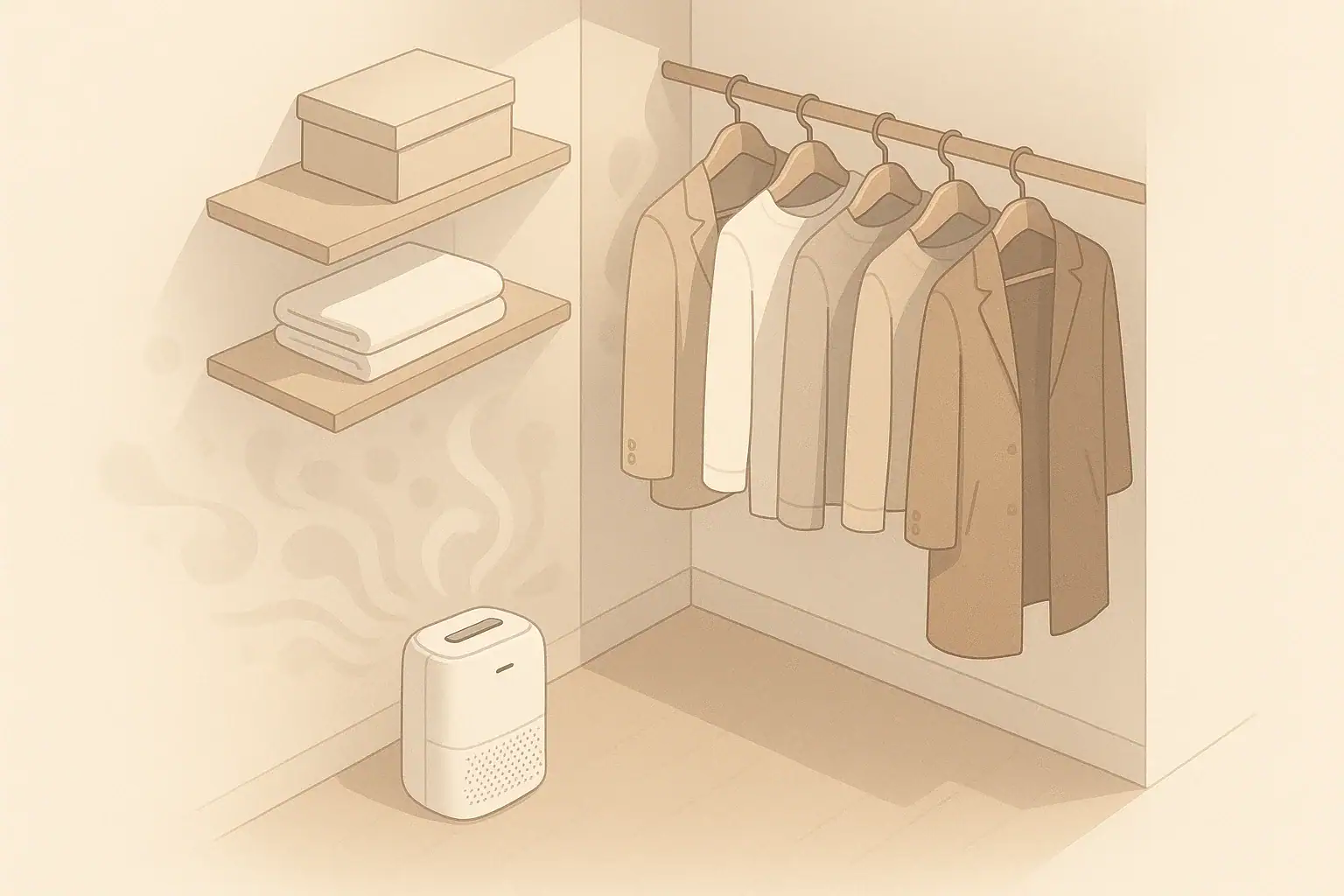
Desiccant packs are usually better for small closets with mild dampness, while electric dehumidifiers are better for larger, leak-prone, or consistently humid closets.
The right closet dehumidifier option depends on closet size, moisture source, temperature, ventilation, and how often you can maintain the device. A simple humidity meter is the most useful starting point because it shows whether the closet is only slightly damp or needs stronger moisture control.
- A practical indoor relative humidity target is often about 40% to 50%, with many homes aiming to stay below 60% to discourage persistent dampness.
- Use desiccant packs for small enclosed closets, shoes, storage bins, and seasonal items where moisture is mild.
- Consider an electric unit when closet humidity stays near or above 60%, odors return quickly, or the closet shares a wall with a damp bathroom, laundry area, or exterior wall.
- Measure first with a basic hygrometer for several days; closet humidity can differ from the room by 5% to 15% or more.
- Leave space around any electric unit for airflow, tank access, and heat release; do not place it under hanging fabrics.
What Closet Humidity Means and Why It Matters
Closets are small, enclosed spaces where air can become stagnant. Clothing, shoes, boxes, leather goods, and stored linens can hold moisture from normal indoor air, wet outerwear, or items that were stored before they fully dried.
A closet may feel damp even when the main room feels comfortable. This happens because closet doors reduce air exchange, exterior walls can be cooler, and crowded shelves limit airflow. Cool surfaces can also make relative humidity rise locally, even without a visible leak.
For general home comfort and dampness control, many households try to keep indoor relative humidity in a moderate range, often around 30% to 50% depending on season and climate. In closet planning, staying below 60% is a practical threshold because higher humidity over time can support musty odors and material deterioration.
A closet dehumidifier does not fix water intrusion, plumbing leaks, roof issues, or poor building drainage. If moisture keeps returning quickly, the device should be treated as a clue that the source needs investigation.
Desiccant Packs vs Electric Units: How They Work
Desiccant packs use moisture-absorbing materials to pull water vapor from the air. They are passive, silent, compact, and do not need an outlet. Common formats include hanging bags, canisters, small sachets, and rechargeable moisture absorbers.
Electric dehumidifiers use powered components to remove moisture more actively. Compact models may use small thermoelectric systems, while larger units often use refrigerant-based systems. In a closet, the key issue is not just water removal but also safe airflow, heat release, drainage or tank emptying, and access to a suitable outlet.
Desiccants work best in enclosed locations with light moisture loads. Electric units are more appropriate when new moisture enters regularly, the closet is walk-in sized, or humidity remains elevated despite passive measures.
Temperature matters. Some electric dehumidifiers are less effective in cooler spaces, while desiccants vs compressor dehumidifiers can remain useful across a wider range of closet conditions. However, desiccants also become saturated and must be replaced, emptied, or recharged.
| Decision point | Desiccant packs | Electric units |
|---|---|---|
| Best fit | Small closets and storage bins | Walk-in closets or persistent dampness |
| Power needed | No outlet required | Requires a suitable outlet |
| Moisture removal speed | Slow and gradual | Usually faster and more active |
| Noise | Silent | Low to moderate, depending on design |
| Maintenance | Replace, empty, or recharge when saturated | Empty tank, clean intake areas, check placement |
| Space needs | Very compact | Needs clearance for airflow and service access |
| Good first step | Mild seasonal dampness | Humidity that stays high after basic fixes |
Sizing a Closet Dehumidifier Without Guessing
Closet sizing starts with measurement, not product claims. A low-cost hygrometer placed inside the closet can show the actual relative humidity pattern over several days. Check readings with the door closed, after showers or laundry if nearby, and during humid outdoor weather.
Use closet type as a starting point
For a small reach-in closet, one or more passive desiccant packs may be enough if humidity is only slightly above the rest of the room. For a walk-in closet, an electric unit may be more practical if the area has poor ventilation or stores many absorbent materials.
As a general planning shortcut:
- Small reach-in closet: start with passive moisture absorbers and better air circulation.
- Medium closet with shoes, coats, or luggage: use multiple desiccants or a small powered unit if readings stay high.
- Walk-in closet: consider a compact electric unit when humidity remains elevated for days.
- Closet on an exterior wall: monitor more closely during cold or rainy seasons.
Compare the closet to the room
If the room is at 45% relative humidity and the closet is at 55%, airflow may be the main issue. If both the room and closet are near 60% or higher, the whole room or home may need broader humidity control, ventilation changes, or a larger dehumidifier outside the closet.
A closet dehumidifier should not be asked to dry an entire bedroom, basement, or bathroom. It is most effective when matched to the small space it serves.
Common Mistakes and Troubleshooting Cues
One common mistake is putting a desiccant pack in a closet and never checking it. Once saturated, it has little remaining capacity and may become messy depending on the format. Mark a reminder date, especially during humid months.
Another mistake is crowding the closet so tightly that air cannot move. A moisture absorber or electric unit works better when air can circulate around shoes, boxes, and clothing. Leave small gaps between items and avoid pressing stored goods against cold exterior walls.
Watch for troubleshooting cues:
- Musty odors return within a few days after cleaning.
- Humidity readings stay near or above 60% for long periods.
- Condensation appears on walls, pipes, windows, or nearby surfaces.
- Leather, paper, or fabric feels damp to the touch.
- Moisture absorbers fill unusually quickly.
These signs do not automatically mean there is a serious problem, but they suggest the moisture source is stronger than the closet device can handle alone.
Practical Closet Moisture Checklist
Before buying a larger device, reduce the moisture load as much as possible. Simple steps often make desiccant packs more effective and may reduce the need for a powered unit.
Control what goes into the closet
- Let coats, umbrellas, shoes, gym bags, and laundry dry fully before storage.
- Avoid sealing damp items in plastic bins.
- Store seldom-used fabrics in breathable containers when appropriate.
- Rotate shoes and air out boots after wet weather.
Improve air movement
- Open closet doors periodically when room humidity is moderate.
- Do not block supply or return airflow in the room.
- Leave shelf space and floor space for air to move.
- Use louvered doors or passive vents only when suitable for the room design and privacy needs.
If the closet is next to a bathroom, laundry closet, or exterior wall, run local exhaust ventilation during moisture-generating activities when available. The goal is to reduce the amount of humid air that enters the closet in the first place.
Real-World Closet Scenarios
Small bedroom reach-in closet
A small closet that stores dry clothes and a few shoes usually does not need an electric device unless readings stay high. Start with a hygrometer, reduce clutter, and use one or two desiccant packs. If humidity stays near room levels, passive control may be enough.
Walk-in closet on an exterior wall
A walk-in closet with many clothes and limited airflow can create a separate microclimate. If readings remain around 55% to 65% during humid weather, a compact electric unit may be more consistent than passive packs alone. Keep the unit away from hanging garments and maintain clearance around intake and exhaust openings.
Apartment closet near a bathroom
In apartments, moisture from showers can drift into nearby closets, especially if the bathroom exhaust is weak or not used long enough. Desiccants can help with mild moisture, but better habits may matter more: run the exhaust fan if available, keep wet towels out of the closet, and allow the bathroom to air out before closing nearby doors.
Basement storage closet
A basement closet may reflect the humidity of the whole lower level. If the surrounding basement is damp, a small closet device may fill quickly or struggle. In that case, managing the broader basement humidity is usually more effective than only treating the closet.
Safety, Placement, and Indoor Air Quality Considerations
For any electric closet dehumidifier, follow the product instructions for clearance, temperature range, tank handling, and electrical use. Do not place powered devices where clothing, paper, or boxes can block airflow or rest against warm surfaces.
Avoid running cords through doorways where they can be pinched or damaged. Use a properly located outlet and avoid improvised setups. If the closet is in a bathroom, laundry area, or other potentially wet location, electrical safety requirements may be different from a dry bedroom closet.
Some air-cleaning products use ionizers, ozone-producing features, or UV-C components, but moisture control in a closet does not require intentional ozone generation. For indoor air quality planning, it is generally sensible to avoid devices that intentionally produce ozone in occupied spaces. UV-C components, where present in some devices, should be enclosed and used only as designed by the manufacturer.
Desiccant products should also be used carefully. Keep loose granules, liquids, or saturated containers away from children, pets, and stored items that could be damaged by spills. Choose a stable location where the container will not tip.
Maintenance and Cost Planning
Desiccant packs have a low upfront cost, but they are consumable unless designed to be recharged. In humid seasons, they may need attention more often than expected. Check the indicator, water collection chamber, or weight change according to the product format.
Electric units cost more upfront and use electricity, but they can remove moisture more consistently when the load is ongoing. Maintenance usually includes emptying the tank, wiping exterior surfaces, clearing dust from intakes, and checking that the automatic shutoff works as intended.
Plan for seasonal changes. A closet that is fine in winter may become damp in summer, while a closet on a cold wall may have issues during cooler months. Keep simple notes on humidity readings, weather, and maintenance dates so you can adjust without guessing.
If musty odors remain after humidity is controlled, clean the closet surfaces and inspect stored items. Odors can be held in shoes, cardboard, fabrics, and old storage materials even after the air becomes drier.
| Goal | Simple actions | Tools | Note |
|---|---|---|---|
| Confirm conditions | Measure for several days with door closed and open | Hygrometer | Compare closet to room humidity |
| Stay in a moderate range | Aim around 40% to 50% when practical | Hygrometer, ventilation | Season and climate affect results |
| Reduce mild dampness | Add desiccant packs and reduce clutter | Passive absorbers | Check saturation regularly |
| Manage persistent humidity | Use a compact electric unit with clearance | Electric dehumidifier | Best for larger or damp closets |
| Limit moisture sources | Dry shoes, coats, towels, and bags before storage | Drying rack, room airflow | Prevention lowers device workload |
| Watch for bigger issues | Inspect for leaks, condensation, or wet walls | Flashlight, moisture notes | Fix sources rather than masking them |
Related guides: Best Indoor Humidity Level to Prevent Mold (With Seasonal Targets) • Desiccant vs Compressor Dehumidifiers: Which Is Better for Cold Rooms? • Dehumidifier Capacity Estimator: Room Dampness to Liters/Day • Basement Dampness 101: RH Targets, Dehumidifiers, and Ventilation
Frequently asked questions
Are desiccant packs enough for a small closet?
Yes, if the closet is small and the moisture problem is mild, desiccant packs are often enough. They work best when the closet is not seeing constant moisture from a leak, bathroom steam, or poor building ventilation. A hygrometer is the easiest way to confirm whether passive control is working.
When should I choose an electric closet dehumidifier instead?
Choose an electric unit when humidity stays near or above 60%, odors return quickly, or the closet is larger and more enclosed. Electric models are also more practical when the closet is near a bathroom, laundry area, or exterior wall that regularly introduces moisture. They remove moisture more actively, but they need power, airflow clearance, and regular maintenance.
How do I know if my closet humidity is actually a problem?
A closet is more likely to have a problem if it stays noticeably damper than the room, smells musty, or shows condensation on nearby surfaces. Persistent readings above about 60% relative humidity are a useful warning sign because they can support odor and material damage over time. Measuring for several days gives a better answer than checking once.
Can a closet dehumidifier fix a leak or damp wall?
No, a closet dehumidifier can manage moisture in the air, but it does not repair leaks, seepage, or building defects. If moisture keeps coming back quickly, there may be a source problem that needs attention. In that case, the dehumidifier is only a temporary control measure.
What is the best way to place an electric unit in a closet?
Place it where air can move freely around the intake and exhaust openings, with enough space for servicing and heat release. Keep it away from hanging clothes, paper, boxes, and anything that could block airflow or touch a warm surface. Use a proper outlet and avoid cords that could be pinched by the door.
Summary: Choosing the Right Closet Dehumidifier Option
For a small closet with mild seasonal dampness, desiccant packs are usually the simplest and quietest choice. They are compact, inexpensive to start, and useful where an outlet is unavailable.
For a walk-in closet, a closet near a moisture source, or a space that stays near or above 60% relative humidity, an electric dehumidifier is often more practical. It can remove moisture more actively, but it needs safe placement, power, clearance, and regular tank maintenance.
The most reliable approach is to measure first, reduce avoidable moisture, improve airflow, and then choose the smallest practical option that keeps the closet in a moderate humidity range. If the closet continues to feel damp despite those steps, look beyond the closet for leaks, ventilation problems, or whole-room humidity issues.
Recommended next:
- Best Indoor Humidity Level to Prevent Mold (With Seasonal Targets)
- Air Purifier for Mold Spores: What Works and What Doesn’t
- How to Stop Condensation on Windows (And Why It Matters for Mold)
- Basement Dampness 101: RH Targets, Dehumidifiers, and Ventilation
- Condensation on Windows: Causes, Dew Point, and Fixes That Work
- Bathroom Mold Prevention: Exhaust Fan Timing and Humidity Control
- More in Mold & Dampness →
- Clear sizing logic (room size → CADR/ACH)
- HEPA vs carbon explained for real use-cases
- Humidity + ventilation basics to reduce mold risk