
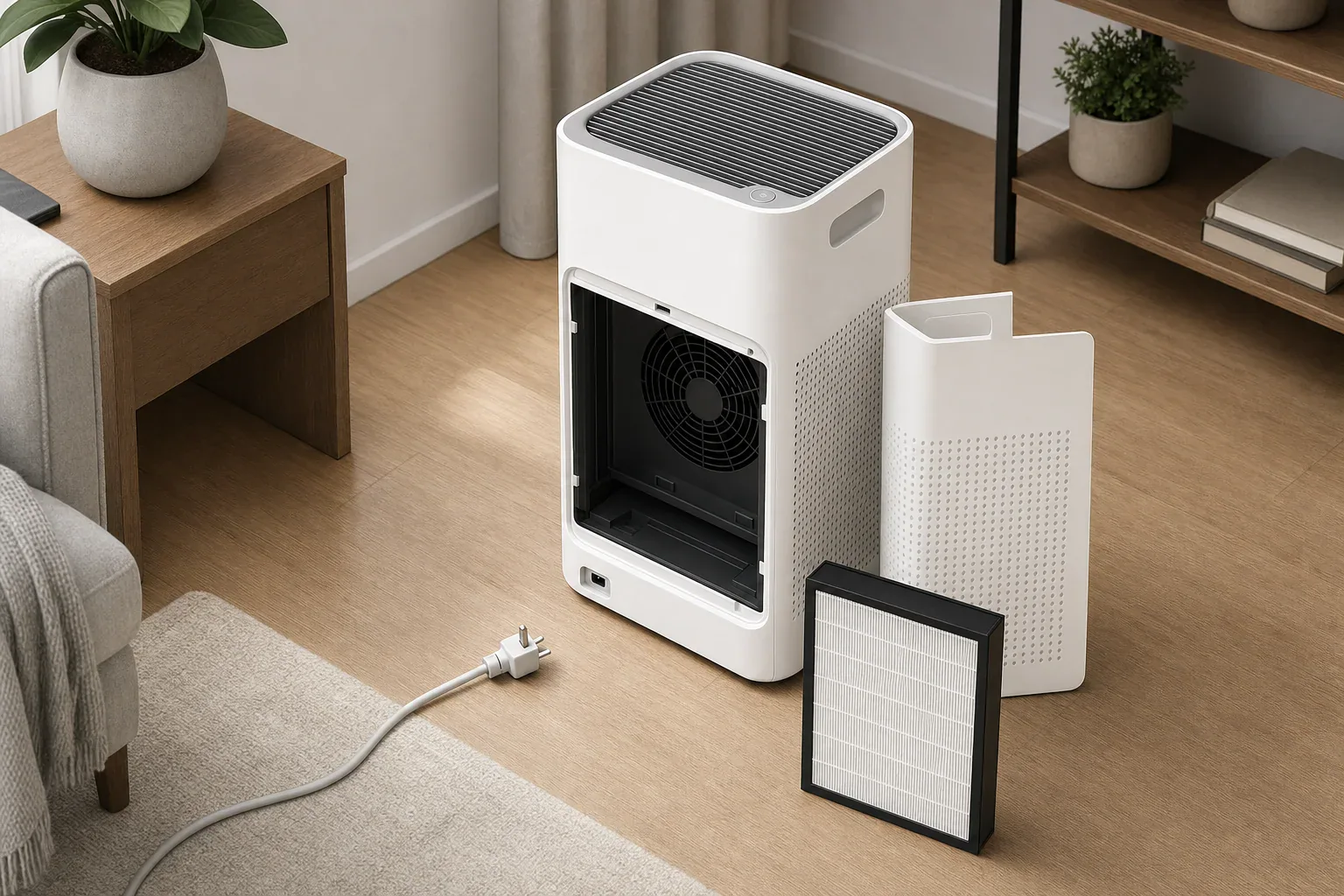
Quick answer: Do not run an air purifier without a filter that its manufacturer requires, unless the exact manual expressly permits a filterless or fan-only mode. The blower may still move air, but rated particle or gas-removal performance no longer applies, and airflow conditions can change.
Can you run an air purifier without a filter?
For a conventional purifier built around replaceable filter media, the safe default is no. Treat every filter the manual identifies as required as part of the appliance’s operating configuration—not an optional accessory. A unit that powers on with a filter missing may circulate air, but that does not show the configuration is approved, effective, or suitable for continued use.
Instructions are model-specific. A Philips owner’s manual instructs users to make sure all filters are properly installed before switching on the appliance. The Sharp FX-J80U manual is more explicit: “Do not operate the product without the filters.” Check the instructions for your exact model rather than relying on a similar-looking purifier.
This is different from a product specifically designed and documented to work without replaceable filter media. Taking the media out of a conventional filtered purifier does not turn it into a tested filterless purifier.
What happens in each missing-filter state?
| Operating state | What can be concluded | Best next step |
|---|---|---|
| All required filters installed; cover secured | This is the intended configuration. Published performance ratings apply only under their stated test conditions. | Use normally according to the manual. |
| Main particle filter missing; pre-filter remains | A pre-filter may catch larger debris, but fine-particle removal and CADR are unknown without model-specific testing. | Keep the unit off unless the manual expressly permits this setup. |
| All filters missing | The fan may circulate air, but rated purification is unavailable. | Do not use it as an air purifier. |
| Carbon stage omitted; particle filter remains | Intended gas and odor removal may be reduced or absent. Whether the remaining setup is allowed depends on the model’s design and instructions. | Operate only if the manual permits that exact configuration. |
| Filter removed for service | No verified filtration is available while the unit is open or incomplete. | Switch off, unplug, reinstall the specified filter, and secure the cover before restarting. |
Why air movement is not proof of air cleaning
The U.S. Environmental Protection Agency’s technical summary of residential air cleaners defines clean air delivery rate (CADR) as the product of particle-removal efficiency and airflow rate. More airflow alone does not establish particle cleaning when a required particle filter is missing. For that reason, do not assume the purifier’s published CADR rating still applies.
A washable pre-filter is not automatically a substitute for the main particle filter. Unless the manufacturer has tested and documented pre-filter-only performance, it does not establish useful fine-particle removal.
Likewise, carbon media and particle filters have different intended roles. Carbon media may be used for certain gases and odors, while particle filters address airborne particles. Removing carbon does not automatically make a purifier unsafe, but it can change its intended contaminant removal and may affect spacing or sealing in some designs. Follow the model manual.
How a missing filter can change airflow
A filter adds resistance to the air path. The U.S. Department of Energy’s fan systems sourcebook explains that a fan’s operating point changes as system resistance changes; in general, airflow rises as backpressure falls. Removing a filter can therefore change airflow, sound, and electrical power draw.
The size and direction of those changes are not universal. They depend on the specific blower, motor, controls, and air path. It is not supported to say that every purifier will overheat, fail, or create a fire because a filter is missing.
Without the main filter, downstream fan surfaces receive air that has not passed through the intended particle-filter stage. Internal dust buildup, any effect on service life, and the need for service are model-dependent and cannot be predicted from the missing filter alone.
Can you use it temporarily as a fan?
Only if the manufacturer identifies a filterless or fan-only operating mode for that exact model. For example, Xiaomi says its Smart Air Purifier 4 effectively functions as a fan without its filter, while also noting that air mixing can make its PM readings fluctuate. That product-specific statement does not authorize filterless use of other purifiers.
A spinning fan, working display, or changing sensor number is not evidence that filterless operation is approved or that the air is being cleaned. Do not defeat a filter-detection switch, cover interlock, or other built-in control to make a unit run.
Safe steps while waiting for the correct filter
- Turn the purifier off and unplug it. Do this before opening the cover or reaching into the filter compartment.
- Identify the exact model. Read the rating label and the owner’s manual to determine which filter stages are required.
- Use the specified replacement filter. Do not fill gaps with fabric, loose material, or an improvised substitute.
- Install it exactly as directed. Confirm orientation, seating, and cover closure before restoring power.
- Reduce avoidable indoor sources. Avoid activities that generate unnecessary particles or odors while filtration is unavailable.
- Consider ventilation only when appropriate. The EPA’s Guide to Air Cleaners in the Home describes source control, ventilation, and air cleaning as separate strategies. Outdoor air quality and other home-safety needs determine whether opening windows is suitable.
- Use another correctly assembled purifier if one is available. Do not rely on a filterless unit when particle filtration is needed, such as during a smoke or dust event.
Shutdown and correct restart checklist
- The purifier is off and unplugged before the cover is opened.
- Every filter the manual requires is present and installed in the stated direction.
- There are no gaps, makeshift media, or bypassed interlocks.
- The cover is fully secured before the unit is plugged back in.
- The cord and plug are undamaged.
- The purifier remains off if there is unusual heat, melting, smoke, sparks, or an unusual electrical odor.
The U.S. Consumer Product Safety Commission’s guide to home wiring hazards advises unplugging and discontinuing use if plugs or cords become unusually hot, melt, smoke, spark, or produce odors. These are general electrical warning signs; they do not prove that a missing filter caused the problem.
Bottom line
A conventional purifier without its required filter may move air, but it no longer has its intended, rated cleaning configuration. Leave it off and unplugged until the specified filters are installed and the cover is secured—unless the manual for that exact model clearly authorizes filterless or fan-only operation.
Related guides: HEPA Filter Direction and Sealing: Why Air Bypass Reduces Performance • Carbon Filter vs HEPA: What Each One Removes • Air Purifier Maintenance Checklist: Filters, Sensors, and Cleaning
Frequently asked questions
Will an air purifier still clean the air with only a washable pre-filter?
Not necessarily. A pre-filter may capture larger debris, but it does not establish fine-particle performance or the purifier’s rated CADR when the required main particle filter is absent.
Can you run an air purifier without a carbon filter?
Only if the manual for that exact model allows it. Omitting carbon can reduce or eliminate intended gas and odor removal, and some designs may rely on each stage for correct fit, spacing, or sealing.
Does higher fan speed mean a filterless purifier is working better?
No. A lower-resistance air path can change airflow, but CADR depends on both airflow and particle-removal efficiency. A faster or louder blower does not show that particles are being removed.
What should you do if the replacement filter is not available?
Turn the unit off and unplug it, then obtain the manufacturer-specified filter. Until it is restored, reduce avoidable indoor pollutant sources and use another correctly assembled purifier if one is available.
Recommended next:
- Air Purifier Maintenance Checklist: Filters, Sensors, and Cleaning
- When to Replace Carbon Filters (And How to Tell They’re Spent)
- How to Clean and Calibrate an Air Quality Monitor
- Air Purifier Maintenance Checklist: Monthly and Seasonal Tasks
- Filter Replacement Schedules: HEPA, Carbon, and Pre-Filters
- Cleaning Air Purifier Sensors and Intakes: What Not to Do
- Clear sizing logic (room size → CADR/ACH)
- HEPA vs carbon explained for real use-cases
- Humidity + ventilation basics to reduce mold risk