
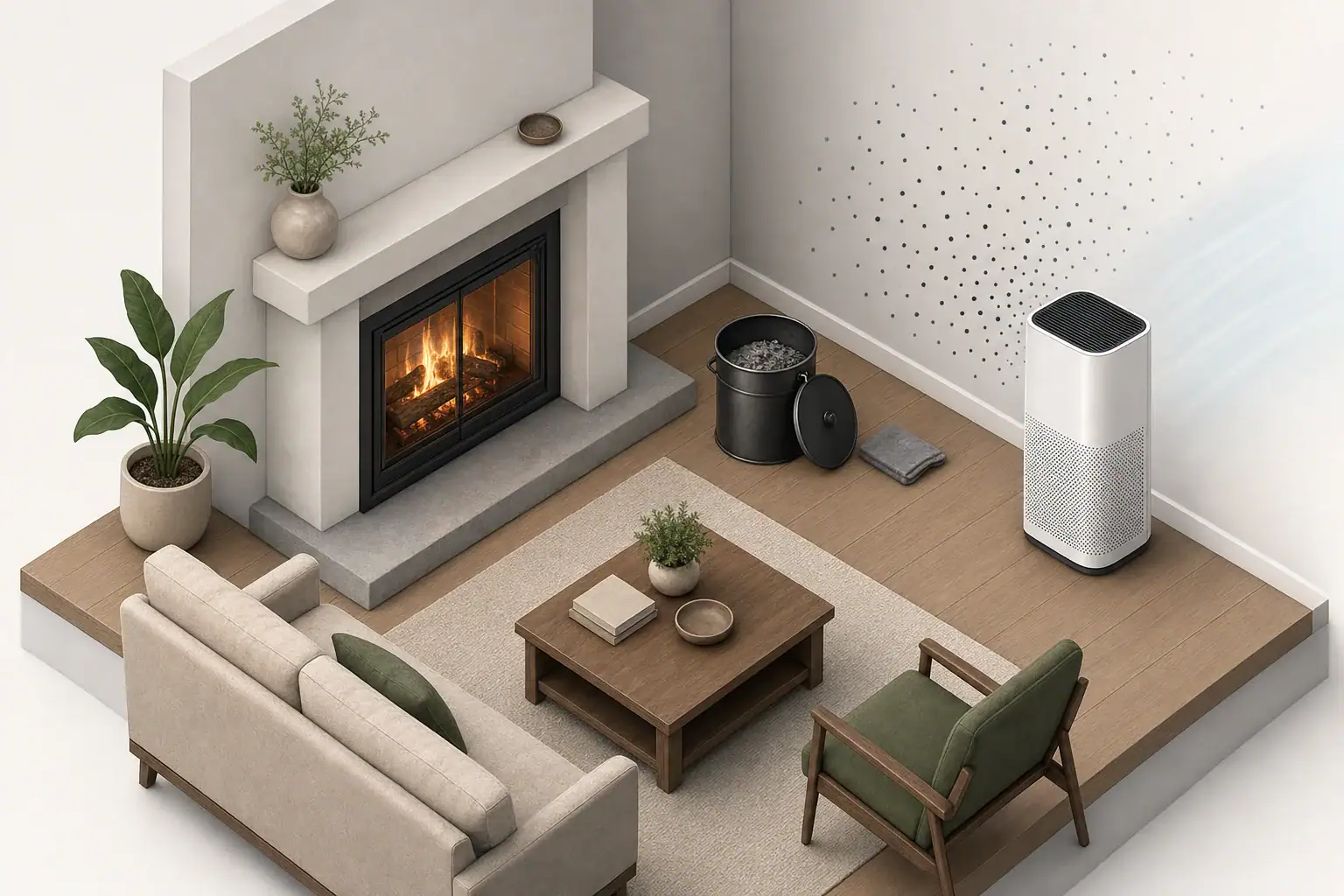
Clean fireplace ash without re-suspending fine dust by letting it cool completely, removing it slowly with suitable tools, and damp-wiping escaped residue instead of dry sweeping.
Fireplace ash contains particles light enough to become airborne when disturbed by a broom, an unsuitable vacuum, or strong airflow. A controlled cleanup limits how much dust spreads into the room and through the home’s ventilation system.
Quick answer
- Wait until the ash is completely cold; depending on the fire and appliance instructions, this may require several days.
- Allow airborne dust to settle for about 30–60 minutes before cleaning nearby surfaces.
- Use a metal shovel, a covered metal container, or a vacuum specifically designed for cold ash with fine-particle filtration.
- Pause nearby fans and forced-air circulation during cleanup when it is safe and practical to do so.
- Damp-wipe hard surfaces and launder washable fabrics rather than dry dusting them.
- Run a properly sized particle air purifier during and after cleaning without aiming its exhaust directly at the hearth.
Why Fireplace Ash Dust Becomes Airborne
Wood ash is a mixture of mineral residue, small pieces of charcoal, and particles produced during combustion. The finest fraction can behave like other indoor particle pollution: it remains suspended for a time, travels with air currents, and settles on floors, furniture, and fabrics.
Visible gray ash is only part of the cleanup issue. Smaller particles may be difficult to see, especially after they spread beyond the hearth. Soot is different from loose ash because it may be oily or strongly attached to surfaces, but both can smear or become airborne when cleaned with the wrong method.
Common sources of re-suspension include:
- Pouring or dropping ash into an open container
- Using a dry broom, feather duster, or compressed air
- Vacuuming with a machine that leaks around its filter or housing
- Running a ceiling fan or HVAC blower across the work area
- Shaking rugs, fireplace screens, or cleaning cloths indoors
- Walking through tracked ash before cleaning it
The goal is not to make the room completely motionless. It is to avoid strong, direct airflow while capturing ash as close to the source as possible.
How to Prepare the Room and Cleaning Tools
Confirm that the fireplace is inactive and the ash is fully cold before beginning. Embers can remain insulated beneath an apparently cool surface, so follow the fireplace or stove instructions and local fire-safety guidance. Never use an ordinary household vacuum on warm ash.
Gather tools before opening the fireplace doors or moving the screen. Useful supplies include a small metal shovel, a metal container with a fitted lid, damp microfiber cloths, disposable bags for cold residue, and a vacuum specifically rated for cold ash. If a vacuum is used, a well-sealed body and an appropriate fine-particle filter help reduce exhaust leakage.
Move easily contaminated items, such as throw pillows and toys, away from the hearth. Close interior doors where practical, but do not block required ventilation or alter the fireplace. Temporarily stop portable fans and forced-air circulation only when doing so is safe for the home and weather conditions.
Example values for illustration.
| Check | Why it matters | Practical note |
|---|---|---|
| Ash is fully cold | Reduces fire risk | Follow appliance guidance; waiting several days may be appropriate |
| Fans are paused | Limits particle movement | Do not interrupt required ventilation |
| Metal container is ready | Contains ash and possible hidden embers | Use a fitted lid |
| Correct vacuum is available | Limits leakage and equipment damage | Use only equipment rated for cold ash |
| Damp cloths are prepared | Capture settled residue | They should be damp, not dripping |
| Nearby fabrics are moved | Reduces secondary cleanup | Do not shake dusty fabrics indoors |
| Disposal location is planned | Avoids carrying open ash through rooms | Keep the route short and clear |
Common Ash-Cleaning Mistakes and Troubleshooting Cues
Dry sweeping is one of the most common mistakes. A broom may collect larger debris while pushing fine particles into the air. Compressed air and forceful brushing create an even stronger plume and should not be used for indoor ash cleanup.
An ordinary vacuum can also worsen the problem. Fine ash may pass through a coarse filter, leak around a poorly seated filter, or escape from the exhaust. Stop vacuuming if a visible haze appears, the exhaust smells dusty, or a particle monitor rises sharply and remains elevated. Check the filter, seals, hose connections, and collection chamber outdoors after the equipment has been switched off.
A little moisture helps capture dust on room surfaces, but pouring water into the firebox is not a general cleanup method. Wet ash can form a difficult paste and may affect masonry or metal surfaces. Follow the fireplace’s care instructions for the firebox itself.
Do not interpret every brief monitor increase as a precise measure of ash exposure. Consumer PM2.5 sensors can respond to cooking aerosols, humidity, and other particles. Trends before, during, and after cleanup are generally more useful than a single reading.
Step-by-Step Method for Low-Dust Ash Removal
1. Let particles settle
After the last fire, keep the fireplace undisturbed until everything is fully cold. If ash was recently stirred or spilled, leave the room calm for roughly 30–60 minutes so larger airborne particles can settle before surface cleaning.
2. Remove larger ash slowly
Open fireplace doors or move the screen gently. Slide a metal shovel beneath the ash rather than scooping forcefully from above. Transfer small amounts into a metal container positioned close to the hearth. Lower the shovel into the container before tipping it to reduce the drop distance.
Do not fill the container to the rim. Close its lid before carrying it through the home, and keep it outside on a noncombustible surface away from structures and combustible materials according to local guidance.
3. Capture remaining fine residue
If the appliance instructions allow vacuum cleaning, use equipment designed for cold ash. Move the nozzle slowly and keep it close to the surface. Avoid scraping aggressively or waving the nozzle above loose material.
For ash that escaped onto a hard floor, lift larger particles first and then wipe with a slightly damp disposable or washable cloth. Work from the outer edge of the affected area toward the center. Rinse or replace the cloth when it becomes loaded rather than continuing to spread residue.
4. Clean surrounding surfaces from high to low
Damp-wipe the mantel, nearby hard furniture, baseboards, and finally the floor. Use the surface manufacturer’s instructions for stone, brick, wood, or metal finishes. Wash removable fireplace tools outdoors or in an appropriate utility area without sending ash into living spaces.
5. Restore normal airflow
Once loose ash is contained and surfaces are clean, restore HVAC operation and normal ventilation. A particle air purifier can continue operating for several air changes. As general guidance, 30–60 minutes on a higher setting may help after a small cleanup, while a larger spill may require longer.
Practical Cleanup Examples for Different Situations
Routine removal from an enclosed fireplace
For a small amount of cold ash behind fireplace doors, place the covered metal container beside the hearth, shovel slowly, and clean the remaining film with an approved ash vacuum or damp cloth. Keep the doors closed between shovel loads if the room is drafty.
Ash spilled onto a hard floor
Stop foot traffic and turn off airflow aimed across the spill. Pick up larger material with a metal scoop, then use damp cloths in overlapping passes. Avoid a wet mop at first because it can spread gray residue across a larger area.
Ash on carpet or upholstery
Do not rub the area or apply water immediately. Carefully lift loose debris and use a suitable, well-filtered vacuum if the material’s care instructions permit it. Embedded soot or a large spill may require a qualified cleaning service because aggressive household cleaning can set stains or spread particles.
A larger visible dust plume
Leave the area calm and allow particles to settle. Close doors to unaffected rooms where practical, then clean hard surfaces from high to low. Replace or clean any nearby filters that show unusual ash loading, following their instructions.
Ventilation, Air Purifiers, and Safety Considerations
Ventilation can dilute indoor particles, but timing matters. Opening a window may help after ash is contained if outdoor air quality and weather are suitable. During shoveling, a strong cross-draft can pull ash into the room, so avoid placing a fan in a way that blows across the fireplace.
A portable purifier with a particle filter can supplement source control. Choose a clean-air delivery rate appropriate for the room and place the unit where it can circulate room air without directing exhaust at the hearth. Activated carbon may help with some odors, but it is not a substitute for particle filtration or proper fireplace venting.
Ionizers and other electronic air-cleaning features are not necessary for ash removal. Some devices can produce ozone as a byproduct, so ozone-generating equipment should not be used in occupied indoor spaces. Ultraviolet systems do not capture ash particles and should not be treated as a replacement for filtration and careful cleaning.
A properly installed carbon monoxide alarm remains important in homes with fuel-burning appliances, but it does not measure ash or PM2.5. Smoke, unusual odors, visible backdrafting, or repeated soot deposits can indicate a fireplace or chimney problem that calls for qualified inspection rather than additional room cleaning.
For unavoidable dusty work, a properly fitted particulate respirator can reduce the amount of dust inhaled. Follow the respirator instructions, and keep children and pets away from the cleanup area until surfaces are clean.
Filter Maintenance, Disposal, and Ongoing Prevention
Fine ash can load filters faster than ordinary household dust. Inspect the ash vacuum filter, portable purifier prefilter, and nearby HVAC return filter after a noticeable spill or dusty cleanup. Do not strike or shake loaded filters indoors.
Clean reusable components only as directed. A filter labeled washable may need complete drying before reinstallation, while many fine-particle filters should not be washed. Replace damaged, warped, persistently odorous, or visibly overloaded filters even if the usual replacement date has not arrived.
Bag disposable cold ash securely before final disposal, following local waste requirements. Keep the covered metal ash container outside and away from combustible materials until there is no possibility of heat or embers. Do not place uncertain ash directly into a combustible trash container.
To reduce future spread, maintain fireplace door seals and screens according to the appliance instructions, arrange tools within easy reach, and use a washable hearth mat where appropriate. Chimney and vent inspections should follow applicable appliance guidance and local safety practices.
Example values for illustration.
| Item | Example interval | What may shorten it | Reminder |
|---|---|---|---|
| Purifier prefilter | Inspect every 2–4 weeks | Frequent fireplace use or visible ash | Clean only as directed |
| Purifier particle filter | About 6–12 months | Heavy particle loading or long daily runtime | Use condition indicators and instructions |
| Activated carbon filter | About 3–6 months | Persistent smoke odors or high airflow | Carbon life varies widely |
| Ash vacuum filter | Inspect after each use | Fine or compacted ash | Service outdoors when fully cold |
| HVAC filter | Inspect every 1–3 months | Dusty cleanup or continuous fan use | Use a filter compatible with the system |
| Washable cloths | After each cleanup | Visible gray loading | Launder separately when practical |
Related guides:
Wood Stove and Fireplace Particles: Keeping Indoor Air Safer •
Vacuuming and Dust Clouds: Why PM Rises and How to Reduce It •
Air Purifier Placement: Where to Put It for Best Results •
Air Purifier Maintenance Checklist: Filters, Sensors, and Cleaning
Summary of Low-Dust Fireplace Ash Cleaning
The main controls are patience, gentle handling, suitable containment, and damp surface cleaning. Let ash become fully cold, minimize drafts, transfer it in small amounts to a covered metal container, and avoid dry sweeping or compressed air.
Use only a vacuum intended for cold ash, with its filter and seals correctly installed. Clean escaped residue from high surfaces to low surfaces, inspect nearby filters afterward, and restore ventilation once the source is contained.
If ash repeatedly enters the room, soot accumulates unusually quickly, or the fireplace appears to backdraft, pause use and arrange an appropriate inspection. Cleaning can remove deposited particles, but it cannot correct a venting or appliance problem.
Frequently asked questions
How long should fireplace ash cool before I remove it?
Ash should be completely cold before removal, which can take several days because embers may remain insulated below the surface. Follow the appliance manufacturer’s instructions and local fire-safety guidance, and treat ash as potentially hot if there is any uncertainty.
Can I use a regular household vacuum to clean fireplace ash dust?
No. Fine ash can pass through inadequate filters, leak from poorly sealed vacuums, damage the machine, or create dusty exhaust. Use only a vacuum specifically intended for fully cold ash and fitted with the recommended filter.
What is the best way to clean ash that spilled on a hardwood or tile floor?
First stop foot traffic and turn off fans or airflow blowing across the spill. Lift larger ash carefully with a scoop, then wipe from the outer edge toward the center using a slightly damp cloth; avoid dry sweeping and heavily wet mopping at the start.
Should I turn off my HVAC system while cleaning fireplace ash?
Pausing forced-air circulation can help prevent fine ash from traveling through the room or entering return vents when it is safe and practical. Do not disable ventilation that is required for safe operation of the home or fireplace, and restore normal airflow after the ash is contained and surfaces are cleaned.
How do I dispose of cold fireplace ash safely?
Place cold ash in a covered metal container and keep it outdoors on a noncombustible surface away from structures and combustible materials. Follow local disposal requirements, and do not put ash into a combustible trash container until there is no possibility of hidden heat or embers.
- Clear sizing logic (room size → CADR/ACH)
- HEPA vs carbon explained for real use-cases
- Humidity + ventilation basics to reduce mold risk
About this site
Home Air Quality Lab publishes practical, independent guides about indoor air quality—clear sizing, safer use, and real-world expectations.
Affiliate disclosure
Some links on this site may be affiliate links. If you buy through these links, we may earn a small commission at no extra cost to you. This helps support our content. Learn more.