
What works most reliably
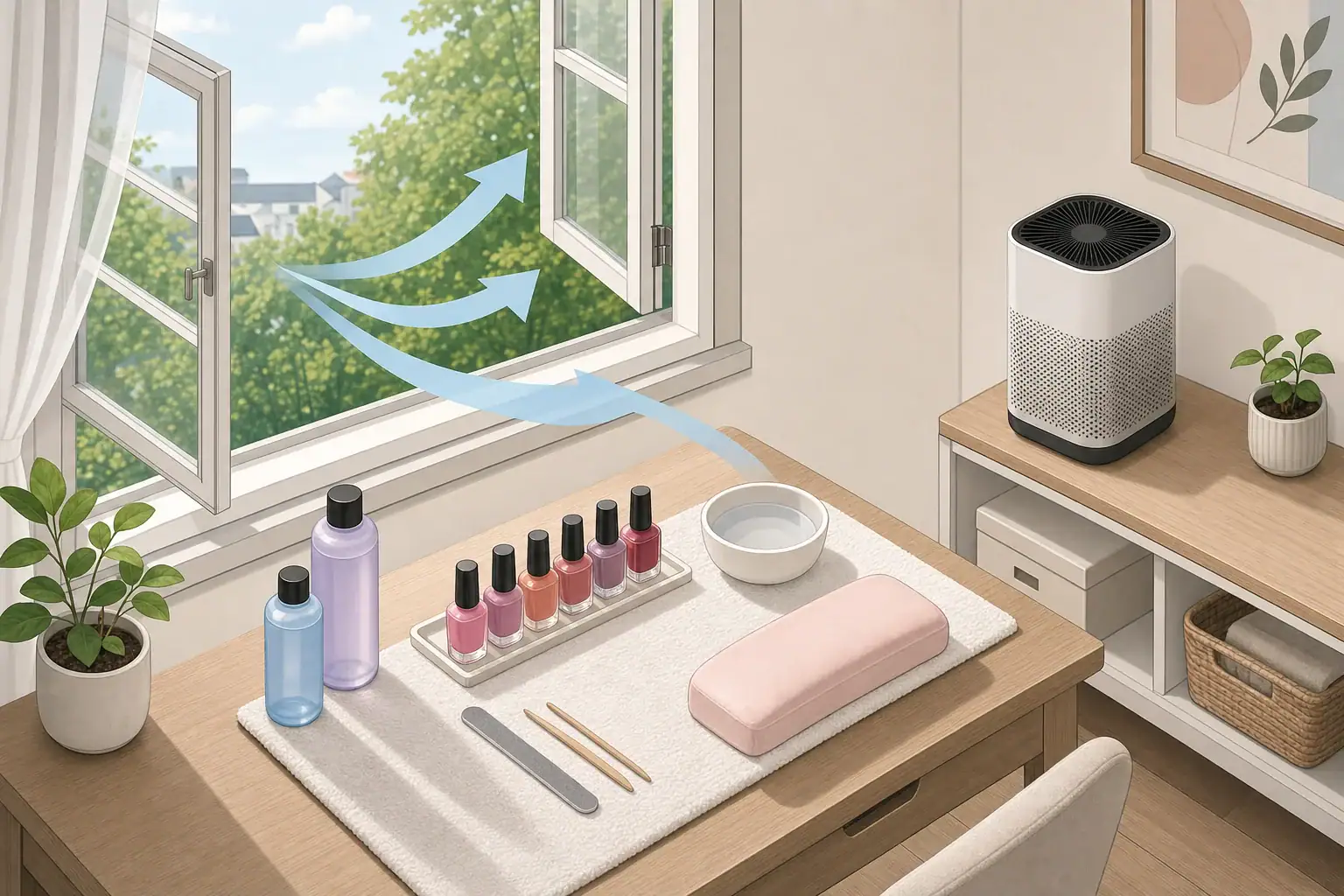
The most reliable way to limit nail polish and acetone fumes at home is to use the smallest practical amount, keep containers closed between uses, and ventilate directly outdoors. An activated-carbon filter may reduce some solvent vapors, but it is supplemental: a typical recirculating purifier does not replace indoor air with outdoor air, and thin carbon filters can lose effectiveness quickly.
Nail products and removers can release volatile organic compounds (VOCs) as they evaporate. The EPA overview of VOCs in indoor air explains why source control and ventilation are important when using products that emit organic vapors.
Reduce vapor at the source
- Set out only the products and tools needed for the session.
- Close polish, remover, and treatment bottles immediately after each use.
- Avoid leaving remover-soaked pads or open dishes in the room.
- Follow the product label and local requirements when discarding solvent-wet materials or unwanted remover.
- Clean up small drips promptly using the label instructions; acetone can also damage some finishes and plastics.
- Do not assume an “acetone-free” remover is fume-free. It may contain other volatile solvents.
Many nail products and acetone removers are flammable. Keep them away from smoking, flames, hot surfaces, and potential sparks, and follow every ignition warning on the container.
Set up useful outdoor ventilation
- Choose a room with an outdoor opening. Avoid a small enclosed room unless it has effective exhaust to the outdoors.
- Open a nearby window. If possible, open a second window or interior door so replacement air can enter and flow toward the outdoor opening.
- Use existing outdoor exhaust if available. Confirm that the fan actually discharges outside. A recirculating hood or fan that only moves room air does not remove vapors.
- Work near the exhaust path. Keep the open container close to the outdoor opening without placing it where it could tip or be reached by children or pets.
- Continue ventilating afterward. There is no universal number of minutes because removal depends on the amount used, room size, wind, temperature, and actual air exchange.
A central heating or cooling system usually recirculates indoor air rather than exhausting it. Running it may spread odor to other rooms and should not be treated as outdoor ventilation. Odor is also an imperfect indicator: smelling a solvent confirms that vapor is present, but a weak or absent odor does not establish a safe concentration.
What carbon and particle filters can do
| Filter or feature | Practical limitation |
|---|---|
| HEPA or another particle filter | Designed for airborne particles, not solvent gases. It should not be expected to remove acetone vapor meaningfully. |
| Thin activated-carbon sheet | May temporarily reduce some odors or vapors, but it contains little sorbent material and may become depleted without an obvious warning. |
| Substantial activated-carbon or other sorbent bed | Offers more potential gas-capture capacity, but results depend on the media, amount of sorbent, airflow, humidity, vapor concentration, and replacement schedule. |
| Recirculating air cleaner | Processes indoor air but does not provide outdoor air or remove the source. |
Particle CADR values do not by themselves establish how well a purifier captures acetone or other gases. Consumer gas filters also may not provide a reliable indicator showing when the media is saturated. Follow the manufacturer’s replacement directions, but do not use filter replacement schedules as proof that vapor control remains effective.
The EPA guidance on home air cleaners and filters provides additional context on the role and limitations of portable filtration.
If adequate ventilation is unavailable
The conservative choice is to postpone use or move to a location that can be ventilated outdoors while still complying with the product label. Using more carbon filtration is not a dependable substitute for outdoor air, especially in a small closed room.
Keep children and pets away from the work area to reduce the chance of spills or contact. Anyone who feels unwell should stop using the product and move to fresh air. Breathing difficulty, fainting, confusion, or severe or persistent symptoms warrant urgent medical help.
Responding to a spill
Close the source if this can be done safely, keep people away, eliminate ignition sources without operating equipment in the vapor area, and ventilate outdoors. Do not use a household vacuum on a solvent spill. For a significant spill, overwhelming odor, or uncertainty about safe cleanup, leave the area and contact local emergency or hazardous-material authorities.
Related guides: Ventilation vs Air Purifier: When You Need One, the Other, or Both • Activated Carbon Filters Explained: VOCs, Odors, and What They Can’t Do • Exhaust Fan Best Practices: Bathrooms and Kitchens That Actually Clear Air
Frequently asked questions
Does opening an interior door provide enough ventilation for nail polish and acetone fumes?
An interior door can help replacement air move through the home, but it does not by itself remove vapors outdoors. Pair it with an open window or exhaust system that actually discharges outside.
Can I rely on odor to tell when the room is ventilated enough?
No. A solvent odor indicates that vapor is present, but odor strength does not reliably show the concentration in the air. Continue source control and outdoor ventilation rather than using odor alone as a guide.
Does an acetone-free nail polish remover eliminate fume concerns?
No. Acetone-free removers may use other volatile solvents that can still produce vapors. Use the same basic precautions: keep the container closed when not in use and provide airflow to the outdoors.
Bottom line
Control nail polish and acetone fumes by limiting the open product, closing containers promptly, and creating airflow to the outdoors. Carbon filtration can be a secondary measure, but filter thickness, capacity, and saturation are major limitations; HEPA filtration and ordinary recirculation do not remove solvent vapor.
- Clear sizing logic (room size → CADR/ACH)
- HEPA vs carbon explained for real use-cases
- Humidity + ventilation basics to reduce mold risk