
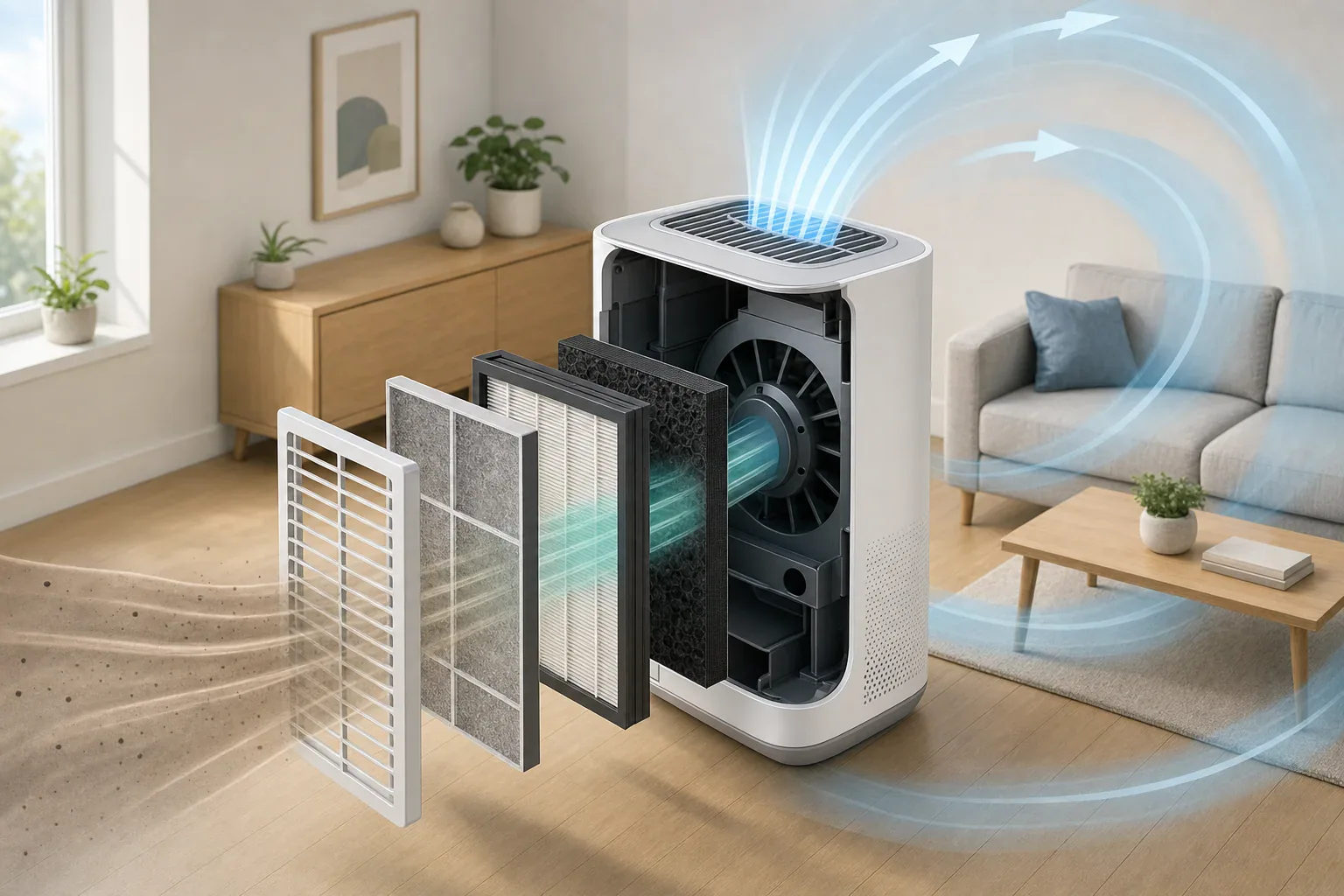
How does an air purifier work, step by step?
A portable air purifier is a recirculating air-cleaning system. A fan draws some room air into the cabinet, directs it through the installed filtration stages, and sends the processed air back into the room. The cycle continues while the unit runs.
The internal layout varies by model. Intakes may be on the front, back, sides, bottom, or around the cabinet. The fan may also sit before or after the filters. What matters is that the housing directs air through the intended filter media rather than allowing it to travel around filter edges.
- Room air enters through an intake. A grille admits air and helps protect internal components.
- A pre-filter may catch coarse debris. It can intercept hair, lint, and larger fibers before they reach later media.
- A particle filter captures particles in the passing air. Its room-cleaning effect depends on both removal efficiency and how much air the complete unit delivers through the filter.
- An optional sorbent stage can target selected gases. Media such as activated carbon can adsorb some gaseous compounds and odor-causing compounds. Results depend on the compound and the media’s capacity.
- The fan maintains airflow through the system. It operates against resistance from grilles, filters, and the internal air path.
- Processed air exits through an outlet. It mixes with room air and may return to the purifier during a later pass.
The U.S. Environmental Protection Agency’s guide to air cleaners distinguishes particle filtration from gas filtration and notes that some air cleaners combine both.
What each stage does—and does not do
| Stage | Purpose | Pollutant class | Main limitation |
|---|---|---|---|
| Intake and grille | Admit room air | None directly | Obstructions can restrict airflow |
| Pre-filter, if fitted | Protect later media from coarse debris | Hair, lint, and larger fibers | Does not establish fine-particle performance |
| Particle filter | Capture particles suspended in passing air | Dust, pollen, and smoke particles | Treats only air that reaches and passes through the media |
| Optional sorbent | Adsorb selected gaseous compounds | Some gases and odor-causing compounds | Performance is compound-specific and limited by media capacity |
| Fan and controlled air path | Move air through the stages | None directly | Resistance, filter loading, and bypass can reduce delivery |
| Outlet and room mixing | Return processed air for recirculation | None directly | Imperfect mixing and continuing sources require repeated passes |
Why one pass does not clean the whole room
An air purifier processes only the air flowing through it at a given moment. The air leaving the outlet mixes with untreated room air, while doors, windows, people, activities, and other sources may continue adding particles or gases. Concentrations therefore fall progressively rather than every air parcel being cleaned in one sweep.
Higher fan speeds and longer run times generally increase the amount of air filtered, according to the EPA guide. Results also depend on room mixing, operating speed, filter condition, and whether outlet air circulates through the room rather than quickly returning to the intake. For setup details, see Air Purifier Placement: Where to Put It for Best Results.
CADR combines airflow and particle removal
Filter efficiency alone does not describe how much cleaner air a complete purifier delivers to a room. A filter with high particle-removal efficiency paired with low airflow may deliver less cleaning than expected. Raw fan airflow is also incomplete because it does not account for the fraction of particles removed.
Clean air delivery rate, or CADR, combines airflow and pollutant-specific fractional removal efficiency:
CADR = airflow through the cleaner × fractional removal efficiency
For example, 300 cubic feet per minute of airflow multiplied by a 0.60 removal fraction equals a particle CADR of 180 cfm. The EPA’s Residential Air Cleaners technical summary explains this relationship and discusses the effects of resistance, filter loading, leakage, location, and operating time.
Particle CADR is pollutant-specific, is normally expressed in cubic feet per minute, and is typically measured at the highest fan speed. It does not rate gas removal. The AHAM room-air-cleaner certification program independently verifies smoke, dust, and pollen CADR for participating listed models under its applicable test program.
Hypothetical airflow walkthrough
Assumptions: A closed room is 12 feet by 15 feet with an 8-foot ceiling. Its volume is 1,440 cubic feet. A purifier delivers a particle CADR of 180 cfm at the chosen setting.
Room volume = 12 × 15 × 8 = 1,440 ft³
Equivalent clean-air room volumes per hour = 180 × 60 ÷ 1,440 = 7.5
Under those assumptions, the unit supplies the equivalent of one room volume of clean air every eight minutes. This is not a promise that every air parcel or particle is treated within eight minutes. Actual concentration changes also depend on mixing, infiltration, ongoing emissions, placement, and runtime. For room-sizing calculations, see CADR Calculator: How to Match Room Size, Ceiling Height, and ACH.
What changes delivered cleaning
Fan speed and runtime
A higher setting usually moves more air through the unit, and longer operation gives room air more opportunities to pass through the filters. Compare performance at the speed you expect to use rather than assuming a highest-speed rating applies at every setting.
Pressure resistance and filter loading
Grilles and filter media resist airflow. As collected material loads a filter, its pressure drop generally rises. The resulting effect on delivered cleaning depends on the fan, controls, filter, and housing, so visible dirt cannot be converted into a universal airflow or CADR penalty.
Bypass leakage
If air can move around a poorly seated filter, some air may reach the outlet without passing through the intended media. The size of this effect is model-specific. A strong outlet stream alone does not establish filtration performance or confirm that a filter is sealed correctly.
Discharge direction and room circulation
Outlet air aimed directly toward an intake can encourage a short circulation path. Keeping both grilles clear and allowing space for room air to mix helps the purifier operate as intended.
Checklist for reading a purifier diagram or specification
- Locate the intake and outlet arrows in the manual rather than guessing from the cabinet shape.
- Confirm the filter order and whether a gas-removal stage is optional.
- Check filter orientation, edge seating, covers, and perimeter seals after installation.
- Distinguish particle CADR from raw airflow, filter efficiency, and a suggested room size.
- Note the particle class and fan speed associated with each CADR value.
- Look for pollutant-specific evidence before interpreting gas or odor claims broadly.
- Check whether a certification or test result applies to the exact model and filter configuration.
- Keep intake and outlet grilles unobstructed and follow the model’s maintenance instructions.
Limits of recirculating filtration
A purifier can address only pollutants that reach its intake and that its installed media can remove. Particle filtration does not establish gas-removal performance, and a sorbent stage does not remove every gas. It also does not correct the source of a pollutant, remove material that has already settled on surfaces, or repair a moisture problem.
The EPA recommends using air cleaning as a supplement to source control and appropriate clean-air ventilation, not as a replacement for them. Match the device and its operation to the pollutant type, room, and intended fan speed.
Related guides: Air Cleaner vs. Air Purifier: Is There a Difference? • HEPA vs Carbon Filters: When Each One Matters Most • Air Purifier Maintenance Checklist: Filters, Sensors, and Cleaning
Frequently asked questions
Where does an air purifier take in air?
The intake location depends on the model and may be on the front, back, sides, bottom, or around the cabinet. Check the manual’s airflow diagram rather than relying on the cabinet shape, and keep the intake grille clear.
Does higher filter efficiency always mean better room cleaning?
No. Room cleaning depends on particle removal efficiency and the airflow delivered through the complete unit. For particles, CADR is more informative because it combines airflow with removal for a specified test pollutant.
Can an air purifier remove gases and odors?
Some models include a sorbent medium, such as activated carbon, that can adsorb selected gases and odor-causing compounds. Results depend on the compound and the amount and condition of the sorbent media. Particle CADR does not measure gas removal.
Why does an air purifier need to run for long periods?
It treats only the portion of room air that passes through the unit at a given time. Repeated circulation gives more room air opportunities to pass through the filters while accounting for mixing and continuing pollutant sources.
Bottom line
An air purifier works by repeatedly moving room air through pollutant-specific media. Delivered particle cleaning depends on airflow, capture efficiency, runtime, resistance, filter condition, housing leakage, and room circulation. CADR is more useful than filter efficiency or fan airflow alone because it represents complete-unit particle-cleaning delivery for a specified test pollutant.
Recommended next:
- Best Air Purifiers for Allergies: What to Look For (CADR, HEPA, Carbon)
- How to Choose the Right Air Purifier for Your Room Size (With CADR & ACH)
- Air Purifier Placement: Where to Put It for Best Results
- Do Air Purifiers Help With Smoke and Odors?
- Air Purifier Noise: What dB Levels Are Quiet Enough for Sleep?
- Best Air Purifiers for Pets: Dander, Odors, and Filter Costs
- Clear sizing logic (room size → CADR/ACH)
- HEPA vs carbon explained for real use-cases
- Humidity + ventilation basics to reduce mold risk