
Does a HEPA filter remove asbestos from indoor air?
A genuine HEPA filter can capture very small airborne particles, including asbestos fibers, when air passes through the filter. The U.S. Environmental Protection Agency (EPA) explains that a HEPA filter can theoretically remove at least 99.97% of particles measuring 0.3 micrometers under its test conditions; particles both larger and smaller are generally captured with greater efficiency. That rating describes the filter, not every particle in a room or building.
Filtration alone does not remove asbestos-containing material, stop damaged material from releasing fibers, collect settled debris, contain contamination, or establish that a space is safe for occupancy. A portable purifier is not an asbestos response plan.
Why the 0.3-micrometer HEPA rating is not a size cutoff
The often-quoted 0.3-micrometer figure is not the smallest particle a HEPA filter can capture. The EPA’s HEPA filter explanation identifies 0.3 micrometers as the test size associated with the most penetrating particles. Filter capture is generally higher for particles above and below that size when they pass through the filter media.
That does not mean all fibers released in a room will reach a portable device. Fibers may remain in material, settle onto surfaces, enter hidden spaces, or continue to be released from an uncontrolled source. A filter’s rated performance also does not account for air that does not pass through the unit or air that bypasses a poorly fitted filter.
Capture, containment, removal, and clearance are different jobs
- Capture means filtering particles from air drawn through a device.
- Containment means limiting the movement of contamination outside a controlled work area.
- Removal or repair addresses the asbestos-containing material or its condition under an appropriate work plan.
- Cleanup and verification address residual contamination and any completion requirements that apply to the project.
HEPA equipment can be one part of trained asbestos work, but it does not perform all of these functions on its own. The OSHA asbestos construction standard pairs HEPA equipment with controls such as restricted access, isolation or enclosure, controlled airflow, wet methods, waste handling, and trained supervision. Those occupational requirements are not instructions for setting up a home project.
Portable purifiers, HEPA vacuums, and negative-air equipment
| Option | What it can do | Critical limitation | Appropriate conclusion |
|---|---|---|---|
| Portable HEPA air purifier | Can capture some airborne particles that enter the unit | Does not remove the source, contain an affected area, collect settled debris, or establish clearance | Do not treat it as proof that a suspected asbestos area is safe |
| Specialized HEPA vacuum | Can collect particles and debris within controlled professional work practices | Leaks, emptying, and filter handling can create exposure; a household vacuum with a HEPA-labeled filter is not equivalent | One control used by trained asbestos personnel |
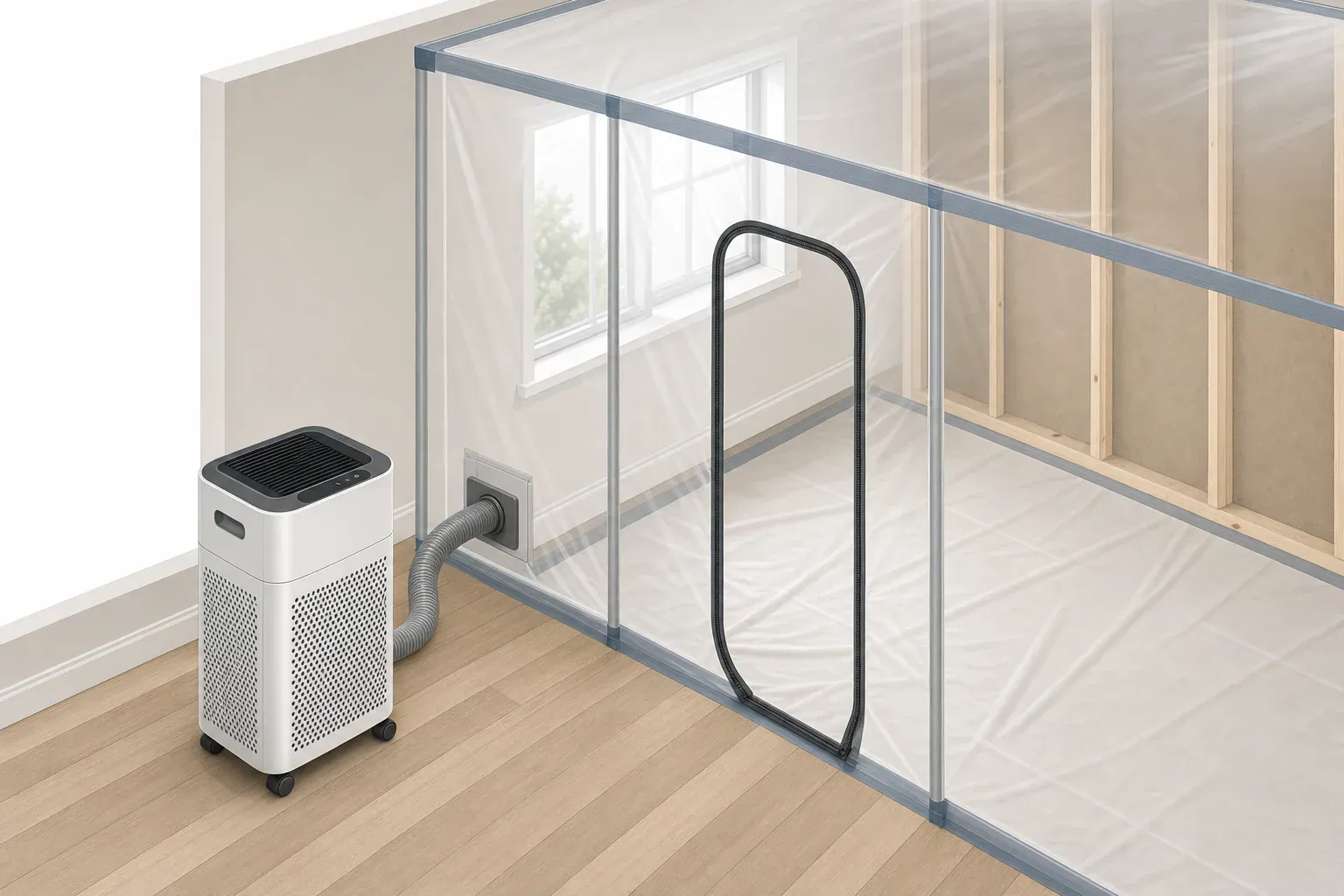
| Negative-air equipment | Can filter exhausted air and help maintain inward airflow in a constructed containment area | Requires containment, equipment selection, airflow planning, and monitoring | A professional control, not simply a purifier placed in a room |
| Professional assessment or abatement | Can address material evaluation, source control, containment, cleanup, and applicable verification | Required qualifications and procedures vary by jurisdiction and project | Appropriate for damage, debris, suspected disturbance, or planned renovation |
Why a household vacuum is not an asbestos cleanup tool
The EPA’s asbestos safe-work guidance describes specialized HEPA vacuums as equipment used in trained operations and maintenance work. EPA notes that ordinary vacuum exhaust may return fibers to a building and warns that emptying a HEPA vacuum or changing its filters can expose workers.
For homeowners, EPA advises against dusting, sweeping, or vacuuming debris that may contain asbestos. Adding a HEPA cartridge to a shop vacuum does not make suspected asbestos cleanup an appropriate household task.
Stop-work checklist for suspected asbestos
The immediate decision should depend on the material’s condition and whether it may be disturbed—not on whether an air purifier is available. The EPA’s homeowner guidance says that material in good condition that will not be disturbed is unlikely to release fibers and should generally be left alone.
- Material appears intact and will remain undisturbed: Do not touch, scrape, drill, sand, or vacuum it. Appearance alone cannot confirm whether a material contains asbestos.
- Material is damaged or deteriorating: Stop activity around it, limit access, and contact a properly qualified asbestos professional.
- Dust or debris appeared after a suspected disturbance: Stop work. Do not sweep, dust, or vacuum the debris. A portable purifier is not a substitute for assessment and controlled cleanup.
- Renovation or demolition is planned: Pause before cutting, sanding, drilling, or removing suspect material. Arrange an appropriate assessment and check the state or local requirements that apply before work resumes.
When to seek professional help
Contact a qualified asbestos inspector or abatement contractor if suspect material is damaged, debris is present, prior work may have disturbed it, or a renovation could affect it. They can determine the appropriate assessment and controls under the rules that apply to the property and project.
Do not use a lack of visible dust, a consumer particle-monitor reading, or time spent running a purifier as evidence that asbestos is absent or that a room has been cleared. Filter efficiency measures particle capture under defined conditions; it does not identify asbestos or provide room-clearance evidence. For a broader explanation of what consumer devices can and cannot measure, see Indoor Air Quality Testing: DIY or Professional Help?.
Bottom line
A HEPA filter can capture asbestos fibers that reach it, but capture is only one limited function. A portable purifier or household vacuum cannot control an asbestos source, contain contamination, clean suspected debris, or confirm that a room is safe. Leave intact material undisturbed and seek qualified help for damage, debris, suspected disturbance, or planned renovation.
Related guides: True HEPA vs HEPA-Type: What the Labels Really Mean • HEPA Filter Grades Explained: E10–E12 vs H13–H14 • HEPA Filter Bypass Leakage: Why Seals Matter as Much as the Filter
Frequently asked questions
Can a portable HEPA purifier make a room safe after suspected asbestos disturbance?
No. A portable purifier may capture some particles that pass through it, but it does not identify asbestos, control a damaged source, collect settled debris, contain the area, or establish clearance. Stop work and seek qualified assessment when suspected material has been disturbed or debris is present.
Does the 0.3-micrometer HEPA rating mean smaller asbestos fibers pass through?
No. The 0.3-micrometer figure is used for HEPA efficiency testing because it represents the most penetrating particle size, not because it is the smallest particle a filter can capture. EPA states that particles both larger and smaller than 0.3 micrometers are generally trapped with greater efficiency when air passes through the filter.
Can a household vacuum with a HEPA filter be used on suspected asbestos dust?
No. A household vacuum with a HEPA-labeled filter is not equivalent to a specialized HEPA vacuum used within trained asbestos work practices. EPA advises homeowners not to vacuum suspected asbestos debris and warns that handling vacuum contents or filters can create exposure.
Recommended next:
- Do Air Purifiers Produce Ozone? What to Avoid and What to Buy Instead
- UL 2998 ‘Zero Ozone’ Explained (What It Certifies and What It Doesn’t)
- HEPA, CADR, and Other Certifications: A Buyer’s Cheat Sheet
- Ozone and Ionizers: What “Zero Ozone” Certifications Mean
- AHAM CADR Ratings Explained: How to Compare Air Purifiers Fairly
- Air Purifier Safety for Kids and Pets: Tipping, Cords, and Placement
- Clear sizing logic (room size → CADR/ACH)
- HEPA vs carbon explained for real use-cases
- Humidity + ventilation basics to reduce mold risk