
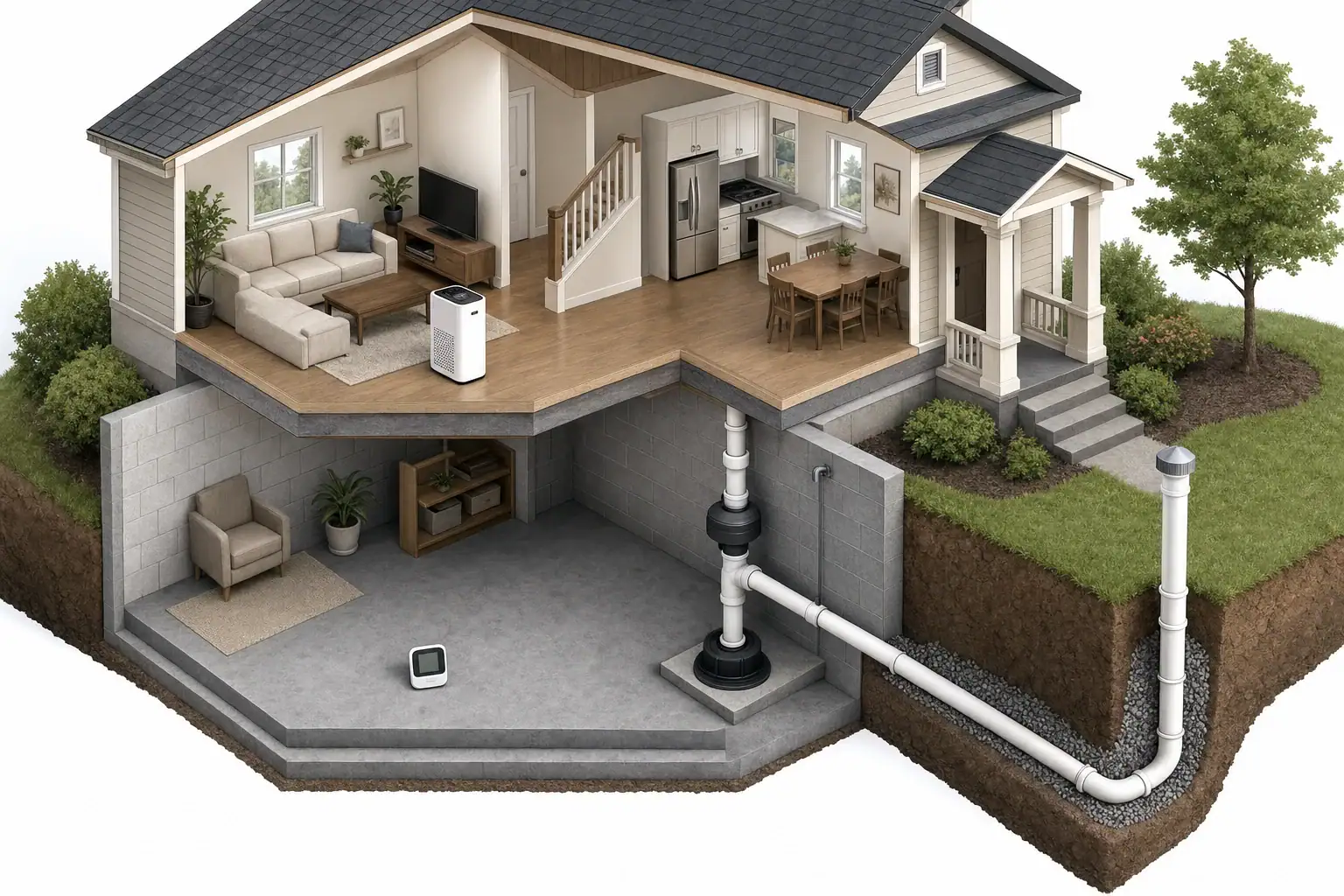
Air purifiers do not solve a radon problem
No. Typical portable air purifiers do not remove radon gas from a home. A particle filter may capture some airborne particles associated with radon decay, but it does not remove the gas, provide a radon measurement, or replace a properly designed mitigation system.
Radon is a radioactive gas that can enter through soil-contact areas and accumulate indoors. Because exposure can increase lung cancer risk, decisions should be based on radon-specific testing rather than air-purifier operation. The EPA explains the health risk from radon and why testing matters.
Why filtration is not radon mitigation
- HEPA and other particle filters target particles: Radon is a gas, so it passes through ordinary particle-filter media.
- Activated carbon is not a dependable household solution: A portable purifier with a carbon filter should not be treated as a radon-control system.
- Purifier sensors generally do not measure radon: Readings for particles, odors, gases, or overall air quality cannot establish a home’s radon concentration.
- Room treatment does not address entry: Effective mitigation usually controls how radon enters from beneath the building.
An air purifier may still be useful for the pollutants it is designed to filter, but its operation should be considered separate from radon testing and mitigation.
How to test a home for radon
- Choose a radon-specific test. Options include passive test kits and electronic continuous radon monitors. Use a device or laboratory recognized by your state radon program when such requirements apply.
- Follow the device instructions exactly. Placement, test duration, closed-house conditions, and shipping deadlines can affect the validity of the result.
- Place the test on the appropriate level. This is generally the lowest level that is regularly occupied or could be used as living space, subject to the test manufacturer’s directions.
- Avoid unsuitable locations. Unless instructed otherwise, keep the device away from kitchens, bathrooms, exterior doors, direct sunlight, strong drafts, excessive heat, and high humidity.
- Confirm results when appropriate. Radon levels fluctuate. A short-term test provides a limited sampling period, while a long-term test can better represent average conditions over time.
The EPA Citizen’s Guide to Radon describes test types, placement, follow-up testing, and result interpretation. EPA recommends fixing a home when the result is 4 picocuries per liter (pCi/L) or higher and advises considering action between 2 and 4 pCi/L.
What radon mitigation involves
The appropriate method depends on the foundation, radon entry pathways, climate, and building layout. A common approach is active soil depressurization, which uses piping and a fan to draw soil gas from beneath the building and discharge it outdoors. Crawlspaces may require a membrane and a suction system designed for that foundation.
Sealing accessible cracks and openings may be one part of a system, but sealing alone is generally not considered a dependable radon-control method. Ventilation-based approaches can also affect heating, cooling, moisture, and combustion conditions, so they should not be improvised as a substitute for a designed system.
A qualified radon professional can evaluate the building, select a method, specify discharge and fan locations, and arrange post-mitigation testing. The EPA Consumer’s Guide to Radon Reduction explains mitigation methods and contractor-selection considerations.
A practical decision process
- Do not use purifier operation or a general indoor-air sensor to estimate radon.
- Perform a radon-specific test according to its instructions.
- Use follow-up testing when recommended for the initial result and test type.
- If mitigation is indicated, obtain an evaluation from a qualified radon professional and check any state-specific requirements.
- Test after installation to verify the resulting radon level, then follow the recommended retesting and system-maintenance schedule.
Related guides: Carbon Filter vs HEPA: What Each One Removes (And What It Doesn’t)
Frequently asked questions
Can a HEPA air purifier reduce radon?
No. HEPA filters are designed to capture particles, while radon is a gas that passes through ordinary particle-filter media. A purifier may capture some particles associated with radon decay, but it does not control the radon gas concentration in the home.
Can an air-quality monitor measure radon?
Most general indoor-air monitors do not measure radon, even when they report particles, odors, gases, or an overall air-quality score. Use a radon-specific test kit or continuous radon monitor to determine a home’s radon level.
Should an air purifier be used instead of radon mitigation?
No. An air purifier does not address radon entry from soil-contact areas or replace a designed mitigation system. If testing indicates action is warranted, a qualified radon professional can evaluate the home and recommend an appropriate mitigation approach.
Is post-mitigation radon testing necessary?
Yes, testing after installation verifies the radon level achieved by the mitigation system. Continue with any recommended retesting and maintenance schedule, since radon levels and system performance can change over time.
Summary
Portable air purifiers are not radon-removal systems. Use a radon-specific test to determine the home’s level, interpret the result using current official guidance, and consider a professionally designed mitigation system when action is warranted. Filtration for particles can remain part of a broader indoor-air plan, but it should not delay radon testing or be used to judge whether mitigation worked.
- Clear sizing logic (room size → CADR/ACH)
- HEPA vs carbon explained for real use-cases
- Humidity + ventilation basics to reduce mold risk