
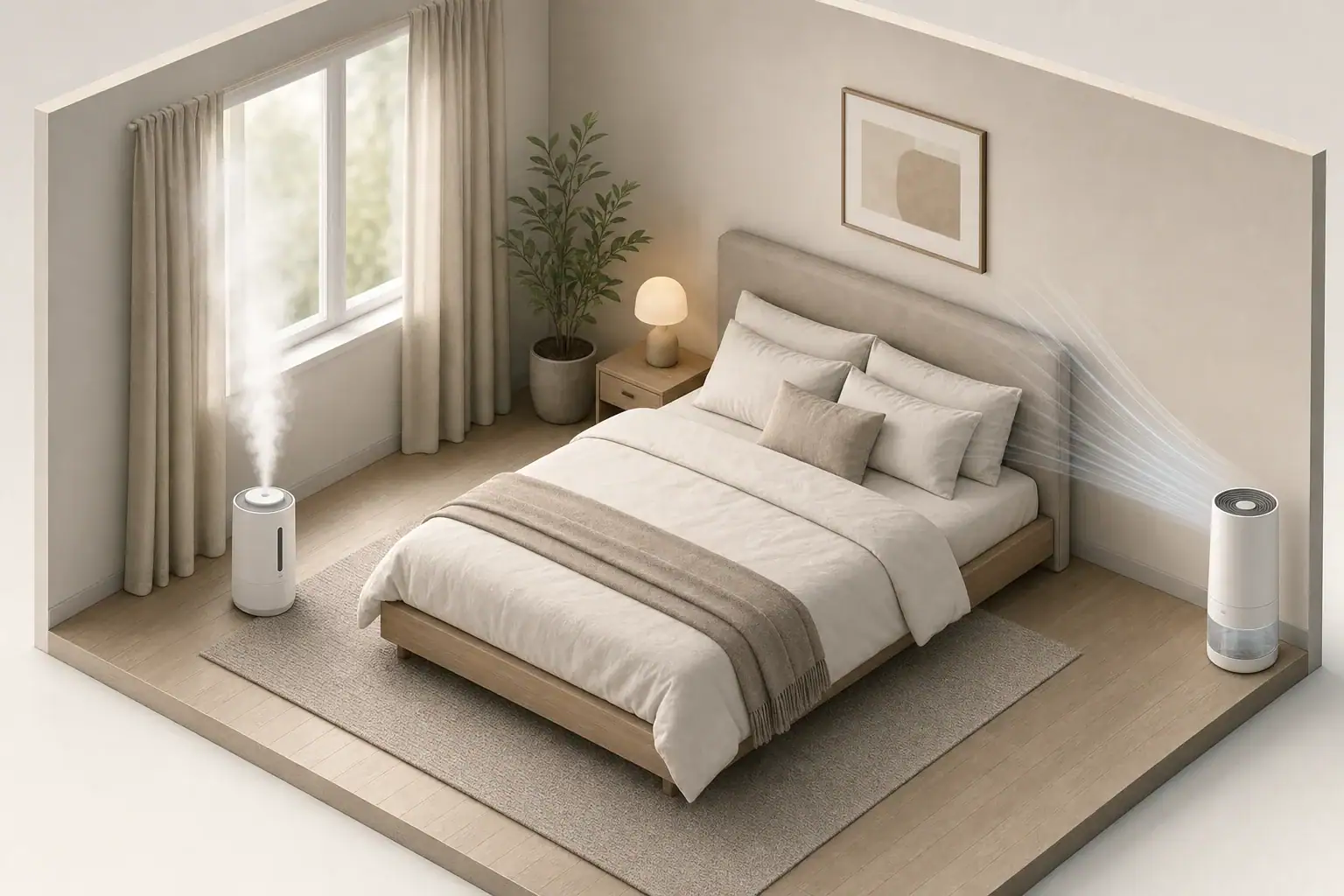
For most bedrooms, an evaporative humidifier is the safer default because it is less likely to over-humidify the room or disperse water minerals, although either type can be used safely with proper cleaning and humidity control. Ultrasonic models are often quieter, but they require closer attention to water quality and output. The safer choice ultimately depends on maintenance, bedroom conditions, and how consistently relative humidity is monitored.
- Aim for about 30% to 50% relative humidity as general indoor guidance.
- Reduce output if windows, walls, or bedding feel damp or develop condensation.
- Evaporative models naturally slow moisture output as room humidity rises.
- Ultrasonic models are usually quieter but can release minerals from tap water as white dust.
- Empty and refill the tank daily, and clean the unit at least every few days or as directed by its instructions.
How Evaporative and Ultrasonic Humidifiers Work
Both types add water vapor to indoor air, but they use different mechanisms. That difference affects mineral release, noise, cleaning needs, and the chance of adding too much moisture.
Evaporative humidifiers
An evaporative unit draws water from a reservoir into a wick or similar absorbent material. A fan moves room air through the damp wick, allowing water to evaporate into the air.
Evaporation becomes less efficient as relative humidity rises, giving this design a degree of natural self-regulation. It can still make a room too humid if oversized or operated continuously, but rapid over-humidification is generally less likely.
The wick also retains many minerals found in tap water. Those minerals may create scale in the unit and shorten wick life, but they are less likely to become airborne as fine white dust.
Ultrasonic humidifiers
An ultrasonic unit vibrates a small diaphragm at high frequency to create tiny water droplets. These droplets leave the unit as a cool, visible mist and then evaporate into the room.
Because the unit aerosolizes reservoir water, dissolved minerals can travel with the mist. When the droplets evaporate, mineral residue may settle on furniture or remain suspended temporarily as fine particles. Contaminants in a poorly maintained tank may also be dispersed.
Ultrasonic operation is usually quieter because it does not require a large fan. However, its output does not naturally decline in the same way as evaporation, so a humidistat or separate humidity monitor is particularly useful.
Bedroom Humidity Targets and Sizing Logic
A practical indoor relative humidity target is approximately 30% to 50%. The right point within that range depends on outdoor temperature, building insulation, air leakage, and whether moisture collects on cold surfaces.
During cold weather, some bedrooms may need to stay closer to 30% to 40% to prevent window condensation. A reading near 50% does not guarantee that every surface is safe from dampness; poorly insulated windows and exterior walls can be colder than the room air.
Choose capacity using the bedroom’s floor area, ceiling height, and air leakage rather than floor area alone. A 150-square-foot room with an 8-foot ceiling contains about 1,200 cubic feet of air, while the same floor area with a 10-foot ceiling contains about 1,500 cubic feet. Frequent door opening, heating-system airflow, and dry outdoor air increase the moisture needed.
Start at a low output and check a separate hygrometer after several hours. Humidity changes gradually, and a humidifier placed close to the monitor can produce a reading that is not representative of the whole room.
| Factor | Evaporative | Ultrasonic |
|---|---|---|
| Moisture method | Fan moves air through a wet wick | Vibration creates a fine mist |
| Humidity behavior | Output tends to decline as humidity rises | Output continues at the selected setting |
| Tap-water minerals | Many remain in the wick or reservoir | May become airborne as white dust |
| Operating sound | Fan noise is usually noticeable | Usually quieter, with possible water sounds |
| Routine replacement | Wick may require periodic replacement | Usually no wick, but mineral scale requires removal |
| Visible mist | Usually none | Common |
| Over-humidification control | Some natural self-regulation | More dependent on settings and monitoring |
Safety Differences and Common Bedroom Mistakes
The main safety concerns are excessive humidity, microbial growth in standing water, mineral release, spills, and electrical placement. These issues are manageable and are not unique to one humidifier design.
Using untreated tap water in an ultrasonic unit
Tap water can contain calcium, magnesium, and other dissolved minerals. In an ultrasonic humidifier, these materials may appear as white residue on nearby surfaces. Distilled or demineralized water generally reduces this release. Water softened by ion exchange may still contain dissolved material and is not equivalent to distilled water.
Running the humidifier without measuring humidity
Room conditions can change overnight as outdoor temperatures fall, doors close, or heating cycles vary. Operating at maximum output without a humidity reading can create condensation and damp areas. A separate hygrometer positioned away from the mist stream provides a useful cross-check.
Leaving old water in the reservoir
Standing water can support biofilm and microbial growth. Adding fresh water on top of old water does not remove deposits from the tank. Emptying, rinsing, and refilling the reservoir daily is a better routine.
Directing mist at the bed or wall
Visible mist should dissipate into room air rather than land on bedding, curtains, electronics, wood furniture, or painted surfaces. Local dampness can occur even when the room’s average humidity reading appears acceptable.
Choosing unnecessary air-treatment features
A humidifier does not need an ionizer or ozone-generating function to add moisture. If a unit includes optional ionization, it can generally be left off. UV-C components, where present, do not replace tank cleaning, and their effectiveness depends on design, exposure time, and maintenance.
Practical Setup and Nightly Safety Checklist
Place the humidifier on a stable, water-resistant surface where it cannot be knocked over. Keep it out of walking paths and follow the appliance instructions for clearance from walls, furniture, and electrical equipment.
- Use a nearby wall outlet rather than placing cords where they create a trip hazard.
- Keep the unit out of reach of children and pets.
- Do not place it directly on carpet, bedding, or unfinished wood.
- Point ultrasonic mist into open room air, not toward a wall or sleeping area.
- Position the hygrometer several feet from the humidifier and away from windows or heating vents.
- Begin with the lowest practical output and adjust gradually.
- Check windows and nearby surfaces for condensation each morning.
A built-in humidistat is useful, but its sensor may read the moist air immediately around the appliance. Comparing it with a separate monitor elsewhere in the room can reveal whether the overall space is actually within the target range.
Use only water additives specifically permitted by the appliance instructions. Essential oils, fragrances, inhalants, and disinfectants can damage components or become airborne when used in a unit not designed for them.
Which Type Fits Common Bedroom Scenarios?
For a very quiet sleeping environment
An ultrasonic humidifier often has the advantage because it lacks a conventional evaporative fan. A low setting may be adequate in a closed bedroom, but humidity should be monitored because the unit can continue producing mist after the desired level is reached.
For a home with hard tap water
An evaporative model may be simpler if distilled water is impractical. Minerals generally collect in the wick and reservoir rather than settling throughout the room. The tradeoff is more frequent wick replacement and scale removal.
For a cold or condensation-prone bedroom
An evaporative model’s self-limiting behavior can provide a useful margin, but it is not a substitute for monitoring. Use a lower target, inspect windows, and avoid placing furniture tightly against cold exterior walls where air circulation is limited.
For a small nursery or pet-accessible room
Cool-mist evaporative and ultrasonic units avoid the hot water and steam associated with warm-mist appliances. Regardless of type, secure the cord, prevent access to the reservoir, and place the unit where it cannot be tipped or climbed on.
For someone sensitive to fine particles
An evaporative model avoids most airborne mineral dust from humidification. An ultrasonic model can also be practical when consistently filled with distilled or appropriately demineralized water and kept clean.
Cleaning, Water Choice, and Ownership Costs
Maintenance has a greater effect on safe operation than the basic humidifier technology. Always follow the appliance’s cleaning directions, particularly because materials and approved cleaning agents vary.
As a general routine, empty and refill the tank daily. Clean water-contact surfaces about every three days, or more often if film, odor, or scale appears. Unplug the unit first, use the recommended cleaning method, rinse thoroughly, and allow components to dry when the humidifier is not in use.
Never mix household cleaning chemicals. In particular, bleach and ammonia must not be combined. Do not run cleaning solutions through the humidifier unless the instructions specifically direct that procedure.
Evaporative ownership costs commonly include replacement wicks. Wick life varies with mineral content, operating hours, and cleaning practices. A hardened, discolored, or persistently odorous wick may need replacement even if a suggested interval has not passed.
Ultrasonic units avoid wick costs but may make distilled water an ongoing expense. They also need regular descaling, especially around the vibrating diaphragm. Abrasive tools can damage that component, so cleaning should follow the supplied directions.
Before seasonal storage, drain, clean, and dry the unit completely. Store it without water and, for an evaporative model, avoid leaving a used damp wick inside.
Decision Guide for Safer Humidity Control
Choose an evaporative humidifier when natural output moderation, reduced mineral dispersion, and the option to use ordinary tap water are more important than near-silent operation. Account for fan noise and replacement-wick costs.
Choose an ultrasonic humidifier when low noise and compact operation are priorities and you are willing to use low-mineral water, monitor room humidity, and clean the tank consistently. Automatic shutoff and an adjustable humidistat are useful general safety features.
With either type, look for clear cleaning access, a stable reservoir, understandable controls, and electrical certification from a recognized independent testing organization. Stop using a unit that leaks, has a damaged cord, produces a persistent unusual odor, or cannot be cleaned adequately.
| Goal or observation | Simple action | Useful tool | Note |
|---|---|---|---|
| Room below about 30% | Run at low output and recheck after several hours | Separate hygrometer | Allow time for the reading to stabilize |
| Maintain a general comfort range | Target roughly 30% to 50% | Humidistat and hygrometer | Use the lower end in condensation-prone weather |
| Window condensation appears | Reduce output or pause operation | Visual inspection | Cold surfaces can become damp before the whole room does |
| White dust appears | Use distilled water or consider evaporation | Water supply check | Most relevant to ultrasonic models |
| Musty odor or film develops | Stop, empty, and clean the unit | Cleaning supplies approved by instructions | Do not mask odors with fragrance |
| Humidity varies around the room | Move the monitor away from mist and vents | Portable hygrometer | Compare readings from representative locations |
Related guides: Ultrasonic vs Evaporative Humidifiers: Pros, Cons, and Which to Buy • Humidifier White Dust: Causes, Health Concerns, and Fixes • Humidifier Safety: Bacteria Risk, Cleaning, and Safe Humidity Limits
Summary: Which Humidifier Is Safer?
An evaporative humidifier is generally the more forgiving bedroom choice because it limits mineral dispersion and tends to reduce output as humidity rises. It may be preferable when tap water is hard, white dust is a concern, or humidity is difficult to manage.
An ultrasonic humidifier can also be used safely and may be better suited to noise-sensitive bedrooms. It requires more careful water selection, output control, and cleaning because it turns reservoir water directly into fine droplets.
For either type, keep relative humidity around 30% to 50% as general guidance, use a separate hygrometer, respond promptly to condensation, replace standing water daily, and maintain the appliance according to its instructions.
Frequently asked questions
Is an evaporative or ultrasonic humidifier safer for a bedroom?
An evaporative humidifier is often the safer default for a bedroom because its moisture output naturally slows as room humidity rises and it releases fewer tap-water minerals into the air. An ultrasonic humidifier can also be used safely when it is cleaned consistently, filled with low-mineral water, and operated with a hygrometer.
Do ultrasonic humidifiers cause white dust?
Ultrasonic humidifiers can create white dust when dissolved minerals in tap water are carried out with the fine mist and settle after the droplets evaporate. Using distilled or appropriately demineralized water generally reduces this residue.
Can an evaporative humidifier make a room too humid?
Yes. Although evaporative output tends to decrease as relative humidity rises, an oversized unit or continuous operation can still raise humidity enough to cause condensation or damp surfaces. Use a separate hygrometer and reduce output if windows, walls, or nearby materials become damp.
What humidity level should a humidifier maintain in a bedroom?
A general indoor target is about 30% to 50% relative humidity. In cold weather or rooms prone to window condensation, a lower range of roughly 30% to 40% may be more appropriate.
How often should an ultrasonic or evaporative humidifier be cleaned?
Empty, rinse, and refill the reservoir daily rather than adding water to old water. Clean water-contact surfaces about every three days, or sooner if scale, film, or odor develops, following the appliance’s instructions for approved methods and cleaners.
Recommended next:
- Best Humidity Level for Winter: Comfort vs Health vs Mold Risk
- Ultrasonic vs Evaporative Humidifiers: Pros, Cons, and Which to Buy
- Humidifier White Dust: Causes, Health Concerns, and Fixes
- How to Clean a Humidifier Properly (And How Often)
- Ideal Indoor Humidity in Winter: Comfort vs Mold Risk
- Humidifier Cleaning Routine: How to Prevent Slime and Odors
- Clear sizing logic (room size → CADR/ACH)
- HEPA vs carbon explained for real use-cases
- Humidity + ventilation basics to reduce mold risk