
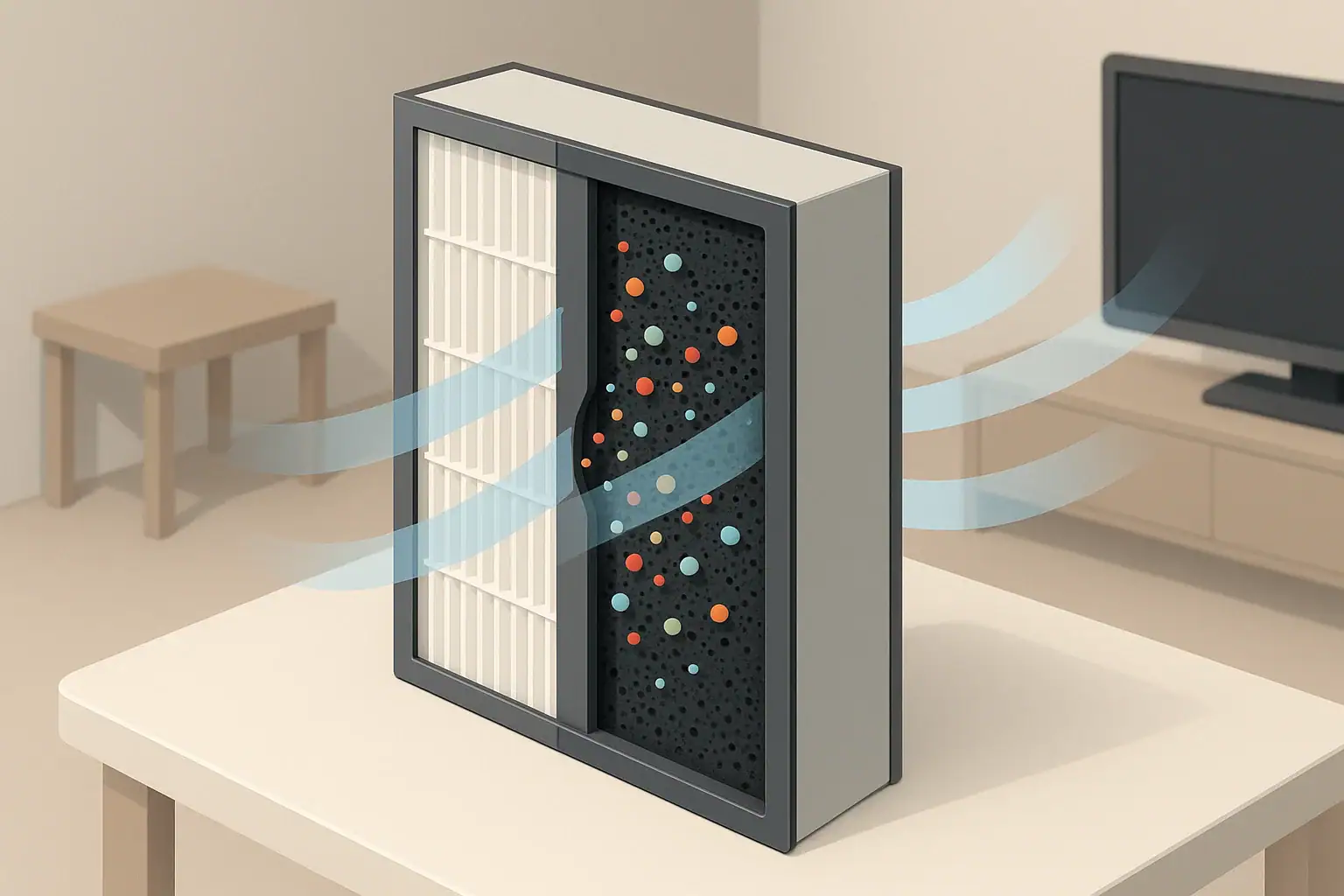
What Activated Carbon Filters Are and Why They Matter
Activated carbon filters are a common add-on in home air purifiers, ventilation systems, and some HVAC setups. They are especially associated with removing smells and chemical fumes, often described as VOCs (volatile organic compounds). While they can be very effective for certain pollutants, they also have clear limits.
This guide explains how activated carbon works, what it can and cannot remove from indoor air, and how it fits with particle filters like HEPA in a broader indoor air quality strategy.
How Activated Carbon Works
What “Activated” Carbon Means
Activated carbon is a highly processed form of carbon (often from coconut shells, wood, or coal) that has been treated to create an extremely porous structure. This gives it a very large internal surface area relative to its size.
Instead of being a solid block, activated carbon is more like a network of tiny tunnels and pores. Gas molecules can move into these pores and stick to the surface.
Adsorption vs Absorption
Activated carbon primarily relies on adsorption, not absorption:
- Adsorption: Gas molecules collect on the surface of the carbon due to physical and chemical attractions.
- Absorption: A substance is soaked up into the bulk of a material (like a sponge and water).
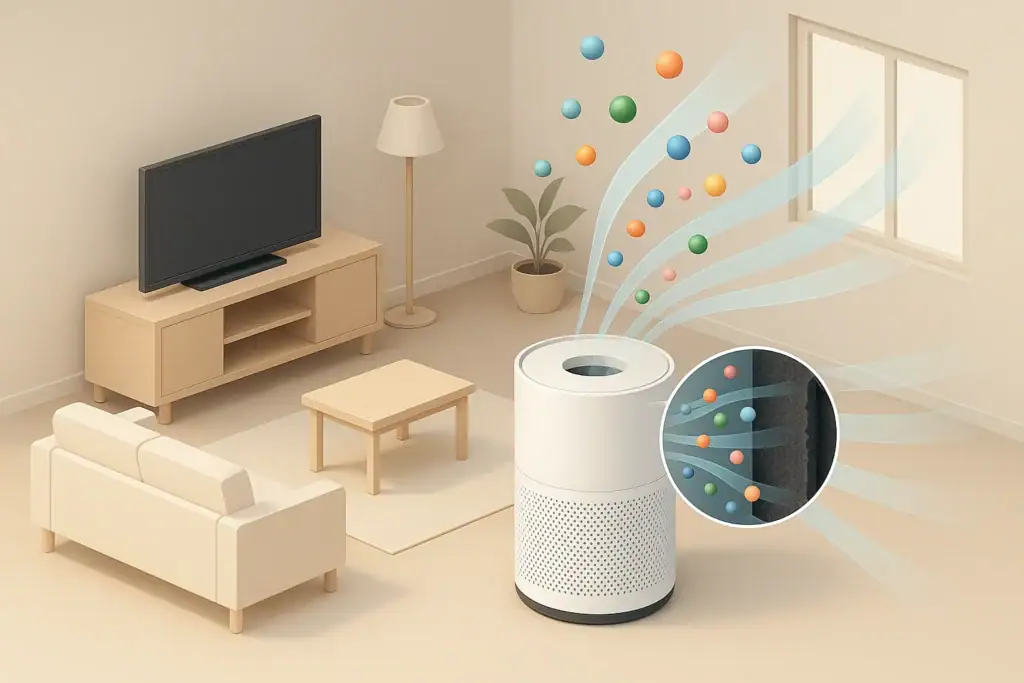
In an activated carbon filter, air passes through or across the carbon. Gas molecules and odor compounds are attracted to and held on the carbon surface, so fewer of them remain in the air leaving the filter.
Why Surface Area Matters
The more internal surface area the carbon has, the more gas molecules it can hold. A handful of activated carbon can have an internal surface area roughly comparable to a large house, thanks to its microscopic pores.
For filter performance, this means:
- More carbon usually means more adsorption capacity.
- Deeper or denser carbon beds generally last longer before saturating.
- Very thin, light carbon layers may provide only modest odor reduction and fill up quickly.
What VOCs and Odors Activated Carbon Can Remove
Understanding VOCs
VOCs (volatile organic compounds) are chemicals that easily evaporate into the air at room temperature. Many have noticeable odors; some do not. Common indoor VOC sources include:
- Paints, varnishes, and solvents
- Adhesives and sealants
- New furniture, flooring, and cabinetry
- Cleaning products and air fresheners
- Personal care products and cosmetics
- Combustion sources like gas stoves, fireplaces, and tobacco smoke
Some VOCs are mainly a comfort issue (smells and irritation), while others may contribute to longer-term health risks depending on exposure level and duration.
Types of Pollutants Activated Carbon Targets
Activated carbon filters are primarily used to reduce:
- Odors: Food cooking smells, garbage, pet odors, musty smells, and other general household odors.
- Many VOCs: Emissions from paints, cleaning products, new building materials, and some combustion byproducts.
- Some gases: Certain organic gases and some inorganic gases, depending on the carbon type and any added treatments (impregnated carbons).
Different VOCs have different levels of affinity for carbon. Many organic compounds in household air are reasonably well-suited to removal by activated carbon, especially when the carbon bed is substantial and air moves through it slowly enough for contact.
Examples of Indoor Situations Where Carbon Helps
Activated carbon filters are often useful in situations such as:
- Newly renovated rooms where paints, finishes, and sealants are still off-gassing.
- Homes with strong cooking odors, such as frying or heavily spiced foods that linger.
- Spaces with occasional chemical use, like craft rooms using glues, solvents, or resins.
- Areas affected by smoke from nearby wildfires or occasional indoor combustion sources.
- Rooms with noticeable musty smell, once the moisture source is addressed, to help clear residual odor.
Carbon filters do best when pollutant sources are moderate and intermittent, rather than overwhelming and continuous.
What Activated Carbon Filters Cannot Do
They Do Not Replace HEPA for Particles
Activated carbon is not designed to remove particles like:
- Dust and dust mites
- Pollen and spores
- Pet dander
- Fine particulate matter (PM2.5) from smoke or traffic
- Bacteria and many airborne microorganisms
For these pollutants, a HEPA or other mechanical particle filter is needed. Carbon and HEPA play different roles and are often combined in the same purifier: HEPA for particles, carbon for gases and odors.
Limits With Some Gases and VOCs
Not all gases are easily captured by standard activated carbon:
- Very small, highly volatile molecules may not be well-adsorbed.
- Some inorganic gases (for example, certain acidic or basic gases) require specially treated carbons or other media.
- Very high concentrations can quickly saturate the carbon, greatly reducing its effectiveness.
Some specialized filters combine activated carbon with other sorbents or chemically treated media to target a broader range of gases. In typical consumer devices, however, the carbon is mainly optimized for common household odors and many organic vapors.
They Do Not Fix the Source of Pollution
Carbon filtration is a control measure, not a cure for underlying issues. It does not:
- Stop materials from off-gassing VOCs.
- Replace ventilation or outdoor air exchange.
- Resolve moisture problems, leaks, or mold growth.
- Eliminate the need to reduce or substitute products that emit VOCs.
For serious or persistent VOC or odor issues, source control and increased ventilation are usually more impactful than relying on filtration alone.
They Have Finite Capacity and Can Saturate
Each carbon filter has a limited amount of space where molecules can adsorb. Over time, as more VOCs and odors are captured, the carbon surface becomes saturated.
Once saturated, the filter will:
- Become much less effective at removing new pollutants.
- Potentially start releasing some previously adsorbed odors back into the air, especially with temperature or humidity changes.
This is why regular replacement is important. A used-up carbon filter often looks the same as a functional one, so performance is usually inferred from time-in-service, pollutant load, and changes in odor control.
Key Design Factors: Depth, Density, and Airflow
Carbon Mass and Bed Depth
One of the most important factors in real-world performance is how much activated carbon the filter actually contains, and how it is arranged:
- Deep-bed filters with substantial carbon mass usually provide better and longer-lasting VOC and odor control.
- Thin-coated filters or very light carbon layers may help a bit with mild odors but saturate quickly, especially in polluted environments.
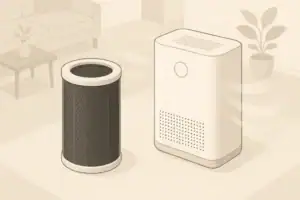
Two filters can look similar from the outside but have very different carbon content and performance characteristics internally.
Contact Time and Airflow
For adsorption to occur, air must actually spend time in contact with the carbon. Performance depends on:
- Airflow rate: Very high airflow can reduce contact time, lowering removal efficiency per pass.
- Filter design: Pathways that force air to pass through a significant volume of carbon improve contact and capture.
In practice, this means there is a tradeoff between airflow and gas removal efficiency. Many systems balance fan speed, noise, and filtration so that enough air is treated without becoming too loud or inefficient.
Humidity and Temperature Effects
Humidity and temperature can affect adsorption:
- High humidity can reduce the carbon’s ability to adsorb some VOCs because water vapor competes for sites on the carbon surface.
- Temperature fluctuations can cause some adsorbed gases to desorb (release) back into the air.
In a typical home, these effects are moderate, but they help explain why a filter that once worked well may seem less capable over time, especially in damp environments.
Activated Carbon vs HEPA and Other Filters
Different Pollutants, Different Tools
Indoor air often contains a mixture of particle pollutants and gases. No single filter handles everything well:
- HEPA filters target particles such as dust, pollen, smoke particles, and pet dander.
- Pre-filters catch larger debris like hair and lint, helping protect downstream filters.
- Activated carbon filters target VOCs and odors.
Some air purifiers combine pre-filter, HEPA, and carbon layers in a single cartridge or in a stacked design. This layered approach lets each medium specialize in what it does best.
When Carbon Matters Most
In some situations, a particle-only system (such as HEPA without carbon) may not address key concerns. Carbon is especially relevant when:
- Odors are the main complaint, even if particles are under control.
- New furnishings or renovations are adding a noticeable chemical smell.
- Smoke odors are present, even after visible particles are removed.
- Solvent use or hobbies regularly introduce VOCs into the space.
In a broader indoor air quality plan, carbon is one component that can improve comfort and reduce exposure to certain gas-phase pollutants.
Maintenance and Replacement of Carbon Filters
How Often to Replace Activated Carbon Filters
The life of a carbon filter depends on:
- The amount of carbon in the filter.
- How often the system runs and at what fan speed.
- The level of VOCs and odors in the environment.
In a typical home with moderate use, replacement intervals are often measured in months. In heavy-use environments (such as strong smoke or frequent solvent use), filters can saturate much faster.
Signs that a carbon filter may be exhausted include:
- Odors that used to clear quickly now linger.
- Initial improvement when new, followed by a slow return of smells over time.
- Musty or stale smell near the filter itself, despite regular operation.
Why You Usually Cannot “Recharge” Carbon at Home
Once VOCs are adsorbed, they are strongly held. Industrial processes can regenerate some types of activated carbon at high temperatures or with controlled treatments, but this is not practical or safe in a home setting.
Common at-home approaches (like leaving the filter in the sun or washing it) generally do not restore its capacity and may damage the filter materials or release captured pollutants in an uncontrolled way. In most consumer systems, carbon filters are treated as consumables and replaced when spent.
Handling and Disposal Considerations
Used carbon filters can contain a mixture of adsorbed chemicals. For typical household exposure levels, they are usually discarded with regular household waste, but local regulations may vary.
Basic handling tips include:
- Avoid cutting or crushing used filters, which can release trapped dust or odors.
- Place spent filters in a bag before putting them in the trash to help contain smells.
- Wash hands after handling used filters, especially if they have been in heavy-use environments.
How Activated Carbon Fits Into an Overall Air Quality Strategy
Combine Filtration, Ventilation, and Source Control
Activated carbon works best as one piece of a larger air quality plan. Effective strategies usually combine:
- Source control: Choosing low-emission products, sealing or replacing high-emitting materials, and storing chemicals in well-ventilated areas.
- Ventilation: Using kitchen and bathroom exhaust fans, opening windows when outdoor air is acceptable, and maintaining mechanical ventilation where present.
- Particle filtration: Using HEPA or other high-efficiency filters for dust, smoke particles, and other airborne particulates.
- Gas and odor control: Using activated carbon or other sorbent media where VOCs and odors are a concern.
Relying solely on any single method, including carbon filtration, rarely addresses every aspect of indoor air quality.
Setting Realistic Expectations
Understanding what activated carbon filters can and cannot do helps set realistic expectations:
- They can significantly reduce many common household odors and some VOCs, especially with sufficient carbon mass and appropriate airflow.
- They cannot stand in for HEPA filtration for particles or fully substitute for good ventilation and source control.
- They require periodic replacement, even if they still look clean, because saturation is largely invisible.
Used appropriately, activated carbon filters are a valuable tool for improving indoor air comfort and reducing certain chemical exposures, as long as their limitations are recognized and they are integrated thoughtfully into a broader approach to indoor air quality.
Frequently asked questions
How long do activated carbon filters typically last in a home environment?
Filter lifetime varies with the amount of carbon, how often the purifier runs, airflow settings, and pollutant load; in many homes this is measured in months rather than years. Heavy use (for example, frequent smoke, solvents, or strong odors) can saturate the carbon much faster, so replacement intervals should be shortened accordingly. Performance drop is usually detected when odors return or clear more slowly.
Can standard activated carbon filters remove formaldehyde and other small VOCs?
Standard activated carbon can remove many organic vapors, but small polar molecules like formaldehyde are often more challenging and may require specially treated carbon or alternative sorbents. Even with treated media, effective removal generally needs sufficient carbon mass and contact time, and source control plus ventilation remain important. Expect variable performance depending on the specific compound and filter design.
Is it safe or effective to clean or “recharge” an activated carbon filter at home?
No; home methods such as washing, sunning, or heating are not effective at regenerating most activated carbon and can release trapped pollutants or damage the filter. Industrial regeneration requires controlled high-temperature or chemical processes and is not suitable for consumer filters. For typical consumer systems, replacing the spent filter is the recommended approach.
Should I use activated carbon filters instead of HEPA filters?
No; they address different problems — HEPA filters remove particles (dust, pollen, smoke particles) while activated carbon filters remove gases and odors. Many effective air purifiers combine both so you get particle removal plus gas-phase adsorption. Choose components based on whether particles, gases, or both are your main concern.
How do humidity and temperature affect the performance of activated carbon filters?
High humidity can reduce adsorption capacity because water vapor competes with VOCs for adsorption sites, and temperature fluctuations can promote desorption of previously captured compounds. These factors can shorten effective filter life or temporarily lower removal efficiency, especially in consistently damp or hot environments. In typical indoor conditions the effects are noticeable but usually manageable with proper maintenance and timely replacement.
Recommended next:
- Clear sizing logic (room size → CADR/ACH)
- HEPA vs carbon explained for real use-cases
- Humidity + ventilation basics to reduce mold risk
About this site
Home Air Quality Lab publishes practical, independent guides about indoor air quality—clear sizing, safer use, and real-world expectations.
Affiliate disclosure
Some links on this site may be affiliate links. If you buy through these links, we may earn a small commission at no extra cost to you. This helps support our content. Learn more.