
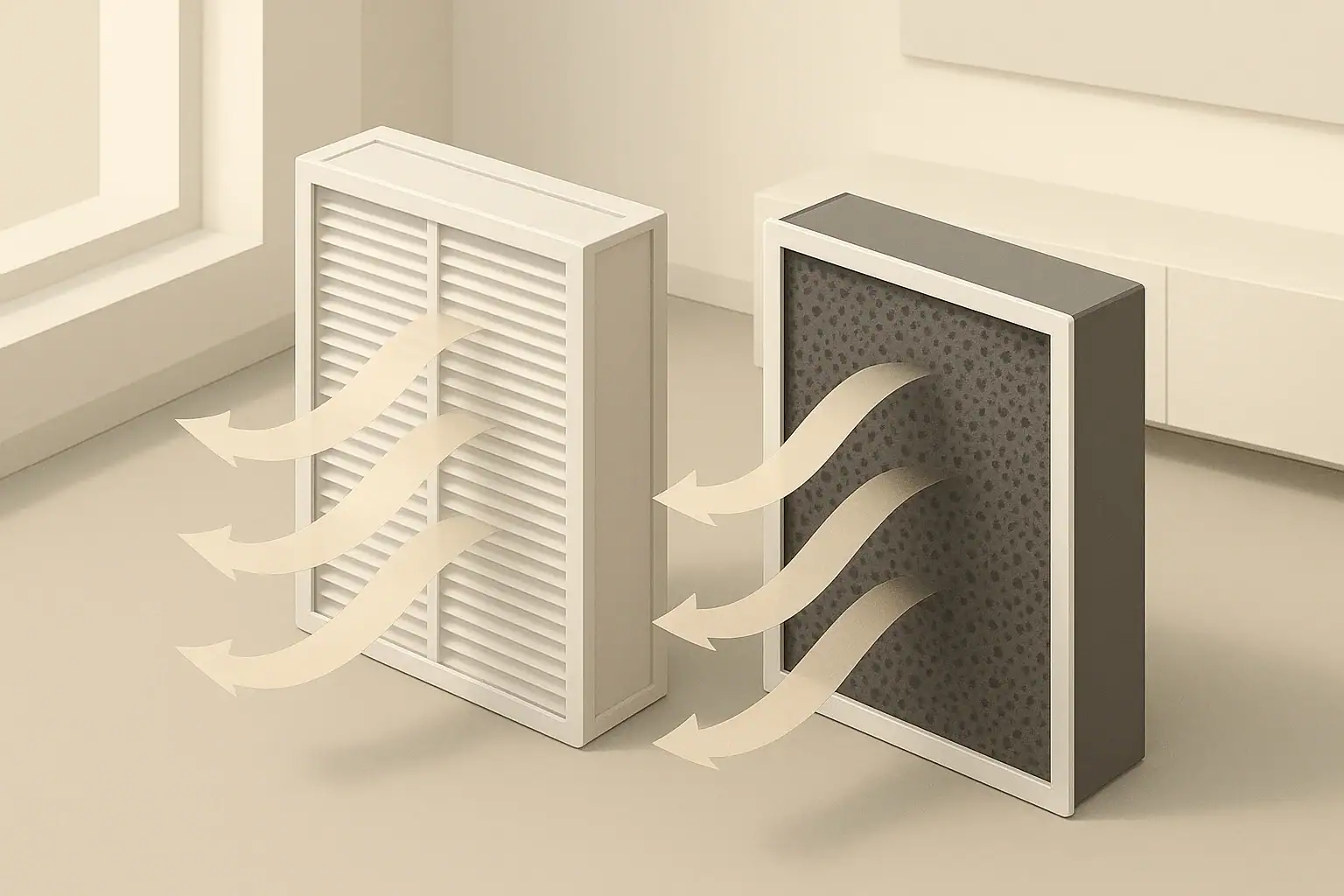
The short answer is that HEPA filters remove particles (dust, pollen, smoke, spores), while activated carbon filters remove many gases and odors, and neither one can do the other’s job well. To clean indoor air effectively, you need to match your filter to the specific pollutants in your home.
People often search for “carbon filter vs HEPA” hoping to find which one is better. In reality, they handle different parts of indoor air pollution: HEPA for particulate matter and allergens, carbon for smells and some chemicals. Choosing the wrong type leads to disappointment, even if the device itself is high quality.
This guide explains how each filter works, what it removes and misses, where each one shines in real rooms (bedrooms, kitchens, basements), and how to avoid common mistakes. You will also see safety basics, maintenance tips, and a practical checklist of specs to look for when you compare air purifiers, furnace filters, or standalone filtration units.
Carbon Filter vs HEPA: What They Are and Why It Matters
From a home air quality standpoint, HEPA and activated carbon filters are complementary tools, not competitors. Understanding the difference helps you avoid buying a “great” filter that does nothing for your actual problem.
- HEPA (High Efficiency Particulate Air) filters target solid and liquid particles suspended in air.
- Activated carbon filters target many gases and odors that glide straight through HEPA media.
In practical terms:
- If you see or feel the problem (dust on furniture, visible smoke haze, itchy eyes from pollen), a particle filter like HEPA is essential.
- If you mostly smell the problem (cooking smells that linger, musty basement odor, traffic fumes, paint or cleaner smells), an activated carbon filter becomes critical.
Most homes have both particles and gases, so many air purifiers and HVAC filter upgrades combine HEPA or HEPA-like media with a carbon layer. The goal is not to pick a winner in “carbon filter vs HEPA,” but to use each where it is strongest.
How HEPA and Carbon Filters Work (and What They Miss)
Although both are called “filters,” they rely on very different physical processes.
How HEPA Filters Work
HEPA filters are dense mats of fibers arranged so that air can pass but fine particles cannot easily escape. As air moves through the filter, particles are captured by several mechanisms:
- Interception – a particle follows the airstream but brushes against a fiber and sticks.
- Impaction – a heavier or faster-moving particle cannot follow the air’s curve and slams into a fiber.
- Diffusion – very tiny particles move randomly (Brownian motion) and eventually collide with fibers.
Certified HEPA media is designed to capture a very high percentage of particles around 0.3 microns in size, which is a “worst case” size. In normal use, HEPA usually performs as well or better on both smaller and larger particles.
HEPA is good at removing:
- Household dust and dust mite debris
- Pollen from trees, grasses, and weeds
- Pet dander and hair fragments
- Fine smoke particles from wildfires, cigarettes, candles, and cooking
- Airborne mold spores (once they are in the air)
- Many bacteria attached to droplets or dust
- General fine particulate matter (PM2.5)
HEPA is poor at removing:
- Individual gas molecules and vapors
- Odors from cooking, pets, or musty spaces
- Most volatile organic compounds (VOCs) from cleaners, paints, and new materials
- Carbon monoxide, radon, and other small gases
How Activated Carbon Filters Work
Activated carbon (also called activated charcoal) is carbon that has been processed to create a maze of microscopic pores. This structure gives it an enormous internal surface area, where gas molecules can stick in a process called adsorption (not absorption).
In air cleaners and HVAC add-ons, activated carbon is usually used as:
- Loose granules or pellets in a cassette or tray
- Carbon-impregnated foam or nonwoven sheets
The performance of a carbon filter depends heavily on:
- Carbon mass – more grams of carbon generally mean more capacity for gases.
- Contact time – slower airflow through the carbon usually improves adsorption.
- Gas type – some VOCs stick readily; others barely adsorb at all.
- Humidity – high humidity can compete with gases for adsorption sites.
Activated carbon is good at reducing:
- Everyday household odors (cooking, mild pet smells, garbage)
- Many smoke odors and some smoke-related gases
- Some VOCs from paints, cleaners, new furniture, and flooring
- Some traffic-related gases that infiltrate indoors
Activated carbon is poor at reducing:
- Dust, pollen, pet dander, and spores (these are particles, not gases)
- Very small or weakly adsorbing gases such as carbon monoxide
- Heavy or continuous VOC loads when only a thin carbon pad is used
- Odors once the carbon media is saturated (even if it still looks clean)
Side by Side: What Each Filter Type Handles
Use the comparison below to quickly map your main concern to the right filter type.
| Indoor Air Pollutant | HEPA Filter Performance | Activated Carbon Performance |
|---|---|---|
| Dust and dust mite debris | Very effective (captures airborne dust and fine debris) | Not designed for particles |
| Pollen (seasonal allergies) | Very effective, primary solution | No direct effect |
| Pet dander and hair fragments | Effective at reducing airborne dander | Helps only with related pet odors |
| Airborne mold spores | Effective at capturing spores in the air | Helps with musty odor compounds only |
| Wildfire or cigarette smoke particles | Effective for haze and PM2.5 | Effective for many smoke odors and some gases |
| Cooking particles (grease, fine aerosols) | Helps reduce fine cooking particles | Limited for particles, better for cooking smells |
| General household odors | Minimal impact | Often noticeably reduces odors |
| VOCs from paint, cleaners, new furniture | No meaningful removal | Sometimes helpful, depends on VOC type and carbon mass |
| Traffic-related gases | No effect | Some components may be reduced |
| Carbon monoxide, radon | No effect | Not reliably removed, not a safety solution |
Real ‐World Scenarios: When You Need HEPA, Carbon, or Both
Most people do not buy a filter for “PM2.5” or “VOCs”; they buy one because something in their home is bothering them. The examples below translate technical filter behavior into everyday situations.
Scenario 1: Seasonal Allergies and Dust
Main complaints: Sneezing, itchy eyes, congestion, visible dust on surfaces.
Typical pollutants: Pollen, dust mites, fine dust, pet dander if you have animals.
- Primary need: HEPA filtration to lower airborne allergen particles.
- Carbon filter: Optional, mainly if you also notice pet or household odors.
In a bedroom, a HEPA-equipped air purifier running continuously can reduce nighttime exposure to pollen and dust, especially when combined with regular vacuuming and washing bedding in hot water.
Scenario 2: Asthma Sensitive to Irritants
Main complaints: Tight chest, coughing, or wheezing triggered by smoke, fragrance, or strong smells.
Typical pollutants: Fine particles plus irritating gases and VOCs.
- Primary need: HEPA filtration to reduce fine particles that can inflame airways.
- Secondary need: Activated carbon to reduce some odor and irritant gases.
In a living room where candles, fireplaces, or scented products are used, a combined HEPA + carbon unit is often more comfortable than HEPA alone. It will not replace medical care, but it can reduce triggers in the environment.
Scenario 3: Wildfire Smoke or Indoor Smoking
Main complaints: Smoky smell that lingers, visible haze, irritated eyes and throat.
Typical pollutants: Very fine smoke particles plus a complex mixture of gases.
- Primary need: HEPA for smoke particles and visible haze.
- Secondary need: Substantial activated carbon for odor and some gases.
For wildfire events, closing windows, sealing gaps, and running a HEPA + carbon purifier on a higher speed in the main occupied room can significantly cut indoor smoke levels. For indoor smoking, filtration helps, but source control (not smoking indoors) is still the most effective step.
Scenario 4: Cooking Odors and Grease
Main complaints: Frying or grilling smells that drift into bedrooms, sticky film on surfaces near the kitchen.
Typical pollutants: Grease droplets, fine cooking particles, and odorous gases.
- Primary need: Ventilation (range hood vented outdoors if possible).
- Helpful add ‐on: HEPA to reduce cooking particles and carbon to reduce lingering odors.
In small apartments where kitchen exhaust is weak, a HEPA + carbon unit placed near the cooking area and run before, during, and after cooking can noticeably reduce both haze and smell, although it cannot replace proper exhaust.
Scenario 5: New Furniture, Flooring, or Paint
Main complaints: “New” chemical smell, headaches, or irritation after renovations or new purchases.
Typical pollutants: VOCs off ‐gassing from adhesives, finishes, and materials.
- Primary need: Ventilation and time for off ‐gassing.
- Helpful add ‐on: Carbon filtration with a meaningful amount of carbon media.
A HEPA filter alone will not help much here, because VOCs are gases. A carbon filter can reduce some of the smell, but you should not rely on it as your only strategy. Bringing in outdoor air and limiting new VOC sources are more important.
Scenario 6: Moldy or Musty Basement
Main complaints: Musty odor, concern about mold spores, feeling “stuffy” downstairs.
Typical pollutants: Mold spores, microbial VOCs, and high humidity.
- Primary need: Moisture control and mold remediation.
- Helpful add ‐on: HEPA to reduce airborne spores and carbon to reduce musty odors.
A HEPA + carbon unit can make a basement smell and feel better to be in, but it will not dry out damp walls or remove mold inside framing or carpet. Dehumidification and fixing water entry are non ‐negotiable.
Common Mistakes and Troubleshooting Cues
Many complaints about “air purifiers not working” come down to mismatched expectations, poor sizing, or incorrect setup. The table below summarizes frequent issues and what they usually mean.
| What You Notice | Likely Cause | What to Check or Change |
|---|---|---|
| Air still smells bad, but dust is reduced | HEPA only; no or minimal carbon media | Add or upgrade activated carbon; confirm odor source is not ongoing and heavy |
| Air smells better, but dust settles quickly | Carbon only; weak or no particle filtration | Add HEPA or high efficiency particle filter; increase airflow or runtime |
| Odors were reduced at first, then slowly returned | Carbon filter saturated with gases | Replace carbon filter; consider a model with more carbon mass or lower fan speed for longer contact time |
| Filter looks clean, but allergy symptoms persist | HEPA media loaded with fine particles you cannot see, or unit undersized | Replace HEPA filter on schedule; verify clean air delivery rate (CADR) is suitable for room size |
| Good filters installed, but little improvement | Bypass leaks or poor placement | Check that filters are sealed correctly; move unit away from corners and obstructions; keep doors open for better circulation |
| Musty smell returns quickly after running purifier | Ongoing moisture and active mold source | Investigate humidity, condensation, or water leaks; address moisture and mold directly, then use filters as support |
Other Common Missteps
- Relying on “HEPA ‑like” or “HEPA ‑style” claims without checking performance ratings. These may not capture fine particles as effectively as true HEPA media.
- Using a tiny tabletop unit for a large open floor plan. Even with good filters, airflow may be far too low to make a noticeable difference.
- Running the purifier only occasionally. For ongoing sources like pets, nearby traffic, or recurring smoke, continuous or long ‑duty operation is usually needed.
- Ignoring humidity and ventilation. No filter can fix stale, under ventilated air or chronic dampness on its own.
Safety Basics: What Filters Can and Cannot Protect You From
HEPA and carbon filters improve comfort and reduce many exposures, but they are not full safety systems.
Limits With Serious Gas Hazards
- Carbon monoxide (CO): Neither HEPA nor standard activated carbon filters can be trusted to remove CO at dangerous concentrations. Dedicated CO alarms and proper combustion venting are essential.
- Radon: Radon gas is not reliably removed by consumer carbon filters. Radon requires specific testing and mitigation systems.
- High ‑level chemical spills: Spills or releases of strong chemicals (for example, concentrated solvents) call for ventilation, evacuation, and appropriate protective equipment, not household filters.
Limits With Biological Contaminants
- Mold growth: HEPA removes spores from the air, but mold on or inside building materials continues to grow and release spores until moisture is controlled and materials are cleaned or removed.
- Bacteria and viruses: HEPA can capture many particles that carry microbes, but it does not sterilize air or replace hygiene, ventilation, or medical guidance.
Electrical and Placement Safety
- Keep air purifiers on stable, level surfaces and away from water sources such as sinks or bathtubs.
- Avoid blocking air inlets or outlets with curtains, furniture, or walls; this can overheat the motor and reduce performance.
- Follow the manufacturer’s instructions for power strips and extension cords; high ‑speed operation can draw significant current.
Maintenance and Long Term Use
Even the best HEPA or carbon filter becomes ineffective if it is clogged, saturated, or installed incorrectly. Long ‑term performance depends on both replacement schedules and day‑to‑day habits.
HEPA Filter Care
- Replacement interval: Often every 6–12 months of regular use, but heavy smoke or dust can shorten this. Follow the device’s guidance.
- Visual checks: A HEPA filter may look only slightly gray yet still be highly loaded with fine particles. Do not rely solely on appearance.
- Pre‑filter cleaning: Many systems include a washable pre‑filter for hair and large dust. Keeping this clean extends HEPA life and maintains airflow.
Activated Carbon Filter Care
- Replacement interval: Often shorter than HEPA, because adsorption sites fill with gases. Odors returning is a common sign that replacement is due.
- Storage: If you buy spare carbon filters, keep them sealed in airtight packaging until use so they do not adsorb background odors while sitting on a shelf.
- Humidity control: Very high humidity can reduce effectiveness; maintaining moderate indoor humidity helps carbon work more predictably.
Whole ‑Home vs Room ‑By ‑Room Strategies
- Portable room units are flexible and can focus on bedrooms, nurseries, or main living spaces where you spend the most time.
- HVAC filters with higher efficiency can improve baseline particle levels throughout the home, but may not include meaningful carbon media for odors and VOCs.
- In many cases, a combination works best: an upgraded central filter for general particle reduction plus targeted room units with HEPA + carbon where specific problems are worst.
Practical Takeaways and Specs to Look For
Choosing between a carbon filter vs HEPA filter (or a combination) becomes easier once you match them to your actual pollutants and room conditions.
Key Takeaways
- Use HEPA when the problem is visible or measurable particles: dust, pollen, pet dander, smoke haze, and spores.
- Use activated carbon when the main complaint is odor or chemical smell: cooking, pets, musty basements, traffic fumes, or new materials.
- Use both together when you have a mix of particles and odors, such as wildfire smoke, indoor smoking, or asthma triggered by both particles and smells.
- Remember that filters treat air that passes through them; they do not replace ventilation, humidity control, or direct source removal.
Specs and Features to Look For
When you compare air purifiers or HVAC filter upgrades, use this checklist to align specs with your needs:
- Filter type clearly stated: Look for true HEPA or equivalent performance data for particles, and explicit mention of activated carbon (not just “odor filter”).
- Clean Air Delivery Rate (CADR): For room units, CADR values for smoke, dust, and pollen should be appropriate for your room size; higher CADR means more cleaned air per minute.
- Carbon mass or thickness: For odor and VOC control, a thicker or heavier carbon section generally offers better capacity than a thin, lightweight pad.
- Fan speeds and noise levels: You need a speed you can tolerate long‑term; quiet enough for sleeping, powerful enough for daytime cleanup.
- Filter access and cost: Check how easy it is to replace filters and what replacement HEPA and carbon elements are likely to cost over several years.
- Sealing and construction: Gaskets or tight frames around filters help prevent unfiltered air from bypassing the media.
- Energy use: If you plan to run the unit continuously, consider power consumption at the speed you will actually use.
By focusing on these specifications—and by being clear about whether your main concern is particles, gases, or both—you can choose HEPA, carbon, or a combined system that actually improves the air you breathe, rather than just moving it around.
Frequently asked questions
What specifications and features should I prioritize when comparing carbon filter vs HEPA air purifiers?
Prioritize verified true HEPA performance and a CADR rating that matches your room size, plus a substantial carbon section (mass or thickness) for odors and VOCs. Also look for good sealing, easy filter access and replacement costs, and fan/noise levels you can run long‑term.
How do I know if I’m using the wrong type of filter for my problem?
If odors persist while dust is reduced, you likely need more carbon; if visible dust, pollen, or smoke haze remains, you need HEPA or more airflow/CADR. Check unit sizing, placement, runtime, and whether the device actually includes the media it claims.
Are carbon and HEPA filters safe to use for everyday indoor air quality, or do they miss hazards I should worry about?
They are safe and effective for many particles and common odors, but they do not replace safety systems: neither reliably removes carbon monoxide or radon, nor do they substitute for professional mitigation after chemical spills. Use alarms and specialist services where appropriate.
Can a single purifier with both HEPA and carbon replace ventilation or dehumidification?
No. A combined purifier reduces airborne particles and many odors but does not remove moisture, supply fresh outdoor air, or eliminate pollution sources. Ventilation, source control, and humidity management remain necessary for lasting indoor air quality.
How often should I replace HEPA and carbon filters to maintain effectiveness?
HEPA filters commonly need replacement every 6–12 months with regular use, while carbon filters often require replacement more frequently depending on odor and VOC exposure. Heavy smoke, continuous odors, or high runtime will shorten intervals; returning smells or reduced CADR are good cues to change filters.
Will running an air purifier nonstop use too much electricity or wear filters out faster?
Continuous operation increases energy use but most modern purifiers are relatively efficient; running at lower speeds when possible saves power. Higher fan speeds will load filters faster, so balance fan setting, CADR needs, and room coverage to optimize both energy use and filter life.
- Clear sizing logic (room size → CADR/ACH)
- HEPA vs carbon explained for real use-cases
- Humidity + ventilation basics to reduce mold risk