
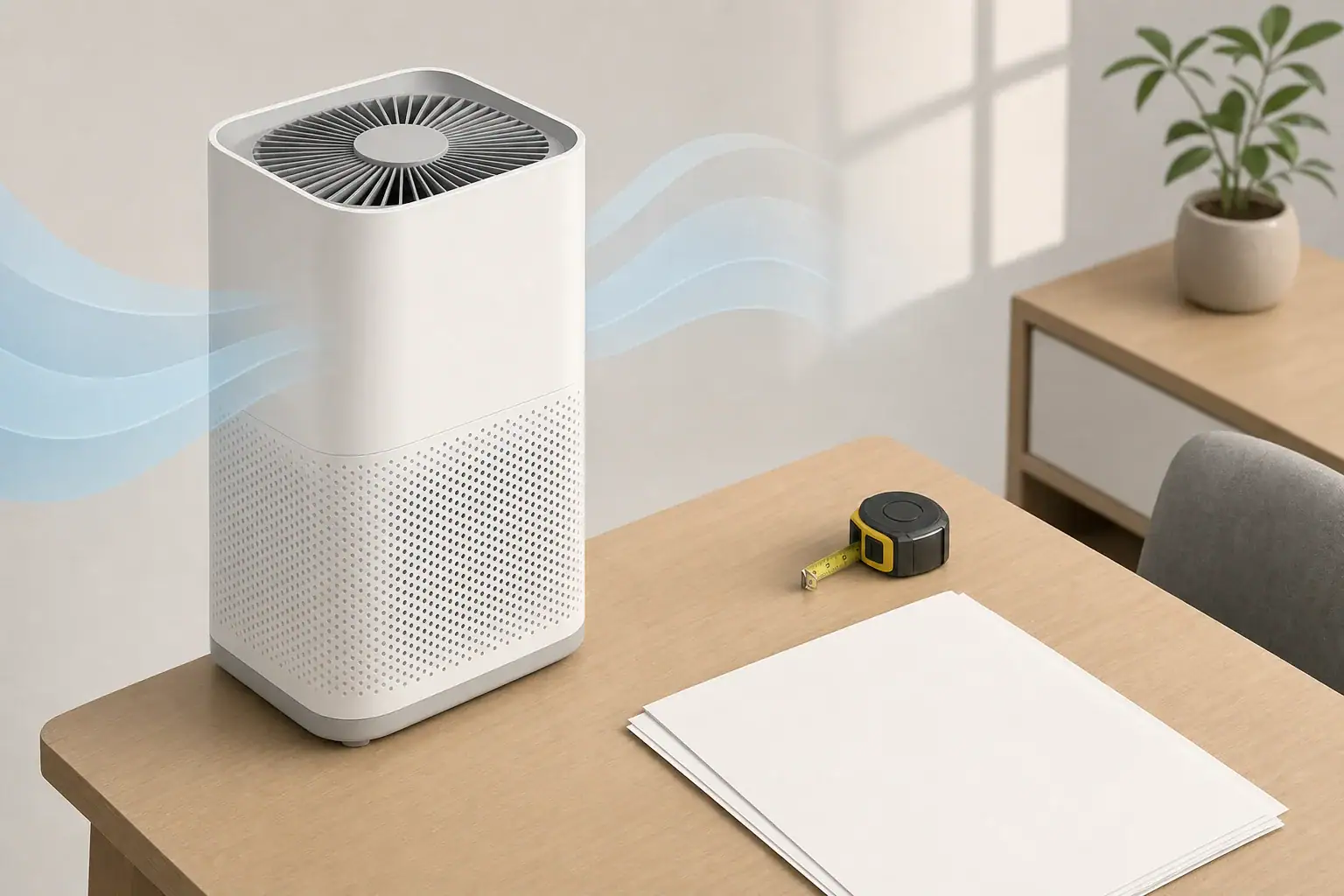
CADR tells you how much particle-cleaned air a purifier delivers, while ACH tells you how many times that clean-air volume can theoretically replace the air in a room each hour. CADR is a device performance measurement; ACH is the result after matching that performance to a specific room volume. Converting between them requires only the room’s length, width, and ceiling height.
Quick answer
- CADR is usually stated in cubic feet per minute, or cfm, and may differ for smoke, dust, and pollen particles.
- ACH means air changes per hour; for portable filtration, it describes equivalent particle-cleaned air rather than outdoor-air ventilation.
- About 4–5 ACH is a practical general planning range for many occupied rooms, while 5–6 ACH may provide faster particle removal when needed.
- Use this formula: ACH = CADR × 60 ÷ room volume in cubic feet.
- Size for a fan setting you can tolerate regularly, not only the purifier’s loudest setting.
What ACH and CADR Mean
Clean air delivery rate, or CADR, estimates the volume of particle-cleaned air a purifier supplies per minute. In the United States, it is commonly expressed in cubic feet per minute. A higher CADR generally means the unit can process particles more quickly, assuming suitable placement, unobstructed airflow, and normal filter condition.
CADR may be reported separately for smoke, dust, and pollen because particle sizes and filter behavior differ. Smoke CADR is often useful for conservative room-size planning because it represents smaller test particles, but the relevant value depends on the particle concern. CADR does not describe gas or odor removal by an activated carbon filter.
Air changes per hour, or ACH, compares clean-air delivery with room volume. A calculated 5 ACH means the purifier supplies an amount of cleaned air equal to five room volumes per hour under simplified, well-mixed conditions. It does not mean every air molecule passes through the filter exactly five times.
Portable-purifier ACH is also different from ventilation ACH. A purifier recirculates and filters indoor air, while ventilation brings in outdoor air and removes indoor air. Both can contribute to indoor air quality, but they address different needs.
How to Convert CADR to ACH
Begin by finding room volume:
Room volume = length × width × ceiling height
All measurements should be in feet, producing a volume in cubic feet. Then use:
ACH = CADR × 60 ÷ room volume
The number 60 converts cubic feet per minute into cubic feet per hour. To calculate the CADR needed for a chosen ACH target, rearrange the formula:
Required CADR = target ACH × room volume ÷ 60
For example, a 12-by-15-foot bedroom with an 8-foot ceiling contains 1,440 cubic feet. A purifier delivering 120 cfm would provide a theoretical 5 ACH because 120 × 60 ÷ 1,440 = 5.
Ceiling height matters. Two rooms with the same floor area can require different CADR values if one has a vaulted or unusually high ceiling. For open floor plans, calculate the connected volume rather than treating one portion as a closed room unless doors or walls meaningfully separate the spaces.
| Comparison point | CADR | ACH |
|---|---|---|
| What it describes | Particle-cleaned air delivered | Clean air relative to room volume |
| Common unit | Cubic feet per minute | Air changes per hour |
| Changes with room size | No, when device speed is unchanged | Yes |
| Main planning use | Comparing particle-cleaning capacity | Checking room coverage |
| Basic conversion | ACH × volume ÷ 60 | CADR × 60 ÷ volume |
| Important limitation | Does not measure gas removal | Assumes reasonably mixed room air |
Common ACH and CADR Sizing Mistakes
Using floor area without ceiling height
Room-size labels often assume a particular ceiling height. If the ceiling is higher than assumed, the purifier will produce fewer air changes than expected. Volume-based calculations avoid this problem.
Relying on maximum fan speed
A listed CADR commonly reflects a high fan setting. Lower speeds generally deliver less airflow and therefore fewer air changes. If noise causes you to run the purifier on low, consider sizing with extra capacity so a quieter setting can still provide useful airflow.
Confusing particle filtration with ventilation
Recirculating filtration can reduce airborne particles captured by the filter, but it does not remove carbon dioxide or replace oxygen. Opening windows when outdoor conditions are suitable or using properly operated mechanical ventilation addresses fresh-air exchange.
Ignoring walls, doors, and airflow barriers
A purifier in a hallway may not clean closed bedrooms effectively. Likewise, a unit placed in one corner of a large open plan may produce uneven results. Separate occupied rooms often need separate planning, especially when doors remain closed.
Treating CADR as an odor rating
Particle CADR does not indicate how well a purifier handles gases, odors, or volatile organic compounds. Those depend on the type, amount, and condition of adsorbent media, as well as the specific contaminant and contact time.
Practical Checklist for Choosing a CADR
- Measure the actual space: Record length, width, and average ceiling height.
- Include connected areas: Add adjoining spaces when air moves freely through wide, continuously open openings.
- Choose an ACH planning range: Around 4–5 ACH is a reasonable general starting point for many rooms. Higher rates can provide faster particle reduction but may increase noise and energy use.
- Calculate required CADR: Multiply the target ACH by room volume, then divide by 60.
- Check the relevant particle value: Use the CADR associated with the particles of interest when separate values are available.
- Allow operating headroom: Extra capacity may let the purifier meet the target at a quieter medium setting.
- Plan the placement: Keep the air inlet and outlet clear of walls, curtains, furniture, and bedding according to the appliance instructions.
- Account for ongoing sources: Cooking, cleaning, candles, outdoor smoke, pets, and open windows can add particles faster than a simple room calculation assumes.
A purifier should not be expected to compensate for every source. Range hoods vented outdoors, suitable ventilation, source control, and appropriate cleaning practices can reduce the load placed on filtration.
Worked Room-Size and CADR Examples
Small bedroom
A 10-by-12-foot room with an 8-foot ceiling has a volume of 960 cubic feet. For a target of 5 ACH:
5 × 960 ÷ 60 = 80 cfm
A particle CADR near 80 cfm would provide approximately 5 theoretical ACH at its rated setting. Selecting more capacity may be practical if the purifier will usually operate below maximum speed.
Medium living room
A 15-by-18-foot living room with a 9-foot ceiling contains 2,430 cubic feet. For 4 ACH:
4 × 2,430 ÷ 60 = 162 cfm
For 5 ACH, the same room would need about 203 cfm. This illustrates why room coverage is not a fixed property: the same purifier can be described as covering a larger room at fewer air changes or a smaller room at more air changes.
Open-plan area
Consider a connected 500-square-foot living and dining area with an average 9-foot ceiling. Its volume is 4,500 cubic feet. Reaching 4 ACH would require:
4 × 4,500 ÷ 60 = 300 cfm
One appropriately sized unit may work if airflow is open and placement is central. Multiple units can distribute clean air more evenly in long, L-shaped, or partially divided spaces. Their CADR values can be added only as a rough planning estimate when the units serve the same connected volume and operate simultaneously.
Safety and Performance Factors Beyond CADR
CADR is important, but it does not show every aspect of purifier design. Filter fit and cabinet sealing matter because air that bypasses the filter is not cleaned as intended. A well-seated filter and intact seals help maintain expected performance.
Mechanical particle filtration, commonly using high-efficiency media, can operate without intentionally generating ozone. Some devices add ionization, electrostatic charging, plasma, or ultraviolet features. These technologies are not required to calculate ACH, and their benefits and limitations should be evaluated separately.
If an electronic feature can be switched off, consumers may prefer to compare performance with that feature disabled. Look for credible emissions testing and follow the manufacturer’s operating and safety instructions. Do not intentionally use ozone-generating devices in occupied home spaces.
UV-C effectiveness depends on factors such as wavelength, exposure time, intensity, and shielding. A light being present does not establish whole-room performance. Enclosed systems should prevent direct exposure to eyes and skin and should not be opened, altered, or bypassed.
Also check electrical certification, cord condition, stability, and clearance requirements. Portable purifiers should be placed on a stable surface where air can circulate and where the cord does not create a trip hazard.
Maintenance, Noise, and Operating Cost
ACH calculations assume the purifier continues delivering approximately its rated airflow. A heavily loaded filter can reduce airflow, while a damaged or incorrectly installed filter can allow bypass. Inspect and replace filters according to the appliance instructions, operating conditions, and visible loading rather than relying only on a calendar date.
Washable prefilters can collect hair and larger dust before it reaches the main filter. Clean them only as directed and let washable components dry fully before reinstalling them. Main high-efficiency filters are generally not washable unless specifically identified as such.
Noise is part of practical sizing. A unit that reaches the desired ACH only on an uncomfortable setting may be used less consistently. Planning extra CADR can provide flexibility to run a lower setting during sleep or quiet activities and a higher setting during temporary particle events.
Energy use depends on wattage, fan speed, and operating hours. Estimate monthly electricity use with: watts × hours per day × days per month ÷ 1,000. Filter prices and replacement frequency should also be included in ownership planning.
A basic particle monitor can help show trends and reveal whether placement or fan-speed changes are affecting PM readings. Consumer monitors are better used for patterns than as laboratory instruments, and readings can be influenced by humidity, aerosols, and sensor design.
| Room or situation | Example ACH range | Planning note |
|---|---|---|
| Low-occupancy secondary space | 2–3 ACH | Slower particle removal |
| Typical occupied room | 4–5 ACH | Practical general starting range |
| Bedroom during sleep | 4–5 ACH | Balance airflow with tolerable noise |
| Temporary elevated particle event | 5–6 ACH | Use more airflow when practical |
| Large open-plan room | 4–5 ACH | Consider distribution and multiple units |
| Room with high ceilings | 4–5 ACH | Calculate from full volume, not floor area |
Related guides: CADR Calculator: Room Size + Ceiling Height + ACH Target • ACH to CADR Conversion: A Simple Formula With Examples • Air Purifier Placement: Where to Put It for Best Results • Air Purifier Noise: What dB Levels Are Quiet Enough for Sleep?
ACH vs CADR Key Takeaways
CADR measures particle-cleaned airflow, while ACH puts that airflow in the context of a room’s volume. Use CADR × 60 ÷ room volume to estimate ACH, or target ACH × room volume ÷ 60 to estimate the CADR needed.
For many home rooms, approximately 4–5 ACH is a useful general planning range rather than a universal requirement. Account for ceiling height, connected spaces, fan speed, noise, placement, filter condition, and active particle sources.
The calculated result is an estimate based on well-mixed air. Real rooms have furniture, corners, doors, drafts, and changing sources, so consistent operation and sensible placement are as important as the number on the specification sheet.
Frequently asked questions
How do I calculate ACH from a purifier’s CADR?
First calculate room volume in cubic feet by multiplying length, width, and ceiling height. Then multiply the purifier’s CADR in cfm by 60 and divide by the room volume: ACH = CADR × 60 ÷ room volume. The result is a theoretical estimate that assumes reasonably mixed air.
What CADR do I need for 5 ACH in a bedroom?
Multiply the bedroom volume in cubic feet by 5, then divide by 60. For example, a 10-by-12-foot bedroom with an 8-foot ceiling has a 960-cubic-foot volume and needs about 80 cfm for 5 ACH. Choosing a higher CADR can help maintain useful cleaning at a quieter fan setting.
Is smoke CADR the best number to use when sizing a home air purifier?
Smoke CADR can be a useful conservative planning value because it represents relatively small test particles. However, use the CADR category most relevant to the particles you are trying to reduce when separate smoke, dust, and pollen values are provided. CADR values do not indicate gas, odor, or VOC removal performance.
Does 5 ACH mean all of the room air is cleaned every 12 minutes?
No. A 5-ACH calculation means the purifier delivers particle-cleaned air equal to five room volumes per hour under a simplified mixing assumption. Air in real rooms does not mix perfectly, and furniture, placement, doors, drafts, and ongoing particle sources can affect results.
Can I add the CADR of two air purifiers together?
Yes, adding CADR values is a reasonable rough planning method when both units operate at the same time in one connected space. Placement still matters, and multiple units may improve distribution in large, long, or irregularly shaped rooms. Do not assume a purifier in one area will effectively clean a separate room with a closed door.
Recommended next:
- Room Size Calculator for Air Purifiers (CADR Rule of Thumb)
- CADR vs Room Size: A Simple Table You Can Use Before Buying
- One Big Purifier vs Two Small Ones: Which Cleans Air Faster?
- CADR Calculator: Room Size + Ceiling Height + ACH Target
- ACH to CADR Conversion: A Simple Formula With Examples
- Square Feet to CADR Cheat Sheet: Quick Sizing Table
- Clear sizing logic (room size → CADR/ACH)
- HEPA vs carbon explained for real use-cases
- Humidity + ventilation basics to reduce mold risk