
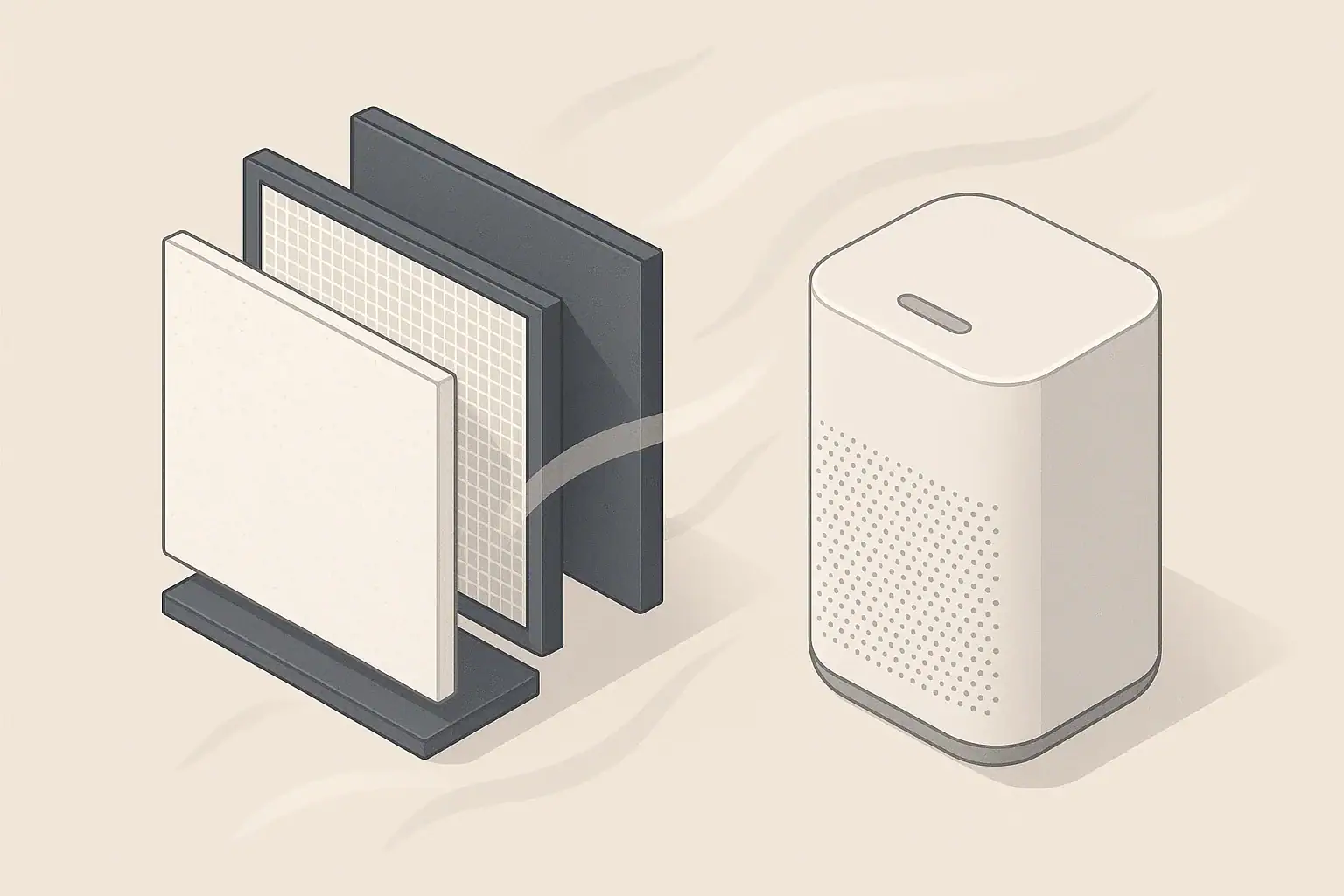
Air bypass reduces HEPA performance because some air travels around the filter instead of through the dense filter media, so fewer particles are captured per pass.
HEPA filter direction and sealing are simple details, but they affect how well a purifier or filter cabinet works as a whole system. The filter media may be efficient, but the installed fit determines how much room air actually uses that media.
- Install the filter with the airflow arrow pointing in the direction air moves through the unit, usually toward the fan or blower.
- A good seal means no obvious gaps, rocking, bent frame edges, or loose access panels around the filter.
- As general guidance, check filter fit at installation, after moving the unit, and during each filter change.
- Expect replacement intervals to vary widely; many home HEPA filters fall around 6 to 12 months, depending on use and dust load.
- Do not tape over vents, block intakes, or modify electrical appliances unless the manufacturer instructions specifically allow it.
What HEPA Filter Direction and Sealing Mean
HEPA filter direction refers to the orientation of the filter inside an air purifier, vacuum, or HVAC-style filter holder. Many filters have an airflow arrow on the frame. That arrow should point the same way the air moves through the device.
Sealing refers to how tightly the filter frame sits against the housing. A sealed fit encourages air to pass through the filter media, not around the edges. In portable air purifiers, this usually depends on the factory gasket, filter frame, access panel, and how the filter locks or slides into place.
HEPA media is designed to capture fine particles as air passes through it. However, the media rating is not the same as the installed performance of the whole appliance. A high-efficiency filter that is loose in its housing can underperform because part of the airflow takes the easier path around it.
Why Bypass Changes Real-World Performance
A HEPA filter creates resistance to airflow because the media is dense. If there is a gap around the filter, air follows the path of least resistance. Even a small edge gap can let some unfiltered air mix with the cleaned air coming out of the device.
For home use, performance is often discussed using CADR, or clean air delivery rate, and ACH, or air changes per hour. CADR is a system-level measure: it reflects fan airflow, filtration efficiency, and how the device is assembled and tested. ACH estimates how many times per hour the air in a room could be processed, based on clean air delivery and room volume.
A simple way to think about bypass is this: clean air delivery depends on both how much air moves and how well that air is filtered. If 100% of the air goes through a well-seated filter, the system can work as intended. If a meaningful portion slips around the filter, the effective clean air delivery rate drops even if the fan still sounds normal.
Filter direction matters because the frame, gasket, pleat support, and prefilter layers may be designed for one airflow direction. A reversed filter may not seat correctly, may expose the wrong surface first, or may create noise and leakage at the frame.
| Check | Why it matters | Practical note |
|---|---|---|
| Airflow arrow | Aligns the filter with the intended air path | Point the arrow toward the fan or blower side |
| Frame fit | Limits edge gaps where air can bypass | The filter should sit flat without rocking |
| Gasket contact | Helps seal the filter perimeter | Look for even contact around all sides |
| Access panel | Completes the seal in many portable units | Close panels fully before running the device |
| Prefilter position | Captures larger dust before the HEPA media | Keep washable or removable prefilters seated correctly |
| Filter damage | Bent frames and torn media can leak | Replace damaged filters rather than reshaping them aggressively |
| Correct size | Prevents loose installation | Use the size and style specified for the appliance |
Common Mistakes That Create Air Bypass
Air bypass is not always obvious. A purifier may still turn on, move air, and sound normal while some air is not being filtered as intended. The most common causes are installation errors, filter wear, or a mismatch between the filter and the housing.
Installing the filter backward
Some filters can physically slide in either way, but that does not mean both orientations work the same. The airflow arrow, gasket side, pull tab position, and prefilter layer can all indicate the intended direction. If the filter does not sit flush when installed, check the orientation before forcing it.
Using a slightly wrong filter size
A filter that is close to the right size may seem acceptable, but even a small perimeter gap can reduce installed performance. In a portable purifier, a nonmatching filter may also interfere with the access panel or sensor pathway. In an HVAC filter slot, a loose filter can shift when the blower starts.
Running the unit with a loose door or panel
Many portable purifiers use the filter door as part of the air path. If the door is not fully latched, air can be drawn from unintended openings. A rattling or whistling sound after a filter change is a useful cue to recheck the panel and filter seating.
Letting dust prevent a good seal
Dust, pet hair, and lint can build up on filter tracks, grille edges, and gasket surfaces. This can keep the filter from sitting flat. A gentle cleaning during filter changes can help restore normal contact without modifying the appliance.
Practical Steps to Improve Filter Fit Without Guessing
The safest first step is to follow the appliance manual and use the specified filter format. HEPA purifiers are designed as complete systems, and the filter housing often has little tolerance for improvisation. Avoid adding thick foam, tape, or improvised seal material inside a device unless the instructions explicitly allow it.
Use this practical sequence when installing or replacing a filter:
- Turn the unit off and unplug it before opening the filter compartment.
- Remove packaging from the new filter, including any plastic wrap around the media.
- Find the airflow arrow, pull tab, gasket, or prefilter side before inserting it.
- Slide or place the filter without bending the frame.
- Check that the filter sits evenly against its stop or gasket surface.
- Close the access panel fully and confirm that latches or magnets engage normally.
- Run the unit briefly and listen for new rattling, fluttering, or whistling.
For HVAC filter slots, the same principle applies: use the correct size and point the arrow toward the blower. If the filter slot has a cover, reinstall it properly. If you see major gaps, poor rack fit, or return-air leakage, consider asking a qualified HVAC professional rather than altering the system yourself.
Real-World Examples of Bypass and Direction Problems
Example scenarios can make the concept easier to apply. These are general situations, not product-specific performance claims.
Bedroom purifier after a filter change
A small bedroom purifier sounds louder than usual after a new filter is installed. The filter door closes, but one corner sticks out slightly. In this case, the filter may be reversed, not fully seated, or the packaging may not have been completely removed. Reopening the unit and checking direction, frame position, and panel closure is the right first step.
Open-plan living area with visible dust at the filter edge
A purifier in a larger living area collects dust mainly along one edge of the filter frame. Some edge dust is normal, but heavy streaking near a gap can suggest uneven airflow or poor gasket contact. Cleaning the track and checking for a warped frame can help identify whether the filter is sealing evenly.
HVAC return filter that shifts when the blower starts
A return grille filter or filter cabinet may pull the filter toward one side when the blower turns on. If the filter is undersized or the grille does not close tightly, air may slip around it. The practical fix is usually correct sizing or proper rack repair, not stacking extra filters or blocking the return.
Safety and Standards Considerations
HEPA describes high-efficiency particle filtration, but standards and labels can vary by product category and market. In consumer air purifiers, terms such as True HEPA, H13, or H14 are often used to describe filter media performance. The installed device still depends on airflow design, housing seal, and filter maintenance.
Be cautious when comparing only filter labels. A very dense filter media can also increase resistance, and the fan must be able to move air through it. A filter that does not match the device may reduce airflow, create noise, or leave gaps that defeat the purpose of the upgrade.
Some air-cleaning devices include ionizers, UV-C lamps, or other add-on technologies. These features should be evaluated separately from HEPA filtration. For general home use, many people prefer mechanical filtration that does not intentionally generate ozone. Do not disable safety switches, expose UV-C lamps, or modify appliances to change how they operate.
For homes with combustion appliances, avoid blocking air intakes, returns, or vents. Airflow changes can affect comfort and equipment operation. When in doubt, use the filter type specified for the equipment and consult a qualified professional for duct or cabinet issues.
Maintenance and Replacement Planning
Good sealing is not a one-time task. Filters load with dust over time, gaskets compress, and removable panels can loosen if they are opened frequently. Regular, light maintenance helps the purifier keep working as designed.
Typical replacement timing depends on filter area, fan speed, dust levels, smoke exposure, pets, renovation dust, and hours of use. Many home HEPA filters are replaced somewhere around 6 to 12 months, but the appliance indicator or manual should take priority. Washable prefilters, if provided, often need more frequent attention because they catch larger lint and hair before the HEPA layer.
Do not wash a HEPA filter unless the instructions clearly say it is washable. Many HEPA filters are made from materials that can be damaged by water, brushing, or compressed air. Damaged media, bent frames, or collapsed pleats can create new leakage paths.
| Filter type | Typical interval range | What changes it | Reminder |
|---|---|---|---|
| Washable prefilter | Every 2 to 4 weeks | Pets, lint, visible dust | Dry fully before reinstalling |
| Disposable prefilter | 1 to 3 months | Dust load and runtime | Replace if clogged or torn |
| HEPA filter | 6 to 12 months | Fan speed, room dust, smoke events | Use the appliance indicator or manual |
| Carbon filter layer | 3 to 6 months | Odors, cooking, VOC sources | Particle capture and odor capture are different |
| HVAC pleated filter | 1 to 3 months | System runtime and household dust | Use the specified size and airflow direction |
| Gasket or seal surface | Check at each change | Compression, dust, handling | Look for gaps, cracking, or uneven contact |
Related guides: HEPA Filter Bypass Leakage: Why Seals Matter as Much as the Filter • How Often Should You Replace a HEPA Filter? • Air Purifier Maintenance Checklist: Filters, Sensors, and Cleaning
Frequently asked questions
Which way should the HEPA filter arrow point?
The airflow arrow should point in the direction the air moves through the device, usually toward the fan or blower. If you are unsure, check the appliance manual or follow the airflow path from the intake side to the discharge side.
What happens if a HEPA filter is installed backward?
A backward installation can prevent the filter from seating correctly and may increase leakage around the frame. In some units, it can also reduce airflow or create noise because the filter was designed for one direction of flow.
How can I tell if my HEPA filter is sealed well?
A well-sealed filter sits flat, does not rock, and has even contact around the perimeter. After the panel is closed, there should be no obvious gaps, loose edges, or air whistling from the housing.
Does a small gap around a HEPA filter matter?
Yes, even a small gap can let some air bypass the filter media. That reduces the amount of room air that is actually cleaned, which can lower real-world performance even if the fan still runs normally.
How often should I check HEPA filter fit and sealing?
Check the fit when you install a new filter, after moving the unit, and during each filter change. It is also worth rechecking any time the device becomes noisier, rattles, or starts to show dust streaks around the frame.
Summary: Key Takeaways on HEPA Bypass
HEPA filter media can only capture particles from air that passes through it. Direction and sealing matter because they help route airflow through the intended filter path instead of around the edges.
For most homes, the practical approach is straightforward: use the correct filter, follow the airflow arrow, close panels fully, and check for gaps or damage during each replacement. If a device becomes unusually noisy, shows dust streaks around the frame, or no longer closes correctly, recheck the installation before assuming the filter itself is the problem.
Air bypass is a performance issue, not a reason for alarm. Careful fit, routine cleaning, and manufacturer-approved replacement parts are usually enough to keep a purifier or filter cabinet operating as intended.
Recommended next:
- True HEPA vs HEPA-Type: What the Labels Really Mean
- HEPA H13 vs H14: Differences, Efficiency, and When It Matters
- How Often Should You Replace a HEPA Filter?
- Do HEPA Filters Remove Viruses, Bacteria, and Allergens?
- HEPA Grades Explained (H10–H14): What’s Relevant for Homes?
- True HEPA vs HEPA-Type vs “HEPA-Like”: Label Tricks to Avoid
- More in HEPA Filters →
- Clear sizing logic (room size → CADR/ACH)
- HEPA vs carbon explained for real use-cases
- Humidity + ventilation basics to reduce mold risk