
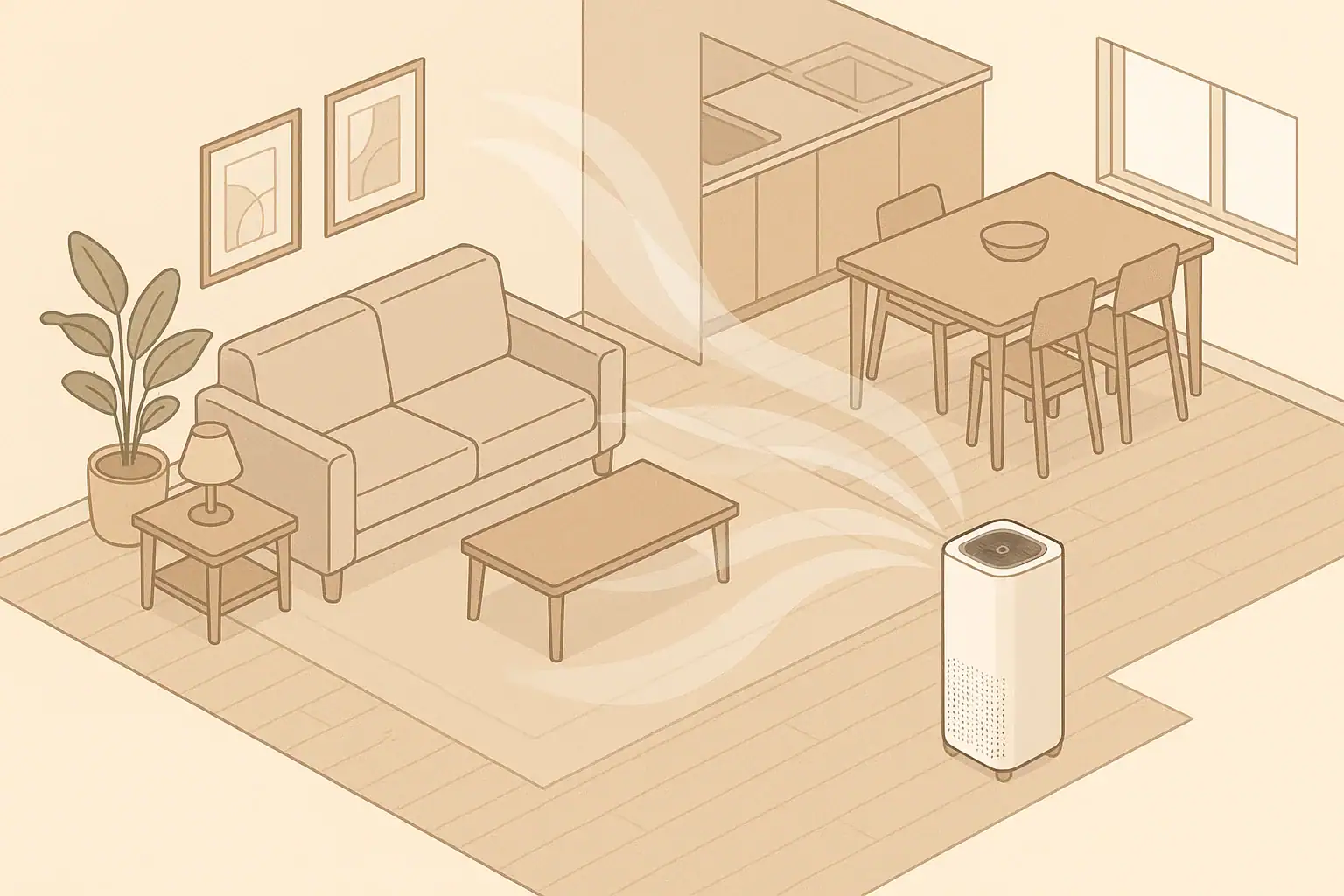
An air purifier for an open-plan living room works best when you size CADR for the connected air volume and place the unit where clean air can circulate without short-circuiting.
Open layouts are harder to plan than closed bedrooms because air can move into kitchens, dining areas, hallways, stair openings, and vaulted spaces. The practical goal is not to seal the space perfectly, but to give the main living zone enough clean air delivery for the way the room is actually used.
- Estimate the connected open area, not just the rug or seating area, when sizing CADR.
- Use the simple planning formula: CADR in cfm ≈ room volume in cubic feet × target ACH ÷ 60.
- For general particle reduction in a busy living space, many homeowners plan around roughly 3 to 5 air changes per hour as a practical range.
- Large open plans often work better with two medium units than one distant unit, especially around L-shaped layouts.
- Place the purifier with several feet of open space around the intake and outlet, away from curtains, corners, and furniture walls.
- Run the unit long enough and at a usable fan speed; CADR is only helpful when the purifier is actually moving air.
What Open-Plan Air Purifier Planning Means
In a closed room, sizing is relatively simple: measure the room, account for ceiling height, and match the purifier’s clean air delivery rate to the target air changes per hour. Open-plan living rooms add uncertainty because the air purifier is not cleaning a neat box. It may be connected to a kitchen, foyer, dining area, hallway, sunroom, or stairwell.
That does not make air cleaning impossible. It means the plan should be based on zones and airflow paths. The main seating area may be the priority, but particles and odors can enter from cooking, pets, fireplaces, open doors, outdoor air, and foot traffic. A purifier placed and sized only for a small sitting area may underperform if the surrounding air volume is much larger.
The main questions are practical: how much connected space does the purifier need to influence, where is particle generation most common, and where can the unit run without being blocked or turned off because of noise?
CADR and ACH Basics for Open Living Rooms
CADR stands for clean air delivery rate. It is usually expressed in cubic feet per minute and describes how quickly a purifier delivers filtered air for specific particle types under test conditions. ACH means air changes per hour. In home planning, ACH estimates how many times per hour the air volume of a space could pass through the purifier, assuming reasonably good mixing.
The basic sizing formula is:
CADR in cfm ≈ room volume in cubic feet × desired ACH ÷ 60
Room volume is floor area multiplied by ceiling height. For an open-plan room, use the connected area that freely shares air, not only the furniture grouping. If the living room, kitchen, and dining area are open to each other, include them in the estimate. If a hallway is narrow or separated by a doorway, you can treat it as a partial connection, but this is still an approximation.
For many everyday home settings, a target around 3 to 5 ACH is a practical planning range for particle reduction. Lower settings can still help over time, while higher targets may be useful during temporary particle events such as cooking smoke or outdoor smoke intrusion. The larger the open volume, the more likely you are to need either a high-CADR unit or multiple units with combined CADR.
| Planning step | Why it matters | Practical note |
|---|---|---|
| Measure connected floor area | Open spaces share air | Include living, dining, and kitchen zones if they are not separated |
| Account for ceiling height | Volume drives CADR need | Vaulted or 10-foot ceilings increase the air volume |
| Choose an ACH target | ACH turns room volume into CADR | Use about 3 to 5 ACH for general particle planning |
| Consider multiple units | Airflow may not mix evenly | Useful for long, L-shaped, or divided open plans |
| Check real fan use | CADR usually depends on fan speed | A quiet speed may deliver less airflow than the maximum setting |
| Leave clearance | Blocked intakes reduce performance | Avoid placing the unit tight against walls, sofas, or drapes |
| Plan filter access | Maintenance affects airflow | Choose a location where filters can be checked without moving furniture |
Placement Strategy for Better Airflow
Placement should support circulation through the busiest part of the open plan. A good starting point is near the main living zone, but not tucked into a corner. The purifier needs access to room air on the intake side and enough clearance for clean air to spread from the outlet.
Use the room’s natural airflow
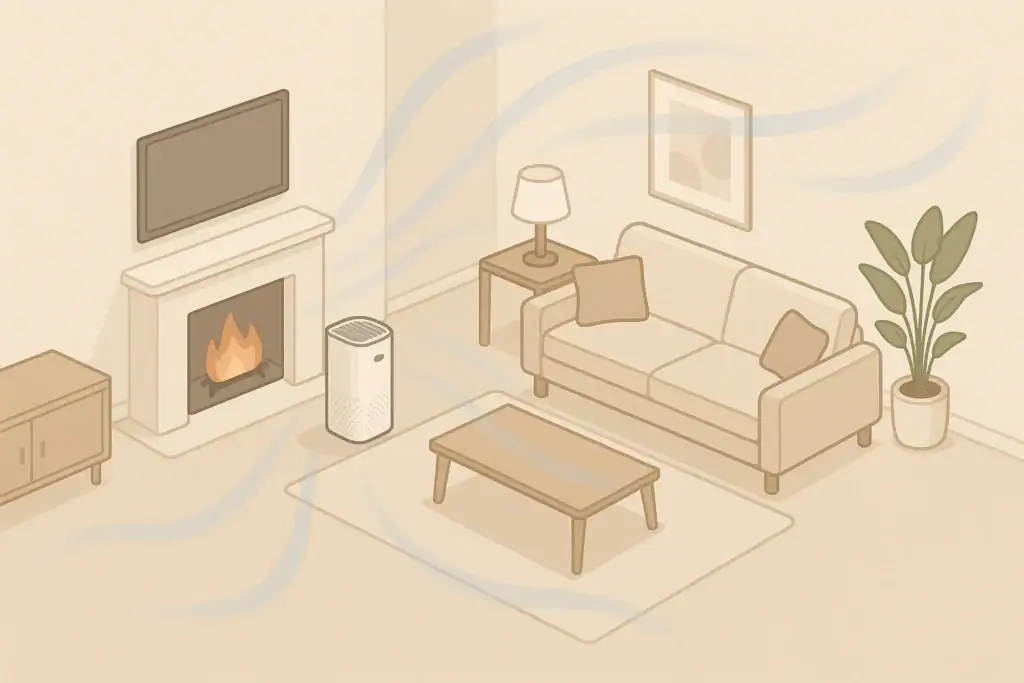
Watch how air already moves. Air purifier placement, HVAC supply registers, return grilles, ceiling fans, open windows, and kitchen exhaust use can influence airflow. A purifier placed where it works with existing movement often performs better than one hidden behind furniture.
Avoid short-circuiting
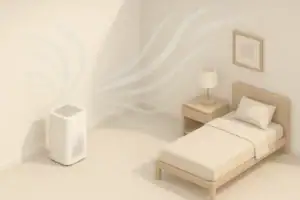
Short-circuiting happens when clean air exits the purifier and immediately returns to the intake without mixing into the room. This can occur when the unit is placed too close to a wall, inside a recessed nook, or next to bulky furniture. Give the outlet room to throw air into the open area.
Think in zones
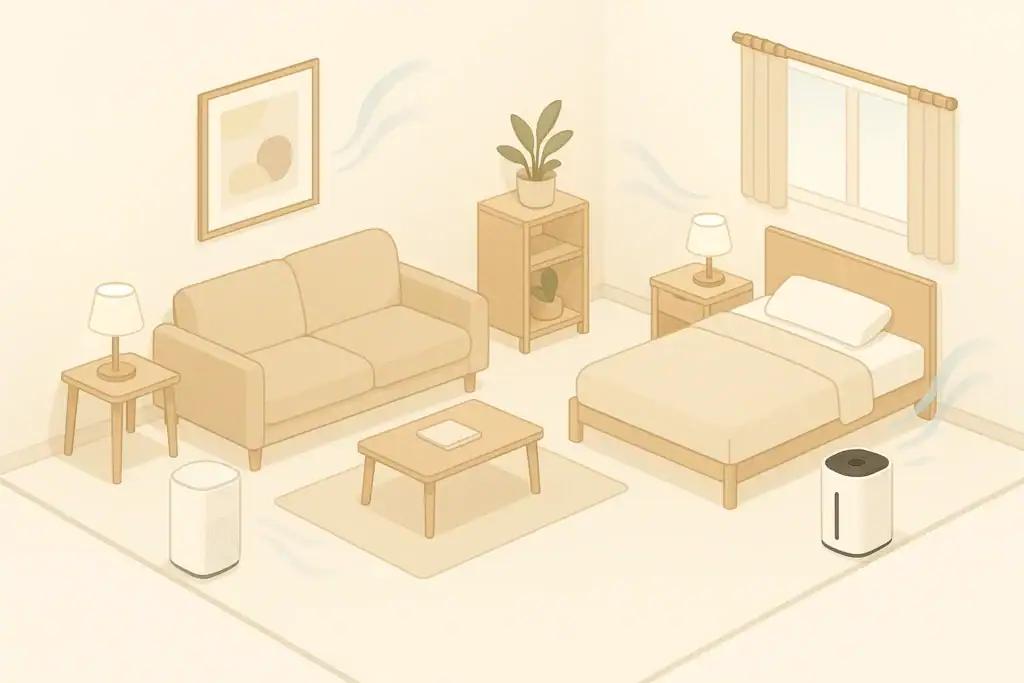
If the open plan is long or L-shaped, one purifier at one end may not influence the other end quickly. In that case, two smaller units placed in separate zones can provide more even coverage than one larger unit placed far away.
Common Mistakes and Troubleshooting Cues
The most common mistake is using the square footage of only the seating area. An open-plan living room with a connected kitchen and dining area may have twice the effective air volume of the sofa area alone. This leads to low ACH and slower particle reduction.
Another issue is operating the purifier only on the lowest fan setting. Lower speeds can be useful for noise control, but they usually deliver less clean air. If a room does not seem to improve during cooking, dusting, or high outdoor particle periods, try a higher setting for a defined period before assuming the unit is too small.
Watch for placement clues:
- Dust collects heavily around the purifier intake, but the far side of the room feels unchanged.
- Odors linger because the unit has little or no activated carbon, or the carbon is spent.
- The purifier is quiet because it is on a low speed that may not match the room size.
- Airflow is blocked by a sofa, cabinet, curtain, or wall.
- Open stairways pull air away from the main living zone.
These cues do not prove failure, but they suggest changes to sizing, placement, fan schedule, or expectations.
A Practical Setup Checklist
Start with a simple room sketch. Mark the living zone, kitchen, dining area, stair openings, HVAC supply and return locations, and any doors that usually stay open. Then estimate the connected floor area and ceiling height.
Next, choose whether one unit or more than one unit makes sense. One purifier can work well in a compact rectangular open space if it has enough CADR and a clear airflow path. Multiple units often make sense when the space wraps around a wall, has a distant dining area, or includes a high-ceiling great room.
Use these practical steps:
- Calculate volume: floor area × average ceiling height.
- Select a target ACH range, often around 3 to 5 for general particle planning.
- Estimate needed CADR using volume × ACH ÷ 60.
- If using more than one unit, add their CADR values for a rough combined total.
- Place units where people will allow them to run regularly.
- Recheck placement after furniture changes, seasonal window use, or HVAC changes.
If odors are a major concern, remember that particle CADR and odor control are not the same thing. Activated carbon filters or other sorbent media is used for many odor and gas-phase concerns. Carbon capacity varies, and thin carbon layers may have limited odor-holding ability.
Real-World Open-Plan Scenarios
Compact apartment living area
A small apartment may have a living room, kitchen, and entry area sharing one open volume. The purifier can often be placed near the living area, a few feet away from walls and soft furnishings. If the kitchen is close, using kitchen exhaust during cooking can reduce the burden on the purifier.
Large suburban great room
A great room may have high ceilings, a dining area, and a partial connection to a hallway or staircase. In this case, ceiling height can matter as much as floor area. A single unit rated for a standard room may not provide the intended ACH. Two units placed across the main zones can be more practical than one unit running loudly at the far end.
Open plan with pets and high traffic
Pets, rugs, and frequent foot traffic can increase dust and hair accumulation. The purifier should be placed where it can pull from the active zone, but the prefilter also needs regular cleaning. Avoid placing the unit where pet bedding blocks the intake.
Safety, Noise, Maintenance, and Cost Planning
Choose air purifiers that can operate without producing ozone intentionally. Some devices include ionizers, plasma features, or UV-C features. Do air purifiers produce ozone technologies should be evaluated carefully, especially if they are optional. For general home particle filtration, a sealed mechanical filter design and adequate CADR are the core features to understand first.
Noise matters because a purifier that is turned off does not deliver CADR. When planning for an open living room, consider the fan speed you will actually use during conversation, television, work, or sleep in connected spaces. A larger unit on a moderate setting or two units on lower settings may be more acceptable than one unit at maximum speed.
Maintenance is part of performance. A clogged prefilter or overdue main filter can reduce airflow and increase noise. Check the owner’s manual for cleaning and replacement intervals, but expect timing to vary with use, dust load, pets, cooking, outdoor smoke events, and fan speed.
Also plan for operating cost. Electricity use varies with fan speed, and filter replacement is a recurring expense. The lowest purchase price is not always the lowest ownership cost if filters are expensive or need frequent replacement in a high-use open plan.
| Connected area | Ceiling height note | CADR planning idea | Notes |
|---|---|---|---|
| 300 square feet | 8 feet | About 120 to 200 cfm for 3 to 5 ACH | May fit a compact open apartment zone |
| 400 square feet | 8 feet | About 160 to 270 cfm for 3 to 5 ACH | Include nearby dining space if open |
| 600 square feet | 8 feet | About 240 to 400 cfm for 3 to 5 ACH | One strong unit or two smaller units may be considered |
| 700 square feet | 9 feet | About 315 to 525 cfm for 3 to 5 ACH | Higher ceilings increase volume |
| 900 square feet | 9 feet | About 405 to 675 cfm for 3 to 5 ACH | Multiple units often improve distribution |
| L-shaped open plan | Varies | Use combined CADR by zone | Place units so each leg has airflow coverage |
| Open room with stairway | Varies | Estimate conservatively | Air exchange with upper levels can dilute performance |
Related guides:
How to Choose the Right Air Purifier for Your Room Size •
Air Purifier Placement: Where to Put It for Best Results •
One Big Purifier vs Two Small Ones: Which Cleans Air Faster? •
Activated Carbon Filters Explained: VOCs, Odors, and What They Can’t Do
Frequently asked questions
How do I size an air purifier for an open-plan living room?
Start by estimating the connected air volume, not just the seating area. Multiply floor area by ceiling height, then choose a target air changes per hour and use the CADR formula to estimate the needed airflow.
Should I include the kitchen and dining area in the CADR calculation?
If those areas are open to the living room and share air freely, they should be included. Open layouts behave more like one connected space, so leaving them out often underestimates the purifier size needed.
Is one large purifier better than two smaller ones in an open-plan room?
It depends on the layout. One strong unit can work in a compact, simple space, but two units often provide better coverage in long, L-shaped, or high-ceiling open plans.
Where is the best place to put an air purifier in an open living room?
Place it where it can draw air from the main living zone and discharge into open space. Avoid corners, tight alcoves, and spots where furniture or curtains can block intake and outlet airflow.
Why does my purifier seem too quiet to be effective?
A quiet setting may mean lower airflow, which reduces CADR. If the room is large or the air has cooking smoke, dust, or odors, a higher fan speed or a better-placed unit may be needed.
Does CADR help with odors as well as particles?
CADR is mainly a measure of particle-cleaning airflow. Odor control usually depends on sorbent media such as activated carbon, and thin carbon layers may have limited capacity for strong or persistent odors.
Summary Takeaways
Sizing an air purifier for an open-plan living room is mainly a CADR and airflow problem. Measure the connected air volume, choose a practical ACH target, and remember that open layouts usually need more clean air delivery than the seating area alone suggests.
Placement is just as important as the number on the box. Keep the purifier out in the room, away from blocked intakes, tight corners, and furniture barriers. In large, long, or L-shaped spaces, multiple units can provide more even coverage than one unit trying to serve the entire open plan from a single location.
For everyday use, the best strategy is the one that can run consistently: adequate CADR, clear airflow, manageable noise, safe operation without intentional ozone production, and filter maintenance that fits the household’s routine.
- Clear sizing logic (room size → CADR/ACH)
- HEPA vs carbon explained for real use-cases
- Humidity + ventilation basics to reduce mold risk


About this site
Home Air Quality Lab publishes practical, independent guides about indoor air quality—clear sizing, safer use, and real-world expectations.
Affiliate disclosure
Some links on this site may be affiliate links. If you buy through these links, we may earn a small commission at no extra cost to you. This helps support our content. Learn more.