
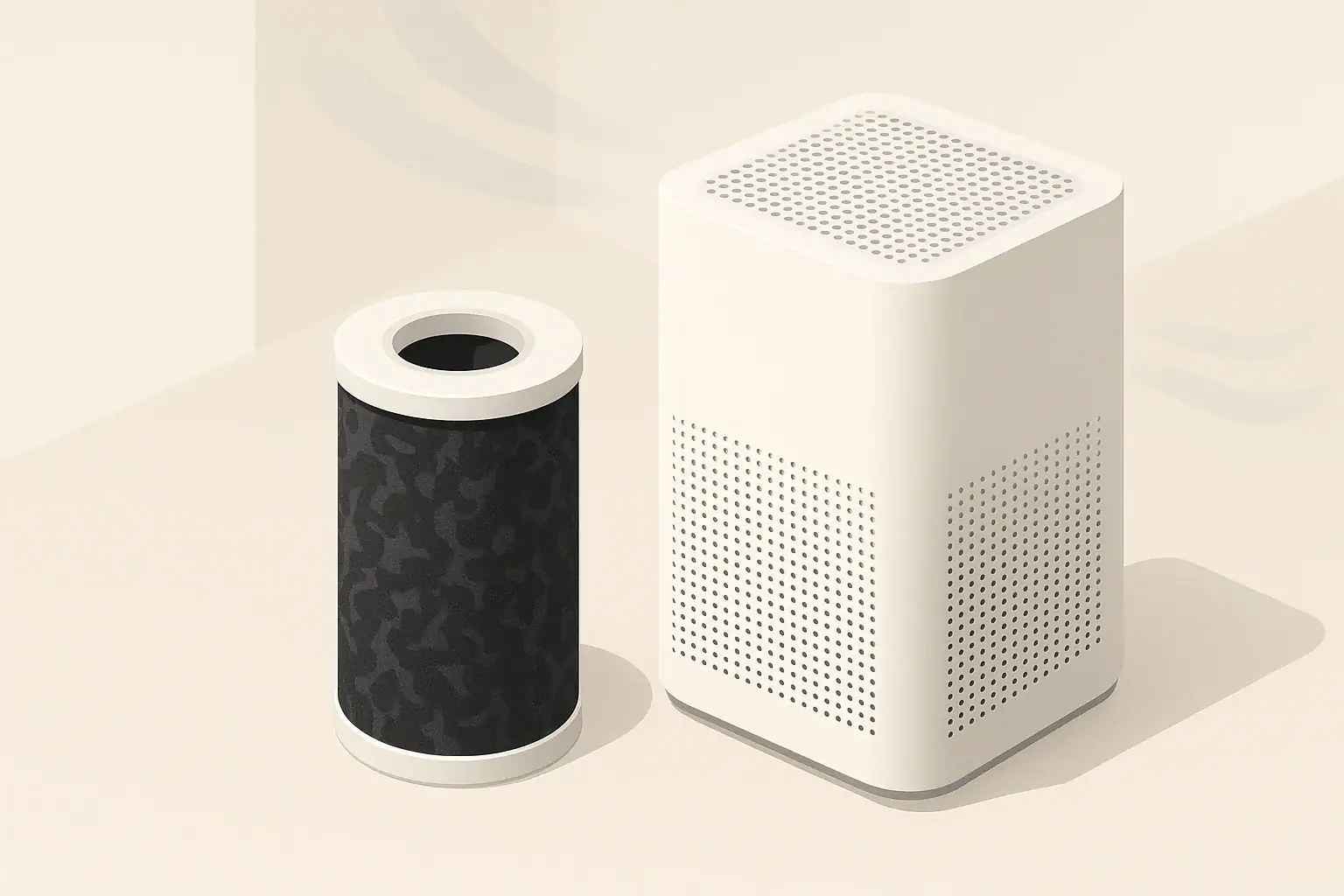
A carbon odor filter is likely spent when odors return quickly after the air purifier has been running, especially if the prefilter is clean and airflow is normal.
Carbon filter saturation means the activated carbon has adsorbed enough gas molecules that it can no longer hold much more. The change is often noticed as odor breakthrough rather than a visible change in the filter. Because homes, odors, humidity, and filter designs vary, the best approach is to combine a few practical checks instead of relying on one clue.
- Odor returns fast: If the same smell comes back within about 15 to 60 minutes after running the purifier, saturation is a reasonable possibility.
- Typical replacement range: Light odor use may last around 3 to 6 months; frequent cooking, smoke, solvents, or new furnishings can shorten that range.
- Airflow matters: Weak airflow may indicate a clogged prefilter or particle filter, not only spent carbon.
- Source control comes first: Remove or reduce the odor source when possible, then use carbon and ventilation as support.
- No single sensor tells all: TVOC readings can be useful trends, but they do not directly measure whether a carbon filter is saturated.
What Carbon Filter Saturation Means
Activated carbon is a porous material designed to capture many odor-causing gases and some volatile organic compounds, often shortened to VOCs. It does this mainly through adsorption, where gas molecules cling to the surface inside the carbon pores.
Saturation happens when available adsorption sites are mostly occupied or when the carbon can no longer hold a specific mix of gases effectively. At that point, incoming odor compounds can pass through the filter instead of being captured. In practical home terms, the purifier may still move air and may still capture particles if it has a particle filter, but odor control becomes noticeably weaker.
Carbon saturation is not the same as a dirty dust filter. A gray or dusty prefilter can often be cleaned or replaced based on visible buildup. A spent carbon filter may look almost unchanged, which is why smell patterns, use conditions, and replacement history matter.
How Activated Carbon Handles Odors and VOCs
Carbon performance depends on carbon mass, pore structure, airflow, contact time, humidity, and the types of gases present. Activated carbon filters with a thicker bed of granular or pelletized carbon generally offer more capacity than a thin carbon sheet, but design details vary. More carbon gives more surface area and usually more holding capacity, while slower contact through the carbon bed can improve adsorption.
Odors are also mixtures, not single substances. Cooking smells, wildfire smoke residue, pet odors, cleaning product fragrances, and off-gassing from new materials do not behave the same way. Some compounds are captured more readily than others, and high humidity can compete for adsorption space or reduce efficiency for certain gases.
It is also important to separate particle filtration from gas filtration. HEPA-style filters are designed for particles such as dust, pollen, and smoke particles. Activated carbon is used for gases and odors. A purifier can perform well for particles while doing little for odors if the carbon layer is small or already spent.
| Cue | What it may mean | Practical check |
|---|---|---|
| Odor returns soon after running | Carbon may be near saturation | Run the purifier on a higher setting for 30 minutes and reassess |
| Airflow feels weak | Dust loading may be the issue | Check prefilter and particle filter before blaming carbon |
| Odor improves near an open window | Ventilation is helping dilute gases | Use short ventilation periods when outdoor conditions are suitable |
| Odor is strongest at one source | Source control may matter most | Remove, seal, clean, or isolate the source if reasonable |
| TVOC trend stays elevated | Ongoing emissions may exceed filter capacity | Compare trends before and after source reduction |
| Filter is past normal interval | Replacement is more likely | Check the date installed and the use pattern |
| Odor changes to stale or sour | Filter or housing may contain residues | Inspect for dampness, dust, or improper storage |
Signs Your Odor Filter Is Spent
The most common sign of carbon filter saturation is odor breakthrough. This means the purifier seems to help briefly, but the odor returns while the unit is still running or shortly after it has been operating.
Odors return faster than they used to
If the same room, same purifier setting, and similar odor source used to clear noticeably better, a faster odor return is a useful clue. This is especially relevant if nothing else has changed, such as room size, purifier placement, or ventilation pattern.
The filter is beyond a realistic service period
Many home carbon filters are changed every few months, but service life can be shorter in heavy odor conditions. Frequent frying, indoor smoke residue, hobby solvents, strong fragrances, or new carpeting and furniture can consume carbon capacity faster than mild everyday odors.
Particle performance seems fine but odor control is weak
A purifier may still reduce visible dust or help lower particle readings while odors persist. That difference often points to the carbon stage rather than the fan or particle filter. However, a clogged particle filter can still limit airflow through the carbon, so both stages should be checked.
A TVOC monitor shows a persistent trend
Consumer TVOC readings are best treated as trend indicators, not precise chemical tests. If readings rise after a known source and do not drop as expected with ventilation and purifier use, the carbon stage may not be keeping up. Sensor drift, humidity, and mixed gases can affect readings, so use the monitor as one clue among several.
Common Mistakes That Look Like Saturation
Not every odor problem means the carbon is spent. Many homes have airflow, source, or placement issues that make a working filter seem ineffective.
A common mistake is placing the purifier too far from the odor source or blocking its intake with furniture. Carbon can only adsorb gases that reach the filter. If the room has stagnant corners or the purifier is tucked behind a sofa, much of the odorous air may bypass the unit.
Another mistake is expecting a small carbon sheet to handle strong or continuous emissions. Thin carbon layers can help with light odors, but they have limited capacity. Strong sources need source reduction and ventilation, not just more run time.
Cleaning products, scented candles, air fresheners, and fragrances can also add more gases to the room. Masking an odor does not remove the original source and may add load to the carbon filter. For odor troubleshooting, simplify the room by reducing optional scented products for a few days.
Finally, high humidity can complicate odor control. Moisture does not automatically ruin every carbon filter, but damp conditions can reduce adsorption effectiveness for some gases and may create separate musty odors from materials, dust, or hidden dampness.
What To Do Before Replacing the Carbon Filter
Before buying a replacement, do a short, controlled check. The goal is to determine whether the filter is likely spent or whether another condition is causing poor odor control.
- Check the source: Identify whether the odor comes from cooking residue, trash, drains, pet areas, damp materials, smoke residue, fresh paint, furniture, or cleaning products.
- Clean the prefilter: If the unit has a washable or vacuumable prefilter, maintain it according to the manual so airflow is not restricted.
- Inspect airflow: Make sure air is entering and leaving the purifier freely. Keep several inches of clearance around intakes and outlets when possible.
- Run a short high-speed test: Operate the purifier on a higher setting for about 30 to 60 minutes, then compare odor strength near the source and across the room.
- Ventilate briefly if suitable: When outdoor air is acceptable, short ventilation can dilute gases and reveal whether the source is ongoing.
- Check dates: Note when the carbon filter was installed and whether recent events increased odor load.
If odor remains similar after these checks and the carbon filter is within or beyond its expected interval, replacement is a practical next step. If the odor is tied to dampness, combustion, sewer gas, or a strong chemical spill, focus on the source and appropriate safety guidance rather than relying on a purifier alone.
Real-World Scenarios: Cooking, Smoke, Pets, and New Materials
Cooking odors often come from both airborne gases and particles. A kitchen exhaust fan vented outdoors, if available, is usually more direct than a portable purifier after the fact. A carbon filter in a nearby room can help with lingering odors, but grease and heavy cooking residue may shorten filter life.
Smoke odors are also mixed. Smoke contains particles, gases, and residues that can settle on fabrics and surfaces. A purifier with particle filtration and carbon may help reduce airborne components, but settled odors often require cleaning surfaces, laundering fabrics, and increasing ventilation when outdoor air quality allows.
Pet odors are frequently source-based. Litter areas, bedding, rugs, and soft furniture can hold odor compounds. Carbon filtration may reduce airborne smells, but routine cleaning and keeping the purifier near the main odor pathway usually matters more than running it in a distant room.
New materials such as furniture, flooring, mattresses, paints, or adhesives may release VOCs over time. The highest emissions often occur early, then decline gradually. Ventilation, temperature moderation, and source choices are important; carbon filtration can be a supporting tool but has finite capacity.
Safety, Ventilation, and Technology Notes
Odor filters are not safety devices for hazardous conditions. If an odor suggests a gas leak, combustion problem, sewer gas, or a strong chemical exposure, follow appropriate safety steps for that situation and do not rely on a portable air purifier as the solution.
Ventilation is often the simplest way to dilute indoor gases when outdoor conditions are suitable. This may mean opening windows briefly, using a bath fan, running a kitchen exhaust fan that vents outdoors, or improving routine air exchange. In apartments, ventilation options may be limited, so source control and purifier placement become more important.
Some devices include ionizers, UV-C lamps, photocatalytic features, or other add-ons. These technologies vary widely, and they are not the same as activated carbon. For indoor use, many people prefer systems that do not intentionally generate ozone. If a device includes optional ionizing or reactive features, review the documentation carefully and consider whether the feature is necessary for your goal.
Never modify appliances, disable safety systems, or attempt to create ozone to remove odors. Ozone can react with indoor materials and is not a routine home odor-control strategy.
Maintenance and Replacement Planning
A simple maintenance plan prevents most guesswork. Write the installation date on the filter frame or keep a reminder in a household calendar. Track unusual events such as wildfire smoke days, painting, strong cooking periods, renovation work, or extended use on high speed.
Store replacement carbon filters sealed until use. Activated carbon can adsorb gases from the air even before installation, so leaving a filter unwrapped in a garage, closet, or utility room may reduce its useful capacity. Keep filters dry and away from solvents, fuels, fragrances, and cleaning chemicals.
When replacing a filter, check the gasket or fit of the filter frame if the design includes one. Poor sealing can allow bypass, where air moves around the filter instead of through it. Bypass can make a new filter seem weak even when the carbon itself is fresh.
Plan costs realistically. Carbon filters used for odor control may need more frequent replacement than particle filters in some homes. Homes with light odor concerns may change carbon less often, while homes with continuous sources may need more frequent changes or a larger carbon capacity approach.
| Filter or task | Typical interval range | What changes it | Reminder |
|---|---|---|---|
| Washable prefilter | Every 2 to 4 weeks | Dust, pets, open windows | Clean only as the manual allows |
| Thin carbon sheet | About 1 to 3 months | Cooking, smoke, fragrances | Limited odor capacity |
| Granular or pellet carbon filter | About 3 to 6 months | Carbon mass, humidity, gas load | Replace sooner if odors break through |
| Particle filter | About 6 to 12 months | Dust load and run time | Odor control is not its main job |
| Purifier exterior and grilles | Monthly | Room dust and placement | Keep intakes and outlets clear |
| Storage check | Before installation | Unsealed packaging or damp storage | Use sealed, dry filters |
Related guides: Activated Carbon Filters Explained: VOCs, Odors, and What They Can’t Do • How Much Activated Carbon Do You Need to Remove Odors? • When to Replace Carbon Filters (And How to Tell They’re Spent)
Frequently asked questions
What are the most reliable carbon filter saturation signs at home?
The most reliable clue is odor breakthrough: the same smell returns quickly even after the purifier has been running. A filter that is past its expected service life, especially in a room with frequent cooking, smoke, or fragrance exposure, is also more likely to be saturated. Weak odor control with otherwise normal airflow is another common sign.
How long does a carbon filter usually last before it is saturated?
For light household odor use, a carbon filter may last about 3 to 6 months, but the range can be much shorter with heavy odor sources. Thin carbon sheets often have less capacity and may need replacement sooner. Use pattern, humidity, and the amount of carbon in the filter all affect the final lifespan.
Can I tell if the carbon filter is spent by looking at it?
Usually, no. A saturated activated carbon filter may look nearly the same as a fresh one because saturation is about adsorption capacity, not visible dirt. Dusty prefilters are often easy to see, but odor performance is a better clue for carbon.
Does better airflow mean the carbon filter is still working?
Not necessarily. Good airflow can mean the fan and particle stages are fine, but the carbon may still be nearing saturation. If airflow is weak, check the prefilter and particle filter first, because reduced airflow can make odor control seem worse than it really is.
Do TVOC monitors prove that a carbon filter is saturated?
No. TVOC monitors can show useful trends, but they do not directly measure carbon saturation or identify the exact odor source. If readings stay elevated after ventilation and normal purifier use, the carbon stage may be overloaded or the source may still be active.
Summary: Practical Takeaways for Spent Carbon Filters
Carbon filter saturation is usually noticed as odor breakthrough, not as a dramatic visual change. If odors return quickly, the filter is past its normal service period, and airflow checks look normal, replacement is a reasonable step.
For the best results, pair carbon filtration with source control, basic cleaning, and ventilation when outdoor conditions allow. Use monitors as trend tools, not as final proof that a filter is fresh or spent.
A calm checklist is often enough: identify the source, clear airflow, check the prefilter, review the installation date, run a short test, and replace the carbon if odor control remains weak. This approach keeps odor troubleshooting practical without assuming every smell requires a new purifier.
Recommended next:
- Activated Carbon Filters Explained: VOCs, Odors, and What They Can’t Do
- How Much Activated Carbon Do You Need to Remove Odors?
- Carbon Filter vs HEPA: What Each One Removes (And What It Doesn’t)
- Formaldehyde in Homes: Sources, Risks, and How to Reduce It
- Activated Carbon Types: Pellet vs Granular vs Impregnated Carbon
- How Much Carbon Do You Need for Odors? Weight, Depth, and Contact Time
- More in Carbon Filters & VOCs →
- Clear sizing logic (room size → CADR/ACH)
- HEPA vs carbon explained for real use-cases
- Humidity + ventilation basics to reduce mold risk