
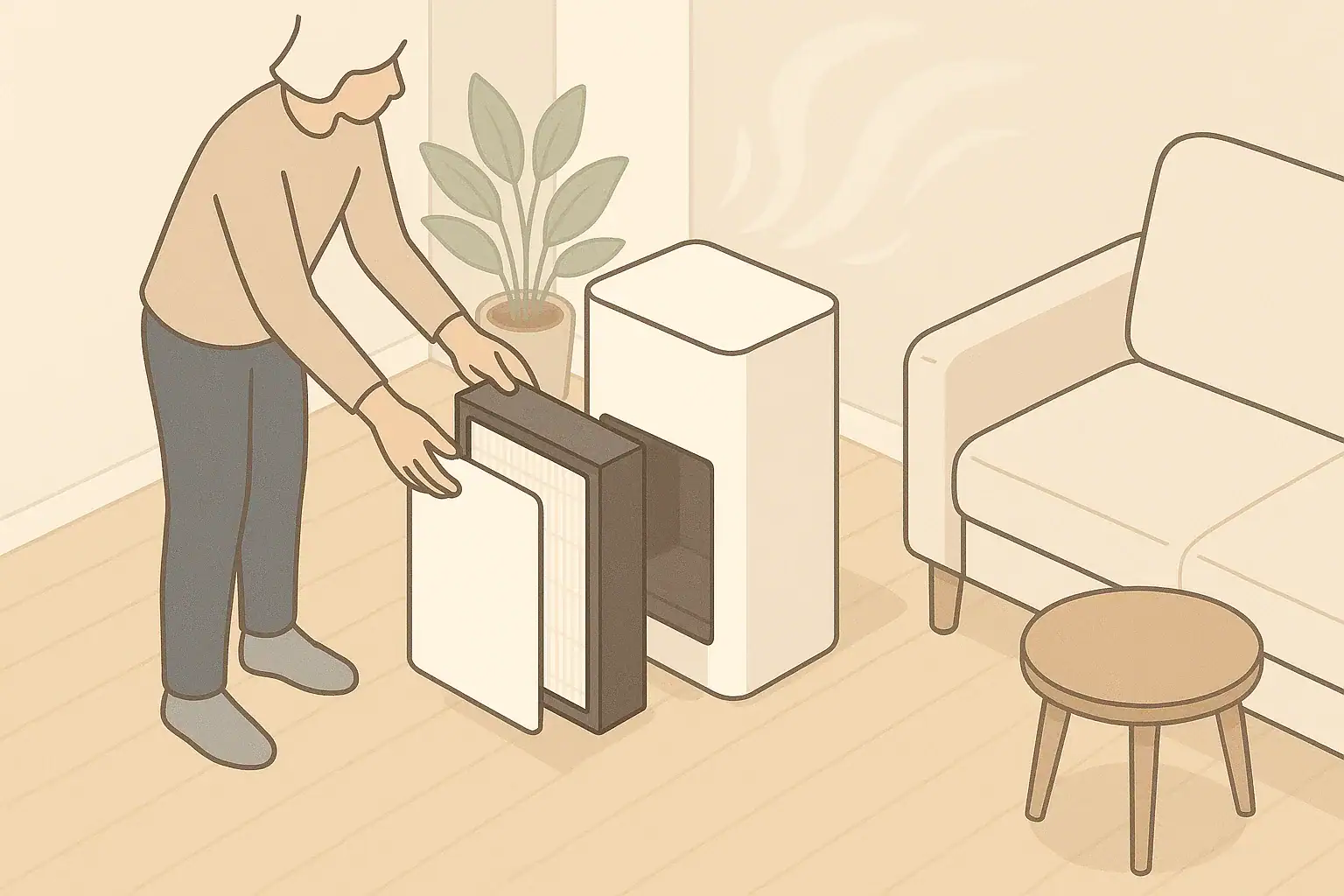
Filter replacement schedules for HEPA, carbon, and pre-filters are based on typical time ranges, visible wear, and changes in airflow or odor, rather than one fixed rule for every home.
Indoor air and usage patterns differ from home to home, so manufacturer guidance is only a starting point. You can refine your schedule by watching for reduced airflow, more dust on surfaces, and lingering smells. This article explains typical ranges and simple checks so you can plan replacements without guessing or wasting filters.
- HEPA filters: often about 12–18 months of use, shorter (6–12 months) in dusty or smoky conditions.
- Carbon filters: commonly 6–12 months, or sooner if odors return or VOC sources are constant.
- Pre-filters: clean every 2–4 weeks and replace 3–6 months, depending on dust and pet hair.
- Continuous 24/7 operation usually shortens all filter lifespans compared with occasional use.
- Watch for signs: reduced airflow, more dust buildup, or persistent odors despite running the purifier.
What Filter Replacement Schedules Mean and Why They Matter
Filter replacement schedules are guidelines for how long HEPA, carbon, and pre-filters can reasonably perform before their efficiency or airflow drops. They are not strict expiration dates but practical planning tools.
In a typical home, filters gradually load with particles and gases. As this happens, two things change:
- Airflow resistance increases, so the purifier may move less air and become noisier on higher speeds.
- Filtration capacity decreases, especially for gas and odor filters that rely on limited adsorption sites.
Replacing filters on an appropriate schedule helps you keep:
- More consistent particle reduction (dust, smoke, pet dander).
- More consistent odor/VOC reduction when carbon is present.
- Reasonable energy use and noise, because the fan does not have to work as hard to push air through clogged media.
A schedule is most useful when it combines the manufacturer’s time estimate with what you observe in your actual environment.
Key Concepts: HEPA, Carbon, and Pre-Filters Explained
Understanding the job of each filter stage makes it easier to decide when to clean or replace it.
HEPA filters: fine particle workhorse
“True HEPA”HEPA (High Efficiency Particulate Air) filters are dense fiber media designed to capture fine particles such as dust, smoke, and many airborne allergens. In consumer air purifiers, you may see “True HEPA” or grades like H13 or H14, which indicate high capture efficiency for small particles under standardized test conditions.
Key points for replacement:
- HEPA filters do not usually wash well; water or detergents can damage fibers or create paths where air bypasses the media.
- They slowly load with particles, increasing resistance and making fans work harder over time.
- Typical replacement guidance in homes is about 12–18 months, with shorter intervals in heavy-use or high-pollution situations.
Carbon filters: odor and VOC reduction
Activated carbon filters use a porous carbon material to adsorb many odor-causing molecules and some volatile organic compounds (VOCs). Their capacity is finite: once filled, they no longer significantly reduce odors or certain gases.
Key points for replacement:
- Performance depends strongly on gas concentration, airflow rate, and carbon amount in the filter.
- Once saturated, carbon will not work effectively, even if it still looks clean.
- Many homes benefit from replacing carbon filters every 6–12 months, or when odors return more quickly after running the purifier.
Pre-filters: first line of defense
Pre-filters are coarse filters or screens that capture larger particles such as hair, lint, and larger dust before they reach the HEPA and carbon stages. They protect the more expensive filters and help maintain airflow.
Key points for replacement or cleaning:
- Many pre-filters are designed to be washed or vacuumed regularly.
- Heavily loaded pre-filters can sharply reduce airflow, even if HEPA and carbon are still usable.
- Typical routine: check and clean every 2–4 weeks, replace every 3–6 months or when damaged or permanently discolored.
| Filter type | Main job | Typical focus for replacement | Example home interval range |
|---|---|---|---|
| HEPA | Fine particles (dust, smoke, pollen) | Airflow resistance and visible loading | About 12–18 months |
| Activated carbon | Odors and some VOCs | Odor breakthrough and hours of use | About 6–12 months |
| Pre-filter (washable) | Hair, lint, coarse dust | Visual dust buildup | Clean every 2–4 weeks |
| Pre-filter (replaceable) | Hair, lint, coarse dust | Clogging or damage | About 3–6 months |
| Combination HEPA/carbon | Particles and odors in one piece | Balance between airflow and odor control | About 9–15 months |
| Specialty gas filter | Specific gases (e.g., higher VOC loads) | Change in odor or irritation cues | Highly variable by use |
Example values for illustration.
Common Mistakes and Signs Filters Need Attention
Many homeowners either change filters too late, reducing effectiveness, or far too early, increasing costs. Recognizing common mistakes can help you avoid both extremes.
Relying only on the calendar
Calendar schedules (for example, “replace every 12 months”) are convenient but ignore real-world variation. A purifier running 24/7 near a busy road may load a HEPA filter much faster than one used a few hours a day in a relatively clean environment.
Use the calendar as a starting point, but adjust for:
- Daily run time and fan speed settings.
- Number of occupants and pets.
- Indoor activities such as cooking, smoking, or frequent use of sprays and cleaners.
- Outdoor air quality, especially wildfire smoke or nearby traffic.
Ignoring reduced airflow and rising noise
If the airflow feels weaker on the same fan setting compared with when the filter was new, or the purifier sounds like it is working harder, resistance may be increasing. A heavily loaded HEPA or pre-filter forces the fan to push against more backpressure.
Signs connected to airflow issues include:
- Dust staying in the air longer than before, even at the same setting.
- Needing to use a higher fan speed to get similar room freshness.
- Uneven air discharge from vents or grills due to partial clogging.
Expecting carbon to remove all smells indefinitely
Carbon filters do not have a visual cue for saturation, and they cannot remove every possible odor or gas. Once the adsorption sites are filled, additional operation will not significantly improve odor reduction, even if the filter looks clean and airflow is fine.
Typical signs to pay attention to include:
- Cooking or pet odors linger longer than they did shortly after installing a fresh carbon filter.
- Odors reappear soon after turning off the purifier, suggesting limited gas capacity.
- You need to run the purifier on higher speeds more often to get noticeable odor reduction.
Practical Filter Replacement Guidance and Checklist
A simple routine helps keep your filter schedule predictable and cost-aware while avoiding unnecessary replacements.
Monthly quick checks
- Inspect the pre-filter: Look for hair mats, lint layers, or visible dust coating. Clean or wash if allowed.
- Check airflow by feel: Place your hand near the outlet at a known fan setting and note whether it feels weaker than you remember.
- Scan for dust on nearby surfaces: If you are seeing more dust settling despite similar use, filtration may be declining.
Quarterly deeper checks (every 3 months)
- Open the unit safely: With power off and unplugged, remove the front or rear panel as directed in the manual.
- Visually inspect the HEPA filter: Look for significant gray or dark loading, patched clogs, or damage to pleats and gaskets.
- Inspect the carbon filter: Note any discoloration, dust buildup on the surface, or musty smell coming from the filter itself.
- Clean the housing: Wipe accessible inner surfaces with a dry or lightly damp cloth to remove dust that might bypass filters.
Yearly planning
Once a year, estimate how many hours your purifier has run and at what settings. Many households find it helpful to:
- Replace HEPA filters about once a year in moderate conditions, sooner in heavy use.
- Replace carbon filters once or twice a year, depending on odor load.
- Budget for a full filter set in advance to avoid delaying replacements.
Real-World Example Schedules for Different Homes
These scenarios show how the same filters might reasonably be replaced on different timelines, based on use and environment. They are examples, not strict rules.
Small apartment, light use
A single person in a small apartment runs a purifier on low for 8 hours a day, with no pets and limited cooking.
- Pre-filter: quick vacuum every month, replace every 6 months if not washable.
- HEPA: likely usable for 15–18 months, with airflow checks at 12 months.
- Carbon: 9–12 months, or earlier if odor control noticeably declines.
Family home with pets
A family of four with two shedding pets runs a purifier 16–24 hours per day near common areas.
- Pre-filter: clean every 2 weeks; replacement around every 3–4 months if non-washable.
- HEPA: 9–12 months, potentially sooner if visibly loaded with hair and fine dust.
- Carbon: 6–9 months, especially if used for pet odor control.
Seasonal wildfire smoke
A home in an area with seasonal wildfire smoke boosts purifier use during smoke events, often running on higher speeds.
- During smoke season: check pre-filters weekly; they can load quickly.
- HEPA: may require replacement after a single severe season if heavily darkened and airflow drops.
- Carbon: often benefits from replacement after the smoke season to restore odor and gas capacity.
Safety, Standards, and What Not to Do
Safe filter replacement is as important as staying on schedule. Follow the purifier manufacturer’s instructions and consider these general points:
- Power off and unplug before opening the unit or handling filters.
- Avoid washing non-washable filters: Moisture can damage HEPA fibers or promote unwanted microbial growth inside the media.
- Do not modify filters (cutting, taping together unrelated media, or using improvised materials) in ways the product was not designed for.
- Replace seals or gaskets if they are damaged, since leakage around a filter can allow air to bypass the media.
Some purifiers include optional technologies such as ionizers or UV-C lamps. If present, review the manual on how they interact with filters and how often lamp components should be replaced. If you prefer to avoid these features, many devices allow you to switch them off while still using mechanical filtration.
Maintenance, Costs, and Long-Term Planning
Planning ahead for filter maintenance helps smooth out costs and avoids long periods of reduced performance.
Budgeting for filter replacements
Different models use different filter sizes and combinations. In general:
- Estimate how many full sets of filters you will use per year (for example, one HEPA and two carbon filters).
- Remember the pre-filter cost if it is not washable or not intended to last the life of the unit.
- Account for heavier use seasons, such as wildfire season or high-pollen months, that may shorten intervals.
Coordinating with other home air strategies
Filters are one part of indoor air quality. Using them alongside other simple approaches can reduce how hard your filters have to work:
- Source control: Reduce smoke, candles, and heavy use of sprays indoors where practical.
- Ventilation: When outdoor air is reasonable, brief ventilation can dilute indoor pollutants.
- Humidity control: Keeping indoor humidity in a moderate range can help limit dust clumping and moisture-related issues.
Using indicators and air quality monitors
Some purifiers include filter-change indicator lights based on run time or airflow estimates. Treat these as prompts, not absolute rules. You can:
- Inspect the filter when the indicator activates and decide whether to replace immediately or schedule it soon.
- Use a simple PM2.5 monitor, if you have one, to see whether particle levels drop as expected when the purifier is on; a persistent lack of improvement may suggest filters are overdue or the unit is undersized.
Filter Replacement FAQs
Can I vacuum a HEPA filter instead of replacing it?
Some HEPA filters allow gentle surface vacuuming to remove loose dust, but this usually does not restore original performance and may damage delicate fibers if done aggressively. Always check the manual. Even if vacuuming is permitted, plan on regular replacement within a typical time range.
How do I know if a pre-filter is still working after washing?
If a washed pre-filter holds its shape, has no tears, and air passes through it easily, it is probably still functioning as intended. If it becomes misshapen, stiff, or starts to fray, it may be time to replace it to avoid bypass or uneven airflow.
Is it better to replace HEPA and carbon at the same time?
Many homeowners replace both together for convenience, especially when they are combined in one cartridge. If the filters are separate, you can sometimes replace carbon more often than HEPA, particularly when odor control is a priority. Aligning replacements can make budgeting and tracking simpler.
What if I rarely use my purifier?
If the purifier runs only occasionally, filters load more slowly. However, dust can still settle on media over time, and some materials may age. A reasonable approach is to inspect at least annually, and replace if the filters look heavily loaded, damaged, or have been installed for several years, even with low run time.
Do more expensive filters always last longer?
Higher cost can reflect more media area or specialty materials, but price alone does not guarantee longer life. Lifespan mainly depends on design, how much media is present, and how challenging your indoor environment is. Use the recommended intervals, visible condition, and your air quality observations together to decide.
| Filter type | Typical interval range | What changes it most | Reminder idea |
|---|---|---|---|
| HEPA | About 12–18 months | Hours of use, smoke or dust events | Annual calendar reminder plus smoke-season check |
| Carbon | About 6–12 months | Cooking, pets, chemical odors | Replace when odors linger despite normal use |
| Washable pre-filter | Clean every 2–4 weeks | Pet hair, visible dust buildup | Monthly cleaning note on calendar |
| Replaceable pre-filter | About 3–6 months | Shedding pets, vacuuming frequency | Coordinate with seasonal house cleaning |
| Combined HEPA/carbon cartridge | About 9–15 months | Odor load and fine particles together | Replace when airflow drops or odor control weakens |
| Specialty gas filter | Highly variable | Specific VOC sources and run time | Follow manufacturer guidance plus odor cues |
Example values for illustration.
Related guides: How Often Should You Replace a HEPA Filter? • When to Replace Carbon Filters (And How to Tell They’re Spent) • Filter Replacement Cost Calculator: Annual HEPA + Carbon Budget
Summary: Building a Filter Schedule That Fits Your Home
Effective filter replacement schedules combine general time ranges with what you observe in your living space. HEPA filters usually last around a year or more in typical homes, carbon filters often benefit from being replaced at least annually for consistent odor control, and pre-filters need frequent cleaning to protect the more expensive stages.
By checking airflow, watching for dust and odors, and planning ahead for costs, you can keep your HEPA, carbon, and pre-filters working steadily without over-replacing them. Over time, you will learn how quickly filters load in your specific home and can fine-tune the schedule to match your air quality needs and usage patterns.
Frequently asked questions
How often should I replace HEPA filters if I have shedding pets?
If you have shedding pets and run the purifier most of the day, expect to replace HEPA filters closer to 9–12 months; in heavy hair or dust conditions check at 6–9 months. Regularly cleaning the pre-filter every 1–2 weeks helps extend HEPA life by removing hair before it reaches the HEPA stage.
Can I wash or vacuum an activated carbon filter to restore odor removal?
No — washing or vacuuming carbon rarely restores adsorption capacity because odor removal depends on internal adsorption sites rather than surface dust. Light surface vacuuming may remove dust but will not recharge the carbon; replace carbon filters when odor breakthrough occurs.
What signs indicate a carbon filter is saturated even if it looks clean?
Typical signs include cooking, pet, or smoke odors returning sooner than when the filter was new and needing higher fan speeds to get the same odor reduction. Because carbon saturation has no clear visual cue, use odor persistence and reduced odor-control performance as triggers for replacement.
How should I maintain pre-filters during seasonal wildfire smoke events?
During smoke events check and clean washable pre-filters weekly because they can load quickly with soot and ash; non-washable pre-filters may need replacement every few weeks. Inspect HEPA and carbon after the season—HEPA may darken and carbon can lose capacity—so plan post-season replacements as needed.
Is it okay to replace HEPA and carbon filters at different intervals?
Yes. If the purifier uses separate cartridges, you can replace carbon more frequently for odor/VOC control while keeping HEPA until airflow resistance indicates it’s time; replacing both together is convenient but not required.
Recommended next:
- Clear sizing logic (room size → CADR/ACH)
- HEPA vs carbon explained for real use-cases
- Humidity + ventilation basics to reduce mold risk