
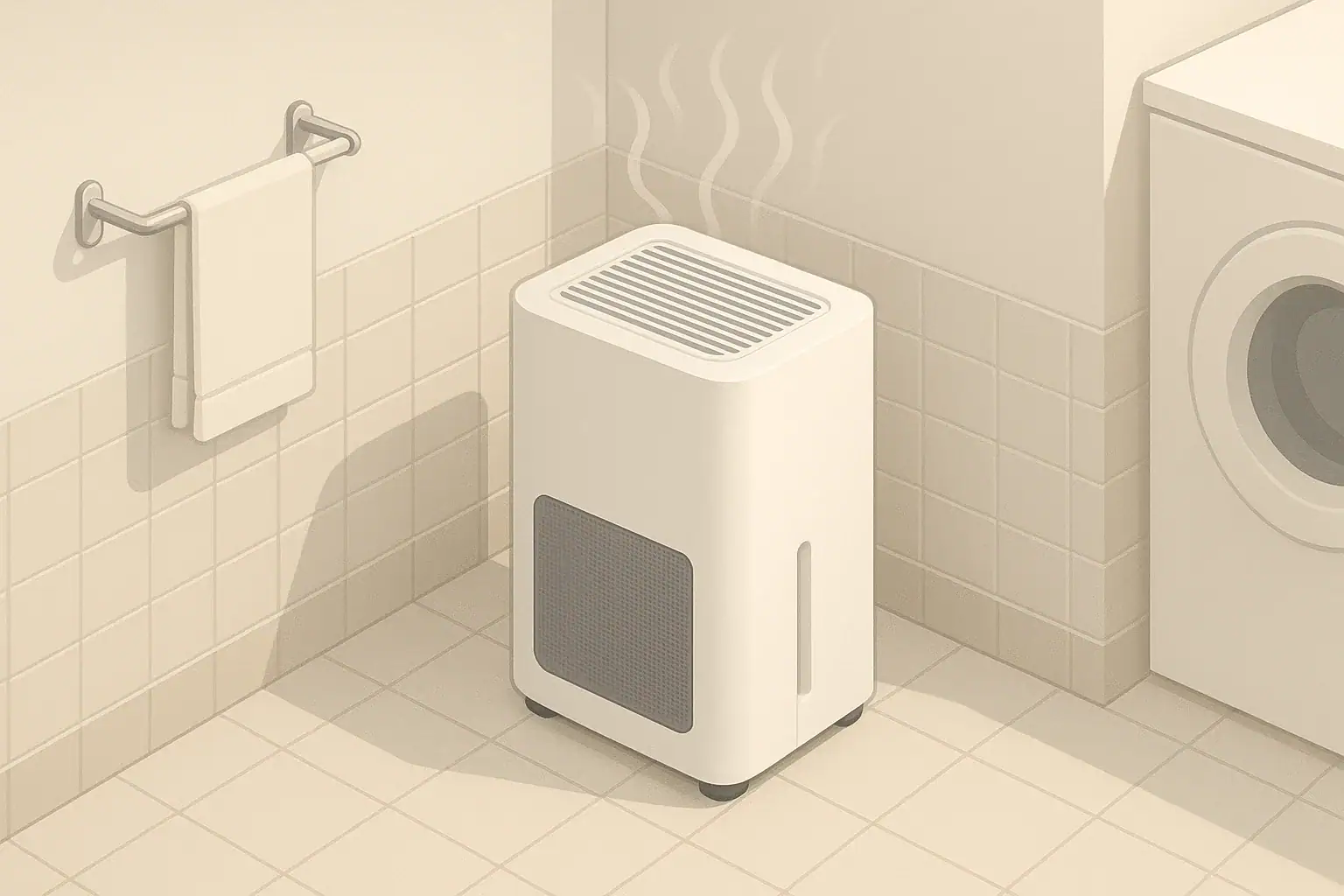
Dehumidifier sizing in liters per day depends mainly on room size, room type, and how damp the space is to begin with.
Getting the capacity right helps keep indoor humidity in a comfortable range, reduce musty odors, and protect materials, without wasting energy on an oversized unit. This article explains how to estimate the right liters-per-day rating using simple steps and example ranges you can adapt to your home.
- For a small bedroom (up to ~150 sq ft) mildly damp, many people find around 8–12 L/day often sufficient.
- For a medium living room (~150–300 sq ft) that feels damp, example needs are around 12–20 L/day.
- For a large basement or open area (>400 sq ft) with clear moisture issues, example ranges are 20–30+ L/day.
- Use higher capacity if you have visible condensation, musty odor, or laundry drying indoors.
- Use lower capacity if the room is only slightly humid and already has some ventilation.
- These are general examples only; actual needs depend on climate, insulation, and moisture sources.
Why Dehumidifier Sizing Matters for Indoor Comfort
Dehumidifiers remove moisture from indoor air and are rated by how many liters of water they can remove in 24 hours under standardized test conditions. If the unit is too small, humidity may stay high, leading to clammy air, musty smells, and more condensation on cool surfaces. If it is too large, you may pay more than necessary and cycle the unit on and off more often.
In most U.S. homes, a relative humidity (RH) target around 40–50% is commonly used for comfort and to help limit excess moisture. Sizing to keep humidity roughly in this range is usually more important than hitting an exact number. Room type (bedroom vs basement), typical moisture sources (showers, cooking, laundry), and local climate all influence how much moisture a dehumidifier needs to handle.
Key Sizing Concepts: Liters/Day, Room Type, and Dampness
Dehumidifier sizing uses three main ideas: capacity (liters per day), the space you are treating, and how damp that space is. Thinking through each of these helps you choose an approximate size without complicated calculations.
1. Capacity in liters per day
Manufacturers usually express dehumidifier capacity in liters per day (L/day) or pints per day (pt/day). The bigger this number, the more moisture the unit can remove under test conditions. Actual performance at home depends on temperature, humidity level, and how the room is used, so capacity is best treated as a rough planning number, not a guarantee.
As a very general orientation:
- Small units: roughly 5–10 L/day – suited to small bedrooms, offices, or closets with mild dampness.
- Medium units: roughly 10–20 L/day – often used for typical living rooms, small basements, or laundry areas.
- Larger units: roughly 20–30+ L/day – often chosen for basements, large open spaces, or more severe dampness.
These ranges are examples only; always adjust up or down based on your specific conditions.
2. Room size and layout
Room area, ceiling height, and layout strongly affect dehumidifier sizing. A small enclosed bedroom retains moisture differently than a large open-plan living room. When you estimate the size of your space, note:
- Floor area: Measure approximate length × width in feet (or meters) to understand the size category of your room.
- Ceiling height: Higher ceilings mean more air volume, which may justify a slightly higher capacity.
- Open-plan or connected rooms: Air flows between connected spaces, so a single unit may effectively serve more than one room if doorways are large and air circulation is good.
3. Dampness level (how wet is the space?)
How the space feels and looks is just as important as its size. You can categorize dampness with simple observations:
- Slightly humid: Air feels a bit clammy in warm weather; perhaps minor odor after rain; little or no visible condensation.
- Damp: Frequent musty smell, light condensation on windows or cool surfaces, fabrics may feel slightly damp.
- Very damp: Noticeable moisture on walls or floors, frequent condensation, stored items feel damp, possible visible mold growth in some areas.
The more severe these signs, the larger the capacity you should consider for the same room size.
| Checklist item | Why it matters | Notes when sizing |
|---|---|---|
| Room type (bedroom, basement, bath, laundry) | Different rooms have different moisture sources | Basements and laundry rooms usually need higher capacity |
| Approximate floor area | Larger rooms contain more humid air volume | Up-size capacity as room area increases |
| Ceiling height | Higher ceilings increase air volume | Consider moving up one size for very tall rooms |
| Dampness level (slight, damp, very damp) | More moisture load requires more removal per day | Choose higher L/day in very damp spaces |
| Moisture sources (showers, cooking, leaks) | Internal sources can overwhelm small units | Address leaks and standing water before sizing |
| Ventilation and air leakage | Outdoor air can add or remove moisture | Poorly ventilated rooms often need more capacity |
| Desired humidity range | Lower targets require more moisture removal | Targets near 40% usually need higher capacity than near 50% |
Example values for illustration.
Common Sizing Mistakes and How to Spot Them
Many sizing problems show up as lingering dampness or inefficient operation. Recognizing these patterns can help you adjust capacity or usage.
Undersized dehumidifier symptoms
- Humidity readings stay above your target (for example, consistently above about 55–60% RH) even with long run times. li>Musty odors persist after several days of operation.
- Condensation still appears on windows or cool surfaces in the treated area.
- The water bucket fills quickly, but the room still feels damp.
If these occur, you may need either a higher-capacity unit, additional units, or changes to moisture sources or ventilation.
Oversized dehumidifier trade-offs
- Unit reaches target humidity quickly and cycles on and off frequently.
- Noise may be more noticeable than needed for a given room.
- Initial cost and potential energy use may be higher than warranted for the space.
While having somewhat more capacity than you strictly need is usually fine, sizing far beyond your requirements can be inefficient and less comfortable in quiet spaces like bedrooms.
Ignoring room type and moisture sources
Using a small bedroom-sized dehumidifier to dry a basement with frequent bulk water intrusion, or a busy laundry room with hanging clothes, often leads to poor results. Address obvious moisture sources (such as leaks, poor drainage, or unvented dryers) as part of the overall plan. Dehumidifiers are most effective when they are dealing with airborne moisture rather than liquid water problems.
Step-by-Step: How to Estimate Dehumidifier Size
You can match dehumidifier capacity to your space using a simple four-step process. This approach uses liters per day as a practical planning number and applies regardless of brand.
Step 1: Identify room type and use
Start by categorizing the room:
- Sleeping areas: bedrooms, nurseries, guest rooms – typically smaller, lower moisture load.
- Living spaces: living rooms, family rooms, home offices – moderate size, occasional higher occupancy.
- Moisture-heavy rooms: bathrooms without strong exhaust, laundry rooms, indoor drying areas, basements.
Moisture-heavy rooms usually need higher capacity than sleeping or living rooms of the same size.
Step 2: Estimate size category
Next, group your space into a rough size category (using square feet as an example):
- Small room: Up to about 150 sq ft.
- Medium room: About 150–300 sq ft.
- Large room: About 300–500 sq ft.
- Very large or open area: More than about 500 sq ft or multiple connected rooms.
Adjust upward for high ceilings or very open layouts, since those increase air volume.
Step 3: Decide how damp the room is
Use your observations to rate the space:
- Mildly humid: Slightly sticky or heavy air at times; no clear visible moisture problems.
- Damp: Frequent mild musty odor, light condensation, or damp feeling on fabrics or walls.
- Very damp: Regular condensation, damp materials, or clearly visible mold patches in some areas.
The more severe the dampness, the more liters per day you will generally want.
Step 4: Match to example capacity ranges
Combine room type, size, and dampness to land on a realistic example range. The numbers below are planning examples, not strict rules:
- Small bedroom (~100–150 sq ft), mildly humid: often about 8–12 L/day.
- Medium living room (~200–300 sq ft), damp: often about 12–20 L/day.
- Large or partially finished basement (~400–700 sq ft), very damp: often about 20–30+ L/day.
You can also adjust for climate. In humid regions, lean toward the higher end of each range. In dry climates, closer to the lower end may be sufficient.
Example Scenarios: From Bedroom to Basement
Walking through a few real-world style scenarios can help illustrate how these principles play out in everyday homes. These are generalized examples meant to help you think through your own situation.
Scenario 1: Small upstairs bedroom
A 120 sq ft bedroom in a reasonably well-insulated house feels a bit stuffy in summer. There is no visible condensation or musty smell, but a humidity monitor often reads above 55–60% RH when the weather is humid.
This room is small, used mainly for sleeping, and only mildly humid. Many people in this situation would consider something in the lower range, around 8–12 L/day, combined with occasional window ventilation when outdoor conditions allow.
Scenario 2: Open-plan living/dining area
A 350 sq ft open-plan living and dining space with average ceiling height hosts family activities and occasional indoor plants. After rainy days, windows sometimes show a bit of fog, and there is a faint musty odor near an exterior wall.
This is a medium-to-large, moderately damp living area. A medium-sized unit in the neighborhood of 12–20 L/day can be reasonable, placed centrally with good airflow around it. Improving insulation or sealing drafts at the problem wall can further reduce moisture load.
Scenario 3: Partially finished basement
A 600 sq ft basement with concrete floors feels cool and clammy most of the year. Cardboard boxes feel damp to the touch, and there is regular condensation on metal surfaces. Laundry is sometimes dried on racks down there.
This basement is clearly very damp, with additional moisture introduced by drying clothes. In this case, many homeowners would lean toward larger capacities in the range of 20–30+ L/day and might also use more than one unit if the layout is segmented. Addressing any water seepage, improving drainage, and venting laundry appliances are also important.
Safety, Standards, and Interaction With Other Air Equipment
Most residential dehumidifiers simply condense water from the air and do not intentionally produce ozone or other reactive gases. However, some devices marketed for air treatment may include additional functions such as ionization or UV-C lights. Neutral, cautious use is appropriate.
- Ozone-producing devices: For typical homes, it is generally advisable to avoid intentional ozone generation. Standard condensing dehumidifiers do not rely on ozone.
- Ionizers and UV-C: If included in a combined device, they should be used according to manufacturer guidance. They are not required for dehumidification and can usually be disabled if you prefer simple moisture control.
- Electrical safety: Place dehumidifiers on stable surfaces, keep cords away from standing water, and use appropriate outlets. Avoid modifying internal components or bypassing safety features.
- Drainage and overflow: If using a continuous drain hose, ensure it slopes correctly and discharges where it will not cause water damage.
When operating a dehumidifier in the same space as an air purifier, there is usually no conflict. The dehumidifier controls moisture, while the purifier focuses on particles and sometimes gases. Both may improve comfort in different ways, but they serve different functions.
Maintenance and Operating Tips That Affect Sizing
Maintenance and how you run the dehumidifier can greatly influence real-world performance. A well-maintained, correctly used medium unit can sometimes outperform a neglected larger unit.
Keep filters and air pathways clear
- Clean the air filter regularly according to the manual. A clogged filter reduces airflow and water removal.
- Ensure clear space around the unit (often a foot or more on each side is suggested by many manufacturers) so air can circulate freely.
Use humidity settings wisely
- Set a realistic target, often in the 40–50% RH range for general comfort. Very low targets can increase run time with little additional benefit in many homes.
- Allow continuous operation during wet weather or in consistently damp areas such as basements.
Drainage, placement, and energy
- Empty the bucket promptly or use a drain hose if available so the unit does not shut off early.
- Place the unit away from walls or furniture that would block air intake or exhaust.
- Consider energy impact when choosing capacity. Larger units may remove moisture faster, but they can also draw more power; finding a reasonable match to your needs is usually most efficient.
Humidity and Mold Risk: Quick Planning Table
While dehumidifiers are not a stand-alone solution for all moisture issues, they can play a key role in keeping humidity in a range that makes mold growth less likely on many indoor surfaces. The table below provides a simple planning overview.
| Goal range (RH example) | Simple actions | Tools to consider | Notes |
|---|---|---|---|
| Around 30–40% in cold weather | Limit indoor drying, vent bathrooms and cooking, reduce indoor water use where practical | Dehumidifier in basements, exhaust fans in baths and kitchens | Avoid going too low to prevent overly dry air for comfort |
| Around 40–50% in mild weather | Use cross-ventilation when outdoor air is not too humid, run dehumidifier as needed | Room dehumidifier sized to room type and dampness | Common comfort range in many homes |
| Below about 55–60% in humid seasons | Close windows during very humid periods, control indoor moisture sources | Basement or whole-floor dehumidifiers | Helps limit conditions where mold more easily thrives |
| Reducing high peaks after events | Run dehumidifier longer after showers, cooking, or indoor laundry | Timer or continuous mode on dehumidifier | Helps prevent prolonged dampness after moisture spikes |
| Addressing chronic damp spots | Check for leaks, improve drainage, seal cracks or gaps | Dehumidifier plus basic home repairs | Fixing moisture sources usually improves dehumidifier effectiveness |
| Monitoring over time | Track seasonal RH changes in key rooms | Simple hygrometer or indoor air quality monitor | Helps refine dehumidifier size and run-time decisions |
Example values for illustration.
Related guides: How to Size a Dehumidifier (Sq Ft, Pints/Day, and Real-World Tips) • Dehumidifier Running Cost: How Much Electricity Will It Use? • Desiccant vs Compressor Dehumidifiers: Which Is Better for Cold Rooms?
Summary: Matching Dehumidifier Size to Your Space
Dehumidifier sizing in liters per day is mainly about three factors: room type, room size, and how damp the area is. Small, mildly humid bedrooms often need only modest capacity, while larger, very damp basements usually benefit from stronger units or multiple units.
By observing your space, categorizing its dampness, and comparing it with the example ranges in this article, you can narrow down a practical capacity without relying on guesswork. Combined with basic moisture control and ventilation practices, a reasonably sized dehumidifier can help keep indoor humidity in a comfortable and manageable range.
Frequently asked questions
How do I estimate the liters-per-day capacity I need for a specific room?
Measure the floor area and note ceiling height, then categorize the room by use (bedroom, living area, basement) and dampness (mild, damp, very damp). Match those observations to the example capacity ranges in the article—upsize for higher dampness, high ceilings, or poor ventilation.
Should I increase liters per day for high ceilings or open-plan layouts?
Yes. Higher ceilings increase the air volume to treat, and open-plan or connected rooms allow moisture to move across a larger area, so choose a higher-capacity unit or multiple units to ensure adequate moisture removal.
Can a single dehumidifier serve multiple connected rooms effectively?
Sometimes a single unit can work for multiple connected rooms if doorways are wide and airflow is good, but effectiveness drops with closed doors, segmented layouts, or different moisture sources. In larger or compartmentalized spaces, multiple units or a higher-capacity central solution may be needed.
How do I convert liters per day to pints per day?
To convert liters per day to pints per day (using U.S. pints), multiply liters by about 2.11. This gives a quick approximate conversion when comparing specifications that use different units.
Will a dehumidifier fix problems caused by leaks or standing water?
No. Dehumidifiers remove airborne moisture but are not a substitute for repairing leaks, improving drainage, or removing standing water. Fixing bulk water problems is a necessary first step; dehumidification helps control residual airborne humidity after those issues are addressed.
Recommended next:
- Clear sizing logic (room size → CADR/ACH)
- HEPA vs carbon explained for real use-cases
- Humidity + ventilation basics to reduce mold risk