
What is a HEPA filter made of?
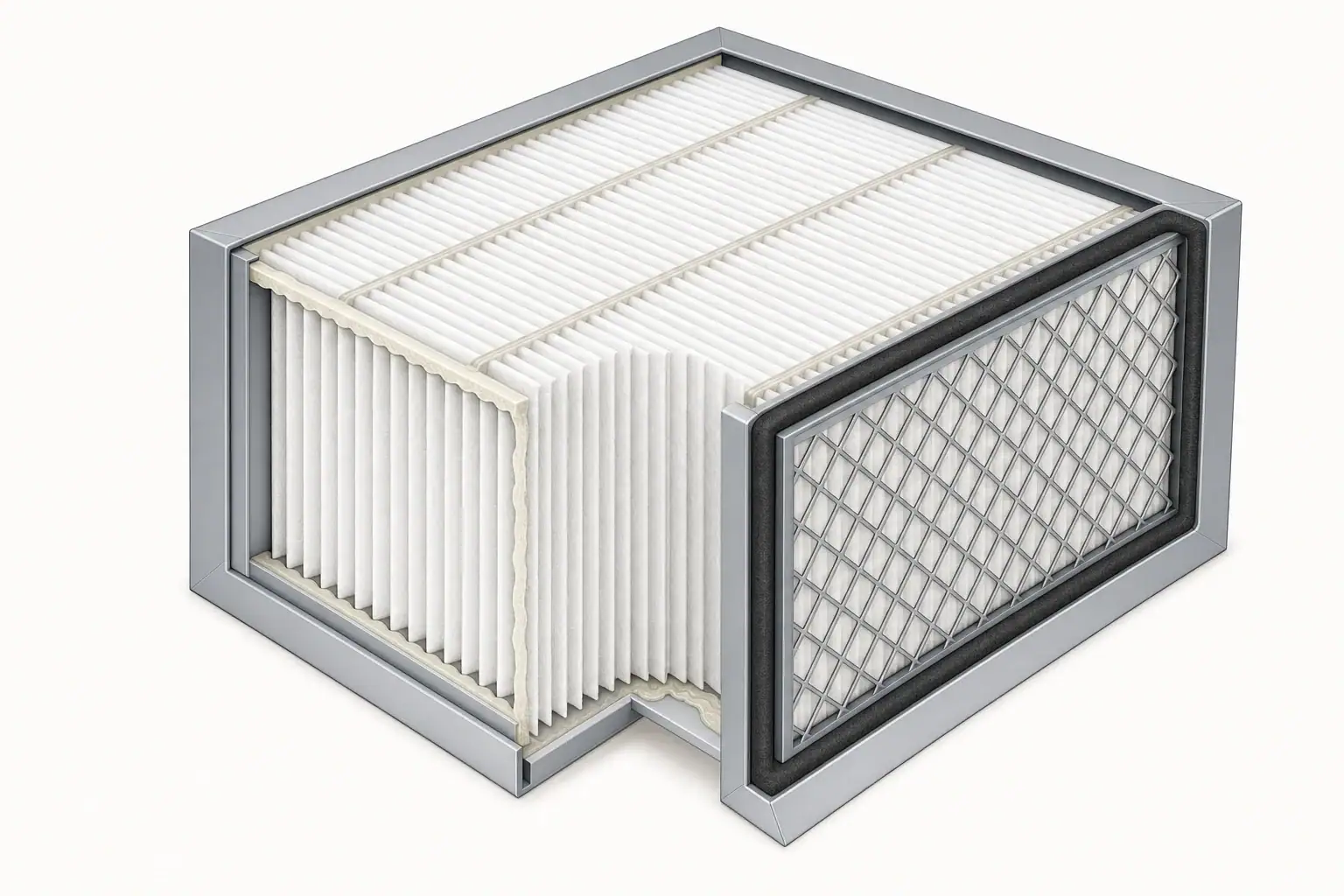
A HEPA filter is not one material. It is a filter assembly centered on a sheet of very fine filter media folded into pleats. The media may be microglass, polymeric material, or a membrane-based material, depending on the design. The filter pack is supported by spacing features and a frame, then sealed at its edges and at the mounting surface.
The U.S. Environmental Protection Agency describes HEPA as a pleated mechanical air filter and gives the familiar U.S. benchmark of at least 99.97% removal of 0.3-micron particles. That is a performance description, not a required recipe for the filter’s fibers, frame, or seals.
HEPA filter components and common materials
| Component | Common documented materials | Function | Buyer-visible clue |
|---|---|---|---|
| Filter medium | Microglass or borosilicate glass-fiber paper; polymeric media; fluororesin membrane | Forms the particle-filtering layer | A specification field called “media” or “media type” |
| Pleats | Folded filter medium, rather than usually a separate material | Packs more filtering surface into the frame and creates air passages | Visible zigzag folds or a stated pleat configuration |
| Separators or pleat spacers | Corrugated aluminum, hot-melt beads, glass-fiber string, or formed media corrugations | Maintains space between adjacent pleats | “Separator,” “mini-pleat,” or “separatorless” in specifications |
| Frame or case | Plastic, aluminum, galvanized steel, stainless steel, or wood in some applications | Supports and protects the filter pack and provides a mounting shape | Frame material listed in a data sheet or visible around the pack |
| Pack sealant | Polyurethane, silicone, or ceramic compounds | Bonds the media pack to the frame and closes the pack-to-frame joint | “Sealant,” “adhesive,” or “potting compound” in specifications |
| Perimeter gasket or gel seal | Polyurethane foam, neoprene, silicone, or a gel-seal system | Seals the finished filter to its housing or mounting frame | A foam strip, gasket profile, gel trough, or knife-edge notation |
| Protective face layer | Expanded or perforated metal, wire cloth, or a plastic grid | Helps protect the exposed media face from handling damage | “Face guard,” “screen,” or “protection grid” |
These are options, not a universal bill of materials. The DOE Nuclear Air Cleaning Handbook describes the construction roles of pleated media, separators, rigid cases, pack sealants, and mounting gaskets. It addresses nuclear air-cleaning systems, so its application-specific requirements should not be treated as specifications for every home air-cleaner replacement filter.
A Camfil HEPA construction guide documents multiple media, frame, separator, sealant, and gasket options. The actual combination is model- and application-specific.
Are all HEPA filters made from fiberglass?
No. Fine glass-fiber media, often called microglass, is an established HEPA-media construction, but it is not the only one. Some HEPA filters use polymeric media or fluororesin membrane media. For example, AAF identifies expanded fluororesin membrane media in its MEGAcel I product documentation.
So “HEPA” and “fiberglass” are not interchangeable terms. Broad descriptions such as “synthetic,” “polymer,” or “membrane” also do not reveal the complete formula or construction. If media composition matters for a particular purchase, use that model’s technical documentation rather than relying on a product photo.
A carbon sheet, washable prefilter, foam layer, or protective mesh may be included in a multi-layer replacement filter, but it is not automatically the HEPA medium. Product documentation should identify the layers separately. For the distinct roles of particle media and carbon, see HEPA vs. activated carbon filters.
Why the medium is pleated and spaced
Pleats are folds in the filter medium itself. Folding lets a larger area of medium fit within a compact frame while leaving channels for air to travel between the folds.
Those channels need to remain open. Traditional designs may use corrugated separators. Compact mini-pleat designs can use hot-melt spacing beads, glass-fiber strings, or corrugations formed in the media. The DOE handbook describes both separator-supported packs and separatorless arrangements with formed corrugations. These features support the pleats so neighboring folds are less likely to press together and obstruct the intended air passages.
Pleat appearance alone cannot verify that a filter is HEPA. A visible fold count or a particular media thickness does not disclose how the completed filter performed in testing.
Frame, pack sealant, gasket, and face guard: different jobs
- Frame or case: The structural border that holds the filter pack and provides its installation shape.
- Pack sealant: Material inside the assembly that joins the media pack to the frame and closes that joint.
- Gasket: A compressible perimeter material that seals the installed filter against a housing or mounting frame.
- Gel seal: A mounting arrangement in which a mating knife edge enters a gel-filled channel. It is generally associated with purpose-built housings rather than ordinary portable air-cleaner filters.
- Face guard: A grid or screen that helps protect fragile media during handling; it is not the filtering medium itself.
Together, these parts give the media support, preserve pleat spacing, and help direct air through the filter pack. Their presence does not, by itself, establish the finished filter’s performance.
Why material names cannot prove HEPA performance
A label that says “microglass,” “polypropylene,” or “membrane” identifies a material family, not a verified whole-filter result. The finished assembly also includes the frame, pack-to-frame seal, and mounting interface.
When a product makes a HEPA performance claim, look for documentation tied to the specific model. Useful details include the claimed efficiency and particle size, the test method or standard, the test airflow, and whether the result applies to the complete filter. The DOE standard for covered nuclear-grade HEPA filters requires production testing and traceable documented results for its scope. It does not automatically apply to retail consumer filters, but it illustrates why materials lists are not substitutes for finished-filter test evidence.
Label and document checklist
| Construction details worth checking | Performance claims that need supporting documentation |
|---|---|
| Specific media type, if disclosed | Claimed efficiency and associated particle size |
| Frame material and dimensions | Named test method or applicable standard |
| Separator, mini-pleat, or separatorless construction | Airflow used during testing |
| Pack sealant or adhesive type | Airflow resistance stated at a stated airflow |
| Gasket material or gel-seal configuration | Whether results apply to media only or the completed filter |
| Face guard or protective screen | Model, lot, serial number, or report traceability where provided |
Construction details can help a buyer assess fit, handling features, and material compatibility. They should not be read as proof of HEPA performance. Conversely, a performance claim may reveal little about the media formula, frame, or gasket unless the manufacturer publishes those specifications.
Summary
A HEPA filter is a multi-part assembly built around pleated fine-fiber or membrane media. Microglass is common, but it is not mandatory. Spacing features preserve airflow channels, the frame supports the pack, sealant closes the pack-to-frame joint, and a gasket or gel system seals the installed filter. Verify a HEPA claim with model-specific performance documentation rather than judging it by fiber type, thickness, or pleat appearance.
Frequently asked questions
Is a carbon layer part of the HEPA filter medium?
Not necessarily. A carbon sheet may be included in a filter assembly for a separate purpose, while the HEPA medium is the fine-fiber or membrane layer intended for particle filtration. Check the model documentation to see whether carbon, a prefilter, and the HEPA medium are identified as separate layers.
What is the difference between pack sealant and a gasket?
Pack sealant is inside the filter assembly: it bonds the pleated media pack to the frame and closes the pack-to-frame joint. A gasket is at the outer perimeter and seals the installed filter against its housing. They seal different interfaces.
Can I tell whether a filter is HEPA by looking at its pleats?
No. Pleats and a protective grid can be visible construction features, but they do not demonstrate finished-filter performance. Check model-specific documentation for the stated efficiency, particle size, test method, and test conditions.
Recommended next:
- True HEPA vs HEPA-Type: What the Labels Really Mean
- HEPA H13 vs H14: Differences, Efficiency, and When It Matters
- How Often Should You Replace a HEPA Filter?
- Do HEPA Filters Remove Viruses, Bacteria, and Allergens?
- HEPA Filter Grades Explained: E10–E12 vs H13–H14
- HEPA Filter Label Claims: How to Check the Evidence
- Clear sizing logic (room size → CADR/ACH)
- HEPA vs carbon explained for real use-cases
- Humidity + ventilation basics to reduce mold risk