
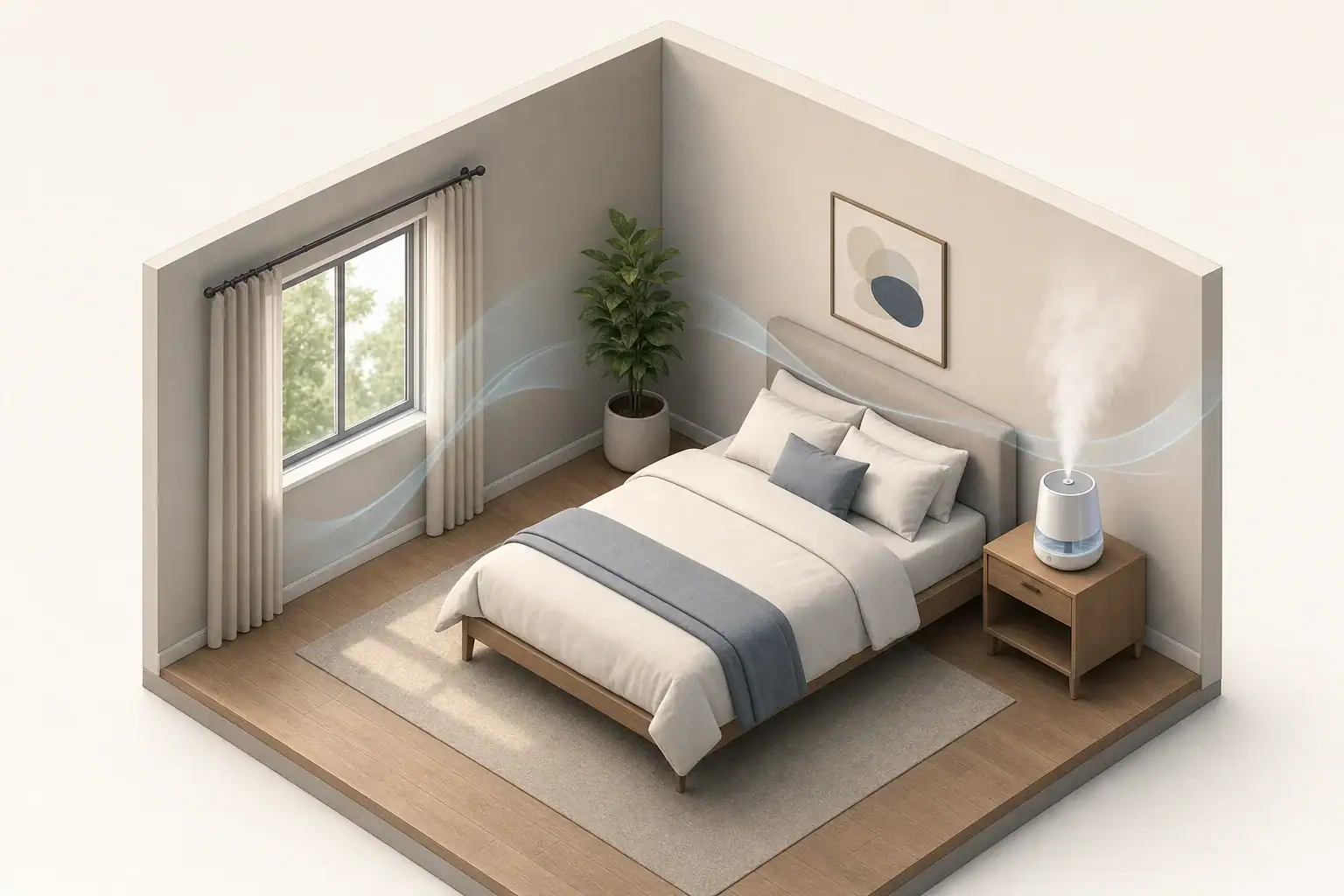
Running a humidifier all night can be appropriate when indoor air is dry, provided humidity stays controlled and the unit is cleaned and positioned correctly.
The main goal is not maximum moisture output but a stable, comfortable indoor relative humidity. A hygrometer, automatic humidistat, and consistent cleaning routine can help prevent excessive dampness, mineral residue, and contamination.
Quick answer
- Aim for about 30%–50% relative humidity as general household guidance.
- Reduce output if windows, walls, bedding, or nearby surfaces become damp.
- Use an automatic humidity setting when available rather than continuous maximum output.
- Place the unit on a stable, water-resistant surface away from bedding, walls, and electronics.
- Empty, dry, and refill the tank regularly; follow the appliance instructions for deeper cleaning.
Can You Safely Run a Humidifier All Night?
A humidifier can generally operate overnight if it is designed for continuous use, remains in good condition, and has enough water to run without being overfilled. Automatic shutoff is useful because it stops operation when the tank is empty or improperly seated.
The more important question is whether the room needs moisture for the entire night. Indoor humidity can change as outdoor temperatures fall, heating equipment cycles, doors close, and people remain in the room. A setting that works at bedtime may create too much humidity by morning.
Use a separate digital hygrometer if the humidifier does not measure room humidity. Even units with built-in sensors can read the moist air immediately around the appliance rather than conditions near the bed or across the room.
Overnight operation may be unnecessary when relative humidity is already within a comfortable range. Humidifiers add moisture but do not remove particles, carbon dioxide, gases, or odors, and they are not substitutes for ventilation or air filtration.
Best Overnight Humidity and Output Settings
For many homes, 30%–50% relative humidity is a practical general range. The appropriate point within that range depends on outdoor temperature, insulation, window quality, room size, and how the space responds to added moisture.
In cold weather, some homes need to remain closer to 30%–40% to prevent condensation on windows and exterior walls. Condensation is a practical sign that moisture output is too high for the building conditions, even if a nearby monitor shows a seemingly acceptable reading.
Choose a target instead of a fixed mist level
If the humidifier has a humidistat or automatic mode, begin with a moderate target such as 40%. Check the room after several hours and again in the morning. Increase or decrease the setting gradually based on measured humidity and visible dampness.
Without automatic control, start on the lowest effective output. Room volume matters: a small closed bedroom can reach the target quickly, while a large or open room may distribute moisture into adjoining spaces. Tank capacity describes runtime, not how effectively the unit controls a particular room.
Measure away from the mist
Place the hygrometer several feet from the humidifier, away from the direct mist plume, heating vents, open windows, and exterior walls. This gives a more representative room reading. Allow time for the reading to stabilize before changing the output.
Example values for illustration.
| Observed condition | Practical response | Reason |
|---|---|---|
| Humidity below 30% | Start with low or moderate output | Add moisture gradually |
| Humidity around 30%–40% | Use a low target-based setting | May suit cold-weather conditions |
| Humidity around 40%–50% | Maintain or pause output | Avoid adding unnecessary moisture |
| Humidity above 50% | Turn down or stop the unit | Limit prolonged damp conditions |
| Window condensation appears | Lower the target or runtime | Surfaces may be colder than room air |
| Nearby furniture feels damp | Move the unit and reduce output | Mist may be settling before dispersing |
| Reading changes sharply near unit | Relocate the hygrometer | The sensor may be sampling the mist plume |
Benefits of Overnight Humidifier Use
Heating systems and cold outdoor air can leave indoor spaces feeling dry. Controlled humidification may reduce dry-air discomfort involving the skin, lips, throat, or nasal passages, although individual experiences vary and a humidifier should not be treated as a medical device unless specifically designed and regulated for that purpose.
Moderate humidity can also reduce static electricity and help limit drying or shrinking in some wood furnishings and finishes. However, wood products have different care requirements, so room humidity should not be raised beyond a sensible household range solely to protect one item.
Running the unit overnight can provide steadier moisture than operating it briefly at bedtime. Automatic control is particularly helpful because it cycles the mist or fan rather than adding moisture continuously after the target has been reached.
These benefits depend on clean operation. A poorly maintained humidifier can release mineral particles or contaminated droplets, offsetting the practical advantages of adding moisture.
Risks and Troubleshooting Cues
The most common overnight problem is over-humidification. Prolonged dampness can support mold growth and dust mite activity, particularly on cool surfaces, around windows, behind furniture, and in poorly ventilated corners.
Watch for fogged windows, water droplets, musty odors, peeling finishes, damp textiles, or a room humidity reading that remains above 50%. These cues do not necessarily indicate a serious problem, but they mean the output, runtime, placement, or ventilation should be reviewed.
White dust from ultrasonic models
Some ultrasonic humidifiers can disperse dissolved minerals from tap water as fine residue commonly called white dust. Using distilled or appropriately demineralized water may reduce this residue. Demineralization cartridges, where specified by the manufacturer, require periodic replacement and do not eliminate the need for cleaning.
Microbial buildup and stagnant water
Water left standing in a tank or base can allow films and deposits to develop. Mist may then carry material from the reservoir into the room. Replacing water regularly, drying wet components, and cleaning on schedule are more reliable controls than adding unapproved chemicals or fragrances.
Noise and sleep disruption
Fans, bubbling water, indicator lights, and intermittent cycling can be noticeable in a quiet bedroom. A lower setting may reduce sound, but the unit still needs enough airflow around it. Do not cover vents or alter safety systems to make an appliance quieter.
Overnight Humidifier Placement and Setup Checklist
Good placement allows moisture to mix with room air before settling on surfaces. The ideal distance varies by mist direction and room airflow, so inspect the surrounding area after the first few hours of operation.
- Set the humidifier on a level, stable, water-resistant surface.
- Keep it away from the edge of furniture and outside the reach of children and pets.
- Do not aim mist directly at a bed, wall, curtain, carpet, wood furniture, or electronic device.
- Leave the air inlet and outlet unobstructed according to the operating instructions.
- Keep the power cord away from walkways and standing water.
- Fill the tank without exceeding its marked capacity, and seat it correctly.
- Confirm that automatic shutoff works as intended.
- Place a hygrometer in the occupied area but outside the direct mist path.
- Check for damp surfaces and condensation the following morning.
Closing a bedroom door can make humidification more efficient, but it can also allow humidity and carbon dioxide to rise faster. A humidifier does not provide fresh air. Use appropriate ventilation based on the room, weather, outdoor air conditions, and household needs.
Settings for Common Bedroom Scenarios
Small bedroom with the door closed
Start on low output and monitor humidity because a small enclosed room can gain moisture quickly. Automatic cycling around a moderate target is generally preferable to continuous high mist. If the room reaches the target well before morning, use a timer or allow the humidistat to pause operation.
Large bedroom or open-plan area
Moisture may spread into hallways or adjoining rooms, making local control less predictable. Place the monitor near the occupied part of the room and avoid increasing output solely because a sensor beside an open doorway reads low. One appropriately placed unit may provide localized comfort without changing humidity throughout the entire floor.
Cold night with window condensation
Lower the target, reduce runtime, or stop the humidifier. Indoor air can be at a moderate relative humidity while cold glass falls below the dew point and collects water. Wipe up condensation and check window frames and nearby walls for persistent dampness.
Room already near 50% humidity
Leave the humidifier off unless conditions change. More mist is unlikely to provide a practical advantage and may create damp areas. If humidity remains elevated without humidifier use, investigate moisture sources and consider ventilation or dehumidification as appropriate.
Dry room without a humidity sensor
Use a separate hygrometer rather than estimating from how the air feels. Start with a short, low-output trial and check the room before committing to all-night operation. Sensations of dryness can have causes that a humidifier will not address.
Cleaning, Water, and Electrical Safety
Follow the appliance manual because cleaning intervals and compatible products vary by design. As a general routine, empty remaining water, rinse the tank and base, and allow components to dry regularly. Remove scale and disinfect only with methods approved for the unit, and never mix cleaning chemicals.
Distilled or demineralized water can limit mineral deposits, especially in ultrasonic models. Evaporative humidifiers may trap more minerals in a wick, but the wick then requires inspection and replacement. No water choice makes routine cleaning optional.
Warm-mist units heat water and can present a burn or scald risk if tipped or touched. They require especially careful placement around children and pets. Cool-mist units avoid heated water but still require stable placement and hygienic maintenance.
Plug the humidifier directly into a suitable outlet unless the instructions explicitly permit another arrangement. Keep plugs and cords dry, stop using damaged equipment, and do not bypass shutoffs, sensors, or other safety features.
Some combination appliances may include ionization or UV-C features. Humidification does not require ozone generation, and features intended to generate ozone should not be used in occupied rooms. Enclosed UV-C components do not replace physical cleaning; never modify housings or expose eyes or skin to an accessible UV-C source.
Example values for illustration.
| Goal | Simple action | Useful tool | Reminder |
|---|---|---|---|
| Keep humidity controlled | Check bedtime and morning readings | Digital hygrometer | Measure away from mist |
| Avoid condensation | Lower output on colder nights | Visual surface check | Inspect windows and exterior walls |
| Limit mineral residue | Use lower-mineral water when practical | Appropriate water supply | Continue routine cleaning |
| Prevent stagnant water | Empty and dry wet components | Clean drying area | Do not simply top off old water |
| Control scale | Descale as instructed | Approved cleaning materials | Do not mix chemicals |
| Maintain steady output | Inspect or replace consumable wicks | Maintenance reminder | Follow condition and manual guidance |
Related guides: Humidifier Safety: Bacteria Risk, Cleaning, and Safe Humidity Limits • How to Clean a Humidifier Properly (And How Often) • Best Humidity Level for Winter: Comfort vs Health vs Mold Risk • Ultrasonic vs Evaporative Humidifiers: Pros, Cons, and Which to Buy
Summary: A Practical All-Night Humidifier Routine
Running a humidifier all night is most practical when measured humidity is below the desired range and the appliance can maintain a stable target automatically. For general household use, aim for approximately 30%–50% relative humidity, with lower targets often needed during cold weather.
Begin with low or moderate output, measure humidity away from the mist, and inspect the room for condensation or damp surfaces. Reduce or stop output when humidity approaches the upper end of the range or moisture collects on windows, walls, bedding, or furniture.
Use stable placement, appropriate water, automatic shutoff, and a regular emptying and cleaning routine. These steps matter more than simply choosing an all-night runtime because safe, useful humidification depends on both moisture control and ongoing maintenance.
Frequently asked questions
Is it safe to sleep with a humidifier running all night?
It can be safe when the appliance is intended for continuous operation, is in good condition, and is used according to its instructions. Keep room humidity controlled, use stable placement away from bedding and electronics, and rely on automatic shutoff where available.
What humidity level should I use when running a humidifier all night?
For many homes, a relative humidity range of about 30%–50% is practical general guidance. In cold weather, a lower target such as 30%–40% may help limit condensation on windows and cold exterior surfaces.
Should I leave my bedroom door open when using a humidifier overnight?
A closed door can help a humidifier raise moisture levels in a small bedroom more quickly, so low output and monitoring are especially important. An open door may spread moisture into adjacent areas, but it does not replace appropriate ventilation or fresh-air needs.
Why are my windows wet after using a humidifier overnight?
Wet or fogged windows usually indicate that indoor moisture is condensing on cold glass because the humidity level or runtime is too high for the conditions. Lower the humidifier setting, shorten operation, or turn the unit off, then wipe away accumulated moisture and inspect nearby surfaces.
Do I need to empty a humidifier tank every day?
Regularly emptying remaining water, rinsing components, and allowing them to dry helps reduce stagnant-water films and mineral buildup. Follow the manufacturer’s instructions for the specific cleaning and disinfection schedule, and avoid simply topping off old water repeatedly.
Recommended next:
- Best Humidity Level for Winter: Comfort vs Health vs Mold Risk
- Ultrasonic vs Evaporative Humidifiers: Pros, Cons, and Which to Buy
- Humidifier White Dust: Causes, Health Concerns, and Fixes
- How to Clean a Humidifier Properly (And How Often)
- Ideal Indoor Humidity in Winter: Comfort vs Mold Risk
- Humidifier Cleaning Routine: How to Prevent Slime and Odors
- Clear sizing logic (room size → CADR/ACH)
- HEPA vs carbon explained for real use-cases
- Humidity + ventilation basics to reduce mold risk