
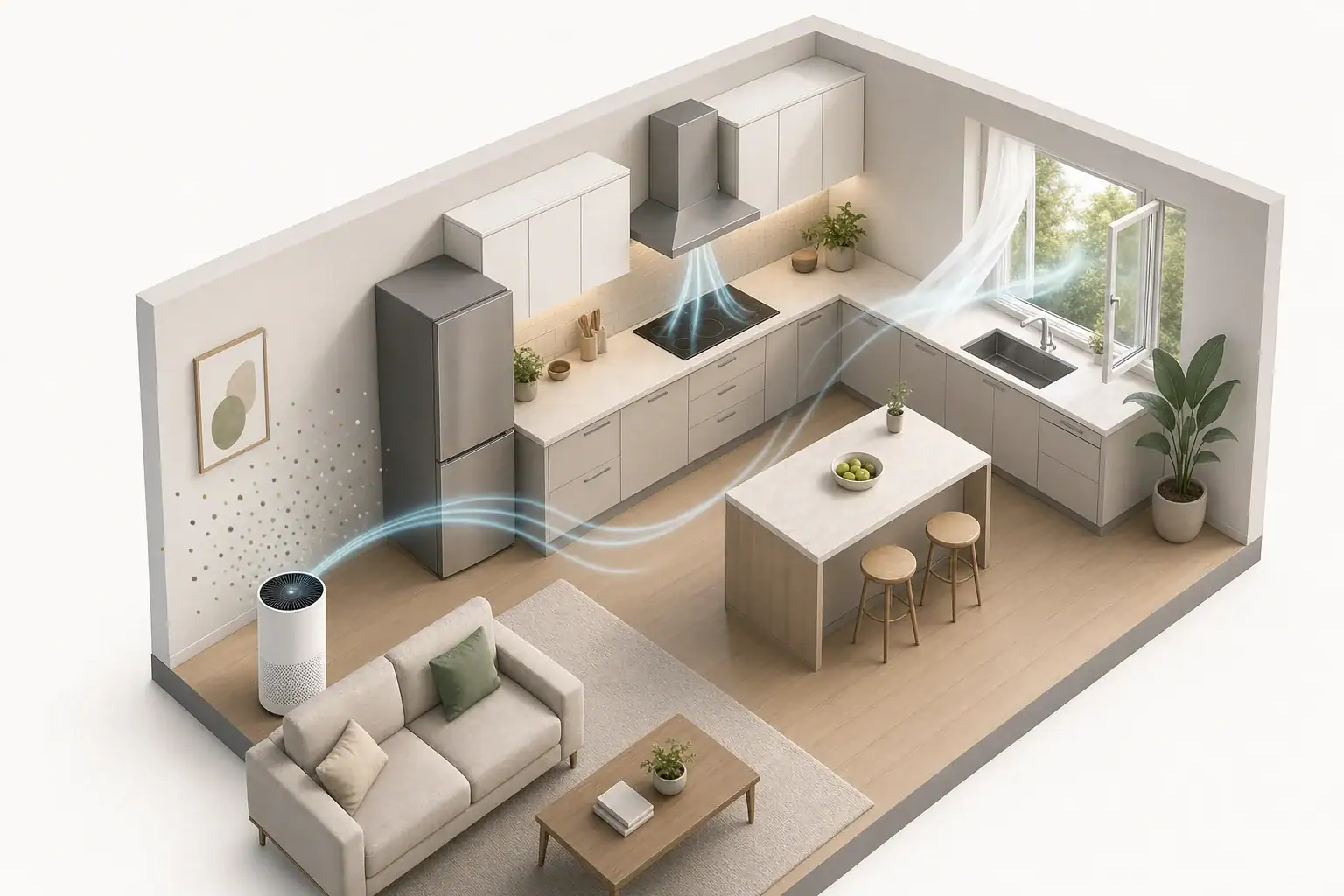
Manage frying particles at the source and interpret the room trend
EPA guidance on cooking and indoor air quality recommends using the hood during cooking, back burners where practical and appropriate alternatives when a hood is unavailable. EPA guidance on low-cost indoor air monitors explains why a local sensor reading needs context. Do not assign an emission rate or cleanup time to every frying method, kitchen and ventilation arrangement.
Open-plan rooms can dilute the initial plume across a larger volume, but they also allow particles to spread farther. In a small closed kitchen, the monitor may show a sharper increase because the same emission is concentrated in less air.
Record the cooking and removal arrangement
Use the cooking appliance and cookware as intended and avoid unnecessary burning or charring. Identify whether the hood actually exhausts outdoors or recirculates through filters, and maintain it by its instructions. A portable cleaner’s particle CADR is not the hood’s capture performance or an assessment of combustion gases.
Keep a monitor out of splashes, direct steam and other unsuitable conditions according to its instructions, and use a consistent room location for comparisons. Record ordinary cooking and fan settings without deliberately producing smoke. If extraction remains poor, obtain a qualified review rather than improvising a powerful exhaust arrangement.
Practical checks
| Observation or input | What to check or do |
|---|---|
| Cooking source | Avoid unnecessary smoke and maintain equipment. |
| Removal | Use the suitable hood or documented alternatives. |
| Observation | Keep placement and settings consistent without claiming clearance. |
Limits and follow-up
Smoke, a suspected gas problem or a proper alarm requires the relevant safety response, not waiting for a PM2.5 value to fall.
Relevant primary guidance: EPA remodeling work practices and hazard boundaries, CPSC carbon-monoxide prevention and emergency guidance.
Related guides
- How Long to Run the Hood After Cooking: Guidance and Limits
- Kitchen Ventilation Without a Hood: Source and Exhaust Options
- Clear sizing logic (room size → CADR/ACH)
- HEPA vs carbon explained for real use-cases
- Humidity + ventilation basics to reduce mold risk