
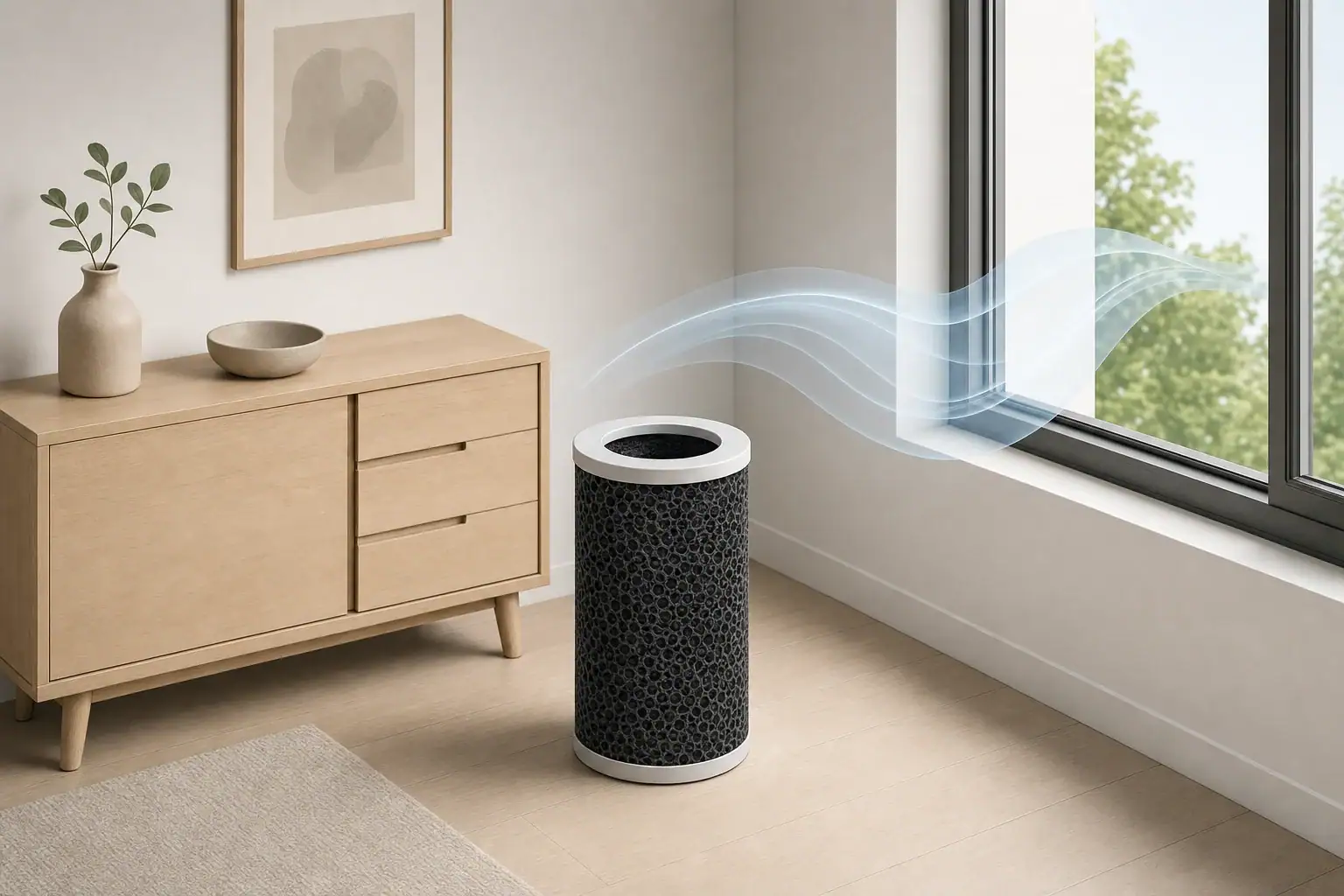
Furniture VOCs from MDF and particle board can usually be reduced through source control, steady ventilation, moderate temperature and humidity, and properly selected activated carbon filtration.
Composite wood can release volatile organic compounds from resins, adhesives, finishes, and surface treatments. Emissions are often strongest when furniture is new and generally decline over time, although the rate varies by construction, coatings, room conditions, and ventilation.
Quick answer
- Ventilate the room for about 15–30 minutes several times a day when outdoor air quality and weather permit.
- As general guidance, keep indoor relative humidity around 30%–50% and avoid unnecessarily high room temperatures.
- If possible, unpack and air new furniture in a garage, spare room, or other well-ventilated area for several days before regular use.
- Use an air purifier with a meaningful amount of activated carbon or other gas-phase media; HEPA alone does not capture VOC gases.
- Choose low-emitting, compliant composite wood products and keep factory-applied laminates or edge sealing intact.
What Furniture VOCs From MDF and Particle Board Mean
MDF, or medium-density fiberboard, is made from wood fibers bonded under heat and pressure. Particle board uses larger wood particles in a similar resin-bonded structure. Both are common in cabinets, shelving, desks, bed frames, and ready-to-assemble furniture.
The wood, bonding resin, paint, laminate, veneer, edge banding, and other finishes can release VOCs into room air. Formaldehyde is one recognized compound associated with some composite wood resins, but it is not the only possible emission. A general VOC odor does not reveal which compounds are present or their concentrations.
Odor and VOC exposure are also not interchangeable. Some compounds are noticeable at low concentrations, while others have little odor. A piece of furniture that no longer smells new may still release small amounts, and a strong smell may come partly from packaging, paint, or surface finishes rather than the wood core.
Emission rates commonly decrease as a product ages. However, airflow, exposed unfinished edges, heat, humidity, product thickness, and the type of adhesive or coating can affect how quickly that happens.
What Controls the VOC Level in a Room
Indoor concentration reflects a balance between the rate at which furniture releases gases and the rate at which those gases are removed or diluted. A large cabinet in a small closed bedroom can have a greater effect than the same cabinet in a large, well-ventilated living area.
Temperature matters because warmer materials often release VOCs faster. Deliberately heating furniture to accelerate off-gassing is not a controlled home-air-quality strategy and may create unnecessarily high short-term concentrations. A stable, comfortable indoor temperature—often roughly 68°F–75°F—is a more practical general range.
Humidity can also influence composite wood emissions and material condition. A general indoor target of about 30%–50% relative humidity balances comfort and moisture control in many homes. Local climate, season, and building conditions may require adjustments.
Ventilation removes indoor air and replaces it with outdoor air. Filtration can supplement this process, but the filter must contain gas-sorbing material such as activated carbon. Particle filters, including HEPA filters, are designed primarily for airborne particles rather than VOC gases.
| Situation | Primary step | Supporting step |
|---|---|---|
| New furniture still packaged | Unpack in a ventilated area | Remove cardboard and plastic promptly |
| Noticeable odor in one room | Increase outdoor-air ventilation | Open interior doors to improve dilution |
| Outdoor air is smoky or polluted | Keep windows closed temporarily | Use gas-phase and particle filtration |
| Exposed MDF or particle board edges | Ask the manufacturer about compatible sealing | Avoid sanding or damaging the surface |
| Room is unusually warm | Return it to a moderate temperature | Keep furniture away from heat sources |
| Humidity remains above 50%–60% | Identify and control the moisture source | Consider dehumidification if appropriate |
| Odor persists despite ventilation | Isolate or remove the suspected source | Evaluate other finishes, fabrics, and cleaners |
Example values for illustration.
Common Mistakes When Addressing Composite Wood VOCs
Relying on a HEPA filter alone
HEPA filters capture particles such as dust, pollen, and smoke particles. VOC molecules are gases and pass through particle media. A purifier needs activated carbon or another appropriate gas-phase medium to address them.
Assuming all carbon filters perform the same
A thin carbon-coated sheet may help with light, intermittent odors but has limited gas-holding capacity. A deeper bed containing more sorbent generally offers more capacity, although actual performance depends on the compound, airflow, contact time, humidity, and filter condition.
Masking odor instead of removing the source
Fragrances, sprays, candles, and scented plug-ins add compounds to indoor air. They may cover a furniture odor without lowering the underlying emissions. Source control and ventilation are more direct approaches.
Using heat as a shortcut
Heating a room or placing furniture near a heater can raise the short-term emission rate and may damage finishes or adhesives. Keep the product within the temperature and humidity conditions specified by its manufacturer.
Treating a consumer TVOC reading as a laboratory result
Consumer VOC sensors typically respond to a mixture of gases and may also react to cleaners, alcohol, cooking, fragrances, and changes in humidity. They are more useful for observing trends than identifying a specific chemical or proving that a room is safe.
Practical Steps to Reduce MDF and Particle Board VOCs
1. Control the source first
Remove packaging and inspect the furniture for damaged laminate, missing edge banding, or exposed core material. If an item has an unusually persistent odor, contact the seller or manufacturer for material information and handling instructions. Returning or relocating the source can be more effective than trying to filter a continuously high emission rate.
2. Ventilate according to outdoor conditions
Cross-ventilation is most effective when air can enter through one opening and leave through another. When conditions permit, open windows on different sides of the room and use existing exhaust fans that vent outdoors. Short ventilation periods of about 15–30 minutes can be repeated during the day.
Check outdoor smoke, pollution, heat, cold, and humidity before opening windows. During poor outdoor-air conditions, use the home’s mechanical ventilation as designed and keep windows closed until conditions improve.
3. Improve room airflow
Do not press large composite wood panels directly against supply vents or block return grilles. Leave some space around wardrobes, bookcases, and desks so room air can circulate. A portable fan may help mix air toward an open window, but it does not remove VOCs by itself.
4. Add suitable gas-phase filtration
Place an activated carbon air purifier where room air can reach it without being trapped behind furniture or curtains. Run it long enough to process room air consistently. CADR ratings primarily describe particle removal and do not provide a direct measure of VOC-removal capacity.
Carbon eventually becomes saturated. A returning odor or a gradual loss of odor control can indicate that replacement is due, but odor alone is not a precise capacity test.
5. Avoid unnecessary indoor VOC sources
Temporarily limit fragranced cleaners, aerosol products, solvent-based projects, and indoor smoking. This makes it easier to assess whether the furniture-related trend is improving and reduces the total gas load placed on ventilation and carbon filters.
How the Steps Change in Different Rooms
New dresser in a small bedroom
If practical, assemble and air the dresser in a ventilated spare area before moving it into the bedroom. Once installed, ventilate during the day, keep drawers open for limited airing periods, and close them before sleeping if odor remains noticeable. Do not block the room’s supply or return vents.
Particle board cabinets in a kitchen
Kitchen cabinetry has extensive surface area, but finished faces and edge banding can reduce exposed core material. Use the kitchen exhaust fan during cooking if it vents outdoors, manage indoor humidity, and repair plumbing leaks promptly. Avoid drilling, sanding, or refinishing composite panels without appropriate instructions and dust controls.
Large bookcase in an apartment
An apartment may have fewer cross-ventilation options. Open a window and the interior door when outdoor conditions are suitable, and use bathroom or kitchen exhaust only as intended. Check whether exhaust operation causes outdoor air to enter from undesirable locations, such as an attached garage or smoky neighboring area.
Home office with several composite wood items
Multiple desks, shelves, and cabinets can create a larger total source. Introduce new pieces in stages when possible. This makes odor changes easier to interpret and avoids placing several new emitting products into a closed room at once.
Product Standards, Air Cleaners, and Safety Considerations
In the United States, composite wood products may be labeled as compliant with federal formaldehyde emission requirements under TSCA Title VI. California Air Resources Board Phase 2 terminology may also appear on products. Compliance indicates that regulated composite wood panels meet specified formaldehyde emission requirements; it does not mean a product emits no VOCs.
When shopping, look for clear information about the panel material, compliant composite wood, finishes, adhesives, and edge sealing. Solid wood can also emit naturally occurring VOCs or compounds from coatings, so material type alone does not determine total room emissions.
For air cleaning, activated carbon or other sorbent media is the relevant component for gases. HEPA media remains useful when the room also has dust or fine-particle concerns. The purifier should be appropriately sized for the room’s particle-cleaning needs, but a high particle CADR does not guarantee strong VOC performance.
Avoid devices that intentionally generate ozone. Ozone is a reactive gas and is not appropriate as an occupied-space solution for furniture VOCs. Ionizers and some electronic air cleaners may produce ozone as a byproduct, so review independent safety certification and the manufacturer’s operating information. UV-C can be used in some air-handling equipment for microbial control, but it does not replace ventilation or adequate gas-phase media for furniture emissions.
Monitoring, Filter Replacement, and Ongoing Upkeep
Keep the room clean without using heavily fragranced products. Dust furniture with a damp microfiber cloth, vacuum surrounding floors as appropriate, and avoid soaking exposed composite wood. Excess water can damage panels and edge seams.
Inspect carbon filters according to the purifier’s instructions. Replacement timing may range from a few months to longer, but there is no universal interval. Heavy VOC loads, smoke, frequent cooking, high humidity, and a small amount of carbon can shorten useful life.
Particle prefilters should also be cleaned or replaced as directed. A clogged prefilter reduces airflow through both the particle and carbon stages. When replacing filters, keep the purifier unplugged and follow its normal safety instructions rather than altering the filter housing or bypassing sensors.
If using an indoor air monitor, compare patterns over time under similar conditions. Note when windows are open, cleaning occurs, furniture is added, or humidity changes. This context is usually more useful than reacting to a single reading.
| Metric | What it indicates | Practical use | Important limitation |
|---|---|---|---|
| TVOC | General sensor response to mixed gases | Compare trends before and after ventilation | Does not identify individual VOCs |
| Formaldehyde estimate | Possible response associated with formaldehyde | Observe repeated patterns | Consumer sensors may have cross-sensitivity |
| CO2 | How occupied-room ventilation is performing | Compare closed-room and ventilated periods | Does not directly measure furniture VOCs |
| PM2.5 | Fine airborne particle concentration | Check outdoor smoke and particle filtration | Does not measure gases |
| Relative humidity | Moisture level in room air | Use 30%–50% as general home guidance | Sensor placement affects readings |
| Temperature | Room thermal conditions | Maintain a stable range near 68°F–75°F | Local heat near furniture may differ |
Example values for illustration.
Related guides: Ventilation vs Air Purifier: When You Need One, the Other, or Both • New Furniture Smell: Ventilation vs Carbon Filters—What Works Faster? • VOC Sensors vs Real VOCs: How to Interpret “TVOC” Readings
Summary of the Most Effective Reduction Steps
Begin with the source: unpack furniture in a ventilated area, preserve finished surfaces and edge sealing, and relocate an item if emissions remain difficult to manage. Ventilate for short, repeated periods when outdoor conditions are favorable, and maintain moderate temperature and humidity.
Use activated carbon or another appropriate gas-phase medium when filtration is needed, recognizing that HEPA filtration alone does not remove VOC gases. Replace filters as their effectiveness declines, and use monitor readings as trend information rather than definitive chemical analysis.
For future purchases, look for compliant composite wood, clear material disclosures, durable surface coverage, and intact edge banding. These practical controls can lower indoor concentrations without relying on fragrances, excessive heat, or ozone-generating equipment.
Frequently asked questions
How long do MDF and particle board VOCs usually last?
Emissions are often highest when composite wood furniture is new and generally decrease over time. The timeline varies with the product’s resin, coatings, exposed edges, room temperature, humidity, and ventilation. Airing the item in a well-ventilated area can help reduce indoor concentrations during the initial period.
Will a HEPA air purifier reduce VOCs from MDF furniture?
HEPA media is designed to capture airborne particles, not VOC gases. To reduce gases, an air purifier needs a meaningful amount of activated carbon or other suitable gas-phase sorbent media. HEPA can still be useful for dust and fine-particle concerns in the same room.
Should I seal exposed MDF or particle board edges to reduce emissions?
Intact laminate, veneer, paint, and edge banding can limit exposed composite wood surfaces. If edges are damaged or unfinished, ask the furniture manufacturer about a compatible low-emitting sealing method before applying a product. Avoid sanding or damaging panels, as this can expose more core material and create dust.
Does opening windows always help reduce furniture VOCs?
Opening windows can dilute and remove indoor VOCs when outdoor air quality and weather conditions are suitable. Cross-ventilation, with air entering through one opening and leaving through another, is generally more effective than opening only one window. Keep windows closed temporarily during smoke, high pollution, or other poor outdoor-air conditions.
Can high humidity make MDF and particle board emissions worse?
Humidity can influence composite wood emissions and may also affect the condition of the material and its edge seams. Maintaining indoor relative humidity around 30%–50% is a practical general target for many homes. Persistent humidity above about 50%–60% should prompt attention to moisture sources, ventilation, or dehumidification where appropriate.
Recommended next:
- Activated Carbon Filters Explained: VOCs, Odors, and What They Can’t Do
- How Much Activated Carbon Do You Need to Remove Odors?
- Carbon Filter vs HEPA: What Each One Removes (And What It Doesn’t)
- Formaldehyde in Homes: Sources, Risks, and How to Reduce It
- Activated Carbon Types: Pellet vs Granular vs Impregnated Carbon
- How Much Carbon Do You Need for Odors? Weight, Depth, and Contact Time
- More in Carbon Filters & VOCs →
- Clear sizing logic (room size → CADR/ACH)
- HEPA vs carbon explained for real use-cases
- Humidity + ventilation basics to reduce mold risk